When you click on links to various merchants on this site and make a purchase, this can result in this site earning a commission. Affiliate programs and affiliations include, but are not limited to, the eBay Partner Network.
Toronto Ontario. Let me know if you''re ever near!
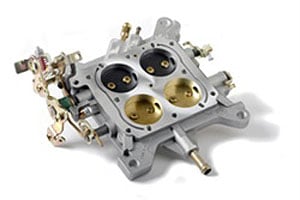
Now that you mention it, there have been 3 or 4 times on the street (never noticed it on the track or autocross) where I could feel the secondaries closing as I eased off the throttle from 100% to whatever position held that rpm. It felt like I had rapidly let off (for example from 100% floored pedal to half-pedal) rather than easing it off. In a way, this system isn't unlike vacuum secondaries in a carburetor. A main difference being that as a carb's secondaries close, it would still be fueling whereas in my system, fuel gets chopped immediately. This is probably why I can feel it in the EFI system but not in the carb system with its vacuum-operated secondaries.
I thought that I could put a small restriction orifice on the actuator's 'dump valve' (which releases vacuum, relaxing the actuator and closing the secondaries) to slightly slow down the rate of closure. This might require some further fuel map adjustment to still be adding some fuel as the secondaries close, to avoid a momentary 'lean stall' that might still give a physical sensation of the secondaries closing.
Another possibility I'll likely play with is programming their closing point at a lower rpm. My sense is that it would produce a weird result, but it's something that could be easily played with.
One way or another, I think think this condition should be able to be tuned out, and the secondary closure be unobvious to the driver. I'll probably play with it because it's easy, but I don't feel terribly motivated to do much. The sense of secondaries closing only happens in a situation such as wanting to pass someone on the highway, down shifting and applying full throttle, then ease off slightly to reduce acceleration rate to time the pass better. I can feel the change in power but it isn't like a lurch or a jerk.
I think it is noticeable because it is an indirectly commanded event. I know that going from 100% to <100% will close the secondaries, but I haven't yet become accustomed to it and have not yet developed the muscle memory or involuntary muscle... compensation to make the sensation feel natural. Like how in a car full of people, only the driver's head isn't moving forward and back as he goes up through the gears. It's because his brain is familiar with the operation and will subconsciously tension the neck and back muscles in time to the clutching and throttling to prevent head movement. The passengers don't have that and get ragdolled forward and backward. I imagine with enough seat time repeating that condition where I can feel the secondaries close, it would become part of the car-human system and be managed in a way that (at least for the driver) doesn't upset anything, be it head or corner balance.
Until achieving that, I suppose in a condition where the car was on the ragged edge of snap oversteer, a gust of crosswind might be enough to upset the car. In that condition, moving from 100% full throttle to <100% would likely have the same resulting spin, regardless of carb or EFI.
I do use trail braking to deliberately initiate oversteer, then apply full power to make it carve around the corner (hard to explain, but it works really well. Maybe due to the torsen diff sending most of the power to the outside wheel) instead of spinning out. Possibly if the guy ahead of me spun out and I needed to let off the gas just a little bit... But even then, if the car is so close to losing rear end traction anyway...? Hard to say. What I can say is that the only secondary operation issue I detected on the track was that they sometimes didn't feel like they opened, which could only practically be due to the consumption of all vacuum in the reservoir. Which in turn could only have occurred from repeated part-throttle-to-full-throttle-to-part-to-full cycles with no opportunity for vacuum to be recharged. If so many part-full-part-full operation on the track didn't cause me any oversteer grief, I'm going to say that for me, at least, it's a non-issue.
That isn't to say that there doesn't exist a situation where secondary closing could cause undesired oversteer. Just that I haven't found it.Could be our driving styles are significantly different. I seem to get myself as set up for a corner as possible before entering it, including ensuring there's enough space between myself and the person ahead to minimize or eliminate the possibility of contact under any circumstance. Stated more simply, it's a rare or never thing that I find myself lifting off the throttle in a corner once I've applied it.
At the autocross, I find that when I use part-power acceleration-- for example carefully accelerating my way through a cone slalom, it is at a throttle position nowhere near opening the secondaries. The primaries only have enough jam to do the trick in all 'part throttle only' circumstances I've come across. Other than cone slaloms, I've only found myself accelerating at 100% or letting off and either decelerating fully or holding a steady RPM. Neither of which have produced anything memorable negative events related to secondary closing. I took a handicapped fellow for a passenger ride in one autocross once. He was a 'little person' with no use of his legs. Afterward he apologized for what he described as 'kicking the **** out of' me' with his uncontrollably flopping legs. I hadn't noticed at all. Could be that someone paying attention to what the secondary closure's effects are would notice something that I didn't notice because it didn't affect my run. Hard to say.
I can't say categorically that under no circumstances will the secondaries closing cause any cornering balance issues. I do believe such an occurrence would be both rare and manageable with practice, however. If not able to be eliminated through tuning, that is!
I'm about to install the Techno Toy Tuning full suspension including the panhard bar conversion, which is apparently the solution to eliminating our beloved SA/FB snap tendencies. From what I've been told, a Watts' Link is a good thing, when it's designed well. And ours aren't. Disappointing. It and the recirculating ball steering probably could have been avoided during design, but Mazda had their reasons and it doesn't make me love the car any less. I only notice the steering on the highway and it isn't a big deal, even with a bit of toe-out, and 225 width tires in rutted pavement.
To be honest, I'm a little leery about changing the suspension. I'm on new stock GSL-SE brakes and suspension. Only the flex hoses are upgraded. The car works SO good... It is very predictable and controllable and corners HARD. Something in me thinks I'm going to ruin it if I change it. Suspension theory aside, the main drive to change is actually due the outer halves of my tires wear WAY faster than the inside, due to the body roll. I have to swap the tires inside for outside on the rims twice a season to even out the wear. In pics, I can see the car wallowing like a kayak in the corners, and the *** end pitching way up under hard braking. Comical.
But I digress.
My mechanical secondaries behave similarly, as in I can really feel when they open and close, but there is not a hard and fast fuel cut like your EFI. You will probably adjust to driving with it and not even notice in a few months. What will be comical is when someone else drives the car for the first time.
A word of advice on the T3 panhard. It's going to rip your shock mount off if you don't strengthen it by welding on some steel. That lower mount they use to claim it is "bolt on" is not designed for lateral strength. Also, the bar has a bend in it and isn't a proper panhard geometry, as in it isn't level with the axle. Unless you're going super low, you're better off leaving the watts.
Here's what I'd do with your vacuum system. Don't use the ECU to cue it off throttle position. Use the ECU to open them based on RPM. However you need to make sure that when the primaries are at partial throttle, the secondaries are at the same partial throttle via hard linkage to the primary lever, something with a slot that will pull them closed, but not open them. Once you're over 4,000RPM (you may need to experiment with best RPM), it will act like mechanical, with the vacuum diaphragm pulling the secondaries up against the hard stop linkage from the primaries. Unless the vacuum system has an air leak, it will keep them there. The vacuum diaphragm needs to be stronger than the secondary spring, but weaker than the primary spring and throttle spring.
This basically relegates driving on primaries to idle and cruise for gas mileage and gives you the ability to stomp on the pedal at low RPM without bogging the motor.
Sort of like the image below. The primary throttle cannot open the secondary, but it can ensure that if something else is trying to open it, the secondaries will never open more than the primaries. So they are synchronized once you engage the vacuum actuator.
Actually, the system opens the secondaries based on RPM, under the condition that the primaries are wide open. I deliberately set it up this way because at part throttle operation (up to 99% on the TPS) I wanted ALL the air going through one side port only. This keeps intake air velocity as high as possible for best... 'cylinder' filling (what is the rotary's equivalent nomenclature to a cylinder on it's intake stroke??). I believe this is largely responsible for the long, flat torque span of this engine.
If, for a given RPM and throttle position, the air going to each... cylinder (intaking rotor face?) were being divided into two, I'd estimate the velocity to be somewhere around half through each port that it was while going through one port only. I think it would be a downgrade from the perspective of low-to-mid range torque to have the secondaries opening before they're absolutely needed.
The RPM at which the secondaries open is the point at which primaries-only torque starts to taper off.
From the driver's perspective as well as the seat-of-the-pants feel, the operation is really good. A very tractable engine whose only adverse point is a noticeable bump if you let off slowly from full throttle at high rpm.I suspect this can be tuned out but I likely won't bother as it's a non-issue as far as I'm concerned, both on the street and on the track. I might have a different opinion in the future with a serious suspension, but for now on stock suspension while making wide R-compound tires work really hard, it bothers me not.
Speaking of suspension, Chuyler 1 your warning about the panhard conversion was received loud and clear. What I'd thought was going to be a simple win was perhaps not to be so much.
I forwarded your comment (name and source withheld) to T3 directly asking them about these concerns.
Their response:
" I'm sorry to hear that someone is unhappy with our design. The lateral rod mount at the shock mount is designed to reinforce the stock mount, not weaken it. We have sold countless numbers of this setup with no complaints of it tearing off or breaking. Although I cannot account for a vehicle with rust or other contributing factors. The lateral rod also has a bend in the middle to clear the differential, while also using the mounting locations without fabrication. The curve in the lateral rod does not negatively effect the adjustment, as there is a single double adjuster to adjust the length without spinning the whole rod to adjust. It is also made out of dom tubing, so the slight bend does not negatively effect structural integrity. So we solved the clearance issues and adjustment issues at the same time.
The whole reason we designed the adjustable upper and lower trailing arms, and lateral rod is because the factory watts link binds when the car is lowered and cornered hard. The owner here at T3 had several SA and FB cars over the years, with virtually every type of driving tested."
I then asked:
"Is there a particular ride height below which you can say that the watts link should be replaced with the panhard? On the reverse side of that coin, is the panhard not really suitable for stock ride height? (Geometry-wise?) I ask because I do not intend to lower the car much on my new T3 suspension, but I do intend to corner it very hard."
They responded:
" Most factory suspensions start to have issues around two inches lower from stock. Our shop car had binding even barely lowered on track cornering. The lateral rod conversion is adjustable to use at any ride height."
While their responses comfort me enough to consider proceeding, I'm curious what seemingly disastrous occurrence you experienced with their part?
Originally Posted by chuyler1
A word of advice on the T3 panhard. It's going to rip your shock mount off if you don't strengthen it by welding on some steel. That lower mount they use to claim it is "bolt on" is not designed for lateral strength. Also, the bar has a bend in it and isn't a proper panhard geometry, as in it isn't level with the axle. Unless you're going super low, you're better off leaving the watts.
Here's what I'd do with your vacuum system. Don't use the ECU to cue it off throttle position. Use the ECU to open them based on RPM. However you need to make sure that when the primaries are at partial throttle, the secondaries are at the same partial throttle via hard linkage to the primary lever, something with a slot that will pull them closed, but not open them. Once you're over 4,000RPM (you may need to experiment with best RPM), it will act like mechanical, with the vacuum diaphragm pulling the secondaries up against the hard stop linkage from the primaries. Unless the vacuum system has an air leak, it will keep them there. The vacuum diaphragm needs to be stronger than the secondary spring, but weaker than the primary spring and throttle spring.
This basically relegates driving on primaries to idle and cruise for gas mileage and gives you the ability to stomp on the pedal at low RPM without bogging the motor.
Sort of like the image below. The primary throttle cannot open the secondary, but it can ensure that if something else is trying to open it, the secondaries will never open more than the primaries. So they are synchronized once you engage the vacuum actuator.
I know two people who tracked their cars with it, one ripped the mount on the axle right off, the other bent it. I don't have pictures as I wasn't there when it happened. A gusset between the axle and the shock bracket is likely all that is needed to give it the lateral stability that it needs for that one time you hit a curb or pothole while cornering. However, that won't change the irregular travel you get with their setup. There is no height adjustment built in and you want the bar long, and straight with the axle and parallel to the axle at rest to give the ideal arc in travel. I'm not so much worried about the bend they put in their bar as much as I am the fact the bend needs to be there to link the lower mount on the axle to the higher mount on the frame which makes the effective layout of the bar not parallel to the axle. The 1st Gen IT7 cars I see at SCCA events run much heavier setups that are triangulated to offer a very low frame mounting point. They are considered older designs and today, if you were going to pull out the welder, you might as well try to fit a modern watts linkage setup that has adjustments for ride height like people do for Mustangs.
A very tractable engine whose only adverse point is a noticeable bump if you let off slowly from full throttle at high rpm.
See, that right there, is what would really mess me up. A slight correction in speed mid-corner on a high speed track could really upset the balance of the car and send you spinning. The way the secondaries work on the motors all the way up to the RX8 is that they open based on RPM which correlates to velocity. They are in no way tied to throttle position as the throttle is separate. This PDF explains how the RX8 works and allows for smooth flow and keeps velocity high through the entire range. https://www.rx7club.com/attachments/...renesis-ve.pdf
You really do want those secondaries open above about 4,000RPM at whatever angle your primaries are open. Otherwise you're at the mercy of the ECU as to how quickly they open, and that would make the response sort of like a turbo car where you punch the gas, wait, and then it kicks in, but the problem is every time you lift slightly to adjust, you're saying it's gonna close the secondaries. You basically have an on/off switch for throttle and if you use it any other way, it's going to be unpredictable.
Ok, you've convinced me. On both accounts, and thank you for doing so. I cancelled the T3 panhard from the order. I'm in no hurry to lower the car and am quite satisfied to run the T3 panhardless system at stock ride height. Later, when I get the widebody kit on and some wider wheels, I'll figure out what ride height I want and then see Watts going on with a better plan for lateral control of the axle. I'll look into this mustang lead you mention. I would quite prefer a good Watts over a good panhard. I admit I dove into the T3 panhard thing blindly. Lucky for me there are more experienced people willing to speak out.
Ditto for the primary/secondary thing. As is for street driving, it's a non-issue. So far in autocross and road course lapping, it's a non-issue. However this is on stock suspension and ride height. With a much more aggressive setup, maybe it would become an issue. On top of that, in a choice between having this little 'bump' under certain conditions and not having it, I'd choose not.
Your above idea with the secondary linkage looks like it would integrate with my opening/closing system well enough. I'll go that route if necessary.
What i'm going to do first is set up a PLC and an electronic actuator to open the secondaries only as much as necessary and only, when necessary (primaries at 100% and based on a MAP signal) to keep the port velocities at maximium. That's a repeat of what I've said before, but now, I'm adding that they will electrically close 1:1 or thereabouts with the primaries. I suspect that at some appropriate point below 100% primaries, I can switch off the secondary injectors and simultaneously add their duty to the primary injectors. When the loud pedal goes down, secondary injectors come back into play. Something like that. Much fiddling to be done.
Thanks again for the steering.
Another idea for you, not sure if this will work but it's the idea I've been thinking about for my build.
1) Add a second basic throttle body below your current throttle body. There needs to be space for the throttle plates to open without getting in the way of your main throttle body plates. On this new throttle body, remove the primary butterflies completely, remove the shaft too. All you need is the secondary plates.
2) Hook up your vacuum system to the secondary plates of the new throttle body. Change the ECU so that it opens them when RPM goes above 4,000RPM and closes them when the RPM drops below 3,800RPM. Remove any relationship to throttle position in the ECU.
3) Directly connect primary and secondary throttle shafts on your main throttle body so they open and close at the same time. Your foot now controls all 4 throttle bodies, but the motor will only see two of them below 4,000RPM so you won't lose any torque or intake velocity cruising around town. When you get into the higher RPMs, your foot controls all 4 in a linear fashion.