


Best way to verify oil pressure?




 Best way to verify oil pressure?
Is there a good way to verify the oil pressure? When I'm at idle, the oil pressure seems to drop very low, at least according to the gauge on the dash. Is there a way to verify to actual oil pressure?
thanks!
thanks!



Too old to act my age

Joined: Feb 2005
Posts: 3,164
Likes: 0
From: Tulsa, Ok.
The best way is using a mechanical oil pressure guage, but it's not real easy to hook up since the stock oil pressure sender can have oddball threads.
I keep a banjo bolt for the oil cooler return line handy, that has been drilled/tapped to accept the proper fitting for an oil pressure guage. Only takes a couple minutes to swap the bolt and hook up a mechanical OP guage.
Of course, I left that setup in place on my car, and have a mechanical OP guage under the dash, since the factory OP guages are so accurate............
I keep a banjo bolt for the oil cooler return line handy, that has been drilled/tapped to accept the proper fitting for an oil pressure guage. Only takes a couple minutes to swap the bolt and hook up a mechanical OP guage.
Of course, I left that setup in place on my car, and have a mechanical OP guage under the dash, since the factory OP guages are so accurate............

Joined: Aug 2011
Posts: 3,078
Likes: 42
From: Cambridge, Minnesota

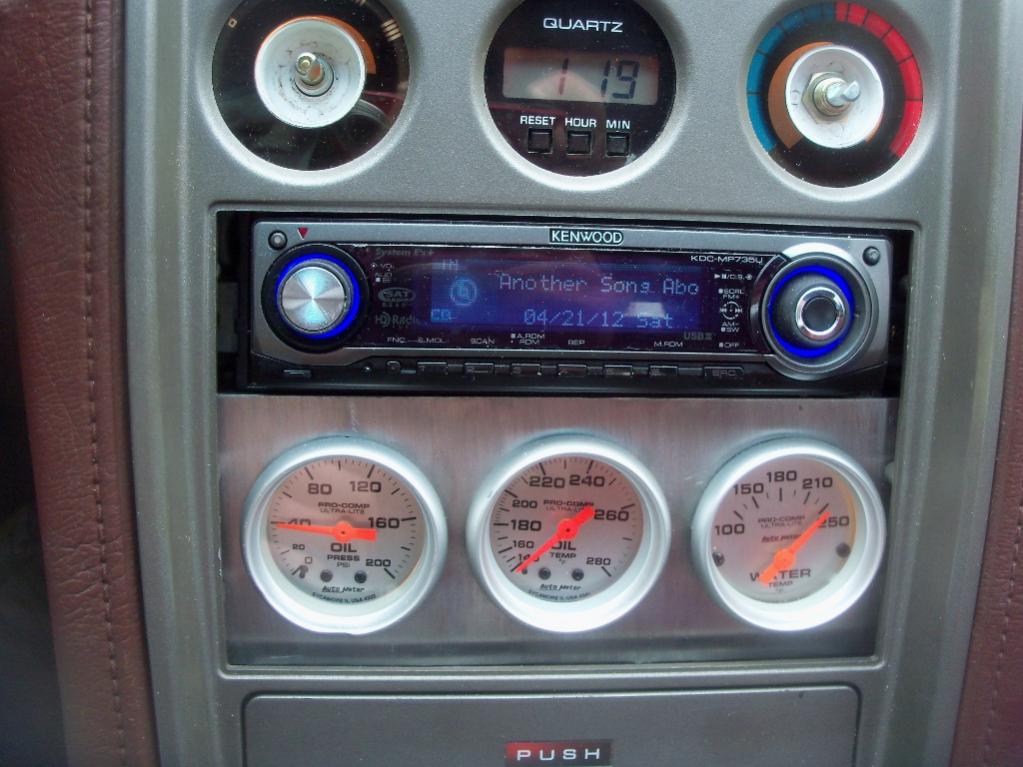
Running at 250*F + water temp, oil temp under 140*F, running 10w40 conventional oil. Didn't cost much and only takes about 45 minutes to install completely correctly.
Thanks for the photos, that helps. My car is bone-stock, and I'd like to keep it that way for the foreseeable future. It looks like you've got something between the oil filter and the beehive cooler. Is that the case, or did you drill & tap? My preference would be something that I can hookup, verify my oil pressure, and then take off again without any substantial modifications. However, is that possible? I'm really learning as I go here.
thanks again!
Jonathan
thanks again!
Jonathan
Joined: Aug 2011
Posts: 3,078
Likes: 42
From: Cambridge, Minnesota
Thanks for the photos, that helps. My car is bone-stock, and I'd like to keep it that way for the foreseeable future. It looks like you've got something between the oil filter and the beehive cooler. Is that the case, or did you drill & tap? My preference would be something that I can hookup, verify my oil pressure, and then take off again without any substantial modifications. However, is that possible? I'm really learning as I go here.
thanks again!
Jonathan
thanks again!
Jonathan
That's called an "oil filter sandwich adapter" with 1/8 NPT threads for the sensors on gauges (both electric and mechanical) and can be taken on and off at leisure. I ordered it on eBay for around $20 and it comes with two different adapters for the two different thread sizes of oil filters (don't worry, one of them works) and has two o-ring style gaskets that seal it where the oil filter would normally seal. So it's just like raising the oil filter by about 1/2 to 3/4 of an inch. Just have a gauge that you could hook up and you'd get a reading in no time!
*Just so you know, the gauge I had hooked up to that adapter read about 20psi higher than the stock cluster gauge did when cold. After it warmed up it was the same. Not sure why that was to this day but it didn't bother me any.

According to the stock gauge, the pressure at the "oil filter sandwich" is read considerbly lower then the stock location. I have both and my wire is long enough to reach either one.
Trending Topics
Actually... My last post I'm wrong. I have one tapped into the banjo bolt at the oil cooler return on the bottom of the rear plate, the other at the "oil cooler sandwich". I even swapped the same sensor to and from both spots to make sure it wasn't the difference in the reading. Anyways, different spots give different readings.

Jonathan, could you post a video or a couple still shots showing your stock oil pressure gauge at idle and then again with it revved up to around 3000-4000 rpm?
Chances are your stock gauge is working fine. It's normal for the pressure to drop down at idle but it should increase to around 60 lbs/in2 when revved.
Chances are your stock gauge is working fine. It's normal for the pressure to drop down at idle but it should increase to around 60 lbs/in2 when revved.
Joined: Aug 2011
Posts: 3,078
Likes: 42
From: Cambridge, Minnesota
Jonathan, could you post a video or a couple still shots showing your stock oil pressure gauge at idle and then again with it revved up to around 3000-4000 rpm?
Chances are your stock gauge is working fine. It's normal for the pressure to drop down at idle but it should increase to around 60 lbs/in2 when revved.
Chances are your stock gauge is working fine. It's normal for the pressure to drop down at idle but it should increase to around 60 lbs/in2 when revved.

I added 2-stroke today to the gas tank, in the event that I've got something going on w/ my OMP. Maybe these two threads should be combined? Maybe I'm chasing ghosts? I dunno.
Per request, here are pictures of my oil gauge at 1000, 2000, and 3000 RPM... The car was warm, as I'd been about four miles or so (round trip) to the gas station. The light is b/c I had the parking brake set.
1000RPM

2000RPM
3000RPM

Per request, here are pictures of my oil gauge at 1000, 2000, and 3000 RPM... The car was warm, as I'd been about four miles or so (round trip) to the gas station. The light is b/c I had the parking brake set.
1000RPM
2000RPM
3000RPM
It's a happy odometer. =)
For whatever reason, I was thinking my oil pressure was higher than I'm currently showing. Should I try to verify it w/ some other means as discussed earlier? Seems there is not a firm agreement as to the reliability of the factory gauge.
For whatever reason, I was thinking my oil pressure was higher than I'm currently showing. Should I try to verify it w/ some other means as discussed earlier? Seems there is not a firm agreement as to the reliability of the factory gauge.
Well, I think the main charge against the 20+ year old stock gauges, vs installing expensive aftermarket gauges, is that the stock gauge is not as accurate.
But so what? Does it really matter if the oil pressure at 3000 rpms is 60, 58 or 64 psi?
What you want is reliability and you will get this if your gauge is behaving consistently. If the stock gauge starts to do things differently, that's when you should get concerned.
Most often, it's just a problem with the gauge itself, usually with the connection, which is an easy fix. If the stock gauge really does stop working because of the gauge itself, that's when you should look into installing an aftermarket unit.
But sometimes squirrelly behavior in the oil pressure gauge is something more serious that actually reflects problems with oil pressure, and the stock gauge will detect these problems just as well as an aftermarket gauge.
But of course, having a backup aftermarket gauge won't hurt anything, so if you want a few more dials crowding the dashboard, sure, why not?
More important than the oil pressure gauge is a backup temp gauge, in my opinion. Small differences in temp behavior can be an early sign of all kinds of problems that can be caught early and repaired before you end up with a breakdown on the road or worse.
But so what? Does it really matter if the oil pressure at 3000 rpms is 60, 58 or 64 psi?
What you want is reliability and you will get this if your gauge is behaving consistently. If the stock gauge starts to do things differently, that's when you should get concerned.
Most often, it's just a problem with the gauge itself, usually with the connection, which is an easy fix. If the stock gauge really does stop working because of the gauge itself, that's when you should look into installing an aftermarket unit.
But sometimes squirrelly behavior in the oil pressure gauge is something more serious that actually reflects problems with oil pressure, and the stock gauge will detect these problems just as well as an aftermarket gauge.
But of course, having a backup aftermarket gauge won't hurt anything, so if you want a few more dials crowding the dashboard, sure, why not?
More important than the oil pressure gauge is a backup temp gauge, in my opinion. Small differences in temp behavior can be an early sign of all kinds of problems that can be caught early and repaired before you end up with a breakdown on the road or worse.

Thread
Thread Starter
Forum
Replies
Last Post


