


Pettit Racing Trak Pro Coilover Kit



Did you order different springs? I'm pretty sure mine are red.


Well I know they are not stage I's due to the fact they are 24 adjustable. The spring part numbers read 200.7060.010 and .080 which would lead me to believe that is 10/8 k springs. So stage II's, I'm pretty darn sure.
Well mine are also Stage 2 and my springs have the same part numbers but they are red.





I don't think red ones are 12/10 because I ordered Stage 2s which come with 10/8 springs and also the part numbers I have on red springs are 200.7060.010 and .008. Like wickedrx7, I think the numbers in the end are for spring rates.
I just recieved mine a week ago. The end # is .012 and .010 so I believe the color doesnt anything to do with spring rates I guess since some of us wtih 12k 10K have black and red

Full Member

Joined: Apr 2009
Posts: 230
Likes: 0
From: Central
What I really met was to eliminate the rear sway bar completely. Sway bar tends to rub against the shock body.
Anyhow, got my first test run on the stage III's. I must say they are impressive. Huge noticed of responsive handling especially in tight corners. Ofcourse its 285's in the rear.
Anyhow, got my first test run on the stage III's. I must say they are impressive. Huge noticed of responsive handling especially in tight corners. Ofcourse its 285's in the rear.
Hey, clevis update.
mdpalmer talked to Pettit last week. Seems like the whole Japan mess had made the delivery really behind schedule. Pettit said they are going to call everyone when they get the parts in to send them out. Nice!
mdpalmer talked to Pettit last week. Seems like the whole Japan mess had made the delivery really behind schedule. Pettit said they are going to call everyone when they get the parts in to send them out. Nice!

Junior Member

Joined: Jan 2011
Posts: 33
Likes: 0
From: sydney australia
I thought these coilovers were made in Taiwan? where does the Jap part come into it? I've sent numerous emails over the last few months to pettit and they haven't responded....I've given up.

 1993 FD Rx-7 touring ls1/t56 corner balance/weight
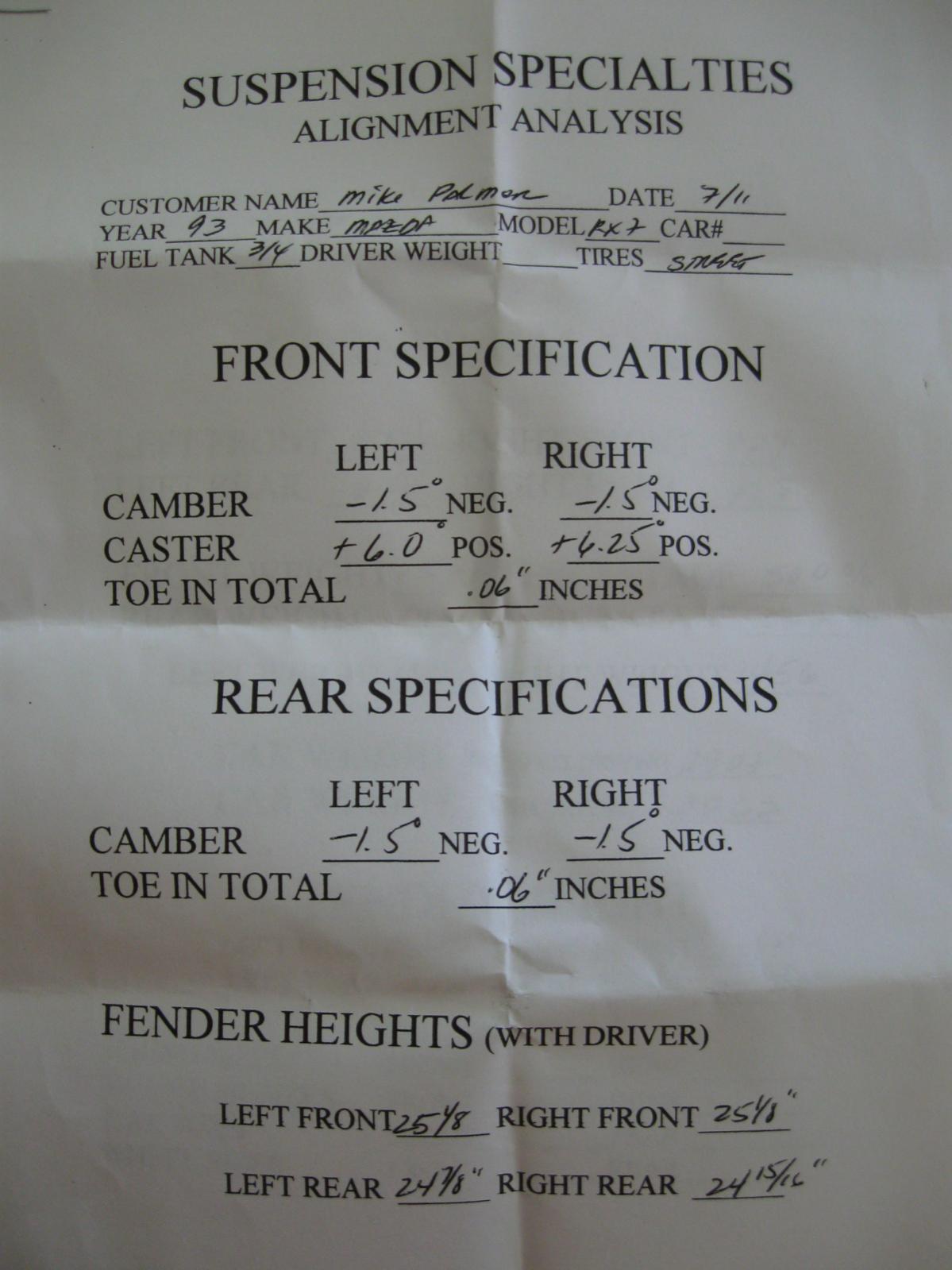
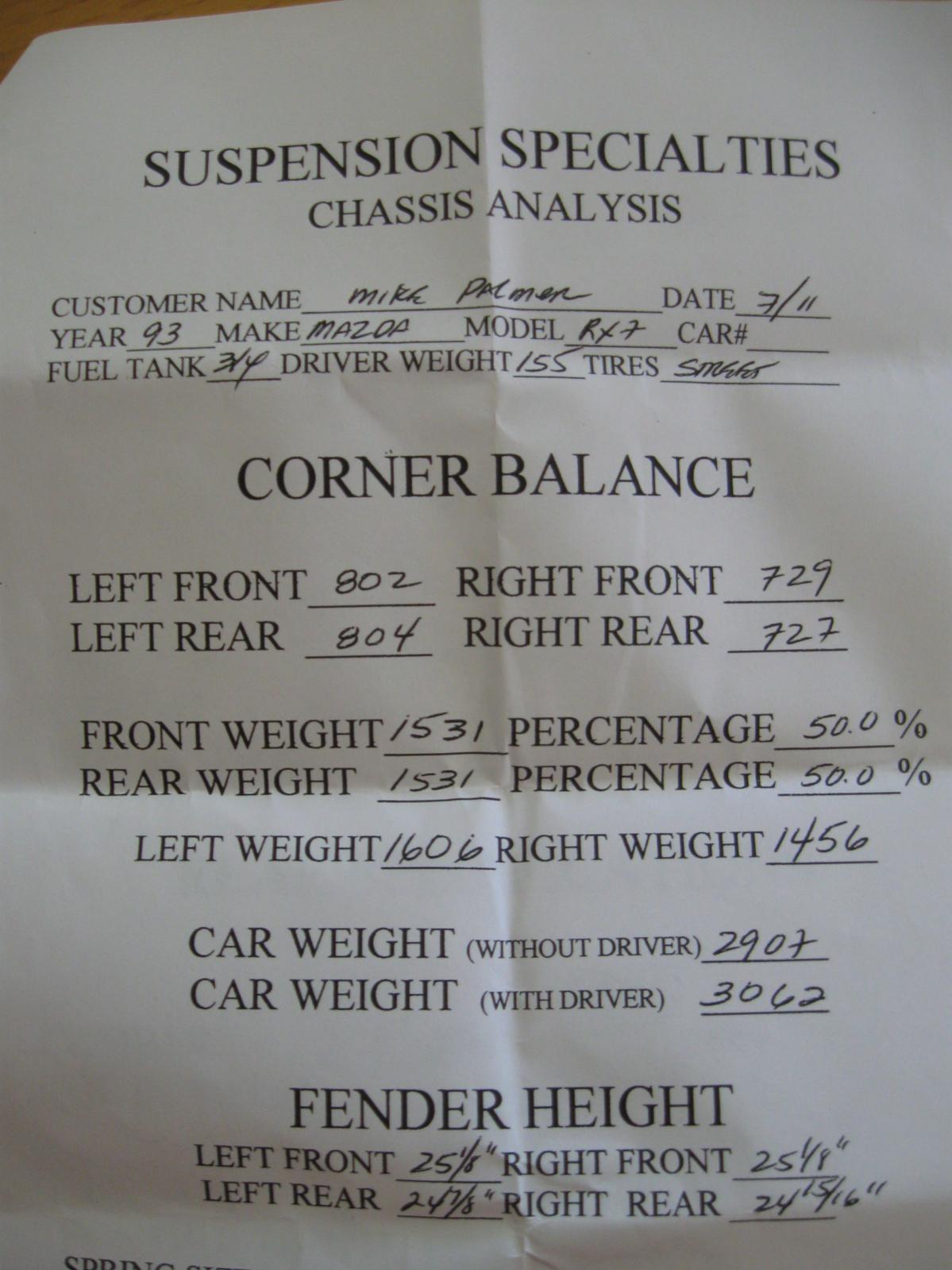
So, finally had the car aligned and corner balanced today. Didn't get the updated clevis/lug fitting yet, but didn't want to wait since Mazfest/Sevenstock is coming up. See attachment/pics. Nice tech write-up HERE.
Here’s the summary (all weights are in POUNDS, distance in INCHES):
-----------------------------------------------------------------------------------------------------------
Basics:
-1993 Mazda Rx-7 (FD) touring
-Little more than ¾ tank fuel
-NO A/C
-YES P/S (stock mazda rack + f-body pump)
-Full interior (mostly.. see notes below), no BOSE or glove box
-2002 alum block/heads ls1/t56 (Camaro z28 pullout/rebuild)
-155 lb driver
-Samberg setup (radiator/intake/mounting/bumpsteer correction kit)
-Pettit Trak Pro Stage 2 adjustable height/damping coil over shock setup
-Gram Light 57 optimise wheels (17” diam), 235 (f)/265 (r) tires
-Otherwise stock suspension
-----------------------------------------------------------------------------------------------------------
Results:
-Car weight (no driver): 2907 (before, /w twin turbo rotary, no air pump, stock wheels, 1/2 tank gas was 2790)
-Car weight (little fatty in driver’s seat): 3062
-Front weight/distribution: 1531/50%
-Rear weight/distribution: 1531/50%
-Left Front/Right Front: 802/729 (delta = 73)
-Left Rear/Right Rear: 804/727 (delta = 77)
-LF+RR: 1529
-RF+LR: 1533
-Cross weight delta: 4
-Left Weight/Right Weight: 1606/1456 (delta = 150)
Fender Height (in):
LF/RF: 25 1/8 | 25 1/8
LR/RR: 24 7/8 | 24 15/16
NOTE: date is wrong.. not sure why they put 7/11 on it. maybe dreaming of slurpees?
-----------------------------------------------------------------------------------------------------------
Cliff’s notes:
-tech was surprised how close I got the toe on the front (eyeball job )
)
-went pretty well except took them a couple trips back and forth to the scales to set the corner weights
-have a little bit of play in the toe control link on pass side (not to mention a curbed wheel.. dammit!), not too bad but it won’t get any better
-guys at shop were amazed the car was that balanced (front/rear in particular) given the motor setup
-had a little more than ¾ tank of fuel, just filled up day before and drove about 20 miles before I went to shop (probably down a gallon or so from full)
-I must have put on some weight b/c last time I weighed myself (when I was working out/surfing all the time… about a year ago) I was 140ish.. I stepped on one of the corner scales and I hit 155. Damn.. I’m only 5’4” or so.. so if you run the BMI (body mass index) calcs.. I’m obese. Time to trim some fat
-----------------------------------------------------------------------------------------------------------
^^ I have no idea what the deal is /w Japan, perhaps they source raw materials from there, dunno. I tried emailing them twice and never heard back... just call them...
Here’s the summary (all weights are in POUNDS, distance in INCHES):
-----------------------------------------------------------------------------------------------------------
Basics:
-1993 Mazda Rx-7 (FD) touring
-Little more than ¾ tank fuel
-NO A/C
-YES P/S (stock mazda rack + f-body pump)
-Full interior (mostly.. see notes below), no BOSE or glove box
-2002 alum block/heads ls1/t56 (Camaro z28 pullout/rebuild)
-155 lb driver
-Samberg setup (radiator/intake/mounting/bumpsteer correction kit)
-Pettit Trak Pro Stage 2 adjustable height/damping coil over shock setup
-Gram Light 57 optimise wheels (17” diam), 235 (f)/265 (r) tires
-Otherwise stock suspension
-----------------------------------------------------------------------------------------------------------
Results:
-Car weight (no driver): 2907 (before, /w twin turbo rotary, no air pump, stock wheels, 1/2 tank gas was 2790)
-Car weight (little fatty in driver’s seat): 3062
-Front weight/distribution: 1531/50%
-Rear weight/distribution: 1531/50%
-Left Front/Right Front: 802/729 (delta = 73)
-Left Rear/Right Rear: 804/727 (delta = 77)
-LF+RR: 1529
-RF+LR: 1533
-Cross weight delta: 4
-Left Weight/Right Weight: 1606/1456 (delta = 150)
Fender Height (in):
LF/RF: 25 1/8 | 25 1/8
LR/RR: 24 7/8 | 24 15/16
NOTE: date is wrong.. not sure why they put 7/11 on it. maybe dreaming of slurpees?
-----------------------------------------------------------------------------------------------------------
Cliff’s notes:
-tech was surprised how close I got the toe on the front (eyeball job
)-went pretty well except took them a couple trips back and forth to the scales to set the corner weights
-have a little bit of play in the toe control link on pass side (not to mention a curbed wheel.. dammit!), not too bad but it won’t get any better
-guys at shop were amazed the car was that balanced (front/rear in particular) given the motor setup
-had a little more than ¾ tank of fuel, just filled up day before and drove about 20 miles before I went to shop (probably down a gallon or so from full)
-I must have put on some weight b/c last time I weighed myself (when I was working out/surfing all the time… about a year ago) I was 140ish.. I stepped on one of the corner scales and I hit 155. Damn.. I’m only 5’4” or so.. so if you run the BMI (body mass index) calcs.. I’m obese. Time to trim some fat
-----------------------------------------------------------------------------------------------------------
^^ I have no idea what the deal is /w Japan, perhaps they source raw materials from there, dunno. I tried emailing them twice and never heard back... just call them...


Junior Member
Joined: May 2009
Posts: 7
Likes: 0
From: Palm Bay, FL
Why are there no brake line brackets for the Trak Pro Coilovers?
We've gotten a couple people asking this question. Did we overlook it? Were we lazy? Is it even needed?
Aside from the obvious benefits of not having a third attachment point for the brake line like: Less weight, ease of maintenance, added line longevity and improved safety, there are still those forum skeptic types that believe if the factory put it there, removing it breaks some unwritten law. Even asking someone who should know will usually get a similar textbook reply. Using a little common sense should help answer these questions , but these days it seems common sense is not so common.
Nevertheless most folk's that give some thought while reading these facts will gain the understanding needed to know without a doubt there are several benefits from "not" having a third attachment point for the brake line. First it helps to understand a little about the dynamics of the suspension & brake system interaction. The RX7's suspension is a double wishbone design, the shock body and the spindle /caliper where the brake line terminates have two different ranges of motion, with the line connected at the body & caliper only there is one range of motion & 2 stress points, connecting the brake line to the shock creates 2 ranges of motion & 4 stress points instead of 2. By NOT attaching the brake line to the shock, you alleviate 2 points of stress. Also in the event a foreign object makes contact with the line it will deflect further (more movement) allowing an object to pass by whereas a restricted movement (shock attachment point) can cause an object to damage the line. Properly installed lines are fixed and will maintain their position, if they change something is wrong, this should be corrected immediately and before driving again.
So why dose the RX7 have a bracket that's not needed, nearly everything that is mass produced has a host of items not needed & absolutely unnecessary, all one time use items that hold & guide pre-assemblies to improve quality & speed on the automated assembly lines. In the RX 7's case, as the body is mated with sub frames & suspension a worker actually connects the flex line to the body's hard line & threads them together by hand, installs the lock clip & tightens the line. In this case the shock tube bracket holds the line up & away from any chance of being caught or snagged as it moves along the assembly line and the worker finds it in the exact same place on each car.
We've gotten a couple people asking this question. Did we overlook it? Were we lazy? Is it even needed?
Aside from the obvious benefits of not having a third attachment point for the brake line like: Less weight, ease of maintenance, added line longevity and improved safety, there are still those forum skeptic types that believe if the factory put it there, removing it breaks some unwritten law. Even asking someone who should know will usually get a similar textbook reply. Using a little common sense should help answer these questions , but these days it seems common sense is not so common.
Nevertheless most folk's that give some thought while reading these facts will gain the understanding needed to know without a doubt there are several benefits from "not" having a third attachment point for the brake line. First it helps to understand a little about the dynamics of the suspension & brake system interaction. The RX7's suspension is a double wishbone design, the shock body and the spindle /caliper where the brake line terminates have two different ranges of motion, with the line connected at the body & caliper only there is one range of motion & 2 stress points, connecting the brake line to the shock creates 2 ranges of motion & 4 stress points instead of 2. By NOT attaching the brake line to the shock, you alleviate 2 points of stress. Also in the event a foreign object makes contact with the line it will deflect further (more movement) allowing an object to pass by whereas a restricted movement (shock attachment point) can cause an object to damage the line. Properly installed lines are fixed and will maintain their position, if they change something is wrong, this should be corrected immediately and before driving again.
So why dose the RX7 have a bracket that's not needed, nearly everything that is mass produced has a host of items not needed & absolutely unnecessary, all one time use items that hold & guide pre-assemblies to improve quality & speed on the automated assembly lines. In the RX 7's case, as the body is mated with sub frames & suspension a worker actually connects the flex line to the body's hard line & threads them together by hand, installs the lock clip & tightens the line. In this case the shock tube bracket holds the line up & away from any chance of being caught or snagged as it moves along the assembly line and the worker finds it in the exact same place on each car.
brake line brackets, rear upper arm BS
You're forgetting to mention that there are a number of people out there who just want to buy parts and bolt them up. Not have to think about how to route brake lines. Some of these folks are not mechanically inclined. Some of them are lazy. Some of them are sick of having to figure out "how am I going to make this work". I am in the category where if I can bolt something up that works well, I will go that way.
I decided to give these coilovers a try. They sure look nice. Pettit has a good rep, why not. Good price too, if the dampers/springs/etc. are as good as they say. I figured plug/play, Pettit knows Rx7s.
But:
You didn't mention the benefits to you, the seller (or I guess reseller), since you don't have to conjure up something to solve that "problem". You can use off the shelf stuff (shock body, springs, lower rear fittings that don't even work on an FD) instead of having to come up with a solution for the end user to make his/her life easier. That means less work for you. Least you could have done is include some recommendations for how to route and/or support the lines for the less uninitiated. Oh, and to grind off some material from your rear upper arms. Like I said before, there was no mention of it in your product literature/advertising.
BTW, where are the new fittings for the rear upper arms?
FWIW I really like how the car "feels" (subjective of course) with the trak pros, but I hoped you would be more forthcoming with the details of the product in your advertising, other than "it will make you a better driver" lol. Gimme a break.
I decided to give these coilovers a try. They sure look nice. Pettit has a good rep, why not. Good price too, if the dampers/springs/etc. are as good as they say. I figured plug/play, Pettit knows Rx7s.
But:
You didn't mention the benefits to you, the seller (or I guess reseller), since you don't have to conjure up something to solve that "problem". You can use off the shelf stuff (shock body, springs, lower rear fittings that don't even work on an FD) instead of having to come up with a solution for the end user to make his/her life easier. That means less work for you. Least you could have done is include some recommendations for how to route and/or support the lines for the less uninitiated. Oh, and to grind off some material from your rear upper arms. Like I said before, there was no mention of it in your product literature/advertising.
BTW, where are the new fittings for the rear upper arms?
FWIW I really like how the car "feels" (subjective of course) with the trak pros, but I hoped you would be more forthcoming with the details of the product in your advertising, other than "it will make you a better driver" lol. Gimme a break.
Why are there no brake line brackets for the Trak Pro Coilovers?
We've gotten a couple people asking this question. Did we overlook it? Were we lazy? Is it even needed?
Aside from the obvious benefits of not having a third attachment point for the brake line like: Less weight, ease of maintenance, added line longevity and improved safety, there are still those forum skeptic types that believe if the factory put it there, removing it breaks some unwritten law. Even asking someone who should know will usually get a similar textbook reply. Using a little common sense should help answer these questions , but these days it seems common sense is not so common.
Nevertheless most folk's that give some thought while reading these facts will gain the understanding needed to know without a doubt there are several benefits from "not" having a third attachment point for the brake line. First it helps to understand a little about the dynamics of the suspension & brake system interaction. The RX7's suspension is a double wishbone design, the shock body and the spindle /caliper where the brake line terminates have two different ranges of motion, with the line connected at the body & caliper only there is one range of motion & 2 stress points, connecting the brake line to the shock creates 2 ranges of motion & 4 stress points instead of 2. By NOT attaching the brake line to the shock, you alleviate 2 points of stress. Also in the event a foreign object makes contact with the line it will deflect further (more movement) allowing an object to pass by whereas a restricted movement (shock attachment point) can cause an object to damage the line. Properly installed lines are fixed and will maintain their position, if they change something is wrong, this should be corrected immediately and before driving again.
So why dose the RX7 have a bracket that's not needed, nearly everything that is mass produced has a host of items not needed & absolutely unnecessary, all one time use items that hold & guide pre-assemblies to improve quality & speed on the automated assembly lines. In the RX 7's case, as the body is mated with sub frames & suspension a worker actually connects the flex line to the body's hard line & threads them together by hand, installs the lock clip & tightens the line. In this case the shock tube bracket holds the line up & away from any chance of being caught or snagged as it moves along the assembly line and the worker finds it in the exact same place on each car.
We've gotten a couple people asking this question. Did we overlook it? Were we lazy? Is it even needed?
Aside from the obvious benefits of not having a third attachment point for the brake line like: Less weight, ease of maintenance, added line longevity and improved safety, there are still those forum skeptic types that believe if the factory put it there, removing it breaks some unwritten law. Even asking someone who should know will usually get a similar textbook reply. Using a little common sense should help answer these questions , but these days it seems common sense is not so common.
Nevertheless most folk's that give some thought while reading these facts will gain the understanding needed to know without a doubt there are several benefits from "not" having a third attachment point for the brake line. First it helps to understand a little about the dynamics of the suspension & brake system interaction. The RX7's suspension is a double wishbone design, the shock body and the spindle /caliper where the brake line terminates have two different ranges of motion, with the line connected at the body & caliper only there is one range of motion & 2 stress points, connecting the brake line to the shock creates 2 ranges of motion & 4 stress points instead of 2. By NOT attaching the brake line to the shock, you alleviate 2 points of stress. Also in the event a foreign object makes contact with the line it will deflect further (more movement) allowing an object to pass by whereas a restricted movement (shock attachment point) can cause an object to damage the line. Properly installed lines are fixed and will maintain their position, if they change something is wrong, this should be corrected immediately and before driving again.
So why dose the RX7 have a bracket that's not needed, nearly everything that is mass produced has a host of items not needed & absolutely unnecessary, all one time use items that hold & guide pre-assemblies to improve quality & speed on the automated assembly lines. In the RX 7's case, as the body is mated with sub frames & suspension a worker actually connects the flex line to the body's hard line & threads them together by hand, installs the lock clip & tightens the line. In this case the shock tube bracket holds the line up & away from any chance of being caught or snagged as it moves along the assembly line and the worker finds it in the exact same place on each car.