


Oil Restrictors for DBB(35R, 40R, 42R), What Garrett says...


Rotary Enthusiast

Joined: Dec 2001
Posts: 1,209
Likes: 6
From: Delaware
catch can for you mike ..
http://images.andale.com/f2/127/115/...34_OCT_TNk.jpg
keep it 15mm all the way, and add a big filter near top. Looks easy to mod, and less than $50 iirc. should handle high blow by cases.
http://images.andale.com/f2/127/115/...34_OCT_TNk.jpg
keep it 15mm all the way, and add a big filter near top. Looks easy to mod, and less than $50 iirc. should handle high blow by cases.

Originally Posted by zkeller
Why would you install an extra restrictor before the gauge for the intial test? Don't we want to see what the pressure is without it first? Then go from there.

Originally Posted by KevinK2
catch can for you mike ..
http://images.andale.com/f2/127/115/...34_OCT_TNk.jpg
keep it 15mm all the way, and add a big filter near top. Looks easy to mod, and less than $50 iirc. should handle high blow by cases.
http://images.andale.com/f2/127/115/...34_OCT_TNk.jpg
keep it 15mm all the way, and add a big filter near top. Looks easy to mod, and less than $50 iirc. should handle high blow by cases.
I still don't think I should need such a drastic vent setup. I was running this much boost before the motor was rebuilt and didn't have these problems. that was with my RX6B. Different motor, different turbo. Too many variables

ok, I just got some info back from another member who has a gt40r. It would seem that it is normal on this turbo, to be able to blow air into the chra via the drain and have it come out the turbine housing. This is provided you cap the oil feed side. As soon as you blow into the bearing housing with you mouth, air seeps past the piston ring seal on the turbine. I had wondered if it was normal to blow air so easily past this seal and evidently it is. More data points would help.
This explains why these turbos are sensitve to oil pressure, drain size, and case pressure. As Sean has explained, all these things need to be functioning propperly. Exhaust pressure in the turbine helps seal the two sections. When you let off quickly, backpressure goes to 0 and oil pressure in the bearing section pushes oil past the seal and we get smoke.
So, what keeps the exhaust gases that are under pressure in the turbine housing from coming into the bearing section and pressurizing the crankcase. If air can easily bypass this seal, what keeps this scenario from happening. Also, a friend of mine who is now running a gt47 in pro import class is also having smoking problems with the new garrett DBB. He runs a piston motor. I can't say who it is.
Mike
This explains why these turbos are sensitve to oil pressure, drain size, and case pressure. As Sean has explained, all these things need to be functioning propperly. Exhaust pressure in the turbine helps seal the two sections. When you let off quickly, backpressure goes to 0 and oil pressure in the bearing section pushes oil past the seal and we get smoke.
So, what keeps the exhaust gases that are under pressure in the turbine housing from coming into the bearing section and pressurizing the crankcase. If air can easily bypass this seal, what keeps this scenario from happening. Also, a friend of mine who is now running a gt47 in pro import class is also having smoking problems with the new garrett DBB. He runs a piston motor. I can't say who it is.
Mike


Originally Posted by MFilippello
ok, I just got some info back from another member who has a gt40r. It would seem that it is normal on this turbo, to be able to blow air into the chra via the drain and have it come out the turbine housing. This is provided you cap the oil feed side. As soon as you blow into the bearing housing with you mouth, air seeps past the piston ring seal on the turbine. I had wondered if it was normal to blow air so easily past this seal and evidently it is. More data points would help.
This explains why these turbos are sensitve to oil pressure, drain size, and case pressure. As Sean has explained, all these things need to be functioning propperly. Exhaust pressure in the turbine helps seal the two sections. When you let off quickly, backpressure goes to 0 and oil pressure in the bearing section pushes oil past the seal and we get smoke.
So, what keeps the exhaust gases that are under pressure in the turbine housing from coming into the bearing section and pressurizing the crankcase. If air can easily bypass this seal, what keeps this scenario from happening. Also, a friend of mine who is now running a gt47 in pro import class is also having smoking problems with the new garrett DBB. He runs a piston motor. I can't say who it is.
Mike
This explains why these turbos are sensitve to oil pressure, drain size, and case pressure. As Sean has explained, all these things need to be functioning propperly. Exhaust pressure in the turbine helps seal the two sections. When you let off quickly, backpressure goes to 0 and oil pressure in the bearing section pushes oil past the seal and we get smoke.
So, what keeps the exhaust gases that are under pressure in the turbine housing from coming into the bearing section and pressurizing the crankcase. If air can easily bypass this seal, what keeps this scenario from happening. Also, a friend of mine who is now running a gt47 in pro import class is also having smoking problems with the new garrett DBB. He runs a piston motor. I can't say who it is.
Mike
I am waiting on my GroundZero LIM, so I may be delayed in getting the oil pressure measured. Does anyone else want to take on the task a little sooner?
I feel that checking the turbo oil inlet pressure and following Garrett's specifications will put alot of the questions to rest.
Rotary Enthusiast
Joined: Dec 2001
Posts: 1,209
Likes: 6
From: Delaware
Originally Posted by MFilippello
Exhaust pressure in the turbine helps seal the two sections. When you let off quickly, backpressure goes to 0 and oil pressure in the bearing section pushes oil past the seal and we get smoke.
Mike
Mike
The seal is like a piston compression ring. It seals well as exh gas pushes it out radially against the bore in the center housing, and laterally against the groove in the shaft. Lift off will temporarilly unseat it with vac. Puff.

Hey, where did my $$$ go?

Joined: Feb 2001
Posts: 4,413
Likes: 0
From: Bimingham, AL
I made a stop by BNR during lunch and talked to Bryan some about this. After looking at a piston ring and seeing how it works its easy to understand how exhaust goes from the turbine side into the bearing housing and then into the crank case. Here is the interesting part. There is a piston ring on both sides, the turbine side AND the compressor side and they both have a factory spec gap that causes blow by into the crank case. This is why crank case vent is so important on turbo cars. The turbos are designed to do this and there really isnt anything you can do to change it.
Carbon seal designs (like the stockers) dont have a piston ring or gap so they dont require as much crank case vent as piston ring turbos.
Basically all you can do is vent the crank case better to make up for the additional air thats leaking in thru the turbo. Different turbos have slighly different piston ring gaps so the problem can change form turbo to turbo. If you run aftermarket twins with piston rings then you really need a lot of vent.
Carbon seal designs (like the stockers) dont have a piston ring or gap so they dont require as much crank case vent as piston ring turbos.
Basically all you can do is vent the crank case better to make up for the additional air thats leaking in thru the turbo. Different turbos have slighly different piston ring gaps so the problem can change form turbo to turbo. If you run aftermarket twins with piston rings then you really need a lot of vent.
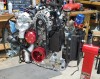


Does anyone know what the correct size swivel fitting for the oil feed is on the top of the front iron? I'd like to setup some AN lines to run off of that to the turbo but I'd need to know what size it needs to be.
This would be for an S5 Turbo block.
This would be for an S5 Turbo block.
Originally Posted by SPOautos
I made a stop by BNR during lunch and talked to Bryan some about this. After looking at a piston ring and seeing how it works its easy to understand how exhaust goes from the turbine side into the bearing housing and then into the crank case. Here is the interesting part. There is a piston ring on both sides, the turbine side AND the compressor side and they both have a factory spec gap that causes blow by into the crank case. This is why crank case vent is so important on turbo cars. The turbos are designed to do this and there really isnt anything you can do to change it.
Carbon seal designs (like the stockers) dont have a piston ring or gap so they dont require as much crank case vent as piston ring turbos.
Basically all you can do is vent the crank case better to make up for the additional air thats leaking in thru the turbo. Different turbos have slighly different piston ring gaps so the problem can change form turbo to turbo. If you run aftermarket twins with piston rings then you really need a lot of vent.
Carbon seal designs (like the stockers) dont have a piston ring or gap so they dont require as much crank case vent as piston ring turbos.
Basically all you can do is vent the crank case better to make up for the additional air thats leaking in thru the turbo. Different turbos have slighly different piston ring gaps so the problem can change form turbo to turbo. If you run aftermarket twins with piston rings then you really need a lot of vent.
This is what I am trying to understand. I am at the point where I either have a bad motor or a turbo that is letting too much blowby into the crankcase. I filled my entire catchcan and overflowed it yesterday just running 15 psi. There was oil all under the hood, the dipstick was pushed out and the can was full. The oil level light even came on from loosing a quart of oil to the can. this has to be caused by blow by, and it is excessive. I have two large vents. My concerns are not smoking. It does not smoke for the most part. I just can't keep oil in the case.
The only two places for the pressure to come from are the turbo (which I had never heard of the gases going into the bearing section until SPO mentioned it above), or motor (which means I have to pull a freshly rebuilt motor out.
I would hate to pull the motor out only to find that the cause of the excessive crank case pressure was a result of the piston gap size on my turbo being off.
On the other hand Sean has explained to me that Garret has a very low failure rate. I believe him, so I have been trying to put my finger on what is wrong before pulling and disassembling my motor (lots of work). I really don't know how to test for this and eliminate one or the other. I can't see inside while I am driving to find where the blowby is coming from.
This leaves me having to pull the turbo 1st and send it out to have it checked. If it comes back OK then out comes the motor. I was betting on the motor until SPo came back with the info from BNR. now its up in the air again
Mike
Rotary Enthusiast
Joined: Dec 2001
Posts: 1,209
Likes: 6
From: Delaware
what is the minimum restriction (ID) in each of the 2 vent paths to the can?
you noted one bad side seal on your rebuild?? could have a shop do a "leak down" test, comparing each of 6 faces. If one or more is real bad, it should show up as different than the others.
you noted one bad side seal on your rebuild?? could have a shop do a "leak down" test, comparing each of 6 faces. If one or more is real bad, it should show up as different than the others.


Thread
Thread Starter
Forum
Replies
Last Post
troym55
3rd Generation Specific (1993-2002)
23
May 25, 2016 12:42 PM
tiger18
3rd Generation Specific (1993-2002)
9
Sep 3, 2015 08:27 PM
