When you click on links to various merchants on this site and make a purchase, this can result in this site earning a commission. Affiliate programs and affiliations include, but are not limited to, the eBay Partner Network.
lean fronts are often caused by being not adequately protected from the turbine heat.
If the front runners are hotter and transfer that heat to the charge air it will be at a higher temperature and less dense, meaning less air mass into the front rotor which should result in a richer AFR with the same injector open time? Or am I missing something? Unless your injectors/rail are on the outside of the manifold and suffer fuel density loss die to heat.
I would have thought injector flow variations which may include rail flow past the injectors potentially reducing dynamic pressure on the front injectors depending on fuel system layout. Or the rear intake or exhaust doesn't flow as well and running richer on average.
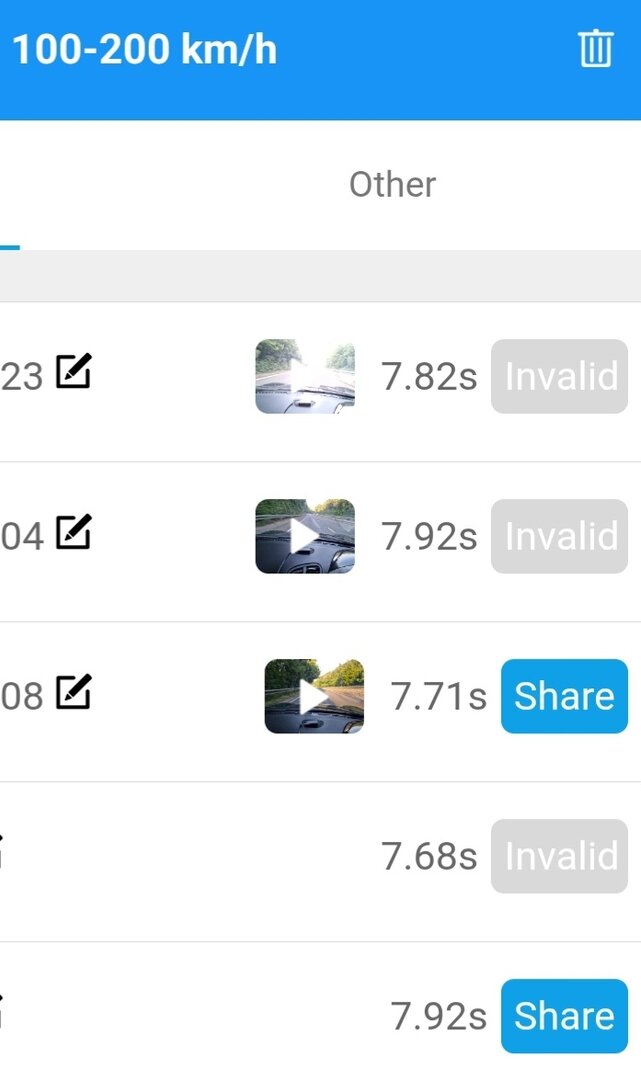
Since dyno day, it's been a learning curve getting used to the new fuel system, but I’m starting to get things dialed in. I'm now hitting the 7-second range using only 99 pump fuel no wmi needed. After increasing boost by just 1 psi to 15.5 psi, the car comfortably dropped into the 7s. On the dyno tune, the car managed an 8.4-second run. Now, it's doing 7.7s in real-world acceleration. I’ve also refined the accel fueling between gear changes, which has noticeably improved transient throttle and engine response. This can really be felt behind the wheel and shows in the acceleration run.
The goal is to consistently hit high 6 to low 7-second times on low boost, still using pump fuel and no wmi. My previous personal bests were set during colder winter conditions, so with the current summer heat, I’ve needed an extra 0.5 to 1 psi of boost to achieve similar performance. As temperatures drop later in the year, I’m confident the times will improve even further under the same setup.
The 100-200 suggests around 440ish hp or maybe lower.
How does transition to boost feel at lower rpm compared to the old setup?
The new setup behaves similarly to the old one in terms of how it transitions into boost, but with some welcome improvements. I'll try my best to explain. I've replaced the stock Torsen LSD with a 1.5-way ATS carbon diff, which allows me to bring the boost in a bit earlier. It’s not a dramatic change, but I can now run about 2–3% more duty cycle. That small bump is just enough to make the car feel a touch more responsive and lively, without compromising its street-friendly character. For example, I can now go wide open throttle in 2nd and 3rd gear through 30° bends, with the boost coming in smoothly and progressively. Previously, I would have needed to stay at partial throttle in those situations. I’ve specifically tuned the car for a smooth, linear boost and power delivery since it’s a street car, as my priority is drivability and traction out of corners, not an aggressive hit of boost that unsettles the car. If I really push it, I can get the boost to come in about 4-500 RPM earlier. But that takes away from the fun and turns the car into something that demands Keiichi Tsuchiya or Taniguchi level reflexes to manage. For a mere mortal like me, I’ll happily admit my reflexes aren't fast enough to control that kind of spiciness.
A few of you have asked me asking about the sensors and safeties I’ve got running. I figured I’d drop it all here in one spot to help others out. The more reliable we make these things, the more success stories we’ll see popping up online and that’s only going to drive demand and push FD prices to the moon . Imagine a world where FDs are known not just for being lightweight, agile, and timeless, but also more reliable than a piston engine. Yeah, I said it !!
It blows my mind that R34 shitbox GTRs are fetching the prices they are, while our beloved FDs still fly under the radar. Let’s change that narrative together !! FD prices to the MOON!!
Current Sensors Connected to ECU:
Wideband O2 (Lambda)
Fuel Pressure
Oil Pressure
Oil Temperature
Coolant Temperature
Intake Air Temperature (IAT)
MAP Sensor
Electronic Boost Controller
Throttle Position Sensor (TPS)
Sensors to be added with the new G40 900 Turbo and manifold:
Exhaust Gas Temperature (EGT)
Exhaust Manifold Pressure (EMAP)
Turbo Speed Sensor
GPS Wheel Speed Sensor
Dual O2 Sensors (One for each rotor/bank)
ECU Safety Strategies I run:
Dual MAP Limit: Protects against overboost in both low and high boost modes.
RPM Limit: Prevents the engine from exceeding redline.
Lean Protection: If AFR goes lean (below target), the ECU will stall the engine to prevent damage.
Coolant & Oil Temperature: If either exceeds 100°C, engine goes into limp mode (no boost) until temps cool down.
Oil Pressure Fail-Safe: If oil pressure drops below 20 psi, the engine shuts down.
IAT and ECT Timing Correction: If Intake Air Temp exceeds 50°C and Coolant Temp exceeds 100°C, ECU begins to pull timing to reduce thermal stress.
The one thing I want to add is to connect my WMI system to the ECU so it can read the flow from the water meth injector and have it fully controlled via the ECU under Lean out protection.
Let me know what you are running and if there's any safety is I should consider.
If you ever do circuit work it will go out on oil temp. A guy running turbo rotary race boats that had an engine dyno will independent cooling control posted somewhere years ago that he got best power with coolant around 70C and oil around 120C.
You will obviously struggle to keep coolant near that in a chassis car running petrol or E85 on track but can probably stay at ir underthat oil temperature unless do8ng very long sessions. You can probably give your coolant a but more leeway too.
Perhaps an alarm or warming light at the lower temperatures for street driving so you can pick up a potential failure before it cuts out?
back when i was building/racing full tilt piston engines (2 liter 4 cyl overhead cam 2 valve on gas NA road racing) i found best coolant temp for power was 195 For 90 C. testing was on an engine, not chassis, dyno and was extensive. i further proved this w hot boats... they were of course using lake water in their cooling system and were too cold. we added an adj restrictor and picked up power. that said i have no idea as to proper coolant temp on a turbo'd rotary.
back when i was building/racing full tilt piston engines (2 liter 4 cyl overhead cam 2 valve on gas NA road racing) i found best coolant temp for power was 195 For 90 C. testing was on an engine, not chassis, dyno and was extensive. i further proved this w hot boats... they were of course using lake water in their cooling system and were too cold. we added an adj restrictor and picked up power. that said i have no idea as to proper coolant temp on a turbo'd rotary.
I cant test any higher than 185 on my current engine dyno setup unless I disassemble the water tower and replace the thermostat but I can attest power goes up and up between 165 and 185 - usually to a tune of about 1.5-2% between the two.
instrumentation is actually an investment that will provide a positive return. it is relatively inexpensive and will save your $10,000 engine many times. it will also allow you to end up w a better tune.
you don't have to be a genius tuner if you have instrumentation.
just a few comments on the post:
where's knock? knock data in the 21st century is central to motor protection and tuning. all motors knock under load, it is a question of degree. of course reading the knock situation is only half of the drill. knock reaction is the other part. Link has a fabulous knock system. ...
knock is most likely at max cylinder pressure which is max torque. that would be between 5500 and 6500 for most. so let's use 6000.
300 knock opportunities per second per rotor
.003 per power impulse.
if one of those is serious knock you have .003 of a second to do something. obviously the only timely response can be an ignition cut.
to state the obvious, a boost cut might take a couple seconds.... that would be 600 power events... per rotor.
serious knock can be triggered by numerous fails.
these happened to me:
fuel quality caused knock.
my fuel pump disconnected from the hard up-pipe in my tank 24 psi, 4600 rpm 4th gear
in both instances (which were logged) my ignition went to zero and there was no motor problem. thank you ViPEC/Link.
as to IATs, use an air thermocouple rather than a glacial speed "fast" thermistor. your really want to know your accurate IAT.
i will be very interested to hear what you learn re rotor specific AFRs .
Last edited by Howard Coleman; May 16, 2025 at 09:53 AM.
I cant test any higher than 185 on my current engine dyno setup unless I disassemble the water tower and replace the thermostat but I can attest power goes up and up between 165 and 185 - usually to a tune of about 1.5-2% between the two.
What configuration is that in? Turbo/NA/Injected/Carb?
Was best low rpm torque at a different coolant temperature than best power?
What configuration is that in? Turbo/NA/Injected/Carb?
Was best low rpm torque at a different coolant temperature than best power?
Generally NA is where I'd say the information is valid - under, boosted the boosted conditions I've worked with that little bit of power would probably look like noise given all systems involved - both carb'd and injected.
I didn't particularly notice any power delivery changes, just a repeatable shift 'up' on the torque curve.
On my setup, coolant and oil temps at operating conditions typically stay around 79°C during idle and cruising sometimes lower is colder weather. When pushing hard through the twisties, both oil and coolant temps can climb up to around 90°C and settle. Oil temperatures have stayed below 100°C even during track use likely thanks to the 19-row twin Setrab oil coolers doing their job effectively. If I added dedicated air ducts, this would improve their efficiency further.
I've configured my safety thresholds to be conservative, so if any of them trip, it’ll likely be a sign that I need to upgrade to a larger radiator or more efficient oil coolers to better manage thermal stress. The FD can do 5 hot laps of spa and anglesey without any of the safeties tripping, then i let things cool down. If my FD was an endurance race car doing 24hrs of the nurburgring the cooling package, aero and ducting would need to be addressed for that purpose. However, for street use its more than sufficient. From what I recall, Mazda’s race teams aim to keep oil temperatures below 110°C, with an ideal target around 100°C. IIRC racing beat advise oil temps around 96*C max.
The new low boost setting, sitting around 15–15.5 psi, is consistently delivering 100–200 km/h times in the 7.8-second range when averaging both valid and invalid runs. I’m very happy with that as it’s a solid improvement of around 0.6 seconds over the previous 8.4-second runs.
This is all on pump fuel, with no wmi and in fairly warm conditions. The car feels really well-balanced on the street, especially through the twisties and on corner exits where traction is more limited for street use on colder tyres. I’m tempted to try bumping the boost slightly higher maybe up to 16.5 psi (around 1.15 bar) on pump fuel, just to see how it affects both the acceleration runs and handling through the twisties.
I think this level of performance is easily attainable for the vast majority of FD owners who desire a well balanced machine with strong acceleration through the twisties.
Recently, I was given a new to me but old pioneer headunit with bluetooth audio, hands free calls, and apple music etc etc. My previous headunit also happens to be a pioneer unit but with none of the modern gismos! In a way the headunit really brought the FD into the modern world....making me think why in the world I didnt get bluetooth handfree and ability to stream my apple music through the FD. I took these things for granted in my M3 and never thought I needed such luxuries in the 7, but I was wrong.
One thing led to another and its finally time to improve the performance of the stock audio system in my FD. The goal is better clarity, improved mid-bass, and reduced cabin noise, all while keeping the setup simple, affordable, and clean. That means no subs, no big amps, no additional heavy wiring and no rear speakers. Just aiming to get the best possible sound from the front stage.
Changes being made:
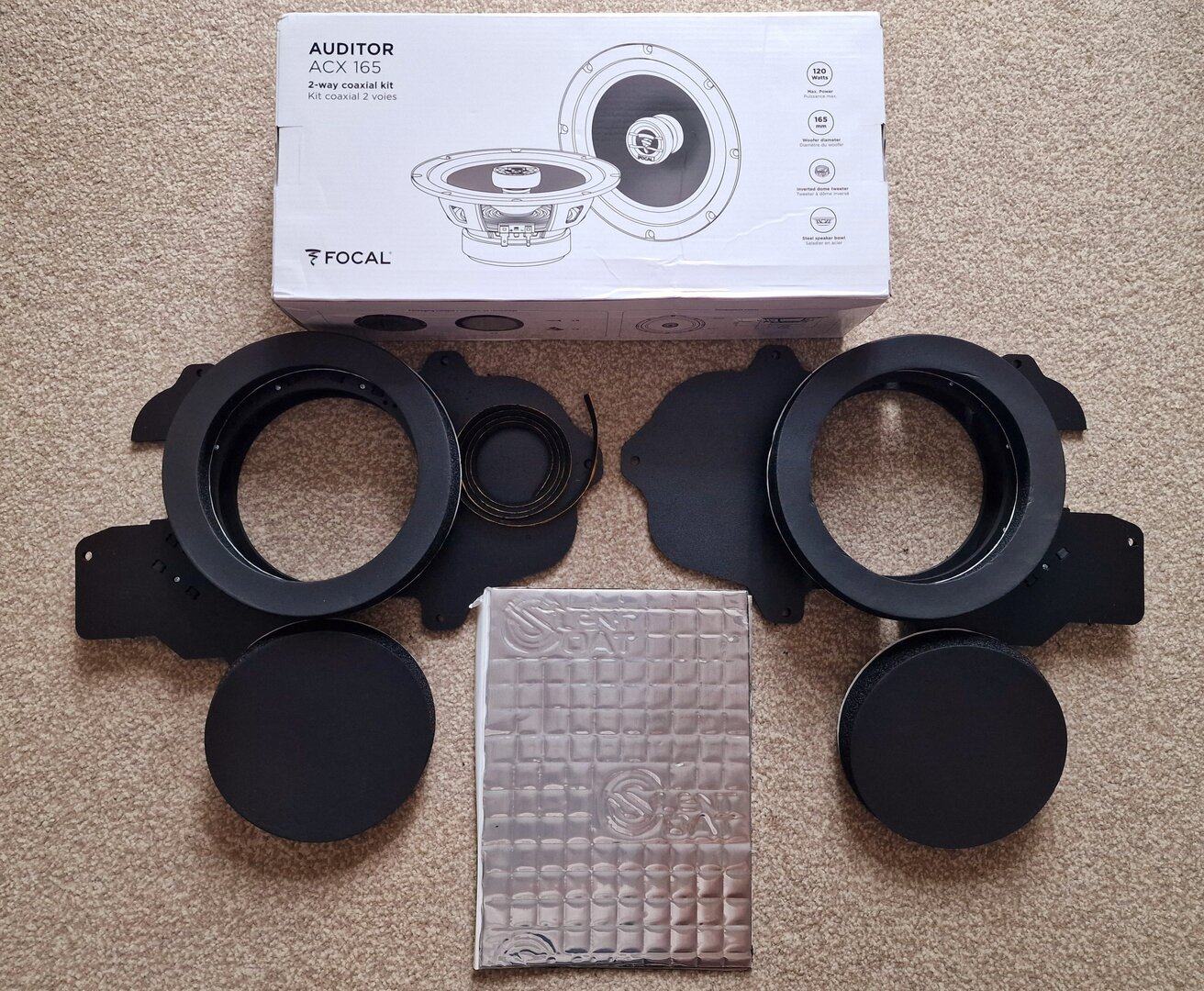
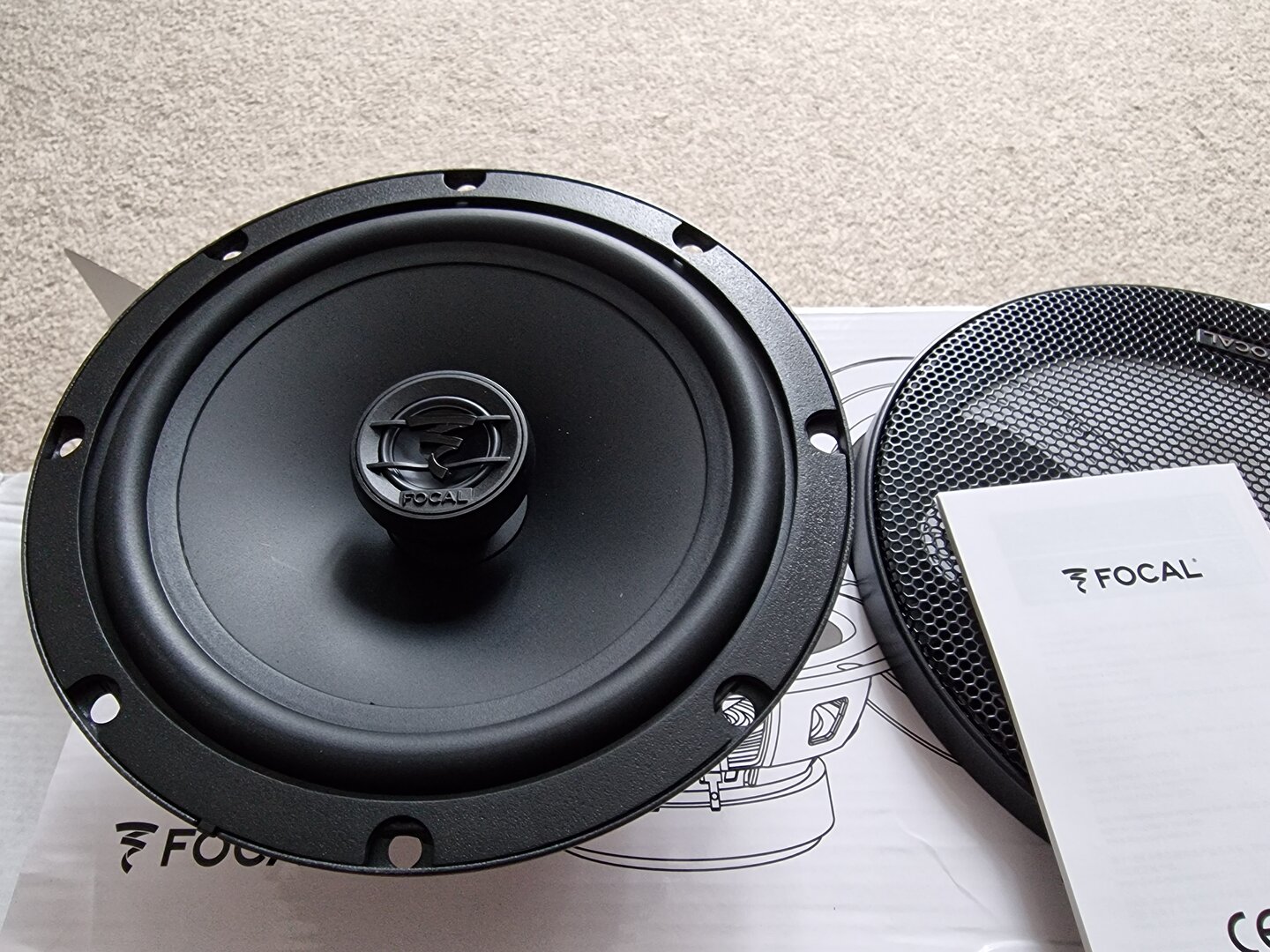
Front Speakers: Swapping in Focal ACX 165 6.5" coaxials (60W RMS) using new 6.5" adapters and foam rings for better fit and seal.
Amplification: Adding a Pioneer GM-D1004 compact mini amp to power the Focals properly (45W RMS per channel). Plug-and-play using an ISO harness with no cutting. Hopefully will sit behind the head unit.
Head Unit: Keeping the Pioneer DEH-4500BT as it easily integrates with the mini amp and also allows me to tune EQ and high-pass filter for cleaner sound.
Sound Deadening: Its pointless, installing new speakers in a car like the RX7 without treatment of the door cards. So i'll be applying Silent Coat 2mm sheets to outer and inner door skins. On top of that, adding 3mm closed-cell foam (CCF) on the inner skin only, away from the window path and gasket tape around speaker adapter to reduce leaks and resonance.
Most will agree the stock audio setup is weak and distorted at higher volumes, like listening to music via your phone speakers. I hope the Focals will offer a cleaner, more dynamic sound, and the mini amp helps drive them properly without overloading the head unit. Sound deadening should help a lot in my RX-7’s loud and noisy cabin. Everything is non-destructive and easily reversible back to OEM, as if anyone would want to go back to stock 30yr old speakers
Hopefully this will be a night and day difference in sound quality for those long journeys to Spa or Nurburgring. Fingers crossed, its a worthwhile upgrade without a significant weight penalty.
Refining the low boost has led to this point. After 11, 100–200 runs, the new fuel system has proven itself to be consistent, repeatable, and reliable which is exactly what I wanted to put to the test. In my view it has passed and all the negative air about the Bosch 2200cc injectors being rubbish and inconsistent is either internet forum rubbish or poor fuel system setup as I've not experienced any kind of inconsistency with them run after run.
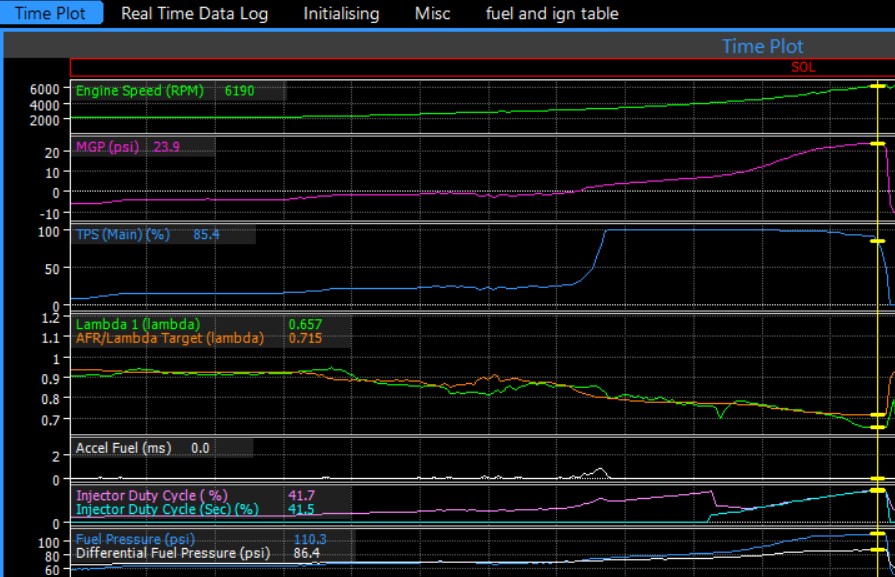
There is enough confidence in the fuel system to start high boost tuning. I did a 24 psi test run to 6k rpm and the skies opened up so I had to call it a day. As expected, the fuel system handled it effortlessly. The injector duty cycle was only around 42%, and fuel pressure stayed rock solid, with none of the pressure drops I experienced with the old setup. I need to work on refining the high boost map but hopefully that wont take too long.
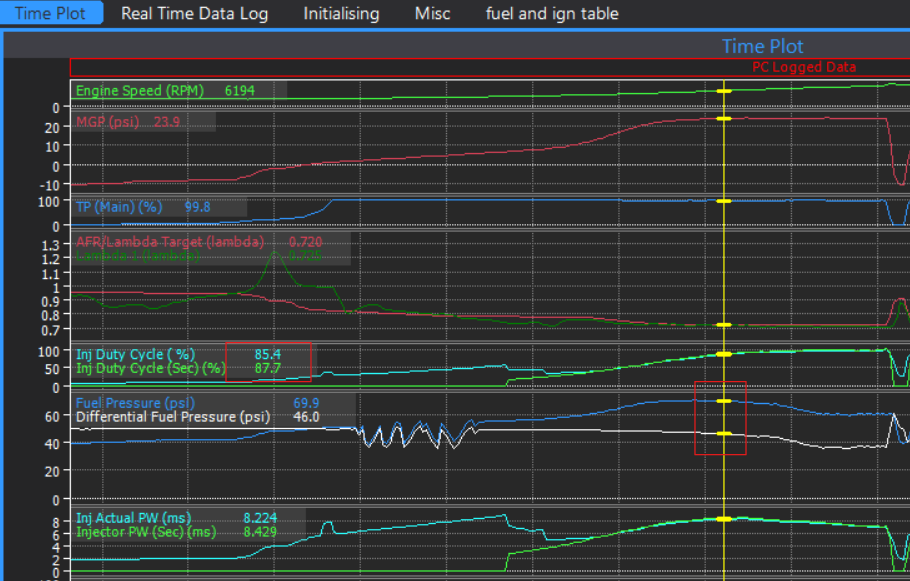
This is the previous run which did the 5.98s 100-200. The new fuel system confirms nearly a 44% reduction in injector duty cycle, and fuel pressure remained completely stable with no drop at all and those funky oscillations are gone too.
2 bar (29 psi) coming soon... Can a 13b street port handle the boost? Will the 100–200 km/h times drop even further? Stick around, we’re about to find out!
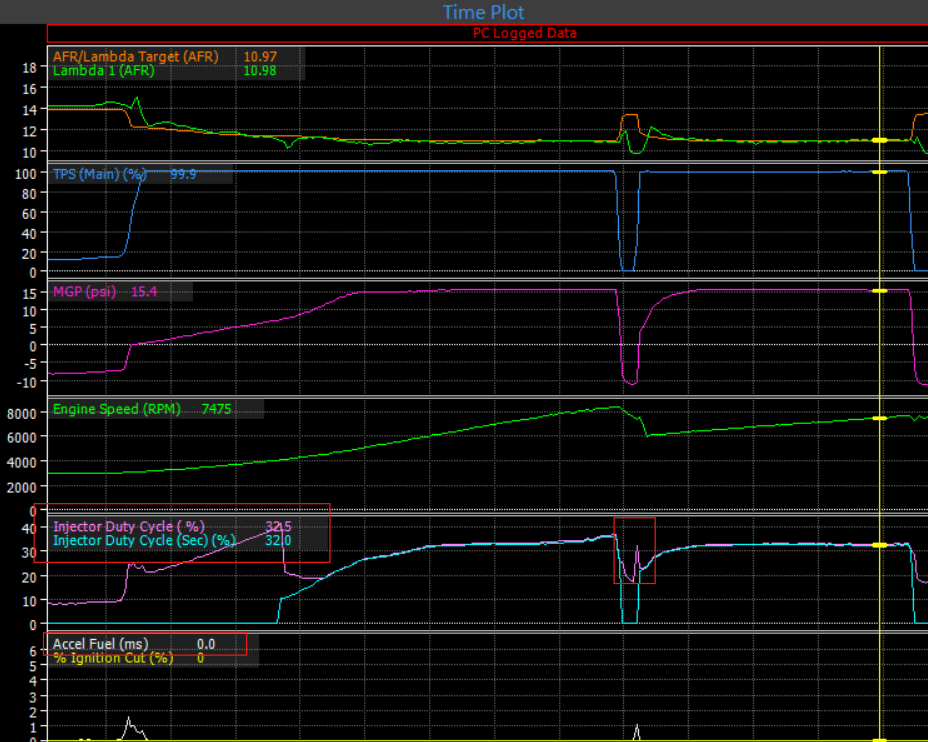
Looking at your wideband trace your Injector data doesn't look right.
It goes lean on the transition and rich once your over 37-40% injector duty cycle. Your minimum pulse width also looks high seeing as it rich spikes as soon as they come on.
That usually indicates dead times are too low and flow rate is too low
Also another item that indicates to that, if your VE map has to dramatically change anytime injectors go over 40% duty cycle it indicates to poorly configured injectors. The fact that your on target at 14psi but it's no longer on target at higher boost eludes to that as well. VE of an engine doesn't change that match once your on boost if anything at all. Not that much anyways.
I agree, the secondaries kick in around 1ms at approx 4,000 RPM, and as expected, there’s a brief moment where the AFR goes rich, then slightly lean, before settling as they balance with the primaries. I’m using ID2000s deadtimes and battery voltage data for the secondaries, and while the data isn't perfect, this setup seems to work best for me so far. Everything else i've tried has been off by a worse margin.
I’m definitely open to suggestions on making the transition between the primaries and secondaries smoother. You can clearly see the handover in the AFR trace, though interestingly, you can’t feel it in the car the pull remains smooth, so subjectively it feels seemless. It took a lot of effort to get the secondaries behaving well at low boost, but after some work, they’re now performing seamlessly both on and off throttle, and consistently across the 11 or so 100–200 runs I’ve logged. However, they may not be to your haltech standards for the afr trace. So def welcome on thoughts on what to trial and error on the link g4x i'm using.
The reason it goes overly rich at 24psi is because that part of the main fuel table is still too rich so now it’s time to start refining it closer to my target lambda. Hopefully wont take too long, couple of runs should get it close.
Last edited by rx7srbad; May 29, 2025 at 09:40 AM.
as far as i am concerned the elephant in the room is fuel pressure. you can't tune anything w diff fuel pressure set at 60 and being 86 at the end of the run. either you need a different pressure sensor or you have some sort of restriction in the return line system.. you mentioned you are Dash 8 which is fine. perhaps something else, a kink or?
here's the link to the new significantly cheaper Honeywell PxL pressure sensor... there are many counterfeits so i only buy from a trusted source such as Ballenger Motorsports
That's a good shout. The fuel system is massive so i'll get a new sensor and retest when the fuel pressure is 40psi and hopefully it will work even better.
That's a good shout. The fuel system is massive so i'll get a new sensor and retest when the fuel pressure is 40psi and hopefully it will work even better.
Might be worth checking scaling of the sensor and how the differential channel is set up before buying a new one.
If the ecu is running feed forward differential rail pressure compensation with an incorrect scaling it will be fighting itself too, you may have baked the incorrect pressure sensor scaling (or sensor fault) into your VE map as a result.
Probably difficult to eyeball as the flow variance od square root of differential change not linear too.
Probably some weird trim fluctuations if it's also doing wideband feedback.
the diff f p separates from the 60 static setting at the onset of boost and increases in a fairly linear fashion. this points to the probability of a return restriction rather than the sensor.
Verified base fuel pressure using a manual gauge and confirmed it's set to 40psi differential.
Swapped in a new fuel pressure sensor and re-calibrated it to match the manual gauge. Took some time but worth it to reduce error.
Retuned the fuel map slightly to suit the new pressure. Injector data remains set for 40psi base.
Staging is improved but still not perfect asit dips rich briefly as secondaries come in, then stabilizes. It feels smooth on the road, but logs show room for improvement.
Omar pointed out that injector dead times and flow rates in the Link G4X might not be ideal at the staging point. I have to explore the ECU logic further possibly lowering the sec/pri ratio to soften the transition and reduce that initial rich dip. Will see how it goes and may get Adam from Link involved to fine-tune it.
This was a 3rd gear pull up to 7700rpm before I lifted. There’s still a lot of fuel to clean up, but this is how I prefer to tune on the road, starting rich and gradually leaning it out until I consistently hit the target lambda across multiple runs.
I had the trusty Dragy with me for this session, and even with the map still being a bit off, it managed a 60-90 mph time of 2.50 seconds, which was a pleasant surprise.
The run where I hit 5.9s for 100-200 km/h and the matching 60-130 mph pass shows a 60-90 mph time of 2.16 seconds. That’s just 0.34 seconds off my previous personal best, which is quite promising, especially considering there’s still a fair amount of fuel to trim and i'm not even close to the optimal tune yet.
Below is Nath's time from the leaderboard in his G42-equipped RX-7 running 29psi. He clocked a 60-90mph time of just 1.86 seconds. I’m currently 0.64 seconds off that pace which is a significant gap, and it makes me question whether the smaller G35 on a street port can realistically compete at the same boost level. Either way we will find out soon enough.
Overall, things are heading in the right direction. One concern though, I noticed third gear felt a bit tighter going in than usual, which is slightly worrying. Something I'll need to keep an eye on. Hopefully the gearbox holds out!!
Last edited by rx7srbad; May 31, 2025 at 05:55 AM.






 . Imagine a world where FDs are known not just for being lightweight, agile, and timeless, but also more reliable than a piston engine. Yeah, I said it