


bigger turbo and lower boost vs smaller turbo and higher boost


bigger turbo and lower boost vs smaller turbo and higher boost
I was discussing this with a friend who has recently made the switch to rotaries from srt-4s, but this applies to most piston motors. A lot of these guys with factory forced induction piston cars crank up the boost to crazy levels before switching to a bigger turbo. For example my buddy with an evo 9 is running 30 psi now on the stock turbo. I know why we generally don't do this (our stock turbos tend to take a **** after prolonged use at 15psi) but why don't we see many people running something like a gt30 at 25-30 psi instead of a gt35 at 20 or a gt40 at 15? Is it just something that is sort of ingrained in our minds as a community, run lower boost and save our motors/turbos?
I just purchased a 6265 turbo from Sean at a-spec and am planning on running it at no more than 20 psi. This is a big turbo to the piston guys, but it's middle of the pack for us. Same story with something like a gt40, to4z, or 6765, these things are monstrous and only drag racers or people that just want big numbers even think about running these things, and this size is in abundance in our community. But it doesn't seem like people crank up the boost on these.
Maybe I'm just looking in the wrong place, but these are my observations.
I just purchased a 6265 turbo from Sean at a-spec and am planning on running it at no more than 20 psi. This is a big turbo to the piston guys, but it's middle of the pack for us. Same story with something like a gt40, to4z, or 6765, these things are monstrous and only drag racers or people that just want big numbers even think about running these things, and this size is in abundance in our community. But it doesn't seem like people crank up the boost on these.
Maybe I'm just looking in the wrong place, but these are my observations.

Here are my thoughts....
Bigger turbo at x psi is more efficient then a smaller turbo at x+5.
Bigger turbo has more potential down the road if you still decide you need more HP.
Smaller turbo is likely to give a better response, and less lag compared to a larger unit.
These are just random thoughts, that might make a person choose one over another.
Bigger turbo at x psi is more efficient then a smaller turbo at x+5.
Bigger turbo has more potential down the road if you still decide you need more HP.
Smaller turbo is likely to give a better response, and less lag compared to a larger unit.
These are just random thoughts, that might make a person choose one over another.

Rotorhead

Joined: Feb 2001
Posts: 9,136
Likes: 39
From: Charlottesville, Virginia, USA
See here for turbo sizing:
https://www.rx7club.com/spec-tuning-154/how-size-matters-478915/
My observations:
- It depends who you consider "the piston guys". The ricer piston guys have 2.0L engines that flow about 30% less than a 13B, therefore our turbos are larger than theirs. The muscle car piston guys have 5.7L engines that require two of whatever turbos we put on our 13Bs.
- A road race RX-7 rarely has anything bigger than a T61 turbo, and the large majority of them have non-turbo engines. The reason why you see so many RX-7s with "drag race" turbos is because they are either drag cars or de facto drag cars, lol.
https://www.rx7club.com/spec-tuning-154/how-size-matters-478915/
This is a big turbo to the piston guys, but it's middle of the pack for us. Same story with something like a gt40, to4z, or 6765, these things are monstrous and only drag racers or people that just want big numbers even think about running these things, and this size is in abundance in our community. But it doesn't seem like people crank up the boost on these.
- It depends who you consider "the piston guys". The ricer piston guys have 2.0L engines that flow about 30% less than a 13B, therefore our turbos are larger than theirs. The muscle car piston guys have 5.7L engines that require two of whatever turbos we put on our 13Bs.
- A road race RX-7 rarely has anything bigger than a T61 turbo, and the large majority of them have non-turbo engines. The reason why you see so many RX-7s with "drag race" turbos is because they are either drag cars or de facto drag cars, lol.
I was focusing more on the guys with 6 cylinder and smaller imports. I live in Nebraska, here if it doesn't have a v8, it ain't a real car, so I'm well aware of what they run for turbos. Hell this tard with a mosly stock terminator won't even race my buddy's proven mid-11 stock turbo sti. Guess I thought it was clear based on my talking about srt-4's and evo's in my first post, but no biggie.
I've read Sean's post and just a few days ago bought my turbo through him, even when talking with him he was recommending the 6265 (what I went with) for a combination of street, track, drag, and autox. I recommended Sean to a buddy of mine with an evo 8 and told him what size turbo I bought and his reaction was "Jesus christ! You bought a monster lol." And I'm sitting here thinking, that's just not that big, it's pretty middle of the pack for us rx7 guys It just seems that even the guys that run around the track but drive a lot on the street too have seemingly larger-than-necessary turbos.
I've read Sean's post and just a few days ago bought my turbo through him, even when talking with him he was recommending the 6265 (what I went with) for a combination of street, track, drag, and autox. I recommended Sean to a buddy of mine with an evo 8 and told him what size turbo I bought and his reaction was "Jesus christ! You bought a monster lol." And I'm sitting here thinking, that's just not that big, it's pretty middle of the pack for us rx7 guys It just seems that even the guys that run around the track but drive a lot on the street too have seemingly larger-than-necessary turbos.

with turbos its all about volume. even if a smaller turbo is at higher psi (pounds per. square inch) a bigger turbo at lower psi still can produce more air per cubic inch. the air may be getting pushed harder by the smaller turbo but there is more air getting pushed by the bugger turbo.

The funny thing is most of the garrett gt turbo lineup is all wrong for the rotary.
single entry turbine housings
compressor a/r ratios too low
compressor trims too high and too much compressor on a given turbine.
Anything sub 350rwhp really should be using a series 5 rx-7 hybrid turbo, anything sub 220rwhp should be using a stock series 5 turbo. Don't bother going smaller. So really the first logical step up should be to t3-stage5/gt35r turbine housing. But you still have the problem that the trim on the 35r is all wrong. The same HP can be delivered by a prehistoric H trim 58.5mm/70mm. Rotaries just don't need the big compressor exducers to allow the flow to happen at a high PSI because typically our engines can eat the whole 400rwhp compressor around 17psi.
I'm currently collecting parts to build an engine designed to have a turd volumetric efficiency just like a piston motor but use high compression rotors (PUNY ports). I am going to combine this with a turbine (turbo is already built) that is going to be right on the choke limit at 7200rpm, and then see what happens when you reduce how the tight turbine can '**** up' the engines performance by reducing exhaust to intake overlap, and then see what I can pull out of a relatively small exhaust housing/turbine wheel combo. I think it will be insanely responsive and hard to not drive fast, but given the right throttle input should be very economical.
single entry turbine housings
compressor a/r ratios too low
compressor trims too high and too much compressor on a given turbine.
Anything sub 350rwhp really should be using a series 5 rx-7 hybrid turbo, anything sub 220rwhp should be using a stock series 5 turbo. Don't bother going smaller. So really the first logical step up should be to t3-stage5/gt35r turbine housing. But you still have the problem that the trim on the 35r is all wrong. The same HP can be delivered by a prehistoric H trim 58.5mm/70mm. Rotaries just don't need the big compressor exducers to allow the flow to happen at a high PSI because typically our engines can eat the whole 400rwhp compressor around 17psi.
I'm currently collecting parts to build an engine designed to have a turd volumetric efficiency just like a piston motor but use high compression rotors (PUNY ports). I am going to combine this with a turbine (turbo is already built) that is going to be right on the choke limit at 7200rpm, and then see what happens when you reduce how the tight turbine can '**** up' the engines performance by reducing exhaust to intake overlap, and then see what I can pull out of a relatively small exhaust housing/turbine wheel combo. I think it will be insanely responsive and hard to not drive fast, but given the right throttle input should be very economical.

Junior Member
Joined: Apr 2010
Posts: 40
Likes: 0
From: omaha nebraska
well my big question was, on the rotaries, why aren't the larger turbo guys running these bigger turbos where they shine like 30-35lbs or even higher. Instead they are only seeing 15-20lbs from what I have noticed. I mean you would see the same results from a smaller turbo running them where they shine.
Im new to rotaries so I am just trying to understand this concept.
-wes
Im new to rotaries so I am just trying to understand this concept.
-wes
Trending Topics


The guys making 600-900rwhp are running the 30-35+ lbs boost you indicate, it is just there are few rotary enthusiasts willing/able to put the time and money into running this high boost as it takes a lot of both.
This is largely due to the fact that we only have STOCK Mazda parts available- there is no "built" engine option with the rotary. How many stock block piston engines run in the 30-35+ lbs boost range? Definitely more than rotaries, but this is still considered "built block" territory.
This is largely due to the fact that we only have STOCK Mazda parts available- there is no "built" engine option with the rotary. How many stock block piston engines run in the 30-35+ lbs boost range? Definitely more than rotaries, but this is still considered "built block" territory.

I beg to differ. I mean, there's guys that are running 2pc e-shafts, studded motors, & have everything blueprinted and balanced. I would consider that built for a rotary. We just have to do it a lil bit different then those piston guys. I personally am going to be running a 4294 around 30psi. Correct me if I'm wrong, but the higher the boost setting the quicker the turbo builds boost.
The way I look at it:
Pressure is more "dangerous" then flow and pressure is what requires higher octane.
Flow makes the power, so for reliability and power it is best to run a bigger turbo and lower pressure to make power.
By running a stock turbo at 18psi you are actually increasing the chances of engine damage then running a t70 at 10 pounds and making way more power.
disclaimer: I know this isn't always true
Pressure is more "dangerous" then flow and pressure is what requires higher octane.
Flow makes the power, so for reliability and power it is best to run a bigger turbo and lower pressure to make power.
By running a stock turbo at 18psi you are actually increasing the chances of engine damage then running a t70 at 10 pounds and making way more power.
disclaimer: I know this isn't always true
Joined: Sep 2003
Posts: 3,067
Likes: 7
From: Home of the Rolex 24
See here for turbo sizing:
https://www.rx7club.com/showthread.php?t=478915
My observations:
- It depends who you consider "the piston guys". The ricer piston guys have 2.0L engines that flow about 30% less than a 13B, therefore our turbos are larger than theirs. The muscle car piston guys have 5.7L engines that require two of whatever turbos we put on our 13Bs.
- A road race RX-7 rarely has anything bigger than a T61 turbo, and the large majority of them have non-turbo engines. The reason why you see so many RX-7s with "drag race" turbos is because they are either drag cars or de facto drag cars, lol.
https://www.rx7club.com/showthread.php?t=478915
My observations:
- It depends who you consider "the piston guys". The ricer piston guys have 2.0L engines that flow about 30% less than a 13B, therefore our turbos are larger than theirs. The muscle car piston guys have 5.7L engines that require two of whatever turbos we put on our 13Bs.
- A road race RX-7 rarely has anything bigger than a T61 turbo, and the large majority of them have non-turbo engines. The reason why you see so many RX-7s with "drag race" turbos is because they are either drag cars or de facto drag cars, lol.

I think the biggest difference is that these 4 cylinders especially are engineered to run this kind of boost, and that is partly out of necessity due to the low displacement.
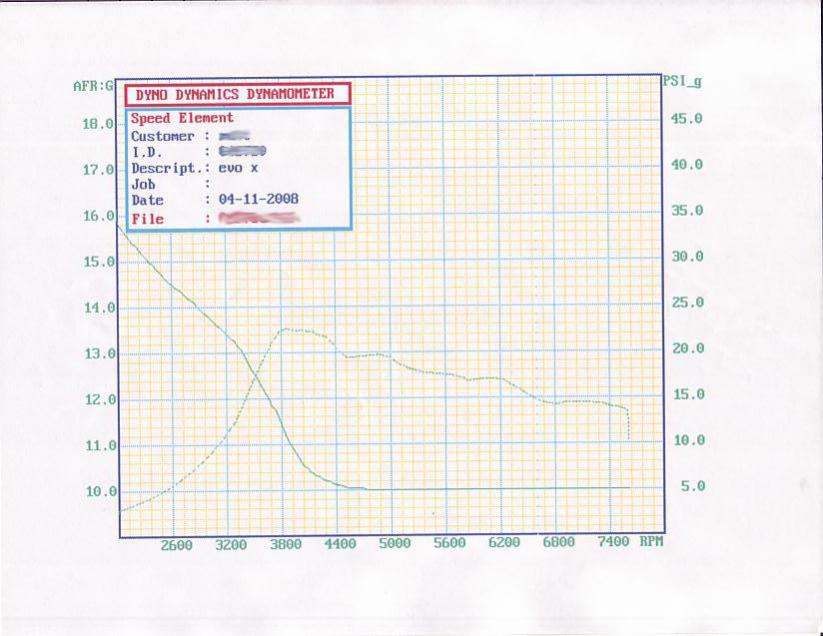
One thing you guys have to realize is that many of these newer piston engines intentionally taper down their boost. They wind the turbo out up through the mid range to these very high peak numbers and then use the factory ECU's boost control to lower boost and keep the turbo in its efficiency range. Evos and STi's do this all the time. They have target boost or target engine load maps and then solenoid duty cycle and closed loop control.
Here are boost target tables from two Cobb maps for a 2.5 turbo Subaru Legacy:

That's only about 16psi. On the Evos the boost control is based on target load, and load is [to simplyify it] calculated as a function of the measured airflow at a given rpm. This next graph I've posted before. It shows AFR and boost on a completely stock Evo X:
Another thing to consider is the fact these newer cars have actual useable knock control when you modify them. If they knock hard enough, depending on the car it will cut boost, richen the mixture, and revert to a completely different "low octane" timing map. Most Rx-7's out there have no useable knock retard. You can't really push things as hard and there's nothing to save your *** if something goes wrong.
here's a log right from the factory Evo X ECU (not the same car as above):
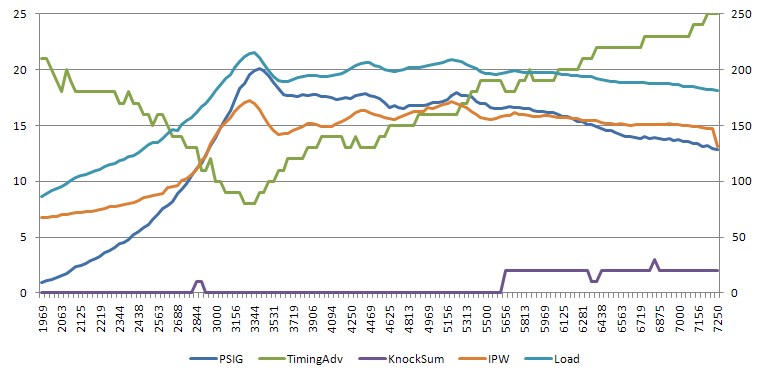
You can see that the timing (green line) is optimized for the very high boost (darker blue line). As the boost and measured engine load increase, the timing retards but then advances as engine rpm increases and boost tapers off. The knock counter (purple) keeps track of potential knock events which are used for the octane calculation. The octane calculation is used to interpolate between the high and low detonation timing maps. Subaru has a similar type of system but it's structured differently inside the ECU.
So just to summarize... the 4 cylinders run that boost
1) because they pretty much have to if they want to make the numbers and have any kind of low end response
2) because the ECU and everything else are actually engineered to run that boost through the factory boost control and knock control systems.
One thing you guys have to realize is that many of these newer piston engines intentionally taper down their boost. They wind the turbo out up through the mid range to these very high peak numbers and then use the factory ECU's boost control to lower boost and keep the turbo in its efficiency range. Evos and STi's do this all the time. They have target boost or target engine load maps and then solenoid duty cycle and closed loop control.
Here are boost target tables from two Cobb maps for a 2.5 turbo Subaru Legacy:
That's only about 16psi. On the Evos the boost control is based on target load, and load is [to simplyify it] calculated as a function of the measured airflow at a given rpm. This next graph I've posted before. It shows AFR and boost on a completely stock Evo X:
Another thing to consider is the fact these newer cars have actual useable knock control when you modify them. If they knock hard enough, depending on the car it will cut boost, richen the mixture, and revert to a completely different "low octane" timing map. Most Rx-7's out there have no useable knock retard. You can't really push things as hard and there's nothing to save your *** if something goes wrong.
here's a log right from the factory Evo X ECU (not the same car as above):
You can see that the timing (green line) is optimized for the very high boost (darker blue line). As the boost and measured engine load increase, the timing retards but then advances as engine rpm increases and boost tapers off. The knock counter (purple) keeps track of potential knock events which are used for the octane calculation. The octane calculation is used to interpolate between the high and low detonation timing maps. Subaru has a similar type of system but it's structured differently inside the ECU.
So just to summarize... the 4 cylinders run that boost
1) because they pretty much have to if they want to make the numbers and have any kind of low end response
2) because the ECU and everything else are actually engineered to run that boost through the factory boost control and knock control systems.

I beg to differ. I mean, there's guys that are running 2pc e-shafts, studded motors, & have everything blueprinted and balanced. I would consider that built for a rotary. We just have to do it a lil bit different then those piston guys. I personally am going to be running a 4294 around 30psi. Correct me if I'm wrong, but the higher the boost setting the quicker the turbo builds boost.
There is NO comparison.


Who said rotaries cannot stand the test of time at high pressure levels? Were do you guys find this crap from?
I have a customer rx7 with gt35r on it that runs 30psi all day long on pump fuel and has done over 100 laps in one day at wake field. In 25lap sprint sessions.
Its done alot of work now at that boost level and is perfect. GOOD TUNE UP IS KEY.
Engine makes around 500rwhp.
I have a customer rx7 with gt35r on it that runs 30psi all day long on pump fuel and has done over 100 laps in one day at wake field. In 25lap sprint sessions.
Its done alot of work now at that boost level and is perfect. GOOD TUNE UP IS KEY.
Engine makes around 500rwhp.

The way I look at it:
Pressure is more "dangerous" then flow and pressure is what requires higher octane. Flow makes the power, so for reliability and power it is best to run a bigger turbo and lower pressure to make power.
By running a stock turbo at 18psi you are actually increasing the chances of engine damage then running a t70 at 10 pounds and making way more power.
Pressure is more "dangerous" then flow and pressure is what requires higher octane. Flow makes the power, so for reliability and power it is best to run a bigger turbo and lower pressure to make power.
By running a stock turbo at 18psi you are actually increasing the chances of engine damage then running a t70 at 10 pounds and making way more power.
A large port engine will require less boost to make the same power as a small port engine with higher boost. This is due to: porting, flow dynamics of the intake and exhaust affecting the boost requirements to force equal amounts of air into the combustion chamber.
If the air temps of the two charges are equal, then the timing and fuel will be similar. Your assumption is only valid if the higher boost to produce the same air flow mass results is noticeably higher intake charge temps.
Higher boost from a turbo normally does produce more heat, but if the IC design and cooling is optimal, higher boost can be just as safe.

tard of teh century

Joined: Jul 2005
Posts: 104
Likes: 1
From: Dublin, OH
The more you compress something the more heat it generates, even with 100% efficiency, that's just how thermodynamics works. So the more air you flow with less pressure the cooler the charge will be leaving the turbo. You can easily look back some years when it was considered almost impossible for a pump gas rx7 to run over 20 psi and people would get flamed for asking if they could do it. However, now there's be countless examples showing that with proper tuning and setups that you can really go as high as you want with boost and still be safe.

Senior Member
Joined: Jul 2009
Posts: 377
Likes: 2
From: England
Not being 'able' to run big boost on pump fuel (or in my case, not having faith in the mappers to allow me to do it) is the only thing that I dont like about my car.
You always get the 'you dont need to run big boost to get big power' and 'rotarys just dont make big torque' arguments from rotary people, but they are both BS really.
You dont 'need' big boost to get big power on any car, and the reason most rotaries dont make big torque is they are running low boost, if you look at these GT35'd rotaries running 25-30psi boost they make nearly as much torque as power, which is as good as most 4-6cyl engines running the same.
Boost=Torque, simple as that, no porting or revving or high compression or anything will get you that.
Smaller turbo at high boost can get you the same power with much more torque, faster response, more midrange, and a wider powerband, than a big turbo at low boost.
Even with holding the peak power boost pressure at exactly the same level, so the car made the same power, the performance and drivability of my FC was night and day going from 12 to 22psi, so I'd love to feel the torque it would make at real mans boost levels, ie 30psi+.
Trouble is, it gives you the rotary enemies- BACKPRESSURE AND HEAT
It makes me annoyed with myself, but on pump fuel, considering the 9:1 rotors and the tuners available, I'm scared to go much higher even though im running lots of pre-turbo water, which sucks seeing as previous piston cars I've ran as low as 7.5:1 comp and as high as 35psi held on pump fuel (no water either) with no worries even on top speed runs and the drivability and torque is night and day compared to running lower boost on a rotary.
You always get the 'you dont need to run big boost to get big power' and 'rotarys just dont make big torque' arguments from rotary people, but they are both BS really.
You dont 'need' big boost to get big power on any car, and the reason most rotaries dont make big torque is they are running low boost, if you look at these GT35'd rotaries running 25-30psi boost they make nearly as much torque as power, which is as good as most 4-6cyl engines running the same.
Boost=Torque, simple as that, no porting or revving or high compression or anything will get you that.
Smaller turbo at high boost can get you the same power with much more torque, faster response, more midrange, and a wider powerband, than a big turbo at low boost.
Even with holding the peak power boost pressure at exactly the same level, so the car made the same power, the performance and drivability of my FC was night and day going from 12 to 22psi, so I'd love to feel the torque it would make at real mans boost levels, ie 30psi+.
Trouble is, it gives you the rotary enemies- BACKPRESSURE AND HEAT
It makes me annoyed with myself, but on pump fuel, considering the 9:1 rotors and the tuners available, I'm scared to go much higher even though im running lots of pre-turbo water, which sucks seeing as previous piston cars I've ran as low as 7.5:1 comp and as high as 35psi held on pump fuel (no water either) with no worries even on top speed runs and the drivability and torque is night and day compared to running lower boost on a rotary.

I dont really get the point of the original question. You cant say if either turbo set up is better or worse. Its all subjective to what the car is used for, desired power output, price range...
With that said, I run a small turbo and run near 20 psi. I use the car for track days and occasional street use. I am only shooting for the low 400 whp range. I feel I am getting everything I want out of this turbo, with excellent spool and moderate power levels. A bonus of this as stated earlier is I still make very good torque numbers due to the higher boost level.
One downside to doing this I see is the need to run aux injection of some sort. If you run a larger turbo at a lower boost level to make the same peak power (although with less tq) there is less need to run aux injection.

-J

Thread
Thread Starter
Forum
Replies
Last Post
