


Power FC Stock 02 sensor AFR conversion


Stock 02 sensor AFR conversion
What's the conversion from the sotck O2 sensor voltage to the AFR number? Not using it for tuning, just trying to see about where I'm at.
I thought I posted this a year or two ago. Compiled many datalogs and put out an excel spreadsheet graphing the stock O2 vs the wideband. Can't find the spreadsheet so I must have killed it. Can say that there is one helluva spread on the NB output meaning that a narrow volt range equals a large AFR range.
Originally posted by twokrx7
I thought I posted this a year or two ago. Compiled many datalogs and put out an excel spreadsheet graphing the stock O2 vs the wideband. Can't find the spreadsheet so I must have killed it. Can say that there is one helluva spread on the NB output meaning that a narrow volt range equals a large AFR range.
I thought I posted this a year or two ago. Compiled many datalogs and put out an excel spreadsheet graphing the stock O2 vs the wideband. Can't find the spreadsheet so I must have killed it. Can say that there is one helluva spread on the NB output meaning that a narrow volt range equals a large AFR range.
Anyone else?

Rotary Enthusiast

Joined: Dec 2001
Posts: 1,252
Likes: 0
From: Sunnyvale, CA
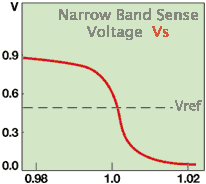
I think the stock sensor is more of a switch, between lean and rich.
Above certain voltage its rich, below certain voltage its lean. How much lean and reach is not accurate.
You can see from this graph:
Above certain voltage its rich, below certain voltage its lean. How much lean and reach is not accurate.
You can see from this graph:
I searched for it as well but I think it's gone.
What I recall is a wide range of AFRs for each nb voltage. xyz volts on nb was equivalent to a wide range of afrs so you could never really know where you were. There was a voltage however where my nb would equal a 10-11.2 or 10-11.5 afr range, just cannot remember. Plus your nb may act different than mine did.
What I recall is a wide range of AFRs for each nb voltage. xyz volts on nb was equivalent to a wide range of afrs so you could never really know where you were. There was a voltage however where my nb would equal a 10-11.2 or 10-11.5 afr range, just cannot remember. Plus your nb may act different than mine did.

Lives on the Forum

Joined: Dec 2001
Posts: 14,716
Likes: 10
From: San Lorenzo, California
There is no equation. Below 14.7:1 is about 1 V, Above 14.7:1 is about 0V. There is a very quick transition between 1V and 0V at 14.7:1, just like in Reza's graph. This is precisely why the stock ecu relies on fuel maps under boost and why an A/F reading from the stock o2 sensor is worthless.
Trending Topics
Originally posted by rynberg
There is no equation. Below 14.7:1 is about 1 V, Above 14.7:1 is about 0V. There is a very quick transition between 1V and 0V at 14.7:1, just like in Reza's graph. This is precisely why the stock ecu relies on fuel maps under boost and why an A/F reading from the stock o2 sensor is worthless.
There is no equation. Below 14.7:1 is about 1 V, Above 14.7:1 is about 0V. There is a very quick transition between 1V and 0V at 14.7:1, just like in Reza's graph. This is precisely why the stock ecu relies on fuel maps under boost and why an A/F reading from the stock o2 sensor is worthless.
Lives on the Forum
Joined: Dec 2001
Posts: 14,716
Likes: 10
From: San Lorenzo, California
Exactly!
The stock o2 sensor will read 1V from 14.7:1 to 0:1. You have no idea what the A/F is within that range. That is why you cannot tune or even monitor with the stock o2 sensor.
The stock o2 sensor will read 1V from 14.7:1 to 0:1. You have no idea what the A/F is within that range. That is why you cannot tune or even monitor with the stock o2 sensor.

Fecal Matter

Joined: Oct 2003
Posts: 222
Likes: 0
From: VA
Is there a way to make the PFC read voltage outputs from a 4 wire o2 sensor? Then you could tag different voltage levels as different afr's. And use it to tune in car while monitoring o2 voltage. That would eliminate the need for an in car mounted WB....if you could decipher the voltages, that is.

Thread
Thread Starter
Forum
Replies
Last Post
trickster
2nd Generation Specific (1986-1992)
25
Jul 1, 2023 04:40 PM
immanuel__7
2nd Generation Specific (1986-1992)
89
Sep 5, 2015 10:23 AM
befarrer
Microtech
3
Aug 22, 2015 05:52 PM
