


Exhaust porting: N/A full bridge, overlap?


Thread Starter
Joined: Dec 2002
Posts: 3,791
Likes: 3
From: Kitchener Ontario Canada
Exhaust porting: N/A full bridge, overlap?
I want to get some other thoughts on this.
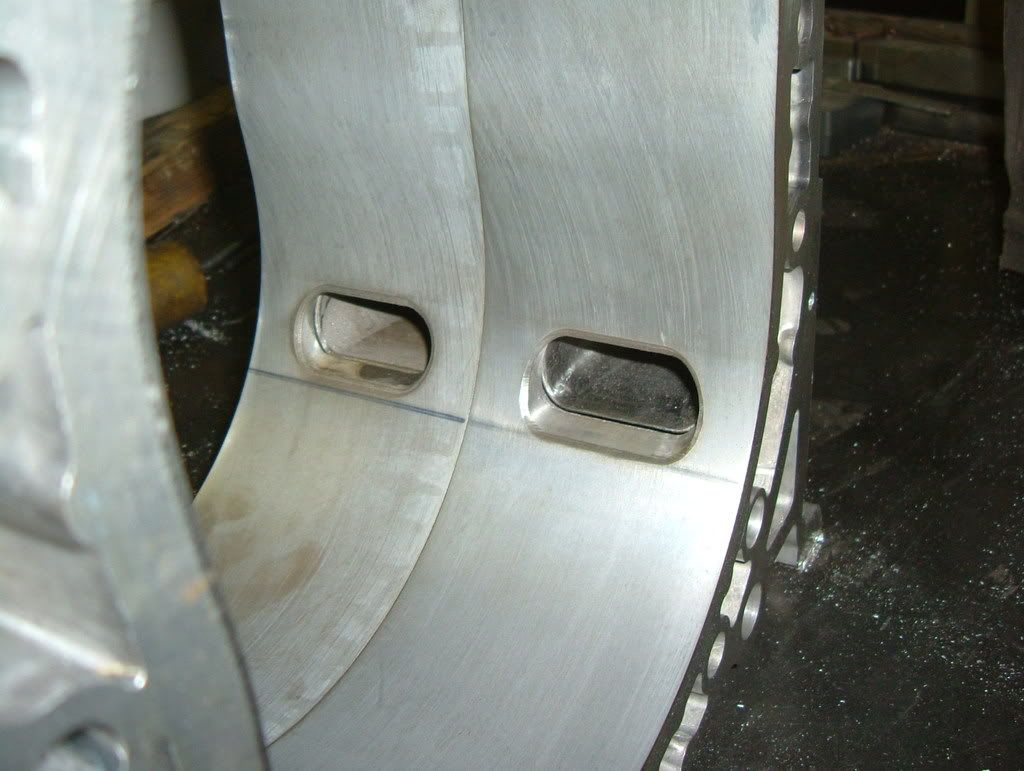
I know that Judge Ito doesn't port the exhaust too aggressively for N/A applications, Here are pics where he moves the closing time up about 2mm and puts a bevel on the closing edge.


Now others like Rice Racing go with more overlap. Heres a few pics of some exhaust ports he does.
He moves the closing port timing waay up....maybe 5mm? 6mm? and puts a bevel on it as well.


I've got my own thoughts on which I would think would be better, but I'd like to get others input on it.
By the way, this engine is an REW block using S5 N/A rotors with a full bridge port.
I know that Judge Ito doesn't port the exhaust too aggressively for N/A applications, Here are pics where he moves the closing time up about 2mm and puts a bevel on the closing edge.
Now others like Rice Racing go with more overlap. Heres a few pics of some exhaust ports he does.
He moves the closing port timing waay up....maybe 5mm? 6mm? and puts a bevel on it as well.
I've got my own thoughts on which I would think would be better, but I'd like to get others input on it.
By the way, this engine is an REW block using S5 N/A rotors with a full bridge port.
Thread Starter
Joined: Dec 2002
Posts: 3,791
Likes: 3
From: Kitchener Ontario Canada
In the past I've been pretty conseritive with exhaust porting, nothing very large or as wild as Rice Racings ports, usually slightly earlier opening for turbo engines polish everything all up and for N/A engines, clean up the factory ports with a slight later closing time. Similar to Itos ports above.



for some reason, Ito's ports did not show up on the monitor, but i am somewhat familiar with them.
i build way more NA engines than i do turbo, so as far as my engines are concerned, i usually leave the open-timing alone for the most part. i do change it slighty for the sake of blending because i do make it a little wider so i'm sure it opens a few degrees earlier, but i never bothered checking it with my degree wheel. like you, i focus most of my work on a later close-timing and the finish. i try to polish them like glass.
i build way more NA engines than i do turbo, so as far as my engines are concerned, i usually leave the open-timing alone for the most part. i do change it slighty for the sake of blending because i do make it a little wider so i'm sure it opens a few degrees earlier, but i never bothered checking it with my degree wheel. like you, i focus most of my work on a later close-timing and the finish. i try to polish them like glass.
Thread Starter
Joined: Dec 2002
Posts: 3,791
Likes: 3
From: Kitchener Ontario Canada
Yeah I hear ya, usually I take that bevel off the opening of the port and blend it in closer to the exhaust sleeve, then widen the port ever so slightly.
How far north would you take the closing edge of the port? keep it squared off then add a 2mm bevel? or slightly round the closing edge with a 2mm bevel?
I figure with a slightly rounded top the apex seal would have a better chance re-introducing itself to the flat housing.
How far north would you take the closing edge of the port? keep it squared off then add a 2mm bevel? or slightly round the closing edge with a 2mm bevel?
I figure with a slightly rounded top the apex seal would have a better chance re-introducing itself to the flat housing.


based on the pics, mine share physical characteristics with both Ito's and Rice's. obviously i can't be exact because they are photos, so i can't really speak on timing much, but if you can picture Rice's port duration with Ito's soft edges and bevels, then generally mine are like that.
i'm actually working on 2 motors right now and one is slated to get a much more radical exhaust than the other, so i'll be sure to take some photos whenever i get to porting the rotor housings, but i have no idea how long that will take.
i'm actually working on 2 motors right now and one is slated to get a much more radical exhaust than the other, so i'll be sure to take some photos whenever i get to porting the rotor housings, but i have no idea how long that will take.
Thread Starter
Joined: Dec 2002
Posts: 3,791
Likes: 3
From: Kitchener Ontario Canada
So you port 4-5mm north on the exhaust port?
Thats basically what I was thinking of doing with this engine, have a much later closing exhaust port compared to others I've done. See how the increased overlap will work with the full bridge-port.
Thats basically what I was thinking of doing with this engine, have a much later closing exhaust port compared to others I've done. See how the increased overlap will work with the full bridge-port.
Trending Topics


Joe, FWIW, on my engine when I didn't change the overlap from stock - I made good torque. Most said I'd lose torque going the way I did, some said I'd lose alot!! But at 382whp, I made ~330ft/lbs which is pretty tight. Now obviously there's alot of differences here but thought I'd mention it since its on the topic of exhaust porting....but yeah, I just went a few MM's earlier opening on the exhaust, and a later closing on the intake - stock otherwise.
My next one is going to go HUGE like the first one, squareish opening and closing.
My next one is going to go HUGE like the first one, squareish opening and closing.
Thread Starter
Joined: Dec 2002
Posts: 3,791
Likes: 3
From: Kitchener Ontario Canada
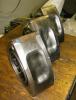
Nice Joe, thats pretty much what I've been doing for the turbo engines. Heres a picture of a recent pair of housings that when into a 10AE:
^Stock closing time, widened slightly near the opening and opening earlier by a couple mm.
But since this engine I'm porting is a Full Bridge port N/A, obviously the exhaust ports need to be different.
Basically I'd like to know a little more about having more overlap and the scavenging effect it might have.
I know with Snowmobile engines or 2 stroke dirtbikes, having the intake and exhaust ports open at the same time it creates almost a suction effect, pulling fresh air/fuel mixture into the combustion chamber while getting rid of the already burnt gas out the exhaust.
I had it explained to me like this once, when you open a window in a closed off room, you get some air blowing in, now open the door to that room and you get one hell of a cross breeze blowing through the room. Out with the old air and in the the new air....real quick.
^Stock closing time, widened slightly near the opening and opening earlier by a couple mm.
But since this engine I'm porting is a Full Bridge port N/A, obviously the exhaust ports need to be different.
Basically I'd like to know a little more about having more overlap and the scavenging effect it might have.
I know with Snowmobile engines or 2 stroke dirtbikes, having the intake and exhaust ports open at the same time it creates almost a suction effect, pulling fresh air/fuel mixture into the combustion chamber while getting rid of the already burnt gas out the exhaust.
I had it explained to me like this once, when you open a window in a closed off room, you get some air blowing in, now open the door to that room and you get one hell of a cross breeze blowing through the room. Out with the old air and in the the new air....real quick.

Nice porting RPM! I always love the attention to detail you guys do on porting. So many just dont understand how to produce very nice work. On the subject of exhaust ports, I will say that I personally go higher on the port closing edge. Its just my preference though.
Judge, this is my race engine that you and I discussed this summer.
Mosport, Watkins, Mt. Tremblant, Mid-Ohio, VIR, road racing/lapping NA FC racecar.
FD Irons
S5 NA Internals
Full Bridge (intermediate)
Hayabusa ITB's
Competition SS exhaust
Haltech'd
TII drivetrain
Your (and anyone elses) input is greatly appreciated! Also any insight on runner length for the ITB manifold would be helpful!
Mosport, Watkins, Mt. Tremblant, Mid-Ohio, VIR, road racing/lapping NA FC racecar.
FD Irons
S5 NA Internals
Full Bridge (intermediate)
Hayabusa ITB's
Competition SS exhaust
Haltech'd
TII drivetrain
Your (and anyone elses) input is greatly appreciated! Also any insight on runner length for the ITB manifold would be helpful!

Rotary Freak

Joined: Oct 2001
Posts: 1,568
Likes: 2
From: N.J. USA
Judge, this is my race engine that you and I discussed this summer.
Mosport, Watkins, Mt. Tremblant, Mid-Ohio, VIR, road racing/lapping NA FC racecar.
FD Irons
S5 NA Internals
Full Bridge (intermediate)
Hayabusa ITB's
Competition SS exhaust
Haltech'd
TII drivetrain
Your (and anyone elses) input is greatly appreciated! Also any insight on runner length for the ITB manifold would be helpful!
Mosport, Watkins, Mt. Tremblant, Mid-Ohio, VIR, road racing/lapping NA FC racecar.
FD Irons
S5 NA Internals
Full Bridge (intermediate)
Hayabusa ITB's
Competition SS exhaust
Haltech'd
TII drivetrain
Your (and anyone elses) input is greatly appreciated! Also any insight on runner length for the ITB manifold would be helpful!
Rotary Freak
Joined: Oct 2001
Posts: 1,568
Likes: 2
From: N.J. USA
Before you cut up the rotor housings the best thing to do is figure out your particular appication in mind. In your case, road racing you need a some what specific hp X rpm goal. I'll give you the basics then you take it from there. to make power at mid, to high rpm range, your going to need air fuel velocity at low rpms. obviously the larger you make intake the ports(not recommended here) the slower your air fuel velocity will be and low torque and power will be comprimised. When porting the rotor housings you need to stay away from overlap(porting up to much) but at the same time, you don't want to cut/port to much into the exhaust stroke.(downwards to much). Overlap is not bad, but to much of it, will make the engine a DOG and non-responsive @ lower rpms.
Some good hp intake ports could be done with out going crazy when porting the inside of the runners. after you have the ports pretty much where you want them, next step is intake manifold length, and header length. The longer you make the intake manifold. Via custom manifold or spacers under your throttle body. The lower your peak power will be@ certain rpm. so if your looking for peak power at 9000rpms your best of with a longer intake manifold(this will be trial and error) but keep in mind longer is better. same goes for the exhaust length. longer primaries will land power at lower rpms..
Your over all goal is reliability and power at your particular needs. follow these guidelines, some test and tuning, and you will hit your target goals..
Some good hp intake ports could be done with out going crazy when porting the inside of the runners. after you have the ports pretty much where you want them, next step is intake manifold length, and header length. The longer you make the intake manifold. Via custom manifold or spacers under your throttle body. The lower your peak power will be@ certain rpm. so if your looking for peak power at 9000rpms your best of with a longer intake manifold(this will be trial and error) but keep in mind longer is better. same goes for the exhaust length. longer primaries will land power at lower rpms..
Your over all goal is reliability and power at your particular needs. follow these guidelines, some test and tuning, and you will hit your target goals..
Last edited by Judge Ito; Nov 27, 2008 at 05:34 AM.

Nice Joe, thats pretty much what I've been doing for the turbo engines. Heres a picture of a recent pair of housings that when into a 10AE:
^Stock closing time, widened slightly near the opening and opening earlier by a couple mm.
But since this engine I'm porting is a Full Bridge port N/A, obviously the exhaust ports need to be different.
Basically I'd like to know a little more about having more overlap and the scavenging effect it might have.
I know with Snowmobile engines or 2 stroke dirtbikes, having the intake and exhaust ports open at the same time it creates almost a suction effect, pulling fresh air/fuel mixture into the combustion chamber while getting rid of the already burnt gas out the exhaust.
I had it explained to me like this once, when you open a window in a closed off room, you get some air blowing in, now open the door to that room and you get one hell of a cross breeze blowing through the room. Out with the old air and in the the new air....real quick.
^Stock closing time, widened slightly near the opening and opening earlier by a couple mm.
But since this engine I'm porting is a Full Bridge port N/A, obviously the exhaust ports need to be different.
Basically I'd like to know a little more about having more overlap and the scavenging effect it might have.
I know with Snowmobile engines or 2 stroke dirtbikes, having the intake and exhaust ports open at the same time it creates almost a suction effect, pulling fresh air/fuel mixture into the combustion chamber while getting rid of the already burnt gas out the exhaust.
I had it explained to me like this once, when you open a window in a closed off room, you get some air blowing in, now open the door to that room and you get one hell of a cross breeze blowing through the room. Out with the old air and in the the new air....real quick.
Also, those square ports from rice racing are nice but not for your application. They are better designed for a large turbo’d engine where the turbo will see the benefits from the sudden port opening/closing pulse that the “square” ports give.
A few things I will suggest/recommend though: On the exhaust port opening I recommend you “D” shape it a slight bit more than you have. On the closing side I pretty much only remove up to the oem bevel and then put a 2mm one back on it. Also with an N/A engine you should leave the exhaust port and sleeve as tapered (down towards the exit) as possible so as to keep the velocity up while going exiting the port. I also highly recommend leaving a 1.5-2.5 “step up” from the exhaust port to the wider sleeve. This will help stop exhaust reverberation. When all is said and done I finish it up with a 2mm bevel around the entire port for ease of transition and apex seal longevity.
You’re looking good though my man, keep up the good work!
Here are a few pictures of my conservative exhaust ports….
-J
Thread Starter
Joined: Dec 2002
Posts: 3,791
Likes: 3
From: Kitchener Ontario Canada
Before you cut up the rotor housings the best thing to do is figure out your particular appication in mind. In your case, road racing you need a some what specific hp X rpm goal. I'll give you the basics then you take it from there. to make power at mid, to high rpm range, your going to need air fuel velocity at low rpms. obviously the larger you make intake the ports(not recommended here) the slower your air fuel velocity will be and low torque and power will be comprimised. When porting the rotor housings you need to stay away from overlap(porting up to much) but at the same time, you don't want to cut/port to much into the exhaust stroke.(downwards to much). Overlap is not bad, but to much of it, will make the engine a DOG and non-responsive @ lower rpms.
Some good hp intake ports could be done with out going crazy when porting the inside of the runners. after you have the ports pretty much where you want them, next step is intake manifold length, and header length. The longer you make the intake manifold. Via custom manifold or spacers under your throttle body. The lower your peak power will be@ certain rpm. so if your looking for peak power at 9000rpms your best of with a longer intake manifold(this will be trial and error) but keep in mind longer is better. same goes for the exhaust length. longer primaries will land power at lower rpms..
Your over all goal is reliability and power at your particular needs. follow these guidelines, some test and tuning, and you will hit your target goals..
Some good hp intake ports could be done with out going crazy when porting the inside of the runners. after you have the ports pretty much where you want them, next step is intake manifold length, and header length. The longer you make the intake manifold. Via custom manifold or spacers under your throttle body. The lower your peak power will be@ certain rpm. so if your looking for peak power at 9000rpms your best of with a longer intake manifold(this will be trial and error) but keep in mind longer is better. same goes for the exhaust length. longer primaries will land power at lower rpms..
Your over all goal is reliability and power at your particular needs. follow these guidelines, some test and tuning, and you will hit your target goals..
Gotcha, I'll leave the large ports for drag engines where high rpm power is needed.

Thread
Thread Starter
Forum
Replies
Last Post


