


'94 Touring Aftermarket Radio/CD Player Recommendation


Thread Starter
Junior Member

Joined: Sep 2007
Posts: 9
Likes: 0
From: Laurel MD USA
'94 Touring Aftermarket Radio/CD Player Recommendation
Have a '94 Touring and need a recommendation for an aftermarket radio. The story thus far:
1. Best Buy installed a Pioneer unit which would not support antenna up when tuner engaged and down when tuner turned off, antenna came up with both tuner or CD player on. Did not like that and had the Pioneer unit pulled.
2. Then also at Best Buy, had an Alpine unit installed which allowed the antenna to operate as is should - only up when tuner is on. HOWEVER, this unit does not control the volume of the subwoofers, Guy said I would need to have another amp installed to the tune of $200 to support control of the subs.
Can anyone recommend a replacement radio and CD player that will raise and lower the antenna corrrectly and also control the subs volume?
Thanks in advance.
1. Best Buy installed a Pioneer unit which would not support antenna up when tuner engaged and down when tuner turned off, antenna came up with both tuner or CD player on. Did not like that and had the Pioneer unit pulled.
2. Then also at Best Buy, had an Alpine unit installed which allowed the antenna to operate as is should - only up when tuner is on. HOWEVER, this unit does not control the volume of the subwoofers, Guy said I would need to have another amp installed to the tune of $200 to support control of the subs.
Can anyone recommend a replacement radio and CD player that will raise and lower the antenna corrrectly and also control the subs volume?
Thanks in advance.


But what model stereo is it and what is the configuration of your total setup? amplifier, speakers, subwoofers...
I find very odd that that the stereo would not control the volume of the subs. I find it even more odd that an amplifier would control it instead... Because an amplifier does exactly what the name denotes. It amplifies a signal coming in.
So let's say an amp has a gain of 10 dB (decibels). All that means is that it amplifies the incoming signal by 10 dB. So if the incoming signal is at 2 dB of power then the output of the amp is at 12 dB. Change the input signal to 4 dB and now the output is at 14 dB, and so on and so on. As you can see, you have to VARY the incoming signal going into the amplifier, and you do that with the volume control. And that is what confuses me.
Off topic- audio signals are measured in Decibels and they are a logarithmic function, in other words not linear. With that said, every 3 dB the power doubles. So if you have a signal of 2 dB and increase it to 5 dB (+3 dB), the power is twice as much now. Increase it by another 3 dB (to 8 dB) and the power doubles again. Keep in mind that it is twice as much as 5 dB or 4 times the power of 2 dB. Another way to put it into perspective: Lets say you have an exhaust that measures at 100 dB and your friend's measures at 103 dB. That means your buddy exhaust is actually twice as loud as yours.
I find very odd that that the stereo would not control the volume of the subs. I find it even more odd that an amplifier would control it instead... Because an amplifier does exactly what the name denotes. It amplifies a signal coming in.
So let's say an amp has a gain of 10 dB (decibels). All that means is that it amplifies the incoming signal by 10 dB. So if the incoming signal is at 2 dB of power then the output of the amp is at 12 dB. Change the input signal to 4 dB and now the output is at 14 dB, and so on and so on. As you can see, you have to VARY the incoming signal going into the amplifier, and you do that with the volume control. And that is what confuses me.
Off topic- audio signals are measured in Decibels and they are a logarithmic function, in other words not linear. With that said, every 3 dB the power doubles. So if you have a signal of 2 dB and increase it to 5 dB (+3 dB), the power is twice as much now. Increase it by another 3 dB (to 8 dB) and the power doubles again. Keep in mind that it is twice as much as 5 dB or 4 times the power of 2 dB. Another way to put it into perspective: Lets say you have an exhaust that measures at 100 dB and your friend's measures at 103 dB. That means your buddy exhaust is actually twice as loud as yours.
Are these your subs:

What model is your stereo? The reason that I keep asking is because I was going to look at the owner's manual to see if it coincides with what your installer claims.
Last edited by Montego; Mar 22, 2018 at 02:23 PM.
I do. But it doesn't really matter as we now know what the problem is.
That's the reason why your system doesn't work. Your stereo guy seriously lacks knowledge and his guessing is just costing you money.
Conventional stereos provide power through their speaker wires to drive conventional speakers. If more power is needed (for bigger subs) then an amplifier is used to amplify the signal from the stereo. Simple.
But with a bose system, the bose stereo is passive (no/low power output) each speaker has an individual amplifier to power up that very low signal that it is expecting. So if you all the sudden swap out to an after market stereo that signal is no longer passive and you end up over driving the bose speakers. Additionally, the bose system is 1 ohm vs the conventional 75 ohm system. What that means is mismatch in impedance all of that combined makes it sound like ****.
But not all is lost as it can be done. The proper way to use an aftermarket head unit with bose speakers is to connect it via a schosche adapter. Read the following thread for more info:
https://www.rx7club.com/interior-ext...adapter-42023/
My advice is to call around and ask for techs that are familiar with bose systems in cars. Once you find someone provide them with this diagram and the schosche adapter
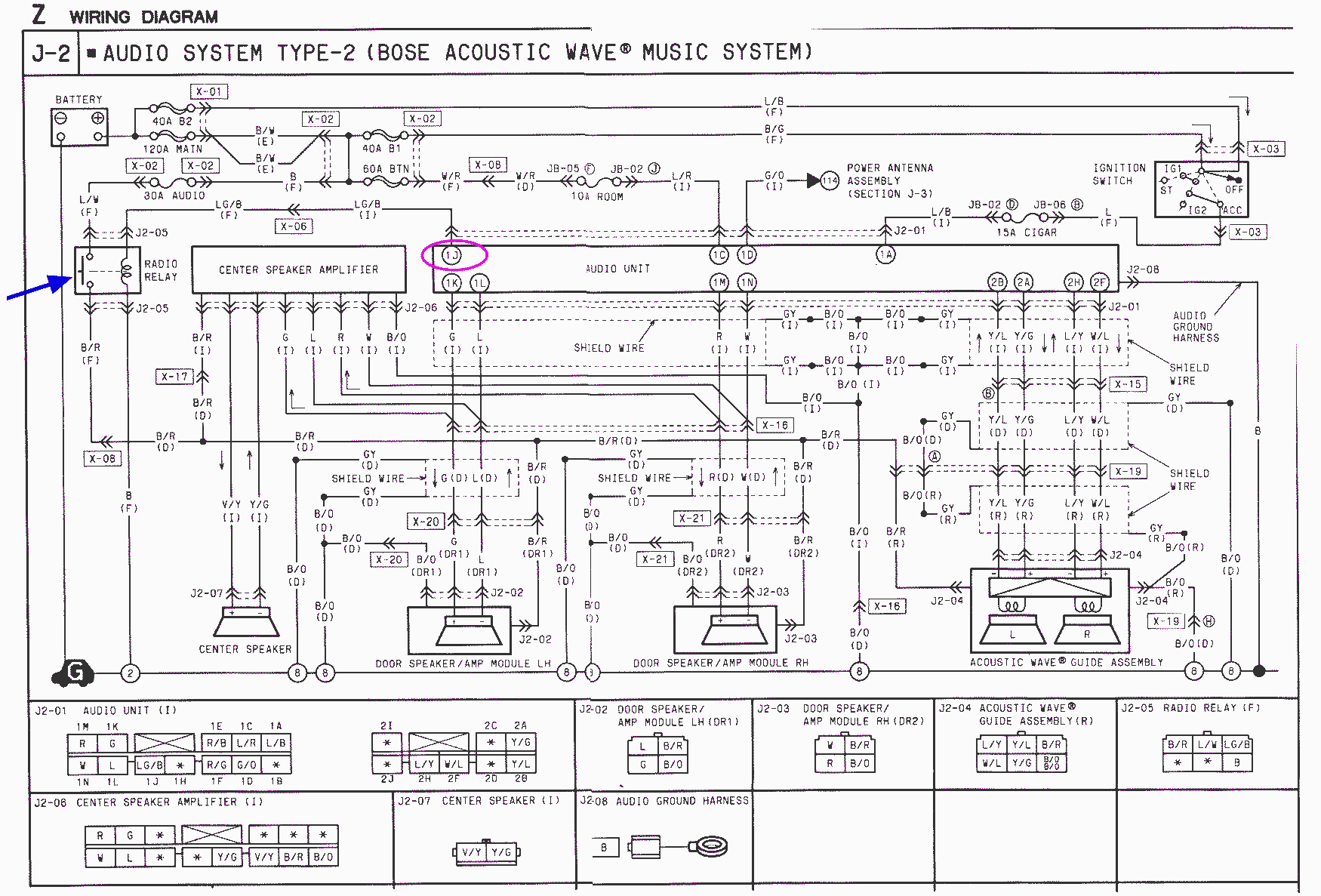
Here is another thread that will help your cause:
https://www.rx7club.com/interior-ext...diagram-25090/
Good luck.
M-
That's the reason why your system doesn't work. Your stereo guy seriously lacks knowledge and his guessing is just costing you money.
Conventional stereos provide power through their speaker wires to drive conventional speakers. If more power is needed (for bigger subs) then an amplifier is used to amplify the signal from the stereo. Simple.
But with a bose system, the bose stereo is passive (no/low power output) each speaker has an individual amplifier to power up that very low signal that it is expecting. So if you all the sudden swap out to an after market stereo that signal is no longer passive and you end up over driving the bose speakers. Additionally, the bose system is 1 ohm vs the conventional 75 ohm system. What that means is mismatch in impedance all of that combined makes it sound like ****.
But not all is lost as it can be done. The proper way to use an aftermarket head unit with bose speakers is to connect it via a schosche adapter. Read the following thread for more info:
https://www.rx7club.com/interior-ext...adapter-42023/
My advice is to call around and ask for techs that are familiar with bose systems in cars. Once you find someone provide them with this diagram and the schosche adapter
Here is another thread that will help your cause:
https://www.rx7club.com/interior-ext...diagram-25090/
Good luck.
M-

Thread
Thread Starter
Forum
Replies
Last Post
bliffle
1st Generation Specific (1979-1985)
1
May 13, 2008 12:46 AM