


New Rotor Housings Vs. Good 2ndhand Housings???


Thread Starter
Point Five Past

Joined: May 2004
Posts: 26
Likes: 0
From: Nottingham UK
 New Rotor Housings Vs. Good 2ndhand Housings???
Ok Guys,
Am just after peoples opinions, ideas and experience on this one.
When rebuilding your rotory engine would you be happy to use good 2nd hand rotor housings or not???? please explain your answer in as much detail as possible. A prediction in the difference in life expectancy would also be good from anyone in the know.
Personally I think it is fine to either re-use or use 2ndhand rotor housings as long as they are in good condtion, especially if money is tight and you're not after serious performance gains and do not cover silly mileage per annum.
Cheers,
Paul
Am just after peoples opinions, ideas and experience on this one.
When rebuilding your rotory engine would you be happy to use good 2nd hand rotor housings or not???? please explain your answer in as much detail as possible. A prediction in the difference in life expectancy would also be good from anyone in the know.
Personally I think it is fine to either re-use or use 2ndhand rotor housings as long as they are in good condtion, especially if money is tight and you're not after serious performance gains and do not cover silly mileage per annum.
Cheers,
Paul



Rotary Freak
Joined: Jun 2004
Posts: 2,718
Likes: 1
From: Ames, IA
Related to this, what's the global supply of new rotor housings looking like? They're getting harder & harder to find, and more and more expensive. Are there aftermarket companies forging housings, or will we be running out of new housings fairly soon?
-=Russ=-
-=Russ=-

I say if you have access to real good cond used housings check them out very carefully and put it together.
I put some used housings in my single turbo FD and am daily driving it now my old GSLSE had 176,000 mile housings put back in it(they looked good&it was my first streetported motor)the GSLSE motor lasted about 30,000 miles before I blew it up but I think a bad injector had something to do with it
I put some used housings in my single turbo FD and am daily driving it now my old GSLSE had 176,000 mile housings put back in it(they looked good&it was my first streetported motor)the GSLSE motor lasted about 30,000 miles before I blew it up but I think a bad injector had something to do with it

OLDROTA
Joined: Apr 2003
Posts: 1,389
Likes: 2
From: Los Angeles
From what I hear/have been told/have read....as long as the chrome is not flaking, especially at the bottom of the housing, the housing are within spec, and as long are there are no major scratches/imperfections, especially in the compression area of the housing (above the plug holes). Other than that...run it till it blows!

Trending Topics

I like the idea.
Joined: May 2002
Posts: 315
Likes: 0
From: (303)
So if I were to buy a Mazda Reman engine, would I get new housings, or are they used ones that meet spec?
What about if I bought a rebuild from Hayes, or Pineapple, or <insert rebuilder name here>? Does that depend on the builder, or is it pretty much a general rule that the housings are used?
Edit/afterthought: since housings for 13Bs are no longer being produced by Mazda, are we looking at the beginning of the twilight of the 13B/ non-renesis engine? If there's only a limited number of good, spec housings out there... well housings crack every day. My rear-rotor housing is cracked... I'm sure hundreds more crack every day worldwide. Who'll take up the slack? Mazda? Are they as loyal to their customers as their customers are to them? :dismay:
What about if I bought a rebuild from Hayes, or Pineapple, or <insert rebuilder name here>? Does that depend on the builder, or is it pretty much a general rule that the housings are used?
Edit/afterthought: since housings for 13Bs are no longer being produced by Mazda, are we looking at the beginning of the twilight of the 13B/ non-renesis engine? If there's only a limited number of good, spec housings out there... well housings crack every day. My rear-rotor housing is cracked... I'm sure hundreds more crack every day worldwide. Who'll take up the slack? Mazda? Are they as loyal to their customers as their customers are to them? :dismay:
Last edited by Crashx7; Sep 7, 2004 at 10:52 PM.


*GOOD* used rotor housing are hard to find. You need to inspect them really well.
You have no idea what the history is on the housing unlesss it was your own. If that was overheated, there's no way to tell unless you get a micrometer and measure.
New housings are expensive but searching will yield good results. I bought 2 new TII housings for $300 in Japan about a year ago for a rainy day.
New parts will give you a much "tighter" engine. Some parts can be re-used such as E-shaft and rotors. Housings will need to be carefully inspected since small holes in the coolant passages can't be easily seen. I used a magnifying glass on a friends FD housing and found a hole that I almost missed. Any flaking will render it useless.
Don't buy housings online since you can't inspect them. Good luck.
You have no idea what the history is on the housing unlesss it was your own. If that was overheated, there's no way to tell unless you get a micrometer and measure.
New housings are expensive but searching will yield good results. I bought 2 new TII housings for $300 in Japan about a year ago for a rainy day.
New parts will give you a much "tighter" engine. Some parts can be re-used such as E-shaft and rotors. Housings will need to be carefully inspected since small holes in the coolant passages can't be easily seen. I used a magnifying glass on a friends FD housing and found a hole that I almost missed. Any flaking will render it useless.
Don't buy housings online since you can't inspect them. Good luck.

The biggest difference between using used housings and new housings is that when u start the motor. The used housing, u have to allow time for the seals to seat themselves, usually around 1000 miles before u really wanna give it full boost. With new housings as soon as u start it u can go WOT.

it WILL run

Joined: Dec 2002
Posts: 2,017
Likes: 1
From: Raleigh,MS
Originally Posted by calvin
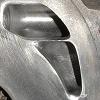
The rotor housing casting is the same for the RX7 and RX8, you can even see the machining bosses cast into the housing of the RX8 where the exhaust port was supposed to be.
Bimmer *****
Joined: Jun 2002
Posts: 2,199
Likes: 1
From: Plano, TX
i got some used housings from atkins.... according to atkins they are the jap equivalent to our GSL-SE housings, which i can see with the SE housings i have now, that they are nearly identical(besides having smaller exhaust ports)... atkins gets those used jdm housings with approx 1500 miles on them, they were used in some sort of race car... they are absolutely flawless... u'd hardly know they were used... they are in my REPU right now... the GSL-SE engine i picked up, the housings on it were mirror smooth and not flaking anywhere... in fact there wasn't even step wear on the cast irons, the motor was so fresh. i have no problems using used housings, at least when they are in as good of shape as mine are.

Used housings should last just as long. But also used housings might not make as much compression as new housings. Just make sure there are no cracks what so ever in the housings. In my rebuild I choose to buy new housings, only because I wanted to make sure it ran perfect and had no problems, but thats just me.
I like the idea.
Joined: May 2002
Posts: 315
Likes: 0
From: (303)
Well in any case, in my rebuild, I'm going to HAVE to buy at least one new one, because my rear housing is cracked. So I might as well save up a bit more and just get two new ones, plus the rebuild kit. Especially since I'm new to the BT, and will inevitably **** up the boost a bit as I learn my way around F/I. 
Good thread. :thumbsup:
Good thread. :thumbsup:

Senior Member
Joined: Feb 2004
Posts: 739
Likes: 0
From: NE Ohio
Originally Posted by RotaryWeaponSE7EN
The biggest difference between using used housings and new housings is that when u start the motor. The used housing, u have to allow time for the seals to seat themselves, usually around 1000 miles before u really wanna give it full boost. With new housings as soon as u start it u can go WOT.
Any engine, rotary, pistion, steam, jet, trubine, .. should be broken in before it gets run hard. Seals need to seat and mesh into new components as much as they do to older ones. Assembly lubricants need to be replaced with regular oil, that will only happen by running the engine. Running it lightly also allows the builder the chance to catch and correct a minor issue before it becomes a major problem.
I think the operative words are CAN or COULD. When those are involved its important to think about if you should do it and if those actions are best in the long run.
Originally Posted by nevarmore
Uhh yea, I'm going to have to sort of ahh, disagree with you there.
Any engine, rotary, pistion, steam, jet, trubine, .. should be broken in before it gets run hard. Seals need to seat and mesh into new components as much as they do to older ones. Assembly lubricants need to be replaced with regular oil, that will only happen by running the engine. Running it lightly also allows the builder the chance to catch and correct a minor issue before it becomes a major problem.
I think the operative words are CAN or COULD. When those are involved its important to think about if you should do it and if those actions are best in the long run.
Any engine, rotary, pistion, steam, jet, trubine, .. should be broken in before it gets run hard. Seals need to seat and mesh into new components as much as they do to older ones. Assembly lubricants need to be replaced with regular oil, that will only happen by running the engine. Running it lightly also allows the builder the chance to catch and correct a minor issue before it becomes a major problem.
I think the operative words are CAN or COULD. When those are involved its important to think about if you should do it and if those actions are best in the long run.
I like the idea.
Joined: May 2002
Posts: 315
Likes: 0
From: (303)
All the same, especially with the fickle nature of rotaries, it is better to err on the side of caution.
How a rotary is treated in it's first 10000 miles will set the precedent for how it will behave for the remainder of its life, or so I've read on a few rebuilder's sites. That makes sense to me, thus it also makes sense to me to break it in easy for the first 1000.
How a rotary is treated in it's first 10000 miles will set the precedent for how it will behave for the remainder of its life, or so I've read on a few rebuilder's sites. That makes sense to me, thus it also makes sense to me to break it in easy for the first 1000.
Senior Member
Joined: Feb 2004
Posts: 739
Likes: 0
From: NE Ohio
Originally Posted by RotaryWeaponSE7EN
With used housings theres groves there where the old seals seated themselves. When rebuilding new seals have to have time to seat themselves properly in those grooves. With new housings U dont have that problem of the grooves already being there. When u start a motor w/ new housings, the first 10 miles they will most likely seat themselves. Theres a big difference between 10 and 1000 miles. Atleast thats what I've been told. And it makes sence to me.
Originally Posted by Crashx7
All the same, especially with the fickle nature of rotaries, it is better to err on the side of caution.
How a rotary is treated in it's first 10000 miles will set the precedent for how it will behave for the remainder of its life, or so I've read on a few rebuilder's sites. That makes sense to me, thus it also makes sense to me to break it in easy for the first 1000.
How a rotary is treated in it's first 10000 miles will set the precedent for how it will behave for the remainder of its life, or so I've read on a few rebuilder's sites. That makes sense to me, thus it also makes sense to me to break it in easy for the first 1000.

Thread
Thread Starter
Forum
Replies
Last Post
cdn
2nd Generation Specific (1986-1992)
14
Sep 10, 2015 06:23 AM
cdn
2nd Generation Non-Technical and pictures
0
Aug 11, 2015 08:59 PM
