When you click on links to various merchants on this site and make a purchase, this can result in this site earning a commission. Affiliate programs and affiliations include, but are not limited to, the eBay Partner Network.
Did some more work in the engine bay, finished the strut bar, made the remote oil filter manifold, mounted that, made a master cylinder brace and made some towing hooks.
On the right is the manifold, 2 normal oil filters bolt up to it, I'm going to be using two because one would cause a large pressure drop. I could've gotten one large filter but I wanted to use normal ones that I can get at every autostore
On the left is a bracket to mount the manifold, which also acts as a master cylinder brace
Sits like this
Also made some towing hooks
So that wraps up most of the fabrication needed in the engine bay. Still a lot left to do though, I was planning on using the stock interior but I changed my mind. Going to remove the interior, build a 6-point rollcage and get some bucketseats in there.
Fixed the oil coolers, there is a set of RX-8 coolers in there now, had to hack up the aluminium vents a bit, add some brackets and change the oil lines but now it fits and works. Also replaced the cheap ignition modules with real bosch ones. The cheap ones were wierd, they would fire the coil, but some of the plugs weren't sparking as strong as others. Swapped the modules and it's fixed. So spend some more time messing with the ecu and now it actually runs and idles , here is a vid of it:
Still messing with it, the ignition timing is off, it's way retarded and changing the trigger settings doesn't seem to do a lot. the AFR values are way off aswell, it reads about 1:10 - 1:11 at idle, and if I start to lean it out the engine dies. The AFR is probably off because of all the misfiring, but that usually causes the meter to read lean, not rich. No major troubles though, so I'm happy .
OMG!!! That thing is a beast!!! Wow! I live in the wrong country lol
I'm not sure the main bearings being out of alignment is that big of an issue. When all is machined well it should be concentric within 0.01-0.02mm's or so, and it really doesnt take any effort to "bend" an e-shaft that much, you can do it with one finger.
I don't have any doubt about your machining skills, but I was thinking you weren't thinking on what a slinky the stack of a 4 rotor is.
One distortion that is going to be the easiest to figure out is the effect of thermal loading.
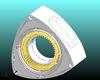
These illustrations show Mazda's findings of rotor housing temperature distribution. Take the 70C delta and multiply that by the coefficient of expansion of the Aluminum rotor housings and multiply that by the length of the 4 rotor housings and you are going to have ~ 0.02" distortion.
You will have to model your rotor housings, side housings and tension bolt clamping to see what shape your 4 rotor slinky stack takes and where the bearing centers end up.
That is one force acting on the slinky.
Another is the gas pressure acting on the rotor housing. Again, you can model the engine, distort the rotor housings according the forces and see how that force transfers into the end housings through the two dowel pins (at near opposite extremes of the forces) and affects bearing centers.
Add that to the thermal distortion, find the next force acting on the engine stack...
My point is the Mazda rotary is a slippy slinky of a stack of housings and on the 3 rotor and 4 rotor with more than 2 bearings to line up- making the eccentric shaft more rigid will weaken the motor, making the shaft more flexible will strengthen it.
Learn something new everyday! This is good information. Where can I find this book?
When CNC was getting big I worked with a guy and he had a saying "CNC, now we can produce scrap at a rate never before possible". Don't get me wrong, I love it and live by it, but he did have a point. Things happen fast and that red e-stop button is usually useless.
my cnc instructo said he would make his first million when he invented an e-button that functioned off of your sphincter cause thats the fasted moving/reacting muscle when things go bad during cnc... hha
I have been driving the RX-7 though with its semi PP 2-rotor, no problems yet , but yeah I really need to pick it up
It's funny, I started following your original 4-rotor build years ago, long before I ever even saw a wankel (in person). About 2 months ago I bought an '84 GSL-SE to turn into a trackday car, first rotary too. The PO had put a Racing Beat Holley setup on it, after the 5th carb rebuild, flat spot off idle, and right-hand corner flooding I got fed up and started buying parts... Notably a GSXR 1000 throttle body assembly and a uh, MS3X! Checked in on this thread on a whim (and drooled again, lol), never thought I would be sharing a concept with you! I've been designing and 3D printing flanges to be sure when I get them watercut they fit (partly because I don't have that machine shop, and also because I have a hybrid 12A/13B), and I just finished building the MS3X today. I was feeling overwhelmed, basically have to build an entire EFI system, but the fact there's evidence of it working, well now I'm excited again!
I plan on using LQ9 coils, the crazy GM ones. I used the slightly lower power coils on both my old supercharged Subaru and my current UrS4, neither has stock power anymore and they worked fine. Did you go for the Bosch units just due to availability?
Also, how are you feeding an IAT signal to the MS3? The GSXR throttles already have a combined vacuum source, so MAP shouldn't be an issue, but I imagine with ITBs the intake temp can vary considerably across them?
Sorry for the super late reply, even I don't check in here anymore
I used bosch coils because they are easy to get over here, LS coils are not so common here in europe.
The IAT is mounted in the plenum. I have an air filter behind the front bumper that feeds an aluminium plenum thats fitted on top of the ITB's.. At first I just mounted a large foam filter directly on the ITB's, but it sucked because it was right above the hot exhaust. Getting rid of that and making a cold air intake really made a big difference.
General car update
About a half year later the car is still working. No major issues apart from throwing a water pump belt.
Not that I drive it that much though, the semi-PP thing is getting kindoff old (Or maybe it's just me ), it's too loud to start up early in the morning without waking the neighbours, it braps and buckles in traffic, and when you finally find a backroad and do get on the gas it's not that great either because the power is way up above 7500 where the transmission doesn't want to shift anymore. Revving it out to 9500 is fun though, it really needs a good transmission.
4-Rotor update
So the 4-rotor then.. Last time I was working on it I was busy machining aluminium side housings so I could build the 4-rotor up as a side-port engine.
During machining and testfitting I wished I did some things on them differently. Of course I didn't start with one prototype housing, I made a fixture and made 3 right away trying to save some time, which backfired as I now have 3 housings with some stuff I wished I did differently. In the end I got tired and shelved them.
After that I did some other stuff for a while, and dabbled a bit in cad here and there, untill I had a design I was happier with:
The last time I was planning to replace all five "irons" with aluminium ones. This time I'm trying to keep it simple by only replacing the center one, and it's not aluminium, but nodular cast iron to keep it easy.
The ports are identical to the secondary ports found in a S5 TII engine, and runner area is also kept the same, so when I assemble the engine with stock S5 TII front, rear, and intermediate iron's, all the rotors will have approximatly the same ports. The rotor housings will also be stock.
Today I started machining it, I really spend some time with the cam part, making sure all the toolpaths were perfect, and it paid off, everything is going smooth so far, still a long way to go though.
Interesting modular setup you have shown there. If you don't mind the questions, could you please explain what you will be using to hold the stationary gear in place? Is it going to be a press fit into the iron along with the countersunk socket head cap screws? Are those screws going to be welded in place to prevent them backing out? Or just going with high temp loctite red?
Looking down the road, what are you planning to use for the final surface? Engineering hard chrome (similar to stock?) or something more modern along the lines of boron nitride... I have always wondered if that could work with our irons and housings.
Interesting modular setup you have shown there. If you don't mind the questions, could you please explain what you will be using to hold the stationary gear in place? Is it going to be a press fit into the iron along with the countersunk socket head cap screws? Are those screws going to be welded in place to prevent them backing out? Or just going with high temp loctite red?
Looking down the road, what are you planning to use for the final surface? Engineering hard chrome (similar to stock?) or something more modern along the lines of boron nitride... I have always wondered if that could work with our irons and housings.
Stock irons are just nitrided. No chrome on them. If you ask for carbo nitriding and leave the irons long enough in the oven, like 48 hours you have a quite long lasting coating. And for the price of it you cant complain. About 250 for 3 housings. John, I was always thinking if I would make a center housing for a 4 rotor I would make an arrangement where there would be a water outlet just after the 2 nd rotor housing, and an inlet just before the 3rd, like the 787B engine also featured. This would all need to happen within 50mm width I guess with the shaft you have at this timeThe idea is that you could mount a temp sensor near the 4th rotor leading plug and that when it get too hot you could trigger a pump that sucks water after 2nd housing, pumps thourgh cooler, and enter again just before 3rd. At part load pump can just be off and the water flow would then be like on a stock engine. Maybe its also a bit over engineering for a road going engine..
Ahh, thanks for the info. Had those confused with the housings having the same coating. Carry on, hope the gcode/cam paths work out well. Looking good so far!
Interesting modular setup you have shown there. If you don't mind the questions, could you please explain what you will be using to hold the stationary gear in place? Is it going to be a press fit into the iron along with the countersunk socket head cap screws? Are those screws going to be welded in place to prevent them backing out? Or just going with high temp loctite red?
Looking down the road, what are you planning to use for the final surface? Engineering hard chrome (similar to stock?) or something more modern along the lines of boron nitride... I have always wondered if that could work with our irons and housings.
Yeah sure, the stationairy gears will be stock ones that are machined down and fitted into a pocket inside the housings. There are 12 bolts that go from one housing, through the gears and into the other housing, when these are tightened everything gets clamped together. Now the thickness of the gears need to be perfect, too thick and the housings will warp during assembly, too thin and the gears will stay loose.
Nothing special about the bolts, just 12.9 bolts and some loctite. Nothing special about the wear surface either, I'll just get them nitrated
Originally Posted by Rub20B
Stock irons are just nitrided. No chrome on them. If you ask for carbo nitriding and leave the irons long enough in the oven, like 48 hours you have a quite long lasting coating. And for the price of it you cant complain. About 250 for 3 housings. John, I was always thinking if I would make a center housing for a 4 rotor I would make an arrangement where there would be a water outlet just after the 2 nd rotor housing, and an inlet just before the 3rd, like the 787B engine also featured. This would all need to happen within 50mm width I guess with the shaft you have at this timeThe idea is that you could mount a temp sensor near the 4th rotor leading plug and that when it get too hot you could trigger a pump that sucks water after 2nd housing, pumps thourgh cooler, and enter again just before 3rd. At part load pump can just be off and the water flow would then be like on a stock engine. Maybe its also a bit over engineering for a road going engine..
Yeah that cooling thing will probably work, but I'm trying to keep things simple, as everything is already too difficult and too much work as it is
I'm not sure if carbonitrating is the best option, I think the higher temperature might warp the housings, so I'd be scared to try it on these.
The stock iron's are made from a plain grey cast iron and are nitrated, with nitrating the base material determines the surface hardness after treatment, which for this material is around 38HRC.
I chose a slighty different material, these are made out of GGG50, a ductile cast iron, with about twice the tensile strength of the stock material, and a hardness after nitrating of around 50HRC, so hopefully with a plain nitrating treatment these will last a decent time. I'm also thinking about not machining o-ring grooves in these, but putting them in the rotor housings instead, so I can rebuild them a few times if it's ever necessary.
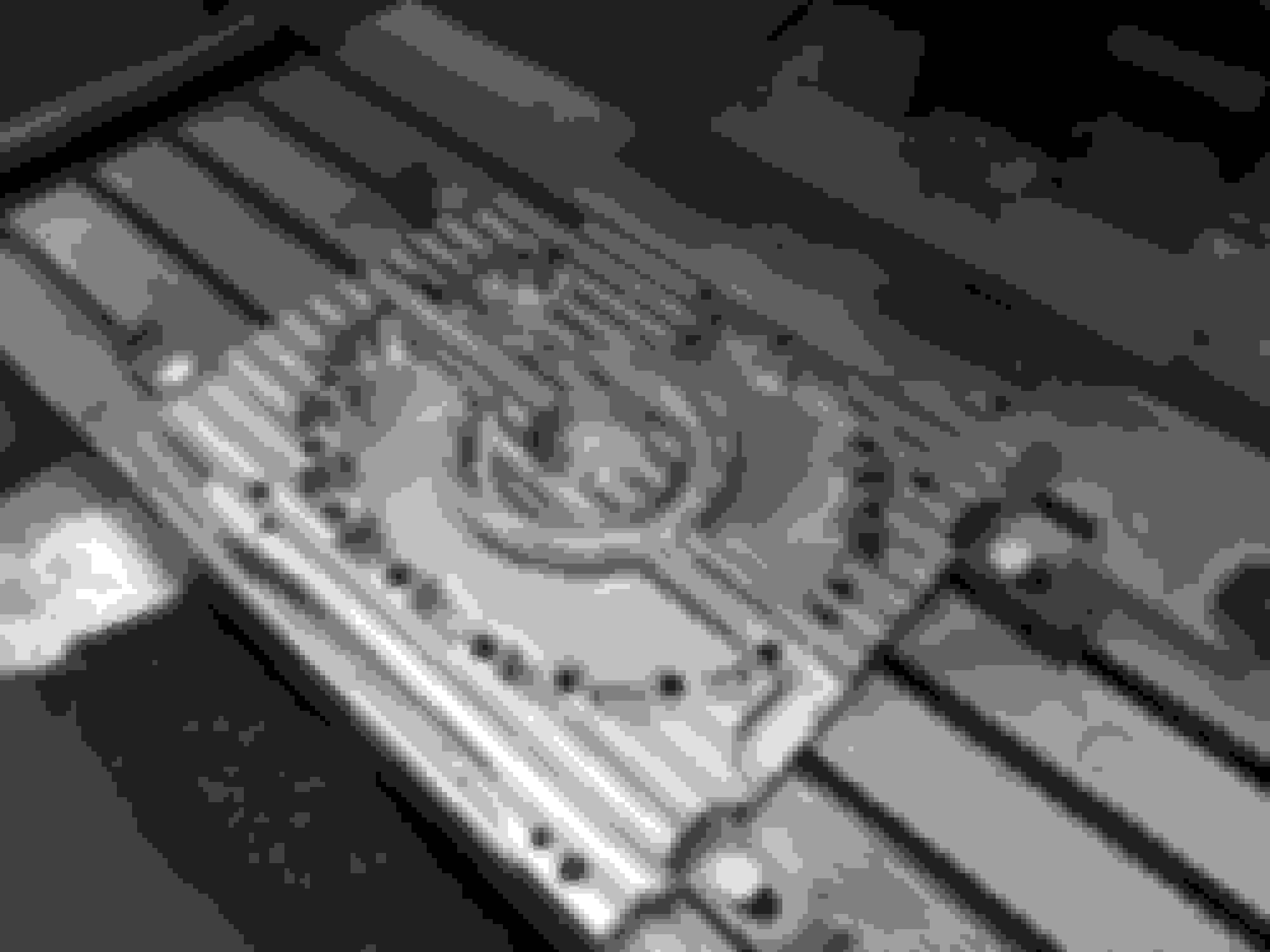
Got the first machining setup on the first housing done, really happy with how it's turning out
Awesome sauce. Good to see you focusing on 4-rotor fab again. This center iron project deserves it's own thread.
Originally Posted by John Huijben
...the thickness of the gears need to be perfect, too thick and the housings will warp during assembly, too thin and the gears will stay loose.
That's what shims are for.
And the oil sealing design the on the bearing feed isn't yet clear to me. Presumably there's a tube inserted into that oil supply bore.
Nice job machining that iron so quickly. Interesting bullseyes in the water jacket floor - You must really like circles.
Been a few years since I was around when I first watched this project pop up. Still loving the ingenuity here bud. Seems like a great long term hobby build for sure.
Got a question? During all your research and the build of you PP 2-rotor did you coming across any new porting ideas in respect with everything or are you thinking everybody's pretty well spot on. I'm sure by now tons of different porting/timing variations have been analyzed and attempted around the world. I'm asking for you direct experience and thoughts in regards to these modded ports and changes in timing.
gave me a good chuckle! Check out trochoidal tool paths and you'll understand the bullseyes And speaking of....part looks great. Get that Maho to work!
Awesome sauce. Good to see you focusing on 4-rotor fab again. This center iron project deserves it's own thread.
That's what shims are for.
And the oil sealing design the on the bearing feed isn't yet clear to me. Presumably there's a tube inserted into that oil supply bore.
Nice job machining that iron so quickly. Interesting bullseyes in the water jacket floor - You must really like circles.
Yep, you are correct, There will be a tube with an o-ring on it to deliver oil to the gears.
Originally Posted by jjandros
Been a few years since I was around when I first watched this project pop up. Still loving the ingenuity here bud. Seems like a great long term hobby build for sure.
Got a question? During all your research and the build of you PP 2-rotor did you coming across any new porting ideas in respect with everything or are you thinking everybody's pretty well spot on. I'm sure by now tons of different porting/timing variations have been analyzed and attempted around the world. I'm asking for you direct experience and thoughts in regards to these modded ports and changes in timing.
Hmmm, ehh well, I haven't come across new porting ideas or anything. The info that can be found in old Mazda and sae papers is still relevant, because the engine hasn't changed since then. The key to making power isn't just having certain ports or timing though, that's just a part of it.
Originally Posted by need-a-t2
gave me a good chuckle! Check out trochoidal tool paths and you'll understand the bullseyes And speaking of....part looks great. Get that Maho to work!
Yeah, the trochoidal toolpaths really help with parts like this, and the cad/cam software of today makes it so easy.
Oh yeah, the maho mill gets put to work a LOT, we use it all the time :-). We also got a maho lathe a few months ago, with a 34hp 5000rpm spindle, 12 tool turret, c-axis and live tooling. Nothing spectacular by todays standards but I'm having fun with it , It really can move some metal, but stuff goes really wrong really fast though
Speaking of moving some metal, today I started on the other side of the middle housing:
Now I need to machine the other side (where the rotor rides) flat, but I think I'll do that on the lathe.
I also went to a track day with the RX-7, which went mediocre. It was freezing and raining, so no grip, and the car isn't working very well right now.
The engine runs ok, but the gearbox sucks, and after half an hour or so I started getting a noise from the back which sounded like wheel bearing, I'll have to take a look and see.
Last edited by John Huijben; Jan 21, 2018 at 02:00 PM.
Hmmm, no, not that worried, the wall thickness is pretty thick (it's 8mm) so I don't really see that blowing out or anything, but we'll see.
Maybe I should add some dimples though to increase surface area and improve cooling.



 Wicked


 , here is a vid of it:









 And speaking of....part looks great. Get that Maho to work!


