


Non-turbo 428rwhp FD build up and history


RX 4BPT
Joined: Feb 2011
Posts: 293
Likes: 0
From: Huddersfield, England
Not sure just yet. I'll have our engineer run some numbers and get it matched with the flow increase I need. When I get the housings machined larger, I plan on making inserts to reduce the diameter. That way two or even three setups will be possible. Such as long track st1, and short track st1.
Full p-port can work with the setup, it would just be too much airflow when sideports are used.
Full p-port can work with the setup, it would just be too much airflow when sideports are used.


Yeah basically. Maybe 12,000 rpm or so. The amount of air needed at high rpm seems to be exponential. In the future I wouldnt mind shooting for power over 10k with some more internal mods to handle it.
RX 4BPT
Joined: Feb 2011
Posts: 293
Likes: 0
From: Huddersfield, England
What would happen to the power band if your semi PPs inlet tract was really short with long your side ports inlet tract being exceptionally long?
Would this bring your torque lower whilst only on the side ports, then once the semi PPs open the torque would be shifted up further allowing power all the way up to and beyond 10,000rpm?
Or would this make it difficult to setup?
Would this bring your torque lower whilst only on the side ports, then once the semi PPs open the torque would be shifted up further allowing power all the way up to and beyond 10,000rpm?
Or would this make it difficult to setup?


What would happen to the power band if your semi PPs inlet tract was really short with long your side ports inlet tract being exceptionally long?
Would this bring your torque lower whilst only on the side ports, then once the semi PPs open the torque would be shifted up further allowing power all the way up to and beyond 10,000rpm?
Or would this make it difficult to setup?
Would this bring your torque lower whilst only on the side ports, then once the semi PPs open the torque would be shifted up further allowing power all the way up to and beyond 10,000rpm?
Or would this make it difficult to setup?
This setup as-is would continue to make effective hp past 10k, but not any higher hp.
Got on the dyno for the final time this year. Took a risk and just did runs in 4th gear instead of 3rd. Eats up more horsepower on a car like mine because the pulls are going into the 175mph range.
Results were still pretty good. Matched hp, and gained torque and a lot more under the curve. 475rwhp and 281 rwtq. In the standard 3rd gear run it would be 481rwhp and 284 rwtq.
Tuning gave me a bunch of issues. The fuel pump seems to be maxed out (walbro 255) so it was very inconsistent. AFR's on the best pull were still 12.6's so some more was in there.
interesting results-
Race gas lost hp and tq. Not a huge amount, but it did drop power. 93 octane seems to still be the best.
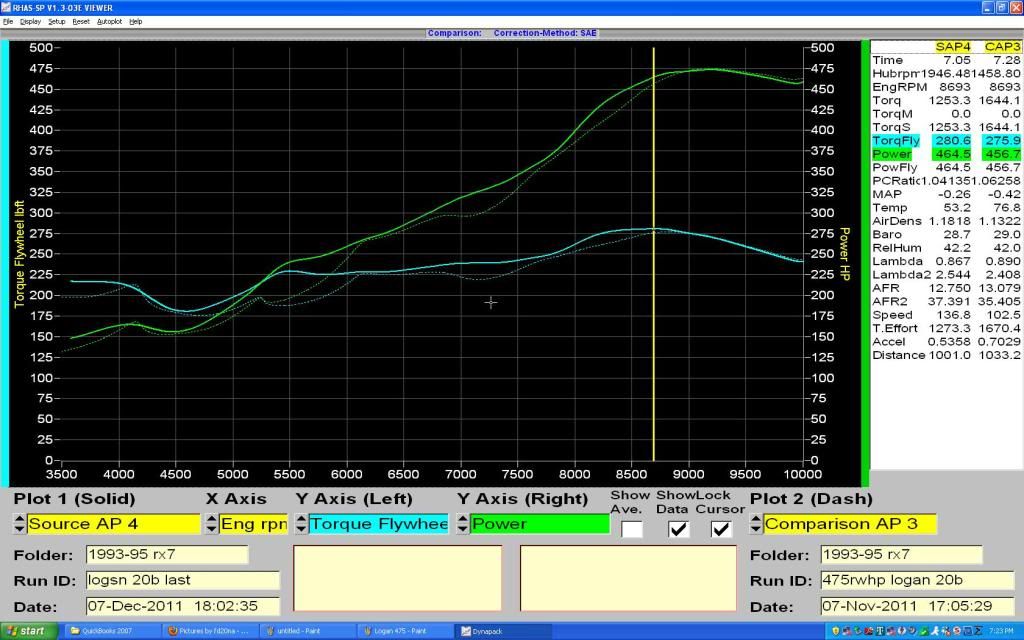
Results were still pretty good. Matched hp, and gained torque and a lot more under the curve. 475rwhp and 281 rwtq. In the standard 3rd gear run it would be 481rwhp and 284 rwtq.
Tuning gave me a bunch of issues. The fuel pump seems to be maxed out (walbro 255) so it was very inconsistent. AFR's on the best pull were still 12.6's so some more was in there.
interesting results-
Race gas lost hp and tq. Not a huge amount, but it did drop power. 93 octane seems to still be the best.
RX 4BPT
Joined: Feb 2011
Posts: 293
Likes: 0
From: Huddersfield, England
Obviously you are using high compression rotors with the engine being NA, but if you were to change the rotors for some custom made rotors and not the standard iron rotors would an increase in compression using race gas yield better results?
Also I have been thinking about WI on a non turbod motor, obviously the same gains would not be seen like the turbo engines do but possibly some would be seen?
Also I have been thinking about WI on a non turbod motor, obviously the same gains would not be seen like the turbo engines do but possibly some would be seen?


From what I understand, raising the compression ratio does not always increase power on a high output NA rotary as it limits the effectiveness of ignition advance.
This is because the mixture is ignited when the trailing side of the combustion chamber is larger then the leading side (split by minor axis in rotor housing) and then all the expanding combustion gasses must pass through the slot in the rotor as the rotor turns and the leading side of the combustion chamber becomes the larger one and then finally the only side of the combustion chamber.
Raising the compression ratio makes the rotor slot smaller raising the pumping losses of the combustion chamber location transfer.
This is because the mixture is ignited when the trailing side of the combustion chamber is larger then the leading side (split by minor axis in rotor housing) and then all the expanding combustion gasses must pass through the slot in the rotor as the rotor turns and the leading side of the combustion chamber becomes the larger one and then finally the only side of the combustion chamber.
Raising the compression ratio makes the rotor slot smaller raising the pumping losses of the combustion chamber location transfer.
 If everything goes well, it should go past 500rwhp a decent amount. We will see.
I could try it and see, going to need more injector to do that though. I doubt any more power would result but I could be wrong of course. 100 octane already lost some power...

 I will try it out at some point
Depends, there is so much to do at the shop right now this is kinda on the back burner. Luckily there wasn't a whole lot to change on the setup. But hopefully no later than mid april
Cool. Can't wait to see your results. Also waiting to see what you finally cook up for Chris' Red GTUS. Great work Logan!!
I enjoy the faith everyone has in us. Not a question of "if" but rather "when" will it happen Well basically its been a super busy year. But all the new engine modifications are finished, and just need a free day or so to assemble it and replace 3rd gear in the tranny. After that its off to the dyno for results.
Very exciting to do the modifications internally I've been thinking of for so long. Will post some pics and results hopefully in the next month!
Well basically its been a super busy year. But all the new engine modifications are finished, and just need a free day or so to assemble it and replace 3rd gear in the tranny. After that its off to the dyno for results. Very exciting to do the modifications internally I've been thinking of for so long. Will post some pics and results hopefully in the next month!





spoon!

Joined: Sep 2002
Posts: 1,208
Likes: 50
From: Dousman, WI
Just finished reading this start to finish again. Just as a question, do you think the semi-pp setup has more potential than a full peripheral engine? It seems like a lot of the tricks you're doing are related to runner tuning and the like, which would apply to a full peripheral as well.
Also, any thought to running less than 93 octane?
Also, any thought to running less than 93 octane?
Thanks guys!
Just finished reading this start to finish again. Just as a question, do you think the semi-pp setup has more potential than a full peripheral engine? It seems like a lot of the tricks you're doing are related to runner tuning and the like, which would apply to a full peripheral as well.
Also, any thought to running less than 93 octane?
Also, any thought to running less than 93 octane?
Yeah years ago we tried 87, 89, 91 and 93. Lower octane used to always make more power, until the engine reached better development. Then the higher octane was a benefit.

