


Overflow Tank: When should coolant leave the system?


Thread Starter

Joined: May 2005
Posts: 1,012
Likes: 45
From: North Dallas, TX
Overflow Tank: When should coolant leave the system?
I'm having trouble with my FD. Coolant seems to be making its way out of the system and into the overflow tank. So much so that the tank has overflowed onto the garage floor.
I thought I may have a bad AST cap so I replaced it Monday afternoon. I topped off the coolant and burped the air from the AST too. Ran the car that night and took it for a drive. I went into the garage the next morning and noticed a puddle of coolant under the overflow tank. I checked the filler neck and it as VERY low.
I removed the coolant overflow tank and checked that the tube was attached properly and went all the way to the bottom of the tank (submerged in coolant). I also checked my coolant lines and everything looks solid.
So here are my questions....
- When is coolant supposed to leave the system?
- When is it supposed to be reclaimed?
- Why is my system NOT reclaiming the coolant?
- How is it that AIR is getting back into the system?
I thought I may have a bad AST cap so I replaced it Monday afternoon. I topped off the coolant and burped the air from the AST too. Ran the car that night and took it for a drive. I went into the garage the next morning and noticed a puddle of coolant under the overflow tank. I checked the filler neck and it as VERY low.
I removed the coolant overflow tank and checked that the tube was attached properly and went all the way to the bottom of the tank (submerged in coolant). I also checked my coolant lines and everything looks solid.
So here are my questions....
- When is coolant supposed to leave the system?
- When is it supposed to be reclaimed?
- Why is my system NOT reclaiming the coolant?
- How is it that AIR is getting back into the system?


As the engine runs it heats up the coolant. The heated coolant expands into the "overflow" tank. After shut down, the engine begins to cool again and in a sealed cooling system, a natural vacuum is formed by the cooling/contracting process. It's that vacuum that should draw the coolant back out of the tank and into the system.
It sounds like you cooling system is no longer completely sealed. It has a leak...somewhere, and that vacuum is being lost. This means coolant goes into your overflow tank every time your engine runs, but isn't drawn out on cool down. Eventually the tank overflows. That's also why your coolant level is now low and air is getting into the system.
You've replaced at least one cap. I would replace the other and closely check ALL hoses, including turbo coolant hoses for any signs of leakage. Then I would pressure test. If you don't have one, a pressure tester is usually available for free (with a deposit) from the chain parts stores. I'd put 16 to 18 psi or so on it and see how long it holds and if it makes a visible leak somewhere.
Not to be an alarmist, but this is one of the classic signs of a failed coolant seal internal to the engine. If so, it's usually accompanied by some other classic signs...lumpy idle on cold start, steam out of the exhaust for a short period on cold start, air in the system, spiking temps etc.
It sounds like you cooling system is no longer completely sealed. It has a leak...somewhere, and that vacuum is being lost. This means coolant goes into your overflow tank every time your engine runs, but isn't drawn out on cool down. Eventually the tank overflows. That's also why your coolant level is now low and air is getting into the system.
You've replaced at least one cap. I would replace the other and closely check ALL hoses, including turbo coolant hoses for any signs of leakage. Then I would pressure test. If you don't have one, a pressure tester is usually available for free (with a deposit) from the chain parts stores. I'd put 16 to 18 psi or so on it and see how long it holds and if it makes a visible leak somewhere.
Not to be an alarmist, but this is one of the classic signs of a failed coolant seal internal to the engine. If so, it's usually accompanied by some other classic signs...lumpy idle on cold start, steam out of the exhaust for a short period on cold start, air in the system, spiking temps etc.



Thread Starter
Joined: May 2005
Posts: 1,012
Likes: 45
From: North Dallas, TX
Thanks Sgtblue.
The other cap you're referring to is the one on the filler neck correct? How often do those really go bad?
Last time I started the car was Monday evening when I went for a drive. I hadn't turned it over since then (5 days). When I started it today it ran and idled fine. No smoke or steam from the exhaust like coolant had been pooling in it.
While the car idled this morning I also felt the large hoses that go to and from the radiator. They seemed to be pressurized well. I marked the level in the coolant tank before I started up the car and then checked it after letting it idle about 15 minutes. The level in the tank went up about half an inch.
I guess the only real way to figure it out is to pressure test it like you said.
The other cap you're referring to is the one on the filler neck correct? How often do those really go bad?
Last time I started the car was Monday evening when I went for a drive. I hadn't turned it over since then (5 days). When I started it today it ran and idled fine. No smoke or steam from the exhaust like coolant had been pooling in it.
While the car idled this morning I also felt the large hoses that go to and from the radiator. They seemed to be pressurized well. I marked the level in the coolant tank before I started up the car and then checked it after letting it idle about 15 minutes. The level in the tank went up about half an inch.
I guess the only real way to figure it out is to pressure test it like you said.
If replacing both caps doesn't cure the problem, put a hose clamp on the AST overflow hose nipple. The hose from the AST to the overflow tank can have a small air leak at the AST nipple that will not leak coolant but will allow air to get into the system when it tries to draw the coolant back from the overflow tank. Mazda didn't even bother to supply a hose clamp at this location, but should have.
Trending Topics
Last time I started the car was Monday evening when I went for a drive. I hadn't turned it over since then (5 days). When I started it today it ran and idled fine. No smoke or steam from the exhaust like coolant had been pooling in it....I guess the only real way to figure it out is to pressure test it like you said.
A coolant seal failure is a common problem....at least in the FDs of which I'm familiar. IMO it's the price for forced induction. Boost is power. More power= more heat= more stress. NA rotarys have the problem, but AFAIK, not nearly as soon as the FDs.
Still, before doing anything, make sure you have a failed seal. Besides the 'Champagne test" these are all the symptoms I can think of... but no single symptom by itself is confirmation. Many symptoms could be from other causes. However the more symptoms/conditions you have in combination, the more likely it is a coolant seal failure.........
*Stumbling idle on cold start-up that clears up quickly. The combustion chamber is fouled with coolant. As soon as it's purged or burned up, your car will run fine until the next cold start.
*Slightly sweet exhaust smell, especially on start-up. See above. Coolant is being burned and it has a distinctive smell.
*"White smoke" (steam) on cold start-up even in warm/hot weather. See above.
*A coolant over-flow tank that is over-flowing. This will usually result in a puddle under the car near the right front...the area of the over-flow tank. When coolant gets hot it expands and that's what the overflow tank is for. But with a failed seal the natural vacuum that forms and pulls that coolant back out as the engine cools down is lost. That leaves that coolant stranded in the tank and eventually it overflows.
*Coolant loss that isn't explained by a puddle on your garage floor. It's being consumed by the engine and going out the exhaust.
*Spiking temps that seemingly recover on their own almost as quickly. Air pockets in the cooling system allow steam to form. That will cause temp spiking. This is different than a rising temp just after a period of hard boost. It can happen as your steadily cruising down the highway.
*Boiling sounds after shut down even shortly after properly "burping" the system. See above.
*Failed coolant system pressure test.
*Failed test of coolant for hydrocarbons.
*Unusually clean plugs. When had my seal failure, when I pulled the plugs right away after briefly starting the car I could smell the coolant.
*One or more episodes of serious overheating in the car's history regardless of miles. (from what I've read, 115 C./240 F. seems to be the critical number for OEM seals to begin to degrade)
*An otherwise well maintained and cared-for FD approaching 100K miles or so.
As for a bandaid, some have used one of the many "Stop-Leak" coolant additives to give them a bit more time but use at your own risk. While it's not anything that will leave you on the side of the road, a failed coolant seal can lead to errosion/rust/pitting of the coolant seal grooves in the irons. That can cause a junk iron and make the inevitiable rebuild more expensive.
Still, before doing anything, make sure you have a failed seal. Besides the 'Champagne test" these are all the symptoms I can think of... but no single symptom by itself is confirmation. Many symptoms could be from other causes. However the more symptoms/conditions you have in combination, the more likely it is a coolant seal failure.........
*Stumbling idle on cold start-up that clears up quickly. The combustion chamber is fouled with coolant. As soon as it's purged or burned up, your car will run fine until the next cold start.
*Slightly sweet exhaust smell, especially on start-up. See above. Coolant is being burned and it has a distinctive smell.
*"White smoke" (steam) on cold start-up even in warm/hot weather. See above.
*A coolant over-flow tank that is over-flowing. This will usually result in a puddle under the car near the right front...the area of the over-flow tank. When coolant gets hot it expands and that's what the overflow tank is for. But with a failed seal the natural vacuum that forms and pulls that coolant back out as the engine cools down is lost. That leaves that coolant stranded in the tank and eventually it overflows.
*Coolant loss that isn't explained by a puddle on your garage floor. It's being consumed by the engine and going out the exhaust.
*Spiking temps that seemingly recover on their own almost as quickly. Air pockets in the cooling system allow steam to form. That will cause temp spiking. This is different than a rising temp just after a period of hard boost. It can happen as your steadily cruising down the highway.
*Boiling sounds after shut down even shortly after properly "burping" the system. See above.
*Failed coolant system pressure test.
*Failed test of coolant for hydrocarbons.
*Unusually clean plugs. When had my seal failure, when I pulled the plugs right away after briefly starting the car I could smell the coolant.
*One or more episodes of serious overheating in the car's history regardless of miles. (from what I've read, 115 C./240 F. seems to be the critical number for OEM seals to begin to degrade)
*An otherwise well maintained and cared-for FD approaching 100K miles or so.
As for a bandaid, some have used one of the many "Stop-Leak" coolant additives to give them a bit more time but use at your own risk. While it's not anything that will leave you on the side of the road, a failed coolant seal can lead to errosion/rust/pitting of the coolant seal grooves in the irons. That can cause a junk iron and make the inevitiable rebuild more expensive.
Thread Starter
Joined: May 2005
Posts: 1,012
Likes: 45
From: North Dallas, TX
If replacing both caps doesn't cure the problem, put a hose clamp on the AST overflow hose nipple. The hose from the AST to the overflow tank can have a small air leak at the AST nipple that will not leak coolant but will allow air to get into the system when it tries to draw the coolant back from the overflow tank. Mazda didn't even bother to supply a hose clamp at this location, but should have.
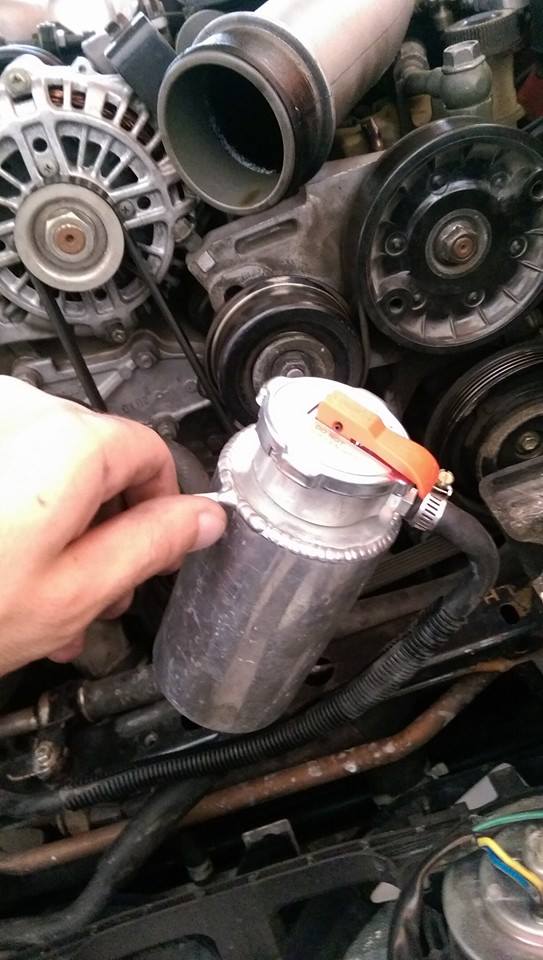
Yes. The filler neck cap has no spring but it does have a seal. I suppose it goes bad as often as the other cap.
Probably not very Kosher to quote yourself, but this is kind of a lengthy post I made some time back in another section. To emphasize, it's early in your diagnosis, but it might be useful...
Probably not very Kosher to quote yourself, but this is kind of a lengthy post I made some time back in another section. To emphasize, it's early in your diagnosis, but it might be useful...
And thanks for the other quote. Very helpful info.

You can find replacement caps for those ASTs at Pep Boys and other autoparts stores. I would also check the hose that goes to the overflow tank. If that has a leak the system will not draw coolant back into the engine.
That AST looks to be a better one than the pettit unit. Take a flat surface, and lay it across the top of the AST with the cap off. Check to see that the top of the AST makes contact with the entire surface of the flat surface. If it doesnt, its warped, and it wont seal.
I thought he said he already checked that, but agree. That hose is also thin-walled. It kinks easy and anything pushing/resting against it would 'plug' it up too.
Thread Starter
Joined: May 2005
Posts: 1,012
Likes: 45
From: North Dallas, TX
Well the car has been at Rotary Performance since Wednesday of last week. Chris called me today to give me the verdict.
He said he's pressure tested the hell out of it but it holds pressure. He said he tested it at 18psi and it holds pressure indefinitely. And as you might imagine, it's not leaking any coolant from any visible area that would end up on the ground. He pulled the plugs too and it's not making its way into the engine on the combustion side.
He said he's stumped.....except for one idea/possibility. He said it's possible that the coolant seal inside the engine is holding pressure and keeping the coolant from getting IN. However, that same seal might not be holding the higher pressure due to combustion. Meaning, it's possible that combustion gasses are making their way into the cooling system. This would cause the system to overpressurize and empty into the overflow tank but not be reclaimed. I asked if it was possible to do the pressure testing with the car HOT so we could check the differences there and he's going to try.
What else can we do? What do you guys recommend? I'm at a loss here.
He said he's pressure tested the hell out of it but it holds pressure. He said he tested it at 18psi and it holds pressure indefinitely. And as you might imagine, it's not leaking any coolant from any visible area that would end up on the ground. He pulled the plugs too and it's not making its way into the engine on the combustion side.
He said he's stumped.....except for one idea/possibility. He said it's possible that the coolant seal inside the engine is holding pressure and keeping the coolant from getting IN. However, that same seal might not be holding the higher pressure due to combustion. Meaning, it's possible that combustion gasses are making their way into the cooling system. This would cause the system to overpressurize and empty into the overflow tank but not be reclaimed. I asked if it was possible to do the pressure testing with the car HOT so we could check the differences there and he's going to try.
What else can we do? What do you guys recommend? I'm at a loss here.
Can he vacuum test the system too? That might reveal why the system doesn't seem to be able to recover coolant from the overflow tank. Since the system holds pressure well, it suggests that the problem lies with the AST cap or the hose to the overflow tank has an air leak. Have you replaced both caps yet? Another cheap precaution would be to just replace that hose.

Well the car has been at Rotary Performance since Wednesday of last week. Chris called me today to give me the verdict.
He said he's pressure tested the hell out of it but it holds pressure. He said he tested it at 18psi and it holds pressure indefinitely. And as you might imagine, it's not leaking any coolant from any visible area that would end up on the ground. He pulled the plugs too and it's not making its way into the engine on the combustion side.
He said he's stumped.....except for one idea/possibility. He said it's possible that the coolant seal inside the engine is holding pressure and keeping the coolant from getting IN. However, that same seal might not be holding the higher pressure due to combustion. Meaning, it's possible that combustion gasses are making their way into the cooling system. This would cause the system to overpressurize and empty into the overflow tank but not be reclaimed. I asked if it was possible to do the pressure testing with the car HOT so we could check the differences there and he's going to try.
What else can we do? What do you guys recommend? I'm at a loss here.
He said he's pressure tested the hell out of it but it holds pressure. He said he tested it at 18psi and it holds pressure indefinitely. And as you might imagine, it's not leaking any coolant from any visible area that would end up on the ground. He pulled the plugs too and it's not making its way into the engine on the combustion side.
He said he's stumped.....except for one idea/possibility. He said it's possible that the coolant seal inside the engine is holding pressure and keeping the coolant from getting IN. However, that same seal might not be holding the higher pressure due to combustion. Meaning, it's possible that combustion gasses are making their way into the cooling system. This would cause the system to overpressurize and empty into the overflow tank but not be reclaimed. I asked if it was possible to do the pressure testing with the car HOT so we could check the differences there and he's going to try.
What else can we do? What do you guys recommend? I'm at a loss here.
My car did this when it had a bad coolant seal years ago—it wouldn't "drink" the coolant, it would start and drive fairly normally, then I'd stop and it would dump a bunch of coolant out of the overflow onto the ground.

If I were trying to construct a test to validate this theory, I'd hook up my cooling system pressure test rig, then I'd plumb 120+ psi compressed air into a spark plug hole and watch for a pressure rise in the cooling system, rotating the engine slowly to expose as much water seal as possible to the pressure from the compressed air.
Thread Starter
Joined: May 2005
Posts: 1,012
Likes: 45
From: North Dallas, TX
Can he vacuum test the system too? That might reveal why the system doesn't seem to be able to recover coolant from the overflow tank. Since the system holds pressure well, it suggests that the problem lies with the AST cap or the hose to the overflow tank has an air leak. Have you replaced both caps yet? Another cheap precaution would be to just replace that hose.

If I were trying to construct a test to validate this theory, I'd hook up my cooling system pressure test rig, then I'd plumb 120+ psi compressed air into a spark plug hole and watch for a pressure rise in the cooling system, rotating the engine slowly to expose as much water seal as possible to the pressure from the compressed air.
And I'm wondering if 120psi is enough. Wouldn't combustion be much higher?

The top coolant line from the AST to the coolant recover tank is cheap and easy to replace.
Replace that line with ONE continuous/contiguous piece (no connectors), and make sure you have a NEW AST cap that seals well.
This will rule-out that line.
Remember a pressure-test doesn't test that section (top of AST-to-coolant recovery tank), because the tank is open to atmosphere pressure.
Also, if memory servers me, I think there is a hose from the bottom of the AST to the radiator. That too, can be suspect. If you have hose pincher, you seal that off.
I had a similar problem and it stumped me, until I just replaced that hose (top of AST to recovery tank).
:-) neil
Replace that line with ONE continuous/contiguous piece (no connectors), and make sure you have a NEW AST cap that seals well.
This will rule-out that line.
Remember a pressure-test doesn't test that section (top of AST-to-coolant recovery tank), because the tank is open to atmosphere pressure.
Also, if memory servers me, I think there is a hose from the bottom of the AST to the radiator. That too, can be suspect. If you have hose pincher, you seal that off.
I had a similar problem and it stumped me, until I just replaced that hose (top of AST to recovery tank).
:-) neil
BTW: make sure you that the new cap, and the overflow valve is not spring-loaded closed.
I went to the McParts store, and all of the new same model number caps (Stant #331) are designed this way.
I did find a Stant 16-lb. cap (pn# 11230) that had the overflow valve spring-loaded closed, and all is well again.
The only way to check is to inspect the cap from the side to see if the valve hangs down, and to gently pull on the valve to see if it is spring-loaded closed.
Check out the pics:
https://www.rx7club.com/showpost.php?...0=&postcount=10
PS: I also found a 13-lb. cap with the spring-loaded overflow valve.
:-) neil
I went to the McParts store, and all of the new same model number caps (Stant #331) are designed this way.
I did find a Stant 16-lb. cap (pn# 11230) that had the overflow valve spring-loaded closed, and all is well again.
The only way to check is to inspect the cap from the side to see if the valve hangs down, and to gently pull on the valve to see if it is spring-loaded closed.
Check out the pics:
https://www.rx7club.com/showpost.php?...0=&postcount=10
PS: I also found a 13-lb. cap with the spring-loaded overflow valve.
:-) neil
Thread Starter
Joined: May 2005
Posts: 1,012
Likes: 45
From: North Dallas, TX
Just wanted to offer some closure for anyone else that finds this thread later....
My final test involved buying one of those yellow funnels online (the kind that mounts to the coolant filler neck) and filling it with coolant. Then I let the engine run. Small bubbles came out with a larger bubble here and there. Then I got the idea to rev the engine a little. Holy ****, it looked like it was carbonated. TONS of bubbles which clearly originated from the system.
Long story short, I had a coolant seal fail that let exhaust gasses into the cooling system but the seal wasn't bad enough to let coolant INTO the engine via a pressure test at 18psi. Rotary Performance rebuilt the engine for me and Chris took pictures of the tiny area where the seal had failed, thus confirming my suspicions. It is what it is. Sucked to have to do a rebuild but I figured others may learn from my experience.
My final test involved buying one of those yellow funnels online (the kind that mounts to the coolant filler neck) and filling it with coolant. Then I let the engine run. Small bubbles came out with a larger bubble here and there. Then I got the idea to rev the engine a little. Holy ****, it looked like it was carbonated. TONS of bubbles which clearly originated from the system.
Long story short, I had a coolant seal fail that let exhaust gasses into the cooling system but the seal wasn't bad enough to let coolant INTO the engine via a pressure test at 18psi. Rotary Performance rebuilt the engine for me and Chris took pictures of the tiny area where the seal had failed, thus confirming my suspicions. It is what it is. Sucked to have to do a rebuild but I figured others may learn from my experience.

Sucks, but the good thing is the engine hard parts are typically all reusable in this scenario. Drops the parts cost huge.
Bad coolant seals will manifest themselves differently depending on how bad the break is, where the break is, etc.
Dale
Bad coolant seals will manifest themselves differently depending on how bad the break is, where the break is, etc.
Dale
Thread Starter
Joined: May 2005
Posts: 1,012
Likes: 45
From: North Dallas, TX


Thread
Thread Starter
Forum
Replies
Last Post
edmcguirk
NE RX-7 Forum
3
May 30, 2018 06:50 PM
ZaqAtaq
New Member RX-7 Technical
2
Sep 5, 2015 08:57 PM