


Newbie question: Any videos or illustrated instructions on changing brake pads?


Thread Starter
Senior Member

Joined: Jun 2003
Posts: 281
Likes: 0
From: Houston Texas Area
Newbie question: Any videos or illustrated instructions on changing brake pads?
I've searched and could only find the service manual for my car but as someone who has Never replaced brake pads on any car, it looked a bit greek to me(SST?).I have found a few "big brake" install videos but I only want to replace my brake pads and one rotor.
I also will need to replace my right rear rotor since it is ground down quite a bit having been driven without much of a pad for awhile by my daughter.
I have a new blank rotor but haven't yet bought brake pads. I can probably get away with just doing the rear brakes for now.
I'd take the car to a garage to get brakes but I am currently unemployed and have little money. It is supposed to rain off and on here in Houston, but I'd like to get this done this weekend since I have an interview on Monday and don't want to drive the car the way it is...
The car is a 1993 Touring with Auto tranny.
Any help anyone can offer would be very much appreciated.
I also will need to replace my right rear rotor since it is ground down quite a bit having been driven without much of a pad for awhile by my daughter.
I have a new blank rotor but haven't yet bought brake pads. I can probably get away with just doing the rear brakes for now.
I'd take the car to a garage to get brakes but I am currently unemployed and have little money. It is supposed to rain off and on here in Houston, but I'd like to get this done this weekend since I have an interview on Monday and don't want to drive the car the way it is...
The car is a 1993 Touring with Auto tranny.
Any help anyone can offer would be very much appreciated.


There's not a lot to it. Remove the wheels, undo the pins that hold the pads in place, slide the pads out, open the bleeder and press the pistons back into the caliper, close the bleeder and slide the new pads into place. If you want to do a quick bleed with the new pad in place, you can.
The main difference with the rear is that you cannot push the piston in; it screws in with something like this (that you can find at Sears or any local auto store):
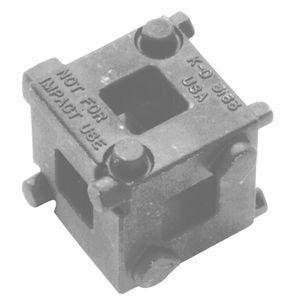
So you'll need to remove the rear caliper to screw in the piston (which you'll be doing if you are replacing the rotors anyway).
The main difference with the rear is that you cannot push the piston in; it screws in with something like this (that you can find at Sears or any local auto store):
So you'll need to remove the rear caliper to screw in the piston (which you'll be doing if you are replacing the rotors anyway).


If you're trying the avoid spending any more than you have to, a stout pair of needle nose pliers can be used to turn the rear piston in. Just be careful so you don't damage something valuable, such as your fingers. I did it many times using pliers before I discovered the tool Mahjik pictured. Though that tool is inexpensive: < $10.00
Also notice how the hand brake works - you will see a nub on the back of the brake pad. That nub must be located within the V shaped depression on the piston.
The point Mahjik makes about opening the bleeder to push the pistons in is particularly important - if you don't open the bleeder the back pressure caused by forcing the piston in can damage the Master Cylinder. Many MC's have a check valve that can be damaged by too much back pressure. That was something I learned by failing to open the bleeder, followed shortly by a new Master Cylinder.
Also notice how the hand brake works - you will see a nub on the back of the brake pad. That nub must be located within the V shaped depression on the piston.
The point Mahjik makes about opening the bleeder to push the pistons in is particularly important - if you don't open the bleeder the back pressure caused by forcing the piston in can damage the Master Cylinder. Many MC's have a check valve that can be damaged by too much back pressure. That was something I learned by failing to open the bleeder, followed shortly by a new Master Cylinder.





The point Mahjik makes about opening the bleeder to push the pistons in is particularly important - if you don't open the bleeder the back pressure caused by forcing the piston in can damage the Master Cylinder. Many MC's have a check valve that can be damaged by too much back pressure. That was something I learned by failing to open the bleeder, followed shortly by a new Master Cylinder.
Yes, many MC's from the '60s and '70s have Residual Check valves, but any vehicle with disc brakes does not. Even if the MC had a Residual Check valve, it is designed to maintain a small amount of pressure in the system and the anything above that will unseat the valve and allow fluid to flow back to the MC reservoir, thus making "too much back pressure" completely impossible.
The main danger with not opening the bleed screws is that the calipers are the lowest point in the braking hydraulic circuit and tend to accumulate dirt and debris, which is then forced up through the lines into the ABS unit, combo valve and MC. The dirt/debris can cause problems with the MC (if it makes it that far) by damaging the cup seals that develop pressure.
Hope that clears that up.
Trending Topics
The main danger with not opening the bleed screws is that the calipers are the lowest point in the braking hydraulic circuit and tend to accumulate dirt and debris, which is then forced up through the lines into the ABS unit, combo valve and MC. The dirt/debris can cause problems with the MC (if it makes it that far) by damaging the cup seals that develop pressure.
The main danger with not opening the bleed screws is that the calipers are the lowest point in the braking hydraulic circuit and tend to accumulate dirt and debris, which is then forced up through the lines into the ABS unit, combo valve and MC. The dirt/debris can cause problems with the MC (if it makes it that far) by damaging the cup seals that develop pressure.
Hope that clears that up.
Hope that clears that up.
What I wrote was what a mechanic told me, one that has worked on my FD in the past.
One whose credibility has just dropped a notch.


Thread
Thread Starter
Forum
Replies
Last Post
djritz
3rd Generation Specific (1993-2002)
2
Aug 25, 2015 02:46 PM
82streetracer
1st Generation Specific (1979-1985)
7
Aug 23, 2015 09:28 AM
Frisky Arab
2nd Generation Specific (1986-1992)
13
Aug 18, 2015 05:30 PM
93, brake, change, changing, illustrated, illustrations, instructions, pad, pads, replacing, rx7club
