


Lite flywheel and bigger turbo...


Thread Starter
Rotary Enthusiast

Joined: Apr 2002
Posts: 917
Likes: 1
From: SC
Lite flywheel and bigger turbo...
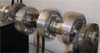
i have a lightweight flywheel..8.5 lb and with a heavy duty pressure plate and ceramic 6puc sprung hub clutch...
really have to rev to engage clutch....but am going to a t66 and was wondering since bigger turbos have a higher rpm range(lag) before they "engage", should I go back to the oem flywheel.
The ad of a lw flywheel is the spool up at the cost on momentum during a gear transition...
would seem like with bigger turbo you would want a heavier flywheel...
really have to rev to engage clutch....but am going to a t66 and was wondering since bigger turbos have a higher rpm range(lag) before they "engage", should I go back to the oem flywheel.
The ad of a lw flywheel is the spool up at the cost on momentum during a gear transition...
would seem like with bigger turbo you would want a heavier flywheel...
Senior Member

Joined: Jun 2003
Posts: 494
Likes: 0
From: Minden, NV
You have to make sure you have enough rpm's?? I don't understand. Do you give it rpm's because it grabs so hard?
And I don't take my car to the strip, but i've heard that lw flywheels aren't good for drag racing.
And I don't take my car to the strip, but i've heard that lw flywheels aren't good for drag racing.


Originally Posted by cover8
It would seem that if you are tracking the car a lite flywheel is better but not at the strip?
Yes, less load on the engine therefore less drag during the rev. Disadvantage is poor acceleration out of the hole for a launch, ie Drag racing. You need the inertia of the heavy flywheel because we lack torque, and since you don't produce much boost from a standing start, maybe 4 or 5 psi, the inertia from the flywheel spinning at high rpm helps to keep the engine from bogging out of the hole. The benefit on a road course is the flywheel is light and since you are slowing and accelerating rapidly the engine can recover the power faster if it doesn't have to work as hard to spin the flywheel to get the power to the ground!


I've heard of serious drag racers that were VERY happy with a light flywheel on their car, and others that preferred a stock heavy flywheel. I think a lot of it is in launch technique.
Might also want to look at a multi-plate clutch - they're easier to drive, but have a lot of clamping power. I'm not a fan of puck clutches, since the engagement is just so harsh and binary and you look like you're still learning to drive a stick when you leave a light . But, I do recognize that there is situations where you just flat need one to hold the power.
Dale
Might also want to look at a multi-plate clutch - they're easier to drive, but have a lot of clamping power. I'm not a fan of puck clutches, since the engagement is just so harsh and binary and you look like you're still learning to drive a stick when you leave a light
. But, I do recognize that there is situations where you just flat need one to hold the power.Dale
Trending Topics


Rotary Freak
Joined: Oct 2002
Posts: 1,625
Likes: 0
From: Salem, IN
i have the act pro-lite in mine with a t78. i drag race every now and then and to be quite honest with you, i don't feel much difference at all on launch. the only place i really feel it is between shifts, because it revs down so much quicker.


Hey, where did my $$$ go?

Joined: Feb 2001
Posts: 4,413
Likes: 0
From: Bimingham, AL
The light flywheels dont have as much stored inertia in them. There are some draw backs to this. The car is much more prone to bogging off the line, your rpms fall faster during a shift making it harder to stay in the powerband, with a large single your boost builds slower (ie, more laggy).
Most of these problems dont seem very apparent with seq twins but once you go non seq or especially large single its much easier to notice.
Stephen
Most of these problems dont seem very apparent with seq twins but once you go non seq or especially large single its much easier to notice.
Stephen

Thread
Thread Starter
Forum
Replies
Last Post
LongDuck
1st Generation Specific (1979-1985)
12
Oct 7, 2015 08:12 PM
