


Injector Dynamics vs. Peak and Hold


Injector Dynamics vs. Peak and Hold
Well I am going to be tweaking the fuel system in my car a bit. I am currently running ID725's in the primary and 1200cc modified stockers in the secondaries. Here are my two options. 1680cc injectors in the secondary and 725cc primary both Peak and hold with a FJO driver or Sell the two sets of 1680cc injectors and 725cc injectors and FJO and buy ID2000's for the secondaries and keep the ID725's in the primary. I am going to be using an AEM ECU. Let me know your thoughts...




Correct.... ID's do not require resistors or an FJO.
I have no experience with ID's, but have heard good things. I use a 850/1680 combo with an FJO. Honestly, I sometimes wish I would have gone the ID route, but my setup works fine and has plenty of fuel for my power levels.
I have no experience with ID's, but have heard good things. I use a 850/1680 combo with an FJO. Honestly, I sometimes wish I would have gone the ID route, but my setup works fine and has plenty of fuel for my power levels.


The short answer: ID/EV14 injectors are much newer and don't require peak and hold drivers to achieve fast opening times, unlike your oldschool 1680cc top feed. If you use EV14 style injectors you can get rid of the FJO driver for the sake of simplicity.
The longer answer: there is the style of injector and the style of the injector driver.
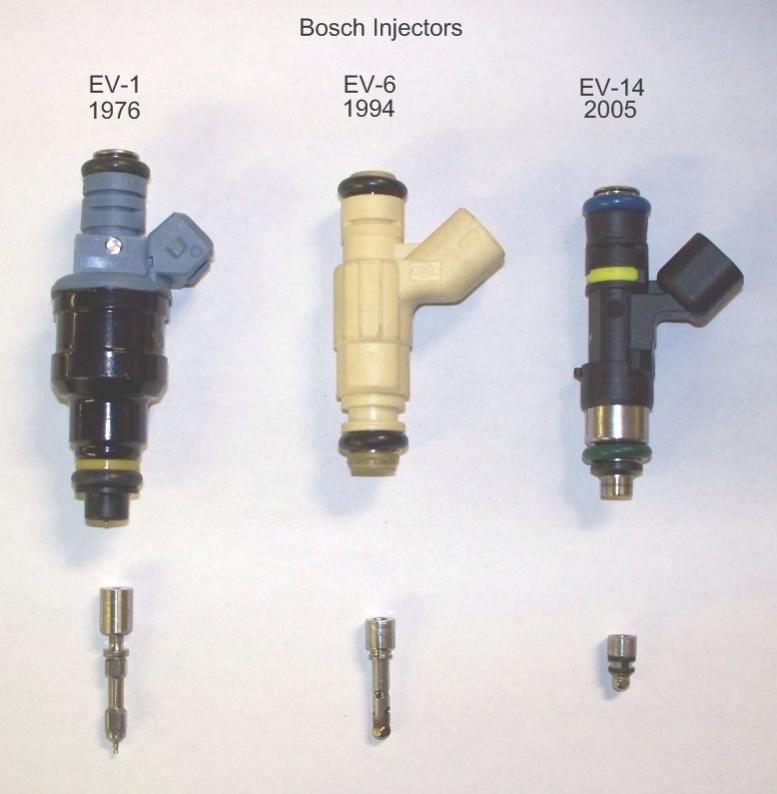
The old top feed injectors are based on the Bosch EV1 technology that you would find on say a Porsche 924. Denso makes similar injectors that were used way back on the fuel injected 1st gen Rx-7's. The ID injectors are a Bosch EV14 design. You can see that the EV14 has a smaller solenoid body and a smaller valve. The smaller valve means less inertia and less pulling force required to open the valve. Among the old EV1 type of injectors, there are basic two types of injector solenoids: high impedence/resistance and low impedence/resistance. The low impedence injectors respond faster. However they require either a resistor in-line (to keep the solenoid from burning up) or ideally a more complicated and faster-responding driver.
There are two basic types of drivers: voltage controlled (saturated) and current controlled (peak-and-hold).
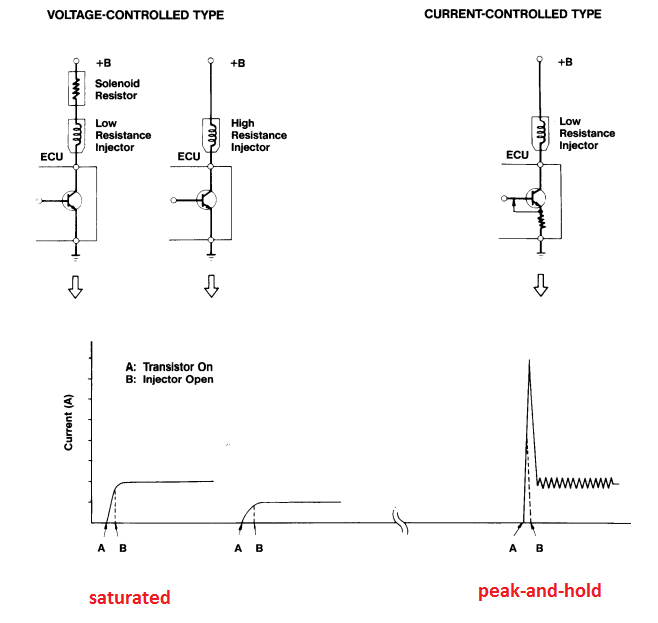
Because the old EV1 style injector is not very responsive, the peak-and-hold driver is optimal even though it brings increased cost and complexity. On the EV14 style injector the valve and solenoid have been optimized to make low impedence and peak-and-hold drivers obsolete. This allows OEM's to inexpensively use higher fuel pressure and have better spray patterns in order to meet emissions targets.
The longer answer: there is the style of injector and the style of the injector driver.
The old top feed injectors are based on the Bosch EV1 technology that you would find on say a Porsche 924. Denso makes similar injectors that were used way back on the fuel injected 1st gen Rx-7's. The ID injectors are a Bosch EV14 design. You can see that the EV14 has a smaller solenoid body and a smaller valve. The smaller valve means less inertia and less pulling force required to open the valve. Among the old EV1 type of injectors, there are basic two types of injector solenoids: high impedence/resistance and low impedence/resistance. The low impedence injectors respond faster. However they require either a resistor in-line (to keep the solenoid from burning up) or ideally a more complicated and faster-responding driver.
There are two basic types of drivers: voltage controlled (saturated) and current controlled (peak-and-hold).
Because the old EV1 style injector is not very responsive, the peak-and-hold driver is optimal even though it brings increased cost and complexity. On the EV14 style injector the valve and solenoid have been optimized to make low impedence and peak-and-hold drivers obsolete. This allows OEM's to inexpensively use higher fuel pressure and have better spray patterns in order to meet emissions targets.
Joined: Sep 2003
Posts: 3,067
Likes: 7
From: Home of the Rolex 24
Sorry to thread jack. Thought this might be relevant. Can you run the id 2000's in the kg parts secondary rail? If not, what are you guys using? I know you have to go back to OEM clips. Thanks G
Trending Topics






Thread
Thread Starter
Forum
Replies
Last Post
24seven_dada
3rd Generation Specific (1993-2002)
20
Nov 10, 2018 12:03 PM


