


Hard start/long start discussion on modified setups


Hard start/long start discussion on modified setups
I also posted this in my PFC Commander guide https://www.rx7club.com/3rd-generation-specific-1993-2002-16/how-make-your-untuned-pfc-basemap-safer-idle-better-no-datalogit-needed-841706/ post #34
I wanted to open up another thread and go through a log of what happens during successful cranking. When you start removing idle control components or changing primary injectors you may find that the car takes longer to start, or won't start without using the accelerator pedal. This problem can often be improved with fuel and timing changes, although not necessarily eliminated.
Factors that affect cranking and starting:
-- Cranking speed, which is affected by battery voltage, the health of the starter, oil temperature, and oil viscosity
-- Cranking ignition timing, a function of the N1-P2, P9-P10 cells of the IGL and IGT maps and [unconfirmed] the ignition timing retard setting in the Datalogit
-- Fuel pressure
-- Throttle plate opening angle (VTA1 and VTA2 tps voltages), affected by the fast idle cam position (if still installed), the primary throttle plate adjust screw, and whether the accelerator pedal is being pressed
-- ISC valve duty cycle (if still installed), which will be 100% during cranking and then taper down
I recently figured out how to log ISC valve duty cycle with the Datalogit, shown as the bottom chart in the log below. Who would've thought that it's labeled with 3 question marks, parentheses, and the number 2? aka Advanced ??? (2). Here is a log of a street ported FD with stock sequential twins, 550/1300 injectors, and stock rats nest (ISC valve and fast idle cam). The FD is hot starting (which is normally not problematic on most healthy engines). The fast idle is not active and the accelerator pedal is not being pressed. Idle IG control is not on and idle speed is set to 850, so ignition timing is fixed during normal idle depending on electrical load etc.
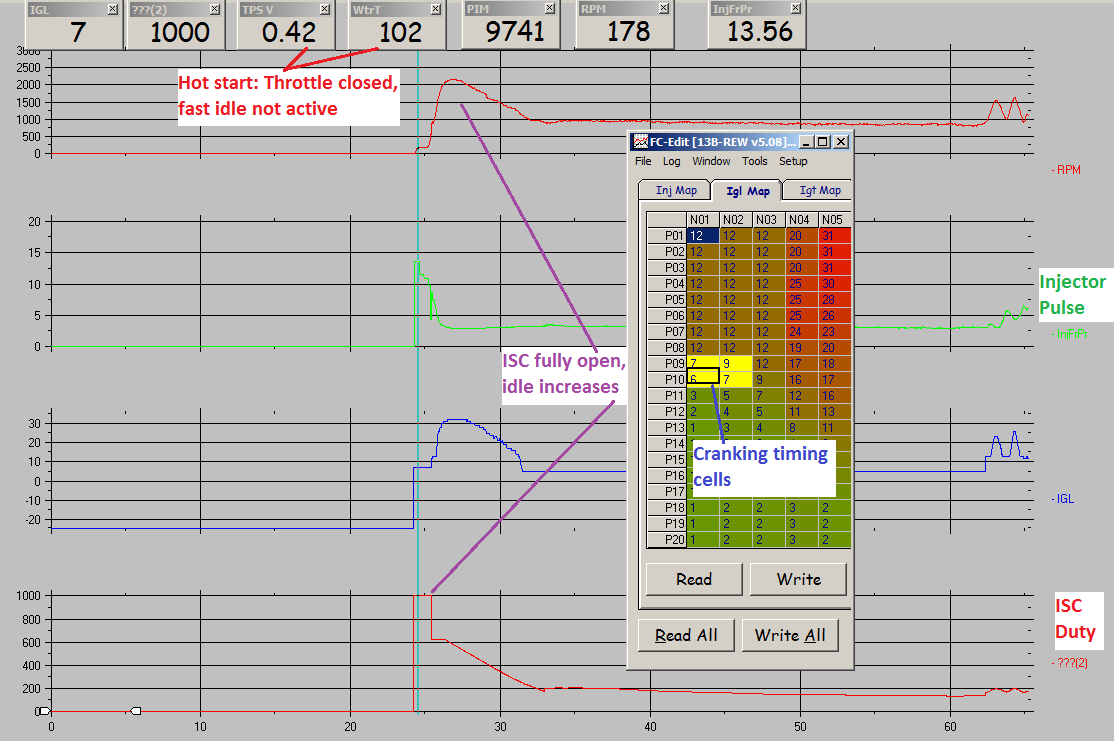
Here are a few things to notice in this log. As I said, it is a hot start with coolant temperature heat soaking at 102C. Fast idle cam is down due to the temperature; if it were active, TPS voltage (VTA1 under Commander sensor/sw select) would be closer to 1 volt and narrow range TPS voltage (VTA2) would likely be over 1 volt. This is because the fast idle cam is the same as you hitting the gas pedal a little bit during cranking.
In this log the cranking speed is around 180rpm which is a little slow, but the battery was a bit discharged on this car. The four yellow cells in the IGL map trace the cells that the PFC is falling into when determining ignition timing during cranking . On default PFC calibrations there is a 15 degree ignition retard value for water temps below 60 C. I believe applies to cranking ignition timing as well, but I don't have a log which verifies that.
Cranking fuel injection, which is labeled here as InjFrPR (Advance InjFrPr, only loggable with a Datalogit), is initially at 13.56 msec and then tapers down. The 80C value for cranking fuel is 12 msec by default, so there must be some unseen correction added in there to increase the fuel. Cranking fuel is NOT determined by the INJ map, don't get confused.
The bottom chart is ISC valve duty. As soon as the engine begins to turn over, the ISC valve goes to full open (100%, labeled as 1000 in the PFC). As the engine fires up, engine speed rises over 2000rpm as a result of the ISC duty and the ignition timing values (throttle plate is closed the whole time). The ISC duty tapers down and idle speed falls.
So that's an example of how the cranking process works on an FD with some mods that is utilizing the Power FC. Are a lot of you running into long starts with bigger injectors or removal of idle components? Also, I don't want to get side tracked on FPR stuff but some FPR's may contribute to slow starts even if the FPR is still holding pressure under boost.
I wanted to open up another thread and go through a log of what happens during successful cranking. When you start removing idle control components or changing primary injectors you may find that the car takes longer to start, or won't start without using the accelerator pedal. This problem can often be improved with fuel and timing changes, although not necessarily eliminated.
Factors that affect cranking and starting:
-- Cranking speed, which is affected by battery voltage, the health of the starter, oil temperature, and oil viscosity
-- Cranking ignition timing, a function of the N1-P2, P9-P10 cells of the IGL and IGT maps and [unconfirmed] the ignition timing retard setting in the Datalogit
-- Fuel pressure
-- Throttle plate opening angle (VTA1 and VTA2 tps voltages), affected by the fast idle cam position (if still installed), the primary throttle plate adjust screw, and whether the accelerator pedal is being pressed
-- ISC valve duty cycle (if still installed), which will be 100% during cranking and then taper down
I recently figured out how to log ISC valve duty cycle with the Datalogit, shown as the bottom chart in the log below. Who would've thought that it's labeled with 3 question marks, parentheses, and the number 2? aka Advanced ??? (2). Here is a log of a street ported FD with stock sequential twins, 550/1300 injectors, and stock rats nest (ISC valve and fast idle cam). The FD is hot starting (which is normally not problematic on most healthy engines). The fast idle is not active and the accelerator pedal is not being pressed. Idle IG control is not on and idle speed is set to 850, so ignition timing is fixed during normal idle depending on electrical load etc.
Here are a few things to notice in this log. As I said, it is a hot start with coolant temperature heat soaking at 102C. Fast idle cam is down due to the temperature; if it were active, TPS voltage (VTA1 under Commander sensor/sw select) would be closer to 1 volt and narrow range TPS voltage (VTA2) would likely be over 1 volt. This is because the fast idle cam is the same as you hitting the gas pedal a little bit during cranking.
In this log the cranking speed is around 180rpm which is a little slow, but the battery was a bit discharged on this car. The four yellow cells in the IGL map trace the cells that the PFC is falling into when determining ignition timing during cranking . On default PFC calibrations there is a 15 degree ignition retard value for water temps below 60 C. I believe applies to cranking ignition timing as well, but I don't have a log which verifies that.
Cranking fuel injection, which is labeled here as InjFrPR (Advance InjFrPr, only loggable with a Datalogit), is initially at 13.56 msec and then tapers down. The 80C value for cranking fuel is 12 msec by default, so there must be some unseen correction added in there to increase the fuel. Cranking fuel is NOT determined by the INJ map, don't get confused.
The bottom chart is ISC valve duty. As soon as the engine begins to turn over, the ISC valve goes to full open (100%, labeled as 1000 in the PFC). As the engine fires up, engine speed rises over 2000rpm as a result of the ISC duty and the ignition timing values (throttle plate is closed the whole time). The ISC duty tapers down and idle speed falls.
So that's an example of how the cranking process works on an FD with some mods that is utilizing the Power FC. Are a lot of you running into long starts with bigger injectors or removal of idle components? Also, I don't want to get side tracked on FPR stuff but some FPR's may contribute to slow starts even if the FPR is still holding pressure under boost.

i don't have an FD but i am hoping to get some knowledge from this thread...my no-emissions, stripped throttle body, 720/1600cc FC motor is a PITA to start sometimes. when it's cold, it is almost impossible. i am going to change the ignition crank map on my haltech to try and combat the problem...hopefully others will chime in with their thoughts/experiences.


Joined: Mar 2001
Posts: 31,851
Likes: 3,238
From: https://www2.mazda.com/en/100th/
i don't have an FD but i am hoping to get some knowledge from this thread...my no-emissions, stripped throttle body, 720/1600cc FC motor is a PITA to start sometimes. when it's cold, it is almost impossible. i am going to change the ignition crank map on my haltech to try and combat the problem...hopefully others will chime in with their thoughts/experiences.
the haltech is similar to the PFC as there is an injector priming map, and such, preumably the stock ecu does too.
so our little "get the thing to start with the haltech" started with the FSM. in the FSM the only timing listed almost is the cranking timing. they say 5BTDC.
ive found 5BTDC works well you can run a little more when its hot, and when its cold it will kick back unless you run a little less.
then you play with the priming map, best starting seems to be close to flooding. this map takes a while, as you start the car, and turn it off and let it cool. different seasons also hit different spots in the priming map, so it actually needs to be done in the winter and the summer.
mazda lists a cranking speed of 499rpm i think, in the training books, so the haltech should just be set the same. the mazda ecu actually has a wire between the start on the ignition switch and the ecu, so it knows you're cranking, the haltech ASSUMES anything under the running rpm is cranking.
spend little time, its satisfying when you're at sevenstock and can just reach in the window and start your 20b just by turning the key, and the guy across has to crank his 20b for 10 minutes before it starts.
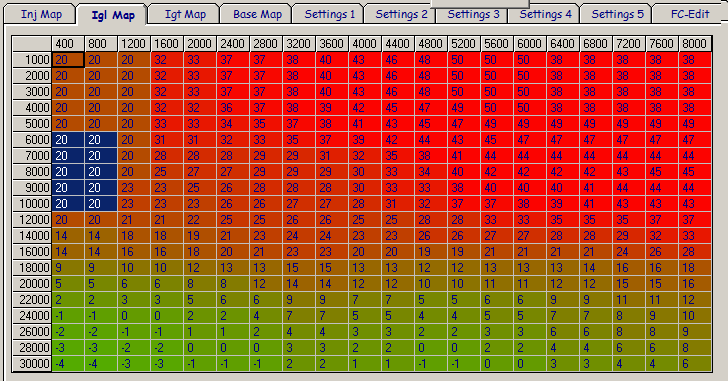
I'm actually running 20 degrees now on my FC. 720/1680, large street port. Pulley timing marks are confirmed to be dead on. I had to pull out my thermowax/fast idle because it was leaking and it was just sick of the damn thing. I still have a BAC valve/ISC valve so that's running at 100% duty during cranking. Since I removed the fast idle, when the engine is completely cold the idle will lug a bit and slowly rise. But when warm the idle will start and go right to 1200-1300rpm. Before I advanced the cranking timing (ISC/BAC valve on, fast idle off) the car would sometimes sputter and die during cranking. This was when water temps got below about 20 C and I did not hit the gas pedal. Also, advancing the timing here helped with random stalling if the revs dropped quickly.
Here's something I've found. If hitting the gas pedal improves starting times, try adding more ignition timing. If hitting the gas pedal doesn't help much, try adding more fuel.
A little bit of cold temp ignition retard (PFC settings 4 tab) seems to help with the popping sound during warm up on some cars. I've found 10 degrees of cold ignition retard works well on that FD from the first post. Setting the ignition retard to 0 raised the cold idle speed from the normal 1500rpm to 1700 and caused a lot more popping in the exhaust.
spend little time, its satisfying when you're at sevenstock and can just reach in the window and start your 20b just by turning the key, and the guy across has to crank his 20b for 10 minutes before it starts.


I am glad you started this thread Ray, because I have been meaning to ask how's the right way to start my car  .
.
Sounds like with a properly setup system I should be able to start my engine without having to touch the accelerator. Mine starts fairly soon after I start cranking but it seems like I need to start depressing the accelerator before it catches. Looks like what you are saying is that the ISC should provide the necessary air and not the throttle plates via the accelerator.
I've noticed that my ISC duty during idle runs much higher than what you show in the attached graph, which may mean I am still not letting enough air in through the throttle plate adjustment and the ISC is maxing out trying to compensate. Looks like more adjusting is in order.
So here's what I would like to ask -
should the car start without touching the accelerator?
are you recommending doing anything to the cranking IGL cells?
and last, is the cranking fuel only determined by the Cranking Fuel Table and not at all by the INJ or Base map?
Thank you for the informative post.
.Sounds like with a properly setup system I should be able to start my engine without having to touch the accelerator. Mine starts fairly soon after I start cranking but it seems like I need to start depressing the accelerator before it catches. Looks like what you are saying is that the ISC should provide the necessary air and not the throttle plates via the accelerator.
I've noticed that my ISC duty during idle runs much higher than what you show in the attached graph, which may mean I am still not letting enough air in through the throttle plate adjustment and the ISC is maxing out trying to compensate. Looks like more adjusting is in order.
So here's what I would like to ask -
should the car start without touching the accelerator?
are you recommending doing anything to the cranking IGL cells?
and last, is the cranking fuel only determined by the Cranking Fuel Table and not at all by the INJ or Base map?
Thank you for the informative post.
Originally Posted by milano maroon
I've noticed that my ISC duty during idle runs much higher than what you show in the attached graph, which may mean I am still not letting enough air in through the throttle plate adjustment and the ISC is maxing out trying to compensate. Looks like more adjusting is in order.
should the car start without touching the accelerator?
are you recommending doing anything to the cranking IGL cells?
and last, is the cranking fuel only determined by the Cranking Fuel Table and not at all by the INJ or Base map?
Trending Topics
Joined: Mar 2001
Posts: 31,851
Likes: 3,238
From: https://www2.mazda.com/en/100th/
I'm actually running 20 degrees now on my FC. 720/1680, large street port.
Here's something I've found. If hitting the gas pedal improves starting times, try adding more ignition timing. If hitting the gas pedal doesn't help much, try adding more fuel.
long cranking times are irritating and embarrassing. Same with idle surging and stalling. It's one of the reasons why I've spent so much time trying to get a handle on these issues. Anybody can make power on an engine. Making that power while still having a "normal" behaving engine is the true challenge.
Here's something I've found. If hitting the gas pedal improves starting times, try adding more ignition timing. If hitting the gas pedal doesn't help much, try adding more fuel.
long cranking times are irritating and embarrassing. Same with idle surging and stalling. It's one of the reasons why I've spent so much time trying to get a handle on these issues. Anybody can make power on an engine. Making that power while still having a "normal" behaving engine is the true challenge.
so if a CARBED P port starts right up without the gas pedal, you're little baby port FD should too. (most of the things you've heard about the P ports are not true, i think its more forgiving about starts than a side port... it also idles happily @800rpms)
Cranking video
Here's the video that I promised. I am getting into the car, putting the key into the ignition and turning over the completely cold engine. I am not hitting the gas pedal. This car has an aeromotive FPR. It doesn't start instantly but IMO it starts quickly and easily enough that anybody could fire it up. Water temp was 16C, ignition timing was 20 degrees leading 10 trailing. Cold start ignition retard has been set to zero in the Datalogit, but that doesn't mean everyone should do that for their engine. Engine has no fast idle but it does have the ISC valve installed.
http://www.youtube.com/watch?v=1B95rHOMG1U
You can see at the end here that the engine idles at about 850 initially. With 20 degrees leading timing it will rise to 1000rpm until 60C water temp is reached, where the Power FC enters closed loop ignition control (Idle IG control = ON) and drops the idle down back down to 900-950.
http://www.youtube.com/watch?v=1B95rHOMG1U
You can see at the end here that the engine idles at about 850 initially. With 20 degrees leading timing it will rise to 1000rpm until 60C water temp is reached, where the Power FC enters closed loop ignition control (Idle IG control = ON) and drops the idle down back down to 900-950.
Joined: Mar 2001
Posts: 31,851
Likes: 3,238
From: https://www2.mazda.com/en/100th/
http://www.youtube.com/watch?v=9675T...eature=related
its more apparent in real life, but the 787B cranks over and starts up just like any other FC...
that is a cold start too, well LA cold, like 90F outside, which is why they warm it up a little.
its more apparent in real life, but the 787B cranks over and starts up just like any other FC...
that is a cold start too, well LA cold, like 90F outside, which is why they warm it up a little.

Thread
Thread Starter
Forum
Replies
Last Post
trickster
2nd Generation Specific (1986-1992)
25
Jul 1, 2023 04:40 PM
Frisky Arab
2nd Generation Specific (1986-1992)
13
Aug 18, 2015 05:30 PM
