


Got Vacuum?


Thread Starter
Registered RX7 Abuser

Joined: Mar 2002
Posts: 875
Likes: 0
From: Southern California
Got Vacuum?
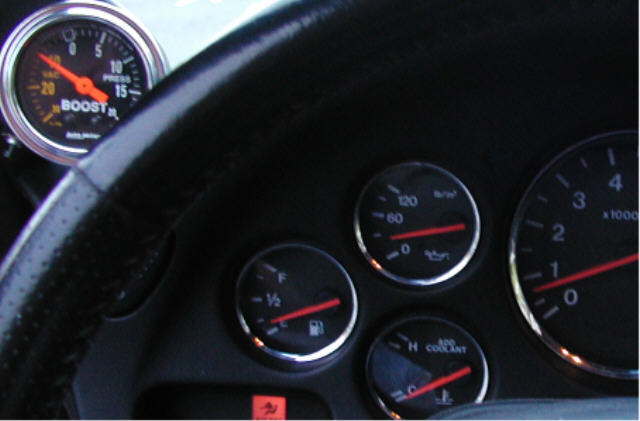
I bought a wrecked RX-7 with a fresh (3000mi) rebuild. It has one piece ceramic apex seals and a street port. My question is this; what should the vacuum be at running temp. Cold it was about 13-14. Warm it dropped down to 10-11. Is this still in normal range for the mods? My old motor was loosing vacuum steadily for a month before it blew. Just before it went it was about 10-11. Both cars are using Auto Meter gauges. If there is an issue I want to fix it while it's out. Pic was taken after a one mile drive to test boost pattern 10-8-9 as set on purple box. It should be mentioned the temp gauge has been linerized so at 180 deg it's at the bottom.
Thanks,
Steve
Thanks,
Steve

that doesn't sound good at all, normally it should be at least 15+, mine is at 19 the higher the better. As for the boost pattern it should be 10-8-10, it sounds like you got a vacuum leak and small boost leak somewhere. Do the silicon hose job and get new couplers for ur intercooler pipes (check for cracks on the pipe as well) list ur mods for everyone else to give you a better opinion.




Place your ad here...

Joined: Apr 2002
Posts: 1,336
Likes: 2
From: Dayton, OH
Yep, porting will definately change vacuum levels. Also, what altitude do you live at? The vacuum is extremely dependant on altitude. When I lived in Colorado (7000ft), my car was pulling ~12in Hg. Now I live in Ohio (basically sea level), and my car pulls no less than 16in. Basically, what I'm trying to say, is that there are many things that effect vacuum. Test your compression, check vacuum lines and hoses, and keep an eye on it. Unless you start experiencing larger problems, i wouldn't worry about it too much.
Trending Topics

Thread Starter
Registered RX7 Abuser
Joined: Mar 2002
Posts: 875
Likes: 0
From: Southern California
What is a more reliable source of vacuum reading? The Autometer mechanical gauge or the read out from the purple box off the ecu. He showed me the ecu was seeing 16-18 but the gauge in my face was saying something totally different. I didn't know if the calibration on the vacuum readings are adjustable so my gut said to go by the gauge.


Thread Starter
Registered RX7 Abuser
Joined: Mar 2002
Posts: 875
Likes: 0
From: Southern California
I would have thought the one piece apex seal would have been a factor but no one has even mentioned it. All I have herd about the ceramics loosing compression and thus HP due to poor corner sealing. So, I assumed it would affect the vacuum as well. Boy was I off base.
Place your ad here...
Joined: Apr 2002
Posts: 1,336
Likes: 2
From: Dayton, OH
Originally posted by Engberg
hey saxyman990, did the lower vacuum effect the operation of the turbo system as compared to sea level?
hey saxyman990, did the lower vacuum effect the operation of the turbo system as compared to sea level?
I actually did a bunch of research and analysis on this (yeah, what can I say, I'm a big geek). I'll see if I can dig up all my info on it, if you want.

no

Joined: Apr 2001
Posts: 2,295
Likes: 0
From: Dallas, TX / Tokyo, Japan currently
Originally posted by saxyman990
Yeah, it sure did. Well technically, it wasn't the vacuum that effected the turbo system; it was the altitude itself (lower pressure, less oxygen). Turbos would spool rediculously SLOW, and the transition between primary to secondary was horrible. Boost would also fall off tremendously at high RPMs. I tried fixing the boost with some ball and spring boost controllers, which helped a lot. But coming back down to sea level put the whole system back to normal operation.
I actually did a bunch of research and analysis on this (yeah, what can I say, I'm a big geek). I'll see if I can dig up all my info on it, if you want.
Yeah, it sure did. Well technically, it wasn't the vacuum that effected the turbo system; it was the altitude itself (lower pressure, less oxygen). Turbos would spool rediculously SLOW, and the transition between primary to secondary was horrible. Boost would also fall off tremendously at high RPMs. I tried fixing the boost with some ball and spring boost controllers, which helped a lot. But coming back down to sea level put the whole system back to normal operation.
I actually did a bunch of research and analysis on this (yeah, what can I say, I'm a big geek). I'll see if I can dig up all my info on it, if you want.
The turbo is simply having to overcome that difference in atmospheric pressure. I think it was something on the order of 3.5 psi at 7250 ft ASL? So, there's your slower spool and reaction times on the secondary.
As far as vacuum readings, I actually see less difference with a larger port between differing altitudes....but with so many factors contributing in different ways with how my car is setup, I just don't freak out unless it gets too close to 10 and doesn't respond to tuning inputs anymore.

I get about 14-15 or so @ 1100 rpm on a good sized street port.
Vacuum readings can vary a lot between different cars for different reasons. To say that your motor is stronger than another just from vacuum readings is a little fishy I think. I can make my motor to change vacuum about 3 inHg just by changing my AFR at idle...
Last edited by suganuma; Dec 8, 2003 at 03:26 PM.
no
Joined: Apr 2001
Posts: 2,295
Likes: 0
From: Dallas, TX / Tokyo, Japan currently
Originally posted by TireSmokin7
I would have thought the one piece apex seal would have been a factor but no one has even mentioned it. All I have herd about the ceramics loosing compression and thus HP due to poor corner sealing. So, I assumed it would affect the vacuum as well. Boy was I off base.
I would have thought the one piece apex seal would have been a factor but no one has even mentioned it. All I have herd about the ceramics loosing compression and thus HP due to poor corner sealing. So, I assumed it would affect the vacuum as well. Boy was I off base.
Corner and side seal effectiveness definitely will affect idle quality and vacuum.
Hopefully you can find someone else using the 1 peice seals and find out what they're seeing. Comparing your readings to those of us using 2mm mazda 3 peice seals probably isn't very fair.

Place your ad here...
Joined: Apr 2002
Posts: 1,336
Likes: 2
From: Dayton, OH
Nic, your results are pretty much exactly the same as what I had. As for the two different readings, you are correct: Power FC (connected to the MAP sensor) reads absolute pressure, whereas the boost gauge reads gage pressure. This leads to a major difference in readings if you are pretty high up in altitude (as we both found out). During my investigation I looked at a bunch of other stuff too (vacuum readings, boost levels, boost response and timing, power output, etc etc etc). Man it was nice to have that Datalogit system.
I'll see if I can dig up all the notes I had on this. They're around my place somewhere, or I left them at my parents house in Detroit. Either way, I'll find em sooner or later. Maybe I'll post my results in a seperate thread...
Isn't it great to be a geek, errrr, I mean "engineer" ?
I'll see if I can dig up all the notes I had on this. They're around my place somewhere, or I left them at my parents house in Detroit. Either way, I'll find em sooner or later. Maybe I'll post my results in a seperate thread...
Isn't it great to be a geek, errrr, I mean "engineer" ?
no
Joined: Apr 2001
Posts: 2,295
Likes: 0
From: Dallas, TX / Tokyo, Japan currently
Originally posted by saxyman990
Nic, your results are pretty much exactly the same as what I had. As for the two different readings, you are correct: Power FC (connected to the MAP sensor) reads absolute pressure, whereas the boost gauge reads gage pressure. This leads to a major difference in readings if you are pretty high up in altitude (as we both found out). During my investigation I looked at a bunch of other stuff too (vacuum readings, boost levels, boost response and timing, power output, etc etc etc). Man it was nice to have that Datalogit system.
I'll see if I can dig up all the notes I had on this. They're around my place somewhere, or I left them at my parents house in Detroit. Either way, I'll find em sooner or later. Maybe I'll post my results in a seperate thread...
Isn't it great to be a geek, errrr, I mean "engineer" ?
Nic, your results are pretty much exactly the same as what I had. As for the two different readings, you are correct: Power FC (connected to the MAP sensor) reads absolute pressure, whereas the boost gauge reads gage pressure. This leads to a major difference in readings if you are pretty high up in altitude (as we both found out). During my investigation I looked at a bunch of other stuff too (vacuum readings, boost levels, boost response and timing, power output, etc etc etc). Man it was nice to have that Datalogit system.
I'll see if I can dig up all the notes I had on this. They're around my place somewhere, or I left them at my parents house in Detroit. Either way, I'll find em sooner or later. Maybe I'll post my results in a seperate thread...
Isn't it great to be a geek, errrr, I mean "engineer" ?
no
Joined: Apr 2001
Posts: 2,295
Likes: 0
From: Dallas, TX / Tokyo, Japan currently
heh - found them - written back in 2001. (lol)
https://www.rx7club.com/showthread.p...acuum+altitude
good check i forgot with the PFC. Try turning the power on without the engine running and see what your boost reading is. That # was negative for me and Dane (DocWankel). He says his results in this thread : https://www.rx7club.com/showthread.p...acuum+altitude
So, that's what I found back then....
https://www.rx7club.com/showthread.p...acuum+altitude
good check i forgot with the PFC. Try turning the power on without the engine running and see what your boost reading is. That # was negative for me and Dane (DocWankel). He says his results in this thread : https://www.rx7club.com/showthread.p...acuum+altitude
So, that's what I found back then....
Last edited by suganuma; Dec 8, 2003 at 09:54 PM.

Thread
Thread Starter
Forum
Replies
Last Post
ls1swap
3rd Generation Specific (1993-2002)
17
Jun 3, 2024 03:25 PM

