When you click on links to various merchants on this site and make a purchase, this can result in this site earning a commission. Affiliate programs and affiliations include, but are not limited to, the eBay Partner Network.
It certainly doesn't hurt to install a stock cat. I'm just debating in my mind whether you have a problem with the engine-out AFR that's the main root cause here. That would most likely be an air pump or ACV issue. Are you sure vacuum is getting to the switching actuator and you're actually getting port air? You must have port air working correctly to pass, no matter what cat you use. You've been chasing the split air system but port air is more important.
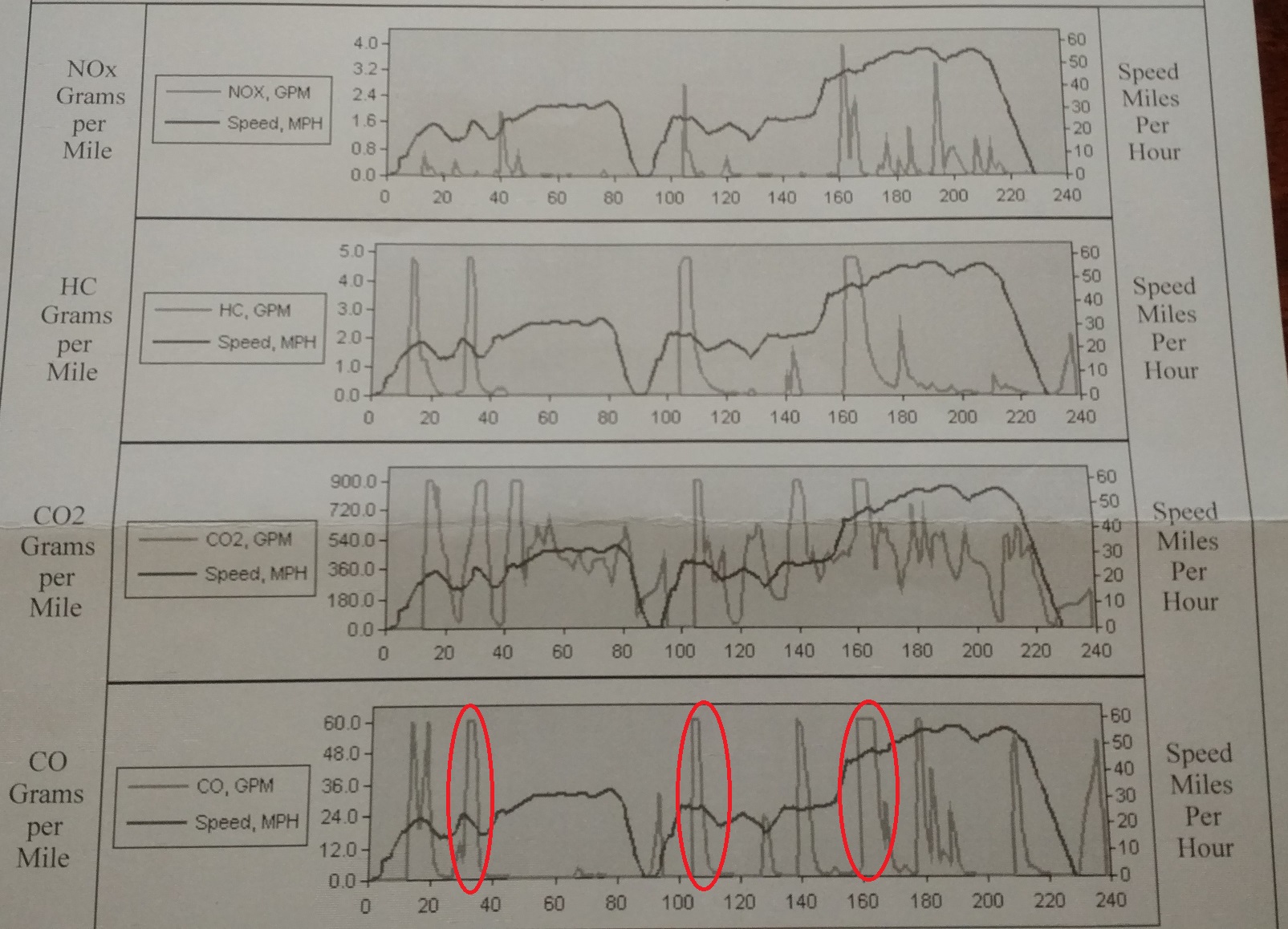
So if you go back to that other thread https://www.rx7club.com/3rd-generati...ed-out-1119012 where the forum (including myself) were helping a guy who had failed the IM240, he had the below CO chart. CO is the most important indicator here, because CO concentration (or shown here is mass flow) more than anything is proportional to the tailpipe AFR. Higher CO means either poor conversion efficiency (bad cat, or just emission underperforming aftermarket cat), or rich AFR coming out of the engine due to O2 sensor, air pump port air not working, or other mechanical problem with the engine.
That right there was mostly due to too much boost causing the engine to go rich on heavy acceleration. Now look at your CO curve:
You've got CO pretty much everywhere, even at say 140 second portion, where load is steady. As far as the cat and airpump go, the split air is more to help with NOx emissions than to help with HC and CO. That's the port air. Port air is default state of the ACV, with vacuum on the switching actuator.
As for the tighter HC requirements, well first you need to fix the CO. The CO is proportional to engine out AFR as I said. If you can't fix CO (tailpipe AFR, engine out AFR) you won't fix HC. You are going to get a lot of HC (and CO) mass flow on first start. On modern cars, the difference between a V8 Camaro and Prius's tailpipe HC NOx and CO is primarily in the first 5-10 seconds of cold start.
The only way to improve cold start HC and CO, assuming you have stock ECU, is fixing any basic mechanical/sensor issues and using stock cat(s). The tighter HC requirement may require a stock main cat at minimum. The air pump doesn't do anything on cranking/first start (Rx-8's are the opposite, they only run the airpump on start). Also, can you haggle with the inspection guy to let you either keep the car idling until right before the test, or to have a very precise timeslot so that the car is minimizing cool down time? That also helps cold start emissions, as it keeps the cat and the engine hot. And previous comments about having the driver drive very gingerly/limiting boost apply as well to reducing emissions on the acceleration portions.
It certainly doesn't hurt to install a stock cat. I'm just debating in my mind whether you have a problem with the engine-out AFR that's the main root cause here. That would most likely be an air pump or ACV issue. Are you sure vacuum is getting to the switching actuator and you're actually getting port air? You must have port air working correctly to pass, no matter what cat you use. You've been chasing the split air system but port air is more important.
So if you go back to that other thread https://www.rx7club.com/3rd-generati...ed-out-1119012 where the forum (including myself) were helping a guy who had failed the IM240, he had the below CO chart. CO is the most important indicator here, because CO concentration (or shown here is mass flow) more than anything is proportional to the tailpipe AFR. Higher CO means either poor conversion efficiency (bad cat, or just emission underperforming aftermarket cat), or rich AFR coming out of the engine due to O2 sensor, air pump port air not working, or other mechanical problem with the engine.
I think the TPS issue was certainly causing a rich AFR coming out of the engine for sure. That has been fixed, but based on one of the diagrams in your 2nd additional reading thread, I think it confirms your suspicion that the port air actuation is likely also an issue. The diagram below shows that I shouldn't be seeing split air under any condition until the coolant was at 50C. When I ran my test in post #8 on a cold engine, I could feel air blowing through at idle and low rev (in red), and cutting at 3250. That seems to be a problem if the expectation is port air only at idle and idle cold start (based on this diagram and yours above as well).
I took the car out just now and warmed it up to test 1) whether being warm would affect the air coming from the split air pipe when presumably it shouldn't be and 2) whether the TPS issue would have potentially fooled the ECU into thinking it was in the "low-load" state from your diagram where both were open. I found that I can still feel air coming from the split air pipe despite the car being warm.
I also took a quick look at the ACV as best I could without pulling the UIM. I noticed that the hose leading to the switching actuator looked like it was possibly kinked, so I moved the hose to straighten it out. This didn't seem to have an effect on the split air, though I'm not sure a 1100rpm idle counts as the "low-speed light load" zone (which would allow split air) from the diagram or not (I also need to readjust the AAS after messing with the TPS). I'm not entirely sure how I could go about testing to see if that hose is applying vacuum with the engine running. I suppose I could try to fish that vacuum line out and hook up my hand pump to see if it's pulling vacuum while the car is running.
Actually that's exactly what I just went and did. That line sees no vacuum at idle, which I guess means one of 3 things: 1) something seriously cross connected. 2) the check valve is in backwards, or 3) something got disconnected, either the TB vacuum source or the actual plug for the solenoid.
Mystery solved, the 3 hard vacuum lines that come out underneath the UIM by the firewall were cross connected. I got those sorted and the switching line pulled a vacuum. Connecting everything back up, it looks like the ACV can finally apply correct vacuum to the switching actuator, which stops the air coming out of the split air pipe at idle.
Last edited by Revelc20b; Oct 3, 2023 at 10:57 PM.
Excellent. This is like a nice science experiment now, on your dime of course. I'm really curious what the IM240 results are now just from confirming port air switching valve is pulling vacuum. Did you notice a change in the idle? It should be leaner now and may affect the idle quality, as the stock control system is designed for the dilution of the port air system.
Basically what you need next is to get the IM240 results. If it's not passing, post the results like you did last time. Then we can narrow down where in the test you're failing. For example if it's just HC that's failing, and you've got a big HC spike on start up, then that implies the cat isn't warm enough, or the cat itself is insufficient (Bonez won't cut it to meet the emission standard, either due to degradation or because you need a good condition stock cat and maybe even need the stock precat).
Excellent. This is like a nice science experiment now, on your dime of course. I'm really curious what the IM240 results are now just from confirming port air switching valve is pulling vacuum. Did you notice a change in the idle? It should be leaner now and may affect the idle quality, as the stock control system is designed for the dilution of the port air system.
Colorado gives you a freebie retest if you get "repairs" done within 10 days of the original failing test, so I'm happy to use this one for some science. Exhaust still smells fairly clean, but tough to say if it's significantly different than when the split air was pouring into the cat. I did notice a change in the idle and not exactly(?) for the better. I'm not sure if it's my imagination, but I notice significantly more "bumps" in the exhaust note at idle and on decel now than before the port air was hooked up. No actual backfires or pops, just the puffs/pauses. I spent the past half hour double checking the TPS and hunting for vacuum leaks, but came up empty handed. I know these are common with basically all non-stock exhausts, but I was surprised how much more common they seem to be now that the port air is fixed. I also abandoned the run to the test station today since there were about 25 cars in line.
Bad news, car still failed the initial run, even as an N/A. I had cracked a few of the clamps between the Y pipe and the IC inlet, and during the drive over I heard one of the couplers pop off. Since they were all over the boost last time, I decided to leave it like that and let them test as it was. This had the effect of blowing a bunch of hot air in the engine bay, which I guess the tech saw since they said they saw "steam" and canceled the second test. Since both tests didn't run, they couldn't print the data, but didn't charge me for the run. Going to just hook it all back up and run it again since I want the data.
Last edited by Revelc20b; Oct 5, 2023 at 12:46 PM.
just run it in good working order (boosting correctly) and then we can see what the change in the ACV did to your emissions in particular parts of the drive cycle, if it made any difference at all. Maybe it did nothing. Maybe it reduced CO and HC at cruising loads and idle, but had no effect on the cold start and heavy acceleration. That's what I would expect to be the case, if it did anything at all.
Pretty close, it would have passed last year with the 1.2 limit. I'm still looking for a fresher cat to borrow locally but no luck yet. Car was still warm from this morning, and the cat got heated with about 20min of spirited driving and highway stuff on the way to the test. All of the boost leaks and whatnot were fixed.
The peaks at 105 and 160 look like they're both clipped so I suppose those are the reasons for the failure. Both the peak height and background HC results seem lowered, just not quite enough. Looks like several members in the thread nailed it when suggesting the Bonez was not going to have quite enough oomf to clean up emissions to standard.
I know it's not a permanent solution, but does anyone have opinions/first hand knowledge on trying to remove surface contaminants from the cat's matrix with a combusted solvent like cataclean or an off-car bath as described in something like this https://pubmed.ncbi.nlm.nih.gov/16570632/ ? I know the PO's last engine died a water seal death, so this cat has definitely seen coolant from that, significant oil/engine lube smoke from my short block installation and break in, as well as pretty rich mixtures from the TPS issue. This photo was from before the new engine was installed (2020). Matrix looks mostly intact, but a bit carbon covered. I can grab a fresh picture if it would be helpful.
Last edited by Revelc20b; Oct 5, 2023 at 07:20 PM.
TL;DR The low hanging fruit here is your heavy acceleration at 155 seconds. I would attempt to address that first before (lower boost, less aggressive driving) going down the catalytic converter rabbit hole. I am saying that because the spikes are especially big at the 90 second and 155 second accelerations, and even brand new cats don't work well when there's a lot of boost and rich mixtures.
First, I'm glad to hear that fixing the port air got you much closer to the emission limits. Now I'm wondering if the "ask him pretty please to accelerate slowly/right at the allowable limit on the last acceleration at 155 seconds" would get you to squeak by. Or you can cap off the precontrol and wastegate actuators or solenoids to limit boost. By that I mean, the solenoids vent pressure from the actuators. If they aren't venting, boost builds more slowly. Instead of introducing some unknown effect of adding a boost leak by loosening clamps, just not letting the turbos build boost as easily may be enough.
Trying to address it with a cat (cleaning it, swapping for OEM) might be workable solution. It depends however if the root cause is low conversion efficiency/poor oxygen storage in the cat, or if it is feed gas composition. In simpler terms, you can fail HC or NOx because you're too rich coming out of the engine or because the cat isn't working as well as could be expected for the scenario. I'm not certain it is the latter in your case, based on the two big spikes under heavy acceleration. Some more background:
When I was working in emission development we would tap an emission analyzer probe before the cat, after the cat, and at the tailpipe, as well as widebands at each of those locations and right after the turbo or n/a exhaust manifold. You could actually see what the root cause of high emissions is--was the cat not converting the emissions as expected? Well you can calculate conversion efficiency with the right equipment. Typically in a high load condition such as acceleration, the cat is not likely to have a high conversion factor. The emissions in those cases need to be limited by addressing what's coming out of the engine (less boost, not so rich, fixing small misfires/bad combustion). The cat has some oxygen storage capacity to help oxidize the HC and CO, and old or aftermarket cats aren't as good at that, but it may not be the solution in your case. Now on cold start, having a brand new cat full of Platinum, RHodium, etc is the ticket, if you've reached your limit on how lean you can go or how much you can retard your spark to heat up the cat.
TL;DR The low hanging fruit here is your heavy acceleration at 155 seconds. I would attempt to address that first before (lower boost, less aggressive driving) going down the catalytic converter rabbit hole. I am saying that because the spikes are especially big at the 90 second and 155 second accelerations, and even brand new cats don't work well when there's a lot of boost and rich mixtures.
Well I'm already down that hole at least a bit since the cat has been soaking in an acid bath for a few hours already. Worst case is that I wasted $20 and/or destroyed a cat that wasn't passing anyways. While I agree that I might be able to squeak by asking to limit boost on those heavy acceleration areas since it's so close, I'm not sure I'm convinced it is solely the reason. The car did run and did fail in a fully N/A configuration, so unless the high load + no boost areas of the stock map are problematic too, there should still be a solvable issue correct? I really wish I could have seen the data for that run.
Last edited by Revelc20b; Oct 6, 2023 at 04:59 PM.
When I was working in emission development we would tap an emission analyzer probe before the cat, after the cat, and at the tailpipe, as well as widebands at each of those locations and right after the turbo or n/a exhaust manifold. You could actually see what the root cause of high emissions is--was the cat not converting the emissions as expected? Well you can calculate conversion efficiency with the right equipment. Typically in a high load condition such as acceleration, the cat is not likely to have a high conversion factor.
That's really interesting. I've only seen the sniffer probes from California smog test stations 15-20 years ago, and never would have thought it would be possible to add a sniffer before a cat converter.
That's really interesting. I've only seen the sniffer probes from California smog test stations 15-20 years ago, and never would have thought it would be possible to add a sniffer before a cat converter.
^He wasn't talking about how the state emissions testers test, he was describing how the automotive OEM's do their developmental emissions testing before a new car/power train goes into production.
^Yes, and the IM240 is like a simplified version of the EPA city cycle. There’s no real cold start for example (making the car sit overnight and run in a temperature controlled lab). The equipment and facilities in development labs costs a gazillion dollars compared to what you find in a test station for the public. For example, for certain tests you need to have a dyno inside a climate controlled lab that can go down to at least 20F/-7C. At those temperatures it’s all about cold start AFR, or management of battery temperatures in the case of an EV.
As for the vehicle not passing with a large boost leak (as opposed to disabling boost control solenoids as I suggested), well I don’t have the second by second data and emission totals so it’s hard to say what was happening. It’s possible there were side effects to this that affected when the air pump was running for example. It’s an additional confounding factor.
I would do some hard driving after treating the cat. You want any kind of chemicals to burn off beforehand. It will take more than just a simple 2nd gear WOT pull. Take some back roads.
More tests and more failures. I ended up testing the cleaned Bonez on Saturday and it failed with close to the same results as the test in post 33, though slightly worse. One thing I will say is that it isn't exactly easy to follow the cleaning procedure as done in the paper. They had a section of honeycomb enclosed in glass which constantly had a flow of the acid bath passed over it at 150-160F for the duration of the cleaning procedure. That is not easy to replicate on the Bonez material and my cleaning certainly did not. I did run the cat hardish with highway pulls on the way to the test, but in hindsight I wish I would have taken a solid afternoon to do a mountain run or something just to be sure. The test was run at a different station by a manager who I begged not to boost it and showed him other run results with the spiked acceleration phases. I'm pretty sure he just blew me off and proceeded to struggle during the test, overshooting the line several times, and serenading the station with the sound of my blow off valve. I included the run data below for posterity, but I don't think it's particularly helpful in progressing to a pass.
Spoiler
I was also able to borrow an OEM cat that had allegedly been used to pass a different FD. The OEM cat performed just as poorly as the Bonez did during the test today. I'm not sure of the exact history for this cat, but the owner owns multiple RX7s and is pretty familiar with building and tuning, so I would guess that his assessment of the cat as "usable" would be ok. The test was performed at the same station by the same tech as the barely failing test in post 33. I spent 30 minutes warming up the cat specifically with highway driving prior to the run, though there was a longer wait (~10-15min I think). Configuration wise, the only difference between the run in post 33 and this one is the borrowed OEM main cat and its intact check valve. The only significant difference I can think of is that the test in post 33 was performed during a cool morning in the 50-55F range while the current test was performed at 78F.
Last edited by Revelc20b; Oct 9, 2023 at 06:23 PM.
I would look into the boost control tricks mentioned earlier, or mix some E85 so the fuel mixture is less rich when the tester steps on the throttle and the ECU goes open-loop. E85 shouldn't hurt the idle or light-load readings, since the ECU can still use the stock O2 sensor to compensate.
Years ago I found someone who allowed me to run a pre-test and make ECU adjustments to see how AFR affected my car's emissions. I don't remember if this was on regular pump gas or if I had some E85 mixed as a precaution, but I do remember we didn't find any downside to running the engine much leaner than you would expect it to run. My wideband O2 sensor showed 16 or possibly even 17 AFR and the HC and CO numbers kept getting better without NOx problems. This was with the air pump sending all of the air to the cat converter, the wideband O2 measurements weren't being skewed by the Port Air mode where fresh air gets pumped into the exhaust via the lower intake manifold ports. This was not on a stock ECU, so I can't guarantee it will work with a stock ECU. But it's what I would try, a few gallons of E85 is cheap and in Colorado in the fall your E85 is probably 50%-70% ethanol content so you can probably add quite a bit without affecting drivability. If you're worried, keep the fuel tank less than half full so you can quickly add a few more gallons of gasoline.
Last edited by scotty305; Oct 10, 2023 at 11:23 AM.
I have in the past (in Colorado) used Denatured Alcohol to pass. Run the tank down to about 1/8 of a tank and dump 3 or 4 quarts of denatured alcohol in or as much as the car will take and still drive halfway decently. Now this may be more risky with a rotary ( I have only done this with piston cars because my rotaries passed with cats only) and if you do try this, I would definitely pull the boost trick to create a massive boost leak where they won't see the "steam" because I wouldn't boost with this fuel mixture. This is similar to the E85 trick mentioned above.
I'm not surprised that the stock cat didn't help. As I mentioned above, the first spike after start isn't very high, and that's where a fresh cat is likely to benefit you the most. CO mass flow is proportional to enrichment under acceleration, so every time you see CO spikes (which correspond to HC spikes in this case) you are seeing basically too much boost, or harder acceleration than necessary. You should see how well trained emissions technicians can drive these types of cycles. In the OEM emission development realm worked at a place with old timers who had 30-40 years of experience, and you could literally just tell them exactly how you want them to drive according to the cycle and they'd just do it. They could under shoot, overshoot, or follow the mph trace almost perfectly (maybe with a bit of practice, and actually giving a **** helps). These are guys who were getting paid very well for this job, were still getting oldschool pensions, that kind of thing.
When I had to meet emissions tailpipe tests on my Rx-7 (idle test only in NC long time ago, no longer required) they were shops known to be more patient with old cars and enthusiast cars. I recommend you ask around. To most other places you are just a nuisance because you don't have a stock Camry or whatever.
All that being said, cap off one of the ports of the wastegate actuator and also the precontrol actuator. This effectively disables the boost control solenoids by not allowing them to vent pressure. Also, if you don't have a stock airbox and stock style air filter installed, put those back in. That might also slow building of boost by restricting the compressor side.
Reverse the pressure and vacuum hoses on the Turbo Control Actuator, this is an easy way to hold the prespool door open and kill early (sequential) spool; and/or wire the waste gate open.
I'm going to try and get the car in today with the boost limiting changes, however I'm still concerned that there is an underlying issue. Looking at the graph in the other thread, Phu5ion's HC and CO are basically 0 from the 40s mark to the 90s mark. My graphs are consistently in the .6 - .7 GPM range for that cruise portion. I know his exhaust had the precat, but those cruise sections should be pretty similar regardless of my 99 spec turbos or intake, correct? This would still point to either a sensor or mechanical issue getting the mixture slightly more rich than it should be for cruise.
Failure #7 brings disappointment but also some interesting data. I ended up taking the advice to swap the pressure/vac lines on the turbo control actuator as well as pulling the C clip on the wastegate actuator and moving it off the pin. This was extremely effective at preventing spool, so much so that I actually couldn't get it to spool even up long hills on the highway drive there. The car was very down on power (obviously) and I had to get my foot almost all the way down to maintain highway speed up the hill. This run was also still using the OEM cat, but due to traffic on the way I don't think the cat got hot as hot as previous tests, even though I was driving for about 30min. No wait for the test and the car idled the whole time.
I think the most interesting parts of this failure are the still large HC/CO spikes at every acceleration phase and the massive one at 160s even though there was no boost. Thinking about the potential causes, I wonder if that is related to the secondary injectors coming online and misbehaving somehow? Or maybe the cause is hitting the air cut at 3250 and getting both port air and split air cut as he winds out a gear? Also, I love that my tech decided mashing the throttle for downshifts on the decel at 220-240 was a good idea...
I wouldn't doubt if that is part of your problem. These techs are excited to drive an FD and getting after it during the test. Heavy throttle vs light will make a massive difference in fueling and load on the cat with the secondaries kicking in
So much for the zero boost theory. I've been comparing the mph graphs from the various posts. Without a doubt, #33 had the smoothest transitions. I used to day trade and so have spent a lot of time staring at charts! The dip at 200 for instance is very pronounced except on #33. With no boost, I guess the tech is probably needing to nail the accelerator to get up to speed. Makes me wonder if rigging things up for 7psi might be a sweet spot, but it does look like the driver is a big variable.
I decided to try taking my car to the Colorado Emissions Technical Center, a free service provided to cars with multiple failures, to see if I could get some extra data or have a reasonable conversation over the hood of the car with someone who was also specifically knowledgeable on emissions testing. This was a poor decision, zero stars, would not recommend. The tech was generally pretty hostile two minutes into the conversation, having not even seen the car, when I asked to go over some of the traces from previous failures. There were only two data points that really came out of this whole encounter, and I was hoping for some confirmation on my conclusions:
1) I was happy to hear that he had a 5 gas analyzer to put in the exhaust while testing since he had previously threatened to just do a visual and send me on my way. He recorded in the report that the system was "not in fuel control" (which I assume meant open loop) and was reading 4%CO and 300 PPM HC "with air system disabled". I'm not sure what method he used to disable the air injection(I'm guessing he pulled the plug on the air pump), but I'm pretty sure in doing so he invalidated the test. I attempted to show him the FSM page about the air injection modes (I had a printout) and he refused to look or talk about it. A few sentences later, he also mentioned the car was at .92 lambda @ 2500 with no load, probably also with the air system disabled. I wasn't able to get him to specify what conditions he was using to test to get it into closed loop. I am thinking I should completely disregard this result due to the disabled port air, correct?
2) He mentioned that the O2 sensor voltage was pegged to .9v throughout the testing. I presume it was pegged to .9v specifically because he disabled the port air. I confirmed the air pump was working and performed the FSM test on the O2 sensor and confirmed that the sensor read values > .5v on acceleration (i saw up to .8) and values < .5v on slow down. I am thinking I should also completely disregard this result based on the O2 sensor passing the FSM specs, correct? This is a Bosch sensor which I know people have had issues with in the past, so it was on my list of potential culprits.
I'm going to pull all the sensors I can think of related to the mixture and verify they're in FSM spec, which I guess will rule whether it's a mechanical or sensor issue. I also was able to get in contact with Phu5ion today. His '21 emissions values were as follows: HC 0.3074 CO: 3.3495 CO2: 466.9 NOx: 0.6361
There is definitely something pushing my HC and CO ridiculously high.
Last edited by Revelc20b; Oct 13, 2023 at 11:40 PM.
If the tech used a 5-gas analyzer, those numbers can be correlated to lambda (air/fuel ratio) so he might have been accurate saying that the car was 0.92 lambda. With the air pump enabled and the ACV working properly, the measured lambda at the downpipe should be leaner than 1.0 lambda at cruise. It's been a long time but I think I saw 1.1 lambda or leaner at cruise when my car had a wideband O2 sensor plus the factory ECU and working air pump and ACV. I think that makes sense considering the air pump is adding air to the ports (before the wideband sensor in the downpipe).
If you have a wideband O2, I would install it to see what's going on. If the engine is really running 0.92 lambda in cruise with the air pump disabled that is not ideal. It makes me wonder if there might be a problem with the air temperature sensor or fuel temperature sensor reading too cold (and going rich in open loop), or the MAP sensor reading too high. If you can safely back-probe to measure the voltage at the MAP sensor, on my car the MAP voltage is about 2.45V with the engine off, 1.40-1.60V at idle (depending on RPM and load), as low as 1.10V when decelerating in gear, and 3.5V-4.0V in boost (about 7psi-10psi). If you want voltage readings for air and coolant temp sensors I can find those also.
I'm interested to learn how the tech measured the O2 sensor voltage, since it's not an OBD2 car he can't just plug into it with most scanners. I would be very surprised if anyone (even a modern Mazda dealership) has a scanner that can communicate with Mazda's proprietary OBD1 diagnostic system. I like the idea of swapping the O2 sensor for a Denso or NTK one, if you can find those brands. Since the O2 sensor is a single wire sensor, it gets grounded through the downpipe and the engine ground wires. That's not ideal in terms of accurate voltage measurement, because it assumes that all the ground connections between the ECU and the threads of the O2 sensor are electrically solid. If you have a multimeter, try measuring voltage between the downpipe metal (near where the sensor threads in) and the engine ground at the firewall (not far from the upper intake manifold and the ABS unit). Both of those points should be ground, so if you measure 0.00-0.01V that should be fine but I would be concerned if you measure 0.05V. If you do measure significant voltage, try removing the bolts for the ground connections and clean up the contacts, remove any dirt or corrosion you find. Some people might even use sandpaper to remove oxidization or paint from ground connections.
It's technically illegal in most states, but I wonder how much cleaner one of these engines could run with a modern standalone ECU and modern injectors, without resorting to tricks like E85. The ECU for our cars was shipped as early as 1992, in video game terms that's the very first year of Super Nintendo and in PC terms that's a 486DX processor running 66 MHz (no Pentium yet) and Windows 3.1. Modern heated O2 sensors are much more accurate so the computer can run closed-loop nearly all the time, and modern ECUs have long-term fuel trims to self-learn based on previous O2 measurements and avoid letting the engine run too rich twice in a row.
Last edited by scotty305; Oct 14, 2023 at 12:34 AM.
Regarding the Colorado Emissions Technical Center, I think you probably just got the working level grunt. It's just a job to him, and he sees people with clapped out old cars coming in all the time. There might be someone who actually knows what they're doing there (maybe an old timer who knows pre OBD 2 cars). Hooking a wideband up will probably tell you what you already know: it's going rich. The CO trace in the chart is going to correspond to any time it goes rich. The reason for that could be open loop enrichment, poor o2 sensor control, or air pump not operating (whether by design or by malfunction).
Your 60-80 second mark is basically steady state cruising. In your most recent chart you posted, there are CO spikes there. In previous charts (after airpump fixed) CO is very low. That tells me that as a side effect of messing with the turbo control actuator, the driver has to go deeper into the throttle and that is triggering acceleration enrichment (based on rate of change of throttle sensor or manifold pressure), or enrichment based on TPS alone (power enrichment due to being near WOT).
Regarding the O2 sensor, it doesn't hurt to install an OEM sensor (Denso?). I don't think it's going to make a difference, due to the above observations about 60-80 second time frame (it appears to have controlled the AFR at cruising in the past), but from process of elimination it doesn't hurt to do it. I still vote for putting the turbo system back together, and just capping off the boost control plumbing (PC and WG). It will limit the peak boost to spring pressure, but it won't force the driver to drop the hammer for basic maneuvers or create an actual boost leak. I certainly can't guarantee that this will help you pass, but
Remember that the Y axis of these charts is mass flow, not concentration. The way to increase mass flow of HC and CO during acceleration is to have a lot of air a little too rich, or a smaller amount of air very rich (possible due to disabling boosting).