


Engine cut below 3800 RPM under boost


Thread Starter
Full Member

Joined: Dec 2006
Posts: 117
Likes: 0
From: Vermont
Engine cut below 3800 RPM under boost
I have been asked to consolidate a few posts in to one to make it clearer for others to help. I am glad to!
Symptoms:
The car starts and idles well, maybe on the third revolution or so. The engine (starting at idle) will rev so long as you keep the manifold pressure in vacuum. If, at any point, you go in to positive manifold pressure below ~3800 RPM, the engine will die and go silent (no combustion, no backfiring, nothing). If you let off the throttle again, the engine will start again. If you are above 3800 RPM and go in to positive manifold pressure, the engine continues to run and builds maybe ~2 PSI of boost, but doesn't seem to run entirely right. 3800 is approximate, as there is a zone of about 400 RPM where the engine will run rough and may die, but also may catch and start to rev. This problem only started occuring immediately after my rebuild.
To summarize
RPM
<~3800 >~3800
MAP<ATM Runs Runs
MAP>ATM Dies Runs (not great ~2psi boost)
What I have tried:
- New ECU: I installed a Apexi Power FC.
Result: No Change. See my attached pictures of idling and then with the throttle floored but the car not running
- Fuel pressure: Moves with manifold pressure between ~30-40 psi. I tested this before the secondary injectors.
- Fuel Injector function: Used a stethescope to listen to when the primary injectors were clicking. The injectors appeared to be clicking while the engine was dying. The secondary injectors turn on somewhere below 4000 RPM.
- Fuel Injector voltage: 12.8V with the ignition on
- Fuel injector signal: Used my automotive multimeter to probe the injector signal at the ECU. I get a duty cycle % exactly matching the PFC readout. In addition, I get an RPM reading matching my RPM.
- Spark: I have removed each of the plug wires with the car running and plugged it in to a spare spark plug. The car exhibits the same symptoms, no better, no worse, and all plugs show spark while the engine is dying due to manifold pressure.
- Timing: Used a timing light. Appears to be correct, though this is a little harder to tell. It is most certainly right most of the time, and the light keeps flashing while the car is dying. I don't know the exact advance, but it doesn't seem like anything drastically changes when the engine is running or not running.
- Coils: Did the impedance test on the coils. All passed.
- MAP sensor: removed the line from the MAP sensor to the intake manifold. The car ran worse most of the time (duh), but exhibited the same symptom of dying silently when in positive pressure.
- Coolant/MAT sensors: These appear to be working. See my PFC pictures.
- CAS connectors: These are connected in the right order. I checked.
- TPS: This was originally out of adjustment, but I fixed it. The idle is now better, but the problem hasn't changed.
- Disconnecting the intake line: I disconnected the intake pipe just after the intercooler. The engine ran like a top (no problems) other than maybe a slight hiccup if you floored it really quickly. Other than that the engine appeared to run very well.
- Compression: I only have a piston compression tester. The faces read evenly, but I think only had a 95psi ish max compression. There are only about 150 miles on this rebuild.
I believe this is everything. I may have forgotten something, so just ask. If I haven't tested it yet, I would love to run another test to get me closer to a solution!
My current possible next steps:
1. Borrow a wideband sensor: This will happen this weekend. However, I don't know how much this will help as the wideband sensor will read lean no matter what if there is no combustion (even if there is fuel but no spark). The engine 100% dies, so there is no combustion. I may learn something when the engine is under vacuum that may help, but this appears to be a longer shot.
2. Check the fuel atomization tube: This is a super long shot, but if the atomization tube going to the primary injectors was unplugged, if the manifold pressure went above atmospheric the flow would be OUT of that tube (instead of in) and might carry some of the fuel out with it.
Question: I can't see this hole, and on the vacuum tube picture I have it looks small. Could this be a problem?
3. Try a leading coil pack: This has been reccommended to me. It has been suggested that my higher manifold pressure is "blowing out the spark". I don't know how that fits the RPM description that I have though.
Does anyone have any thoughts on what I can test other than what I have done so far? My theory based on my testing is that the ECU is telling the car to do "the right stuff", but some link between the ECU and combustion chamber is failing. I don't know if this is an electrical link (though I don't think so based on my test) or a mechanical problem, but I am stumped either way. Any help is much appreciated.
Symptoms:
The car starts and idles well, maybe on the third revolution or so. The engine (starting at idle) will rev so long as you keep the manifold pressure in vacuum. If, at any point, you go in to positive manifold pressure below ~3800 RPM, the engine will die and go silent (no combustion, no backfiring, nothing). If you let off the throttle again, the engine will start again. If you are above 3800 RPM and go in to positive manifold pressure, the engine continues to run and builds maybe ~2 PSI of boost, but doesn't seem to run entirely right. 3800 is approximate, as there is a zone of about 400 RPM where the engine will run rough and may die, but also may catch and start to rev. This problem only started occuring immediately after my rebuild.
To summarize
RPM
<~3800 >~3800
MAP<ATM Runs Runs
MAP>ATM Dies Runs (not great ~2psi boost)
What I have tried:
- New ECU: I installed a Apexi Power FC.
Result: No Change. See my attached pictures of idling and then with the throttle floored but the car not running
- Fuel pressure: Moves with manifold pressure between ~30-40 psi. I tested this before the secondary injectors.
- Fuel Injector function: Used a stethescope to listen to when the primary injectors were clicking. The injectors appeared to be clicking while the engine was dying. The secondary injectors turn on somewhere below 4000 RPM.
- Fuel Injector voltage: 12.8V with the ignition on
- Fuel injector signal: Used my automotive multimeter to probe the injector signal at the ECU. I get a duty cycle % exactly matching the PFC readout. In addition, I get an RPM reading matching my RPM.
- Spark: I have removed each of the plug wires with the car running and plugged it in to a spare spark plug. The car exhibits the same symptoms, no better, no worse, and all plugs show spark while the engine is dying due to manifold pressure.
- Timing: Used a timing light. Appears to be correct, though this is a little harder to tell. It is most certainly right most of the time, and the light keeps flashing while the car is dying. I don't know the exact advance, but it doesn't seem like anything drastically changes when the engine is running or not running.
- Coils: Did the impedance test on the coils. All passed.
- MAP sensor: removed the line from the MAP sensor to the intake manifold. The car ran worse most of the time (duh), but exhibited the same symptom of dying silently when in positive pressure.
- Coolant/MAT sensors: These appear to be working. See my PFC pictures.
- CAS connectors: These are connected in the right order. I checked.
- TPS: This was originally out of adjustment, but I fixed it. The idle is now better, but the problem hasn't changed.
- Disconnecting the intake line: I disconnected the intake pipe just after the intercooler. The engine ran like a top (no problems) other than maybe a slight hiccup if you floored it really quickly. Other than that the engine appeared to run very well.
- Compression: I only have a piston compression tester. The faces read evenly, but I think only had a 95psi ish max compression. There are only about 150 miles on this rebuild.
I believe this is everything. I may have forgotten something, so just ask. If I haven't tested it yet, I would love to run another test to get me closer to a solution!
My current possible next steps:
1. Borrow a wideband sensor: This will happen this weekend. However, I don't know how much this will help as the wideband sensor will read lean no matter what if there is no combustion (even if there is fuel but no spark). The engine 100% dies, so there is no combustion. I may learn something when the engine is under vacuum that may help, but this appears to be a longer shot.
2. Check the fuel atomization tube: This is a super long shot, but if the atomization tube going to the primary injectors was unplugged, if the manifold pressure went above atmospheric the flow would be OUT of that tube (instead of in) and might carry some of the fuel out with it.
Question: I can't see this hole, and on the vacuum tube picture I have it looks small. Could this be a problem?
3. Try a leading coil pack: This has been reccommended to me. It has been suggested that my higher manifold pressure is "blowing out the spark". I don't know how that fits the RPM description that I have though.
Does anyone have any thoughts on what I can test other than what I have done so far? My theory based on my testing is that the ECU is telling the car to do "the right stuff", but some link between the ECU and combustion chamber is failing. I don't know if this is an electrical link (though I don't think so based on my test) or a mechanical problem, but I am stumped either way. Any help is much appreciated.



Datalogs (or at least eyeballing a wideband display) hopefully will help you figure out what is happening right before the engine cuts off. With proper datalogs you might be able to find cause-effect relationships--> did the engine lean out BEFORE it died? Or did it die and then lean out? Were there any aberrations in any of the signals right before the engine cut off? That's the kind of thing you need to look at if all the obvious mechanical stuff checks out.
^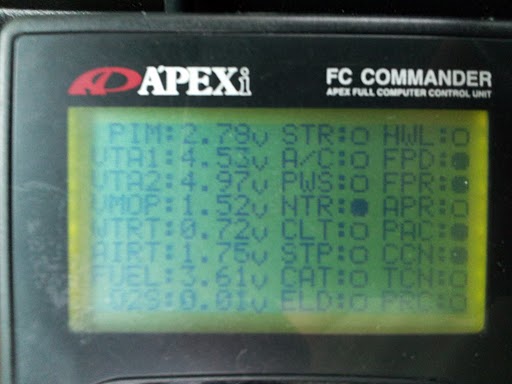
He said those are the voltages with the engine off and gas pedal floored. The TPS voltages look ok at first glance but I don't remember the exact spec off hand.
^
He said those are the voltages with the engine off and gas pedal floored. The TPS voltages look ok at first glance but I don't remember the exact spec off hand.
Thread Starter
Full Member
Joined: Dec 2006
Posts: 117
Likes: 0
From: Vermont
The throttle voltages should be .7-1.25 and .1-.7 when closed, and 4.8-5.0 and 4.2-4.6 when fully open. (from the fsm)
For the second picture when I say "not running ", the engine is still turning, but it is silent with no apparent combustion. The engine is "on" though
For the second picture when I say "not running ", the engine is still turning, but it is silent with no apparent combustion. The engine is "on" though
Ah, I must have missed that line. If it goes massively rich, it may seem like theres no combustion as if there was a fuel cut. I had that happen once when I was tuning an RX-8 and my initial fuel mapping was overly conservative and the car would just "shut off" when it got into boost when really, it was just too much fuel. Wideband and logging would be your next step.
thewird
thewird
Trending Topics

I wouldn't say I had similar issue but I was troubleshooting a car that started fine, but when driving and getting into boost, it would die or can't boost..
Finally, I checked all the wires and it was the wires to the CAS.. Couple of the wires were pulled and wasn't making good contact.
My suggestion is to check all your wires/clips/harnesses. It could be even your injector clips as you are having issues around 3800 when injectors are in transition.
Finally, I checked all the wires and it was the wires to the CAS.. Couple of the wires were pulled and wasn't making good contact.
My suggestion is to check all your wires/clips/harnesses. It could be even your injector clips as you are having issues around 3800 when injectors are in transition.
Thread Starter
Full Member
Joined: Dec 2006
Posts: 117
Likes: 0
From: Vermont
Doing testing right now.
My first test was spraying brake cleaner around the engine area to see if I had any intake leaks around the injectors. The car RPM dipped when I was spraying as close as I could to the primary injectors. I have gotten things far enough apart to see that nothing looks out of the ordinary, and the fuel injector atomization tube appears to be connected. Trying to remember how to take the rats nest out now without taking out the LIM.
My first test was spraying brake cleaner around the engine area to see if I had any intake leaks around the injectors. The car RPM dipped when I was spraying as close as I could to the primary injectors. I have gotten things far enough apart to see that nothing looks out of the ordinary, and the fuel injector atomization tube appears to be connected. Trying to remember how to take the rats nest out now without taking out the LIM.
Thread Starter
Full Member
Joined: Dec 2006
Posts: 117
Likes: 0
From: Vermont
Found the problem
I found the problem. See the pictures.
Primary injector seals. When I was going under boost I think I must have been pushing air past the primary injectors, pushing the fuel out of the system.
So, why did this happen, and can I get a replacement o-ring at a local parts store? I know that it is unlikely to have the perfect replacement, but there is probably something that works. What has everyone else done?
Primary injector seals. When I was going under boost I think I must have been pushing air past the primary injectors, pushing the fuel out of the system.
So, why did this happen, and can I get a replacement o-ring at a local parts store? I know that it is unlikely to have the perfect replacement, but there is probably something that works. What has everyone else done?
Thread Starter
Full Member
Joined: Dec 2006
Posts: 117
Likes: 0
From: Vermont
So, I guess I am not actually sure what I am missing. Is that the only seal that needs to seal the primary injectors? I looked in the FSM, and I am not entirely sure where the injectors are supposed to seal considering it lists the broken seal as an "insulator".
Thread Starter
Full Member
Joined: Dec 2006
Posts: 117
Likes: 0
From: Vermont
Ok guys, case closed.
I forgot the seals on the primary injector housing when I put the car together. Every time the intake manifold went to positive pressure it was blowing the fuel back out of the injector cups instead of in to the engine.
The brake cleaner was key to making myself confident enough to pull the trigger on taking everything apart to get at the injectors.
Now I just have an incredibly loud squeak from the front of the engine. I thought it was an idler pulley, but it apparently is not. Hopefully this isn't bad as well.
I forgot the seals on the primary injector housing when I put the car together. Every time the intake manifold went to positive pressure it was blowing the fuel back out of the injector cups instead of in to the engine.
The brake cleaner was key to making myself confident enough to pull the trigger on taking everything apart to get at the injectors.
Now I just have an incredibly loud squeak from the front of the engine. I thought it was an idler pulley, but it apparently is not. Hopefully this isn't bad as well.

Thread
Thread Starter
Forum
Replies
Last Post
armans
3rd Generation Specific (1993-2002)
5
Aug 15, 2015 09:08 PM