


crv affect on c.a.i and charge temps


Thread Starter
Junior Member
Joined: Jun 2014
Posts: 16
Likes: 0
crv affect on c.a.i and charge temps
Hi all. Iv been thinking on this. What i cant understand is whats the point of a cold air intake if the crv is jetting copious amounts of superheated, unintercooled boost into the filter box between 3000-4500rpm. Surely it would hugely affect intake temps by venting to atmo, or out of engine bay completely, or am i just being stupid amd missing something.


That's actually an interesting point. Stock, Mazda has it vented to the airbox to reduce noise and for emissions purposes.
I don't know if there's a correlation between vented/unvented and intake air temps. Also, it could help to dump back into the airbox as it's a large volume of pressurized air.
Interesting!
The 3000 RPM hesistation is, without question, a bug in the factory ECU. There's things that make it better, but if you plug a PowerFC in, it goes away completely.
Dale
I don't know if there's a correlation between vented/unvented and intake air temps. Also, it could help to dump back into the airbox as it's a large volume of pressurized air.
Interesting!
The 3000 RPM hesistation is, without question, a bug in the factory ECU. There's things that make it better, but if you plug a PowerFC in, it goes away completely.
Dale
Thread Starter
Junior Member
Joined: Jun 2014
Posts: 16
Likes: 0
The reason i posted this was because i noticed a 5 degree c temp drop on my digital coolant temp gauge. And my stock gauge now sits a smidge under half way. All from taking off a pipe and capping off the air intake hole. The way i see it, the air goes into the intake, gets heated up by the secondary turbo, goes back into intake and gets heated up again, so unless you go over 4500rpm. Its just a vicious circle of hotter and hotter intake temps. Could be wrong but thats how it looks to me.

10-8-10-8

Joined: Jan 2012
Posts: 848
Likes: 12
From: Australia
At first glance on this, I thought "Oh someone doesn't understand how the charge relief works again, they want to vent it like an atmosphere BOV..."
Then I read what you're asking, and it got me thinking as well.
The secondary is made to go into compressor surge during pre-spool operation from 3000 to 4500rpm and the CRV is open. The CCV in the Y pipe is closed.
~4500rpm and the CRV closes, and the CCV flapper in the Y pipe opens and boost from the secondary turbo is added into the intake tract.
I know Mazda plugged the CRV to the airbox purely for noise and emissions sake. But yes, the heated air during "surge spool" must be going somewhere... Whether or not there's a big enough quantity of it to affect intake temperatures is the question.
Its definitely not the infamous 3000rpm hesitation, as thats been isolated to some ECUs.
What we need in order to answer this question is someone who is able to disconnect their CRV hose off the airbox and let it vent to atmosphere. And stick a very sensitive, fast reading temperature reporting device into the CRV outlet hose, to measure how hot the surge air into the airbox actually is, and how long it nominally vents this heated air into the airbox.
If the air that is being added to the intake charge from the CRV is hot enough and in a large enough quantity, then yes, there would be good grounds to vent the CRV outlet hose directly to atmosphere to avoid momentary heating of the intake air charge every time the secondary turbo is spooling up.
So... Who's going to volunteer to have a look into this one?

Then I read what you're asking, and it got me thinking as well.
The secondary is made to go into compressor surge during pre-spool operation from 3000 to 4500rpm and the CRV is open. The CCV in the Y pipe is closed.
~4500rpm and the CRV closes, and the CCV flapper in the Y pipe opens and boost from the secondary turbo is added into the intake tract.
I know Mazda plugged the CRV to the airbox purely for noise and emissions sake. But yes, the heated air during "surge spool" must be going somewhere... Whether or not there's a big enough quantity of it to affect intake temperatures is the question.
Its definitely not the infamous 3000rpm hesitation, as thats been isolated to some ECUs.
What we need in order to answer this question is someone who is able to disconnect their CRV hose off the airbox and let it vent to atmosphere. And stick a very sensitive, fast reading temperature reporting device into the CRV outlet hose, to measure how hot the surge air into the airbox actually is, and how long it nominally vents this heated air into the airbox.
If the air that is being added to the intake charge from the CRV is hot enough and in a large enough quantity, then yes, there would be good grounds to vent the CRV outlet hose directly to atmosphere to avoid momentary heating of the intake air charge every time the secondary turbo is spooling up.
So... Who's going to volunteer to have a look into this one?

Joined: Jul 2001
Posts: 10,672
Likes: 413
From: Charlottesville VA 22901
The reason i posted this was because i noticed a 5 degree c temp drop on my digital coolant temp gauge. And my stock gauge now sits a smidge under half way. All from taking off a pipe and capping off the air intake hole. The way i see it, the air goes into the intake, gets heated up by the secondary turbo, goes back into intake and gets heated up again, so unless you go over 4500rpm. Its just a vicious circle of hotter and hotter intake temps. Could be wrong but thats how it looks to me.
Also your coolant gauge should always be just below 1/2 way if it moves at all you are at around 240f which is way too hot.
Does your car have an undertray and does it still have the secondary flapper piece in place that seals to the back of the radiator? Are your fans working? Is your thermostat working etc.....
You have bigger problems than worrying about whether your CRV charge is producing hotter intake temps.
Trending Topics
Thread Starter
Junior Member
Joined: Jun 2014
Posts: 16
Likes: 0
Sorry sir but my cooling system is perfect. It runs about 80c constantly while driving, apart from in heavy traffic when it will slowly creep up to 90-95 ish which is when fans kick and it cools down. I dont know maybe it was just a cool night. But it did make a difference.
Thread Starter
Junior Member
Joined: Jun 2014
Posts: 16
Likes: 0
But engine temps aside it must make a difference to the temps of the turbos and possibly even charge temps. Got to be worth looking into i reckon rather than just shutting it down and forgetting it. I dont have an ait sensor otherwise id check it myself.
Joined: Jul 2001
Posts: 10,672
Likes: 413
From: Charlottesville VA 22901
The reason i posted this was because i noticed a 5 degree c temp drop on my digital coolant temp gauge. And my stock gauge now sits a smidge under half way. All from taking off a pipe and capping off the air intake hole. The way i see it, the air goes into the intake, gets heated up by the secondary turbo, goes back into intake and gets heated up again, so unless you go over 4500rpm. Its just a vicious circle of hotter and hotter intake temps. Could be wrong but thats how it looks to me.
I'd recommend buying a PFC then you'll have all sorts of answers to all sorts of questions and a smoother running car

You can find them used on this site for 600 to 750
Thread Starter
Junior Member
Joined: Jun 2014
Posts: 16
Likes: 0
Yeah its on my shopping list. But dont have the funds right now. Maybe this wouldnt have such an impact on a stock airbox with bundles of cooling ambient airflow. But either way this must affect air temperature. Im not claiming to be an expert and feel free to correct me if im wrong, but my understanding of the crv is it vents constantly between 3000-4500rpm which is alot of hot air, and if it doesnt where does this potential 10psi of boosted air go?? So 3000-4500 which is approx a 1/4 of the usable rev range where the turbo is being fed very hot boosted air. When the aim of a cold air intake is to get as little hot air into the intake as possible.
Joined: Jul 2001
Posts: 10,672
Likes: 413
From: Charlottesville VA 22901
Yeah its on my shopping list. But dont have the funds right now. Maybe this wouldnt have such an impact on a stock airbox with bundles of cooling ambient airflow. But either way this must affect air temperature. Im not claiming to be an expert and feel free to correct me if im wrong, but my understanding of the crv is it vents constantly between 3000-4500rpm which is alot of hot air, and if it doesnt where does this potential 10psi of boosted air go?? So 3000-4500 which is approx a 1/4 of the usable rev range where the turbo is being fed very hot boosted air. When the aim of a cold air intake is to get as little hot air into the intake as possible.


I don't believe the CRV is a huge contributor to airbox intake temps as noted because it is circulating the 2ndary turbo surged compressor output into the airbox where it is mixed with the much greater quantity of air the primary turbo is pulling in to supply the engine with boost.
ie 2ndary turbo is in surge- surge is very very low CFM being moved by this tiny turbo.
Primary turbo is on the map supplying engine with boost, it is pulling in a large quantity of CFM into the airbox.
Supporting evidence-
Mazda put out a TSB for dealerships warning them of airpump failure from drawing in ambient engine bay heat when their customers put on individual filters for primary/secondary turbos (Apex'i kit shown).
If the CRV was causing an elevated airbox temperature the airpump would have the same short life ingesting this air as it does ambient engine bay air.
ie 2ndary turbo is in surge- surge is very very low CFM being moved by this tiny turbo.
Primary turbo is on the map supplying engine with boost, it is pulling in a large quantity of CFM into the airbox.
Supporting evidence-
Mazda put out a TSB for dealerships warning them of airpump failure from drawing in ambient engine bay heat when their customers put on individual filters for primary/secondary turbos (Apex'i kit shown).
If the CRV was causing an elevated airbox temperature the airpump would have the same short life ingesting this air as it does ambient engine bay air.
Thread Starter
Junior Member
Joined: Jun 2014
Posts: 16
Likes: 0
Ok so aftermarket air filters affect air pump life because of the lack of cooling ambient air being fed into filters. So are you saying this would affect intake temps on aftermarket filters alone, or not at all?? This is all just theory for me and im learning as i go. Surely its worth someone with aftermarket filters and a ait sensor trying this, i mean itll only take ten mn
Thread Starter
Junior Member
Joined: Jun 2014
Posts: 16
Likes: 0
Ok so aftermarket air filters affect air pump life because of the lack of cooling ambient air being fed into filters. So are you saying this would affect intake temps on aftermarket filters alone, or not at all?? This is all just theory for me and im learning as i go. Surely its worth someone with aftermarket filters and a ait sensor trying this, i mean itll only take ten mins to pull the pipe and cap the air filter hole. If it makes no difference at all then we can just forget it. But its got to be worth a shot.
I am saying the intake air temperature increase from CRV is going to be negligible due to the very small amount of CFM the 2ndary turbo is moving in surge compared to the high CFM the primary turbo is moving actually on the compressor map.
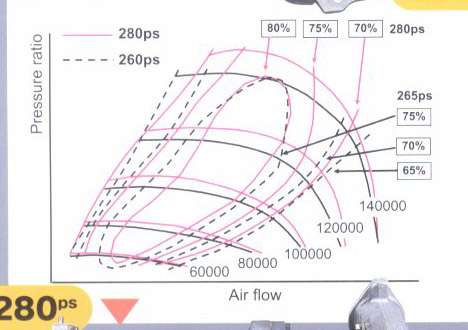
Look at the compressor map.
1.0 (ambient) pressure ratio (not making boost) at the surgeline (far Left line on a compressor map).
Almost no CFM of air being moved by the 2ndary turbo in surge.
Now look at the rest of the compressor map thats where the primary turbo is at and drawing that much CFM into the airbox for the hot CRV air to intermingle with.


Joined: Mar 2001
Posts: 31,851
Likes: 3,241
From: https://www2.mazda.com/en/100th/
[QUOTE=jayzee-fdrx7r1;11802151... jetting copious amounts of superheated, unintercooled boost into...[/QUOTE]
its not boost, i'm sure its warmer than not putting the air through a turbo, but its not super heated
good thinking though!
its not boost, i'm sure its warmer than not putting the air through a turbo, but its not super heated
good thinking though!

I never thought about this until OP brought it up. It's good to see people looking at the system from a different angle.
My first thought is, if hot air is returning back to the airbox at high enough flow to have an effect, having cooler fresh air should help mitigate that. It's hard to say how much without running a bunch of tests with the right instrumentation. You really would want thermocouples (like an EGT sensor) on the compressor inlet and outlet of each turbo, pressure transducers, and speed sensors on each one. Also a thermocouple in several parts of the intake would help too.
My first thought is, if hot air is returning back to the airbox at high enough flow to have an effect, having cooler fresh air should help mitigate that. It's hard to say how much without running a bunch of tests with the right instrumentation. You really would want thermocouples (like an EGT sensor) on the compressor inlet and outlet of each turbo, pressure transducers, and speed sensors on each one. Also a thermocouple in several parts of the intake would help too.

Thread
Thread Starter
Forum
Replies
Last Post
DocHoliday89
3rd Generation Specific (1993-2002)
2
Sep 22, 2015 11:46 AM