When you click on links to various merchants on this site and make a purchase, this can result in this site earning a commission. Affiliate programs and affiliations include, but are not limited to, the eBay Partner Network.
Context: Pulled turbos for a BNR rebuild, doing other maintenance while they're out. Car has been sitting in the garage since January. Car drove well, but could tell the boost pattern wasn't right. Stock TT exhaust housing was completely done and cracked. Appeared to be the sole source of the low boost pattern I was seeing 10-6-7. Temps were rock solid at 180, with a Greddy FMIC and a Fluidyne radiator.
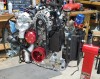
While I was reinstalling the main crank pulley I turned the engine over and the front rotor pushed a little coolant out of the exhaust port. Rear rotor was dry. Car was not smoking and the exhaust didn't smell sweet. Also, never pushed coolant out of the overflow bottle so I was a bit shocked/disappointed. I'm assuming this is the very early sign of a coolant seal failure? Coolant leaked into the chamber over three months.
I think I'm going to go ahead and pull it for a rebuild at this point. Was very much waffling on sending it as is or going in for a rebuild now. The engine was built by KDR probably 10+ years ago, and may have a streetport? The history of the car is unknown other than it came from Allentown, PA and was told it was rebuilt by KDR (it had the KDR trailing plug eliminators in the engine, that is confirmed) but really the Previous owner had no other history on the car.
if you really want to be sure, you could pressure test the cooling system.
a Japanese tuning shop would have started with an inspection and compression test, and if the engine wasn't really really good, they would rebuild it. so starting with a fresh engine may not be so bad
if you really want to be sure, you could pressure test the cooling system.
a Japanese tuning shop would have started with an inspection and compression test, and if the engine wasn't really really good, they would rebuild it. so starting with a fresh engine may not be so bad
I started fixing small problems, things quickly escalated to the turbos getting pulled. I should have started with the compression test for sure. I had been traveling for work quite a bit and lacked the time to really knock out my punch list. As I was discovering more problems I'd order parts and wait for the moons to align to get everything done. Now it's a free for all and I have plenty of time working from home.
It's getting very common for these cars on original or well used engines to developers phantom coolant seal failure. The iron wall erodes away and the water seal dike breaks and blows out a coolant seal
It's getting very common for these cars on original or well used engines to developers phantom coolant seal failure. The iron wall erodes away and the water seal dike breaks and blows out a coolant seal
Usually caused by neglected coolant replacements...if the car sat a long time w/o maintenance that is, IMO, why it occurred.
I agree DaveW. I think this car sat for an extended period of time at some point. Back side of the waterpump shows a line with rust on the steel impeller where it had sat. Also the coolant mixture was too highly concentrated. It was more than 50/50. More like 75-90% coolant and 10% water. I'm expecting to have to replace some plates.
I agree DaveW. I think this car sat for an extended period of time at some point. Back side of the waterpump shows a line with rust on the steel impeller where it had sat. Also the coolant mixture was too highly concentrated. It was more than 50/50. More like 75-90% coolant and 10% water. I'm expecting to have to replace some plates.
The coolant was probably done that way (~90% AF) in a vain attempt to prevent corrosion. Over-concentrating the AF will help in that regard, but it doesn't cool worth a crap at that concentration. Even doing that, long-term lack of replacement will eventually result in corrosion.
Yeah, the only way coolant is getting in there is a failed coolant seal of some kind. I'm actually rebuilding a motor right now that used some old cheapo "upgraded" coolant seals that died.
The high coolant concentration may have been part of the problem - full coolant really doesn't cool that well. Water does, but it freezes at 32 and has no lubricating properties for the water pump. 50/50 is generally best. Too much pure coolant means the motor wasn't cooling as well as it could, may have run hot and had hot spots. Hard to say.
Get up with me this week and I can give you some good ideas.
Yeah, the only way coolant is getting in there is a failed coolant seal of some kind. I'm actually rebuilding a motor right now that used some old cheapo "upgraded" coolant seals that died.
The high coolant concentration may have been part of the problem - full coolant really doesn't cool that well. Water does, but it freezes at 32 and has no lubricating properties for the water pump. 50/50 is generally best. Too much pure coolant means the motor wasn't cooling as well as it could, may have run hot and had hot spots. Hard to say.
Get up with me this week and I can give you some good ideas.
Dale
Thanks Dale. Engine came out this afternoon. You can see the front exhaust insert looks like it's been burning some coolant. It's ugly. seems to be held together with black RTV. I'm guessing there was some massive oil leak from the front iron/cover. I still need to pick up those AC bolts from you.
The rear looks lean to me but burning coolant can certainly cause coloration differences. Pop it apart and go from there. You can sometimes see staining on the irons where the coolant seal was breached. I'm a firm believer that reusing the tension bolts multiple times while increasing the boost/power causes the coolant seals to fail prematurely. Years ago we were re-torquing the bolts during clutch jobs or other services that permitted easy access. We use studs in just about any build that exceeds stock power these days. Routinely changing coolant every season and using only traditional green coolant/distilled water mix or Evans helps prolong coolant seal life too.
For everyone that loves threads that have closure, Dale and I tore the engine down this morning and found exactly what Ihor suggested. Thank you for that insight!
The landing for the coolant seal eroded away likely due to lack of cooling system maintenance or some sort of iron defect which blew the seal out. The front side of the front rotor is nicely steam cleaned as a result, you can see this effect in the rotor picture. Engine had 3pc OEM mazda seals, and a really strange beveling at the edges of the front and rear rotor housings just passed the leading plug holes, in the same area as the coolant blowout. I don't think it's related to the coolant blowout, but could it be related to the engine running lean or some other defect in assembly/tuning/maintenance?
Right on. We recommend running a 50/50 mix of distilled water/green coolant (up to a 70/30 ratio depending on how cold it gets by you) and flush yearly. Another option is Evans coolant. This will help the kind of erosion you are seeing that eventually broke the iron,.