


Why do engines with Walbro's run rich?

Thread Starter
RX-7 Alumni

Joined: Oct 2002
Posts: 1,140
Likes: 1
From: Spacecenter Houston
 Why do engines with Walbro's run rich?
All right, this is bugging me and thought I'd put it up for discussion and see what comes up.
Some members are saying that they run rich after installing a Walbro 255. To me this makes no sense at all and I want to get the facts out. I could understand this problem if the fuel pressure regulator was unable to maintain the correct fuel pressure--but I don't feel like that should happen due to the Walbro.
Here's the flow for a Walbro GSL392 which is
The red box is the S4 TII fuel pump specs per the FSM.
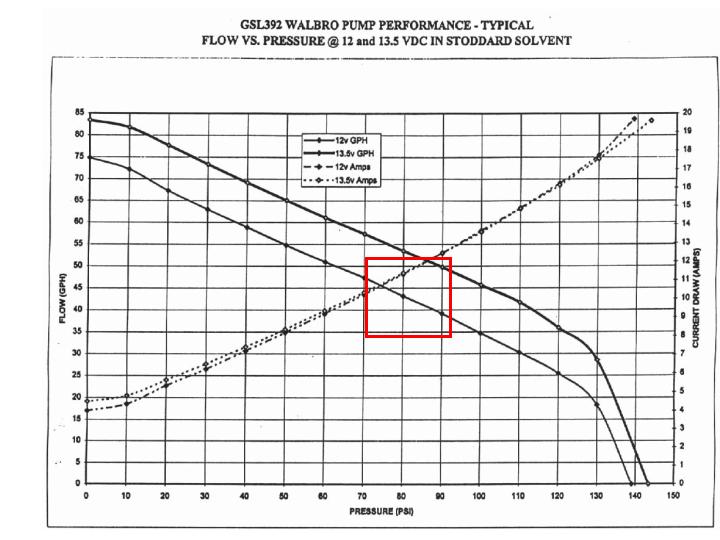
Seems to me this pump is perfect for this application and I see no reason why the stock fuel pressure regulator would have any problem controlling fuel rail pressures.
Anyone got any feedback on this?
Scott
p.s. Yea I know my application is a little different than your FC but my setup right now is stock S4 except the K+N. Obviously I need something to replace the GSL-SE pump as it can not supply sufficient fuel.
Some members are saying that they run rich after installing a Walbro 255. To me this makes no sense at all and I want to get the facts out. I could understand this problem if the fuel pressure regulator was unable to maintain the correct fuel pressure--but I don't feel like that should happen due to the Walbro.
Here's the flow for a Walbro GSL392 which is
similar to in-tank high-pressure 255 pump with even higher shut-off pressure.
Seems to me this pump is perfect for this application and I see no reason why the stock fuel pressure regulator would have any problem controlling fuel rail pressures.
Anyone got any feedback on this?
Scott
p.s. Yea I know my application is a little different than your FC but my setup right now is stock S4 except the K+N. Obviously I need something to replace the GSL-SE pump as it can not supply sufficient fuel.
Last edited by Rex4Life; Feb 21, 2004 at 08:31 PM.

I'm a boost creep...

Joined: Jan 2002
Posts: 15,608
Likes: 8
From: Auckland, New Zealand
The FPR is a very simple device that only responds to changes in manifold pressure. It has no way of responding to changes in upstream fuel pressure from the pump. So if the pump's output pressure increases (and from your graph the Walbro does have a slightly higher output pressure), then you'll see higher pressure at the rails, and richer mixtures unless you compensate.

Thread Starter
RX-7 Alumni
Joined: Oct 2002
Posts: 1,140
Likes: 1
From: Spacecenter Houston
Originally posted by NZConvertible
The FPR is a very simple device that only responds to changes in manifold pressure. It has no way of responding to changes in upstream fuel pressure from the pump. So if the pump's output pressure increases (and from your graph the Walbro does have a slightly higher output pressure), then you'll see higher pressure at the rails, and richer mixtures unless you compensate.
The FPR is a very simple device that only responds to changes in manifold pressure. It has no way of responding to changes in upstream fuel pressure from the pump. So if the pump's output pressure increases (and from your graph the Walbro does have a slightly higher output pressure), then you'll see higher pressure at the rails, and richer mixtures unless you compensate.
That's a bunch of tech talk-heh.

Lives on the Forum
Joined: Feb 2001
Posts: 26,664
Likes: 22
From: n
In theory, it would work as you have described.
In real life, it doesn't.
NZConvertible is right - the bigger capacity fuel pump is will overrun the stock FPR, and all specs get thrown out the door. The stock FPR is only referenced to the stock fuel pump. This about this...if we hooked the stock FPR to the Hoover Dam, would you think the FPR would still keep pressure down to 35psi under vacuum reference?
Think about the stock wastegate...
At stock exhaust flow rates, it maintains about 6psi no problem. Increase the efficiency of the engine (free flowing exhaust), and the boost creeps. The wastegate spring is still the same, so why doesn't it keep it at the stock 6psi boost level?
-Ted
In real life, it doesn't.
NZConvertible is right - the bigger capacity fuel pump is will overrun the stock FPR, and all specs get thrown out the door. The stock FPR is only referenced to the stock fuel pump. This about this...if we hooked the stock FPR to the Hoover Dam, would you think the FPR would still keep pressure down to 35psi under vacuum reference?
Think about the stock wastegate...
At stock exhaust flow rates, it maintains about 6psi no problem. Increase the efficiency of the engine (free flowing exhaust), and the boost creeps. The wastegate spring is still the same, so why doesn't it keep it at the stock 6psi boost level?
-Ted
Thread Starter
RX-7 Alumni
Joined: Oct 2002
Posts: 1,140
Likes: 1
From: Spacecenter Houston
Yea RETed, I follow you and understand how the regulator could get over-run--but this pump runs right thru the stock pump specs--so how could the regulator get over-run? Are the FSM specs not correct or the stock pump is just on the real low end of it?
Trending Topics


Lets not forget that those who do the Walbro probably also do a fuel pump re-wire to bypass the pump resistor.
Are we sure that the stock pump would not run rich if it was rewired as well.
The stock set-up has reduced voltage to the pump under light load conditions.
I could clearly see the difference in AF ratios during light load driving swapping between the stock pump and wiring and the Walbro and rewire back to back.
I even dropped the stock pump/wiring back in for gas mileage on a roadtrip to the Bay Area and then swapped back to the Wally/rewire when I got there so I could play around- Hmm 280...
Are we sure that the stock pump would not run rich if it was rewired as well.
The stock set-up has reduced voltage to the pump under light load conditions.
I could clearly see the difference in AF ratios during light load driving swapping between the stock pump and wiring and the Walbro and rewire back to back.
I even dropped the stock pump/wiring back in for gas mileage on a roadtrip to the Bay Area and then swapped back to the Wally/rewire when I got there so I could play around- Hmm 280...
I'm a boost creep...
Joined: Jan 2002
Posts: 15,608
Likes: 8
From: Auckland, New Zealand
Rex4Life, your description is right, and explains why the FPR can't compensate for pump changes. The FPR is simply a variable restriction that closes as manifold pressure increases, which increases fuel pressure accordingly. Upgrading the pump has no effect on manifold pressure, so the restriction caused by the FPR doesn't change. More pressure in means more pressure out.
And the Walbo's specs don't run right through the stock specs. It's right at the edge of the window given by the FSM specs. If it ran through the middle of the window things would be different.
BLUE TII, the proper fuel pump rewire doesn't bypass the resistor, it keeps it functioning normally. So that's not really an issue.
And the Walbo's specs don't run right through the stock specs. It's right at the edge of the window given by the FSM specs. If it ran through the middle of the window things would be different.
BLUE TII, the proper fuel pump rewire doesn't bypass the resistor, it keeps it functioning normally. So that's not really an issue.

Daily Domestic Killer
Joined: Mar 2001
Posts: 2,425
Likes: 0
From: San Antonio, Tx, USA
Well All I can say is I have a walbro installed, on my large streetported 13BT I can use 87 octane gas and it runs great, my wastegate is ported to hell and I only see 8 psi in 4th, and my car still shoots flames, blue ones that is.
For the record though I use 89 octane when ever I race or what not, I find that using 93 really makes my idle go to **** and I have to adjust my variable resistor...
anyway
For the record though I use 89 octane when ever I race or what not, I find that using 93 really makes my idle go to **** and I have to adjust my variable resistor...
anyway
Lives on the Forum
Joined: Feb 2001
Posts: 26,664
Likes: 22
From: n
Originally posted by Rex4Life
Yea RETed, I follow you and understand how the regulator could get over-run--but this pump runs right thru the stock pump specs--so how could the regulator get over-run? Are the FSM specs not correct or the stock pump is just on the real low end of it?
Yea RETed, I follow you and understand how the regulator could get over-run--but this pump runs right thru the stock pump specs--so how could the regulator get over-run? Are the FSM specs not correct or the stock pump is just on the real low end of it?
-Ted

HAILERS
Joined: May 2001
Posts: 20,563
Likes: 27
From: FORT WORTH, TEXAS,USA
REXFORLIFE..........For what it's worth, I thought more or less like you about the fpr, but got an arguement out of NZ on this thread https://www.rx7club.com/showthread.p...hlight=HAILERS
So in that thread what I did was look at the AFR at idle .....then pull pin 3D which controlls whether or not the fuel pump is running with/without the resistor.....and sure enough at idle the AFR went rich by a few points when the full voltage got to the fuel pump. I did it several times and got consistent results i.e. when the pump pressure went up the AFR got richer. Same car, same afr meter, same rpm, same fpr, just different fuel pressure when the resistor was in/out of the picture.
By the way....the stock fuel system with stock turbo, 2.5inch downpipe, presilencer etc, runs pig rich at full throttle on a uphill run. About 10.3/10.5 afr.
So in that thread what I did was look at the AFR at idle .....then pull pin 3D which controlls whether or not the fuel pump is running with/without the resistor.....and sure enough at idle the AFR went rich by a few points when the full voltage got to the fuel pump. I did it several times and got consistent results i.e. when the pump pressure went up the AFR got richer. Same car, same afr meter, same rpm, same fpr, just different fuel pressure when the resistor was in/out of the picture.
By the way....the stock fuel system with stock turbo, 2.5inch downpipe, presilencer etc, runs pig rich at full throttle on a uphill run. About 10.3/10.5 afr.
I'm a boost creep...
Joined: Jan 2002
Posts: 15,608
Likes: 8
From: Auckland, New Zealand
Something I forgot to mention earlier. The job of the FPR is not to maintain a particular pressure, it's there to maintain a constant pressure differential between fuel rail pressure and manifold pressure as engine load varies. This is so the injector flow rate remains constant. In stock form this dP is ~37psi. If you install a pump with a higher output pressure, this dP will get bigger, but it will still be kept constant by the FPR as engine load varies. 


Lives on the Forum
Joined: Feb 2001
Posts: 26,664
Likes: 22
From: n
I'm a boost creep...
Joined: Jan 2002
Posts: 15,608
Likes: 8
From: Auckland, New Zealand
Originally posted by jetfire76
i installed a Walbro in my AE last year but didnt do the re-wire. is that bad?
i installed a Walbro in my AE last year but didnt do the re-wire. is that bad?
Thread Starter
RX-7 Alumni
Joined: Oct 2002
Posts: 1,140
Likes: 1
From: Spacecenter Houston
Thanks for the help NZ and RETed, I thought the regulator just had a spring and diaphram--one side is fuel pressure and the other is spring + manifold pressure.
I'll let you know how it goes after I get the pump installed.
Scott
I'll let you know how it goes after I get the pump installed.
Scott
Thread Starter
RX-7 Alumni
Joined: Oct 2002
Posts: 1,140
Likes: 1
From: Spacecenter Houston
Final Outcome!
I wanted to close this out with the final outcome just to set the record straight for people that USE the search feature to find information.
The Walbro did cause my car to run a little rich--not horribly but enough to make we want to fix it. Fuel rail pressures ended up about 42 psi as opposed to the stock 37 psi. Even at the lower voltage pump setting the regulator is getting over-run.
So if you install a Walbro you will most likely need to upgrade the FPR (on a stock system). I could install a SAFC and re-tune the lower end but IMHO this is not a proper fix as the FPR is not regulating like it should.
Basically my set-up is a Walbro 255 inline pump and the stock fuel system including the fuel pump relay resistor setup. I performed the fuel pump re-wire and I'm getting good voltage to the pump, ~13.8 and 9.2v on the two relay settings.
My car runs a little rough with a small vibration on the low end and I believe it is because it is running too rich. Other symptoms include: slightly sooted spark plugs, and a significant increase in crank case oil level after only 2000 miles. Once I get over about 3000 rpm the engine smooths out and runs real good all the way up.
I am currently researching the install of an aftermarket FPR, probably will go with the Aermotive 13109.
Scott
p.s. BTW, the GSL-SE's have two pulsation dampers. One on the engine fuel rail and one at the fuel pump outlet.
The Walbro did cause my car to run a little rich--not horribly but enough to make we want to fix it. Fuel rail pressures ended up about 42 psi as opposed to the stock 37 psi. Even at the lower voltage pump setting the regulator is getting over-run.
So if you install a Walbro you will most likely need to upgrade the FPR (on a stock system). I could install a SAFC and re-tune the lower end but IMHO this is not a proper fix as the FPR is not regulating like it should.
Basically my set-up is a Walbro 255 inline pump and the stock fuel system including the fuel pump relay resistor setup. I performed the fuel pump re-wire and I'm getting good voltage to the pump, ~13.8 and 9.2v on the two relay settings.
My car runs a little rough with a small vibration on the low end and I believe it is because it is running too rich. Other symptoms include: slightly sooted spark plugs, and a significant increase in crank case oil level after only 2000 miles. Once I get over about 3000 rpm the engine smooths out and runs real good all the way up.
I am currently researching the install of an aftermarket FPR, probably will go with the Aermotive 13109.
Scott
p.s. BTW, the GSL-SE's have two pulsation dampers. One on the engine fuel rail and one at the fuel pump outlet.

im running a walbro with the stock resistor pack, it ran rich when i put it in, but after i stripped off the rats nest, its running alot richer with some nasty low rpm (>2600) hesitation. after 2600, it revs fine, but i do get the occasional massive backfire with large flames.

Thread
Thread Starter
Forum
Replies
Last Post
trickster
2nd Generation Specific (1986-1992)
25
Jul 1, 2023 04:40 PM
82streetracer
Haltech Forum
11
Mar 11, 2019 05:34 PM
jetlude
Single Turbo RX-7's
4
Aug 18, 2015 04:53 PM
