


maf to map swap?

Thread Starter

Joined: Mar 2006
Posts: 1,129
Likes: 0
From: Cornfield, Indiana
maf to map swap?
hi, i was wondering if it was posible to do a maf to map swap
my reasons for asking:
1.) get rid of ugly maf sensor
2.) cheaper to replace with a brand new part
i know its not alot but i really need to know what the maf actualy controls and what it goes to. Switches and sensors are all just variable resistors, we just need to find a MAP that we can get to give the same output under the same conditions.
i know that the map controls the fuel pump on turbos, but what else?
how could you properly mesure the outputs of the maf sensor?
i know i know flame suit on.
my reasons for asking:
1.) get rid of ugly maf sensor
2.) cheaper to replace with a brand new part
i know its not alot but i really need to know what the maf actualy controls and what it goes to. Switches and sensors are all just variable resistors, we just need to find a MAP that we can get to give the same output under the same conditions.
i know that the map controls the fuel pump on turbos, but what else?
how could you properly mesure the outputs of the maf sensor?
i know i know flame suit on.

The Rtek 2.1 for S4 TIIs already has the ability to switch over to MAP based timing. The whole timing map has to be created from scratch, but there are already some people using it. If/when the AFM removal option comes along too, it would do what you're asking.


1. There is no Mass Airflow Sensor on the car. Most mass airflow sensors heat up a wire that passes in the middle of the inlet stream. There is a Bosch style 80s ("L Jetronic") volume airflow sensor that uses a flapper door attached to a potentiometer. The mass of the air is then calculated.
2. The airflow meter is used to calculate engine load. It's pretty much used for all the basic calculations to make your car run.
3. While it is hardly an "ideal" design from a modern perspective, plenty of cars are making in the low to mid 300whp range with it. On a more stock car, far more gains can be had from modifying the exhaust than the intake, so focus on that first. Do you have a turbo and supporting fuel mods that can make over 300 to the wheels?
Cars that calculate engine load from the manifold (speed density or Bosch "D Jetronic"), like the 3rd gen cars, work in a completely different way. They use assumptions of engine pumping efficiency to calculate what air flow "should" be. I mean you can do what all the DSM owners do and get something equivalent to an E-manage Ultimate, where you tediously have to guess what airflow meter voltage to feed to the ECU at a given manifold pressure as measured by an external MAP sesnor. But you still have all sorts of issues with accelerator pump functions (adding fuel as the throttle opens), injector staging, and most importantly timing control.
It's just kind of a pointless route to go down. You can make plenty of power on the stock airflow meter using software that gives you direct control of the factory maps (Rtek 2.1). You can also purchase plug and play standalones or standalones that requires rewiring the car, both of which can support "true" speed density and thus removal of the airflow meter without tricking the factory ECU.
Look at the "australia" part of this diagram

2. The airflow meter is used to calculate engine load. It's pretty much used for all the basic calculations to make your car run.
3. While it is hardly an "ideal" design from a modern perspective, plenty of cars are making in the low to mid 300whp range with it. On a more stock car, far more gains can be had from modifying the exhaust than the intake, so focus on that first. Do you have a turbo and supporting fuel mods that can make over 300 to the wheels?
Cars that calculate engine load from the manifold (speed density or Bosch "D Jetronic"), like the 3rd gen cars, work in a completely different way. They use assumptions of engine pumping efficiency to calculate what air flow "should" be. I mean you can do what all the DSM owners do and get something equivalent to an E-manage Ultimate, where you tediously have to guess what airflow meter voltage to feed to the ECU at a given manifold pressure as measured by an external MAP sesnor. But you still have all sorts of issues with accelerator pump functions (adding fuel as the throttle opens), injector staging, and most importantly timing control.
It's just kind of a pointless route to go down. You can make plenty of power on the stock airflow meter using software that gives you direct control of the factory maps (Rtek 2.1). You can also purchase plug and play standalones or standalones that requires rewiring the car, both of which can support "true" speed density and thus removal of the airflow meter without tricking the factory ECU.
Look at the "australia" part of this diagram
Thread Starter
Joined: Mar 2006
Posts: 1,129
Likes: 0
From: Cornfield, Indiana
DOUGH!!!
i knew it was a afm not a maf, i'm just a little retarted.
on my car ive got 720cc injectors, walbro 255, rtek 1.8, Full xspower exhaust, custom intake, FMIC, AFPR, rats nest removal, PCV removal (with catch can), MSD 6a, etc...
Is the FD Bosch "D Jetronic" like the s5 afms?
You wouldnt really be tricking the computor, the computor doesnt care as long as it gets "X" votage when the engine is under "X" load. because it shows two differnt votage outputs im thinking it may need two differnt map sensors or posibly a modified harness with a resistor. couldnt you just take the afm to a ohm meter or check the votage outputs, take mesurements open to close, and find a map that gives the same ouput from "X" vaccume to 0 vaccume, or a map that is built to do higher presure like a 2bar or 3bar map sensor.
i knew it was a afm not a maf, i'm just a little retarted.
on my car ive got 720cc injectors, walbro 255, rtek 1.8, Full xspower exhaust, custom intake, FMIC, AFPR, rats nest removal, PCV removal (with catch can), MSD 6a, etc...
Is the FD Bosch "D Jetronic" like the s5 afms?
You wouldnt really be tricking the computor, the computor doesnt care as long as it gets "X" votage when the engine is under "X" load. because it shows two differnt votage outputs im thinking it may need two differnt map sensors or posibly a modified harness with a resistor. couldnt you just take the afm to a ohm meter or check the votage outputs, take mesurements open to close, and find a map that gives the same ouput from "X" vaccume to 0 vaccume, or a map that is built to do higher presure like a 2bar or 3bar map sensor.
DOUGH!!!
i knew it was a afm not a maf, i'm just a little retarted.
on my car ive got 720cc injectors, walbro 255, rtek 1.8, Full xspower exhaust, custom intake, FMIC, AFPR, rats nest removal, PCV removal (with catch can), MSD 6a, etc...
Is the FD Bosch "D Jetronic" like the s5 afms?
i knew it was a afm not a maf, i'm just a little retarted.
on my car ive got 720cc injectors, walbro 255, rtek 1.8, Full xspower exhaust, custom intake, FMIC, AFPR, rats nest removal, PCV removal (with catch can), MSD 6a, etc...
Is the FD Bosch "D Jetronic" like the s5 afms?
Trending Topics
http://www.wotmstore.com/mamaabprelco1.html
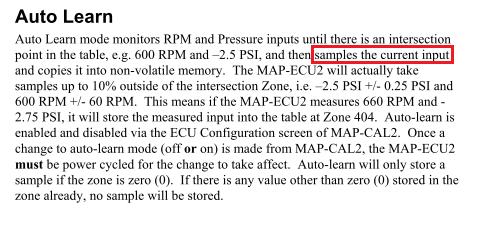
instruction manual page 45.
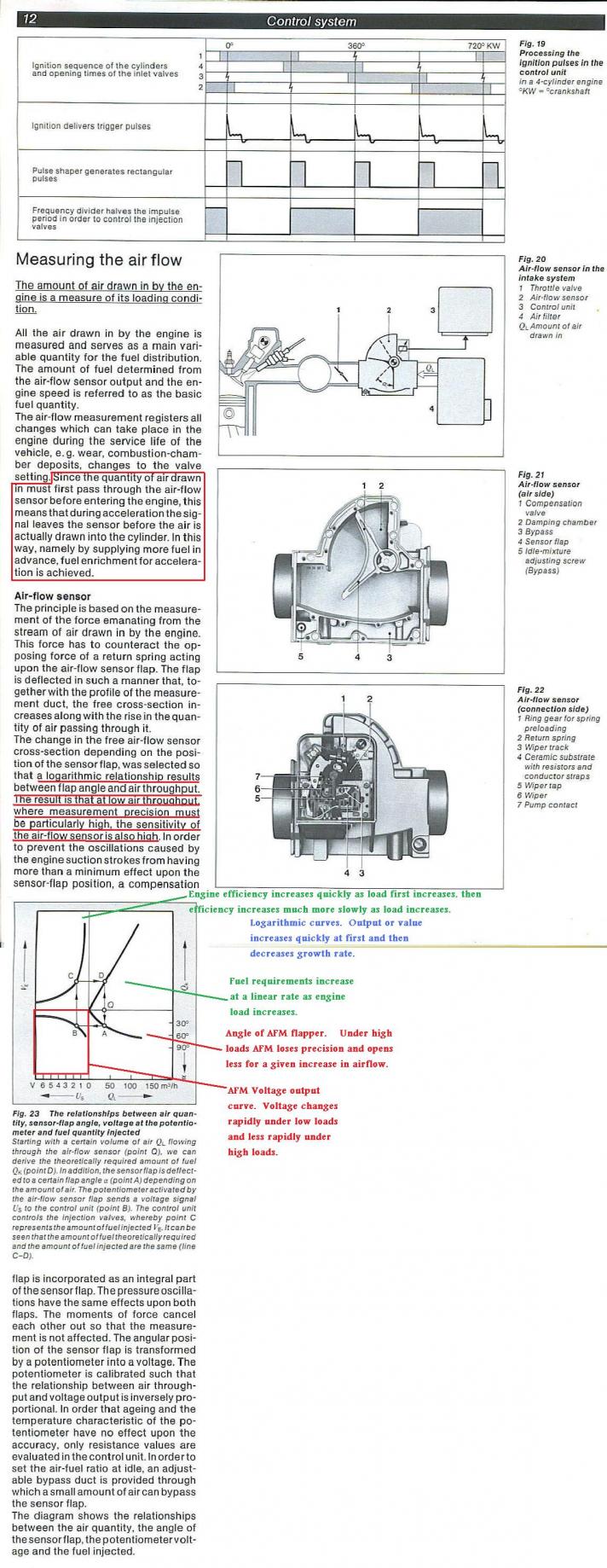
There are other more subtle problems. The AFM output curve does not have a linear correlation with the amount of air entering the engine. These "AFM emulator" style piggybacks can certainly make the car run, make some power, and hopefully not blow up. But there is no substitute for the precision engineering driveability of a full speed density system (standalone or hopefully the upcoming AFM removal code in the Rtek) or a full airflow-meter based system. This is from a Bosch technical manual:

Rotorhead

Joined: Feb 2001
Posts: 9,136
Likes: 39
From: Charlottesville, Virginia, USA
Technically, the AFM is a mass airflow sensor array, and the stock FC RX-7 uses a mass airflow type of engine management system, even though it is not quite the same as a hot wire or vortex type mass airflow system. It is similar to how a turbocharger is technically a type of supercharger. Other than that, nice posts.
Given that, the "AFM" term is better used on this forum as opposed to the more confusing "MAF" term.
+1
Given that, the "AFM" term is better used on this forum as opposed to the more confusing "MAF" term.
It's just kind of a pointless route to go down. You can make plenty of power on the stock airflow meter using software that gives you direct control of the factory maps (Rtek 2.1). You can also purchase plug and play standalones or standalones that requires rewiring the car, both of which can support "true" speed density and thus removal of the airflow meter without tricking the factory ECU.
Thread Starter
Joined: Mar 2006
Posts: 1,129
Likes: 0
From: Cornfield, Indiana
i know they talked about fuel inrichemnt advance, but how much time do you think it takes for the air to past through the AFM and enter the combustion chamber?
with the groth and decay graphs shown to represent the output, why? if your going to increase the fuel needs of the engine linarly then why do you need fancy logrithic outputs for the fuel delivery?
with the groth and decay graphs shown to represent the output, why? if your going to increase the fuel needs of the engine linarly then why do you need fancy logrithic outputs for the fuel delivery?
Why isn't it just a really simple linear output as AFM flapper angle (and thus intake air volume) increases? A couple things:
As a result of the logarithmic output voltage of the AFM, "...at low air throughput where measurement precision must be particularly high, the sensitivity of the airflow sensor is also high." The logarithmic scale is for improved driveability, fuel economy, and although most of us don't care about it, emissions.
But I also think the logarithmic output of a flapper-type AFM may be due partially to the narrow-range TPS design in the series 3 (GSL-SE) and series 4 cars, and as well as the TPS-equivalent in the Bosch fuel injection system. On the Rx-7's, the TPS measurement range is only from when the throttle plates are closed to when they are physically open perhaps 25% of the way. Bosch L-Jetronic systems have something similar, except it is basically an idle switch and a WOT switch, rather than a potentiometer with a more progressive signal for the low load range.
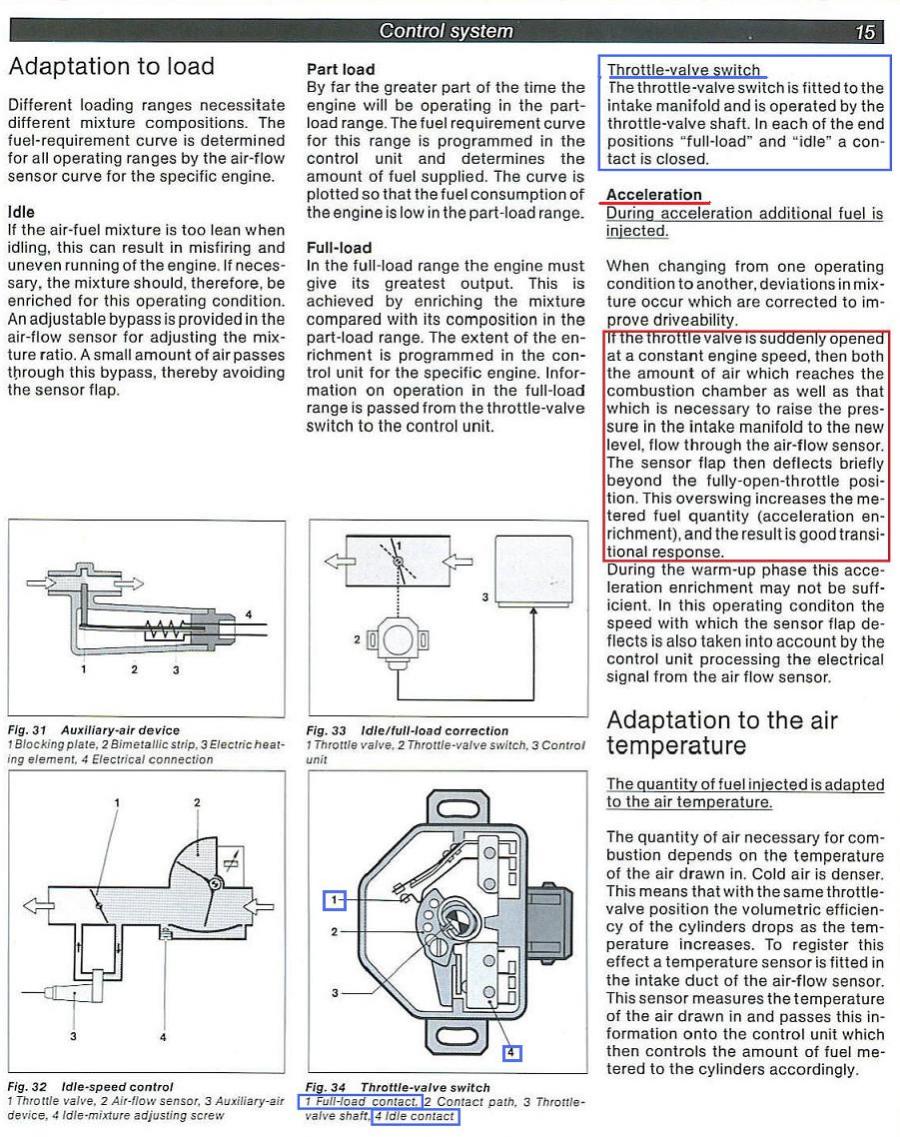
Think about it: if I have the pedal down half way and the TPS is reading is maxed out (4.7 volts or so), and then I suddenly go WOT, how would the ECU know to inject extra fuel (due to rapid movement of the throttle plates) if it can't detect the additional throttle movement? The extra enrichment thus comes from a feature in the physical design of the AFM and its resulting signal output curve. The flapper is designed to "overshoot" when there is sudden movement of the throttle plates, so that the mixture can be enriched and there will be no stumbling:
These output characteristics present some tricky issues when you are just trying to observe what AFM voltage corresponds to what manifold pressure. The sensitivity/resolution of the AFM signal changes with so many different conditions and rates of throttle movement.
Now I know there are probably a lot of guys who have done this type of speed density conversions who would essentially say "wtf are you talking about, these types of piggybacks work fine." All I have to say is that a bunch of people screwing around with 20 year old cars in their garage trying to go fast (myself often included in that bunch) have pretty low standards for smoothness and driveability compared to factory engineers, who program driveability to exacting tolerances.
But that's all academic. The most important points I raised were the financial ones. With the price of these full-featured speed density piggybacks, you should just wait until Rtek provides AFM removal features, or bite the bullet and get a standalone.
As a result of the logarithmic output voltage of the AFM, "...at low air throughput where measurement precision must be particularly high, the sensitivity of the airflow sensor is also high." The logarithmic scale is for improved driveability, fuel economy, and although most of us don't care about it, emissions.
But I also think the logarithmic output of a flapper-type AFM may be due partially to the narrow-range TPS design in the series 3 (GSL-SE) and series 4 cars, and as well as the TPS-equivalent in the Bosch fuel injection system. On the Rx-7's, the TPS measurement range is only from when the throttle plates are closed to when they are physically open perhaps 25% of the way. Bosch L-Jetronic systems have something similar, except it is basically an idle switch and a WOT switch, rather than a potentiometer with a more progressive signal for the low load range.
Think about it: if I have the pedal down half way and the TPS is reading is maxed out (4.7 volts or so), and then I suddenly go WOT, how would the ECU know to inject extra fuel (due to rapid movement of the throttle plates) if it can't detect the additional throttle movement? The extra enrichment thus comes from a feature in the physical design of the AFM and its resulting signal output curve. The flapper is designed to "overshoot" when there is sudden movement of the throttle plates, so that the mixture can be enriched and there will be no stumbling:
These output characteristics present some tricky issues when you are just trying to observe what AFM voltage corresponds to what manifold pressure. The sensitivity/resolution of the AFM signal changes with so many different conditions and rates of throttle movement.
Now I know there are probably a lot of guys who have done this type of speed density conversions who would essentially say "wtf are you talking about, these types of piggybacks work fine." All I have to say is that a bunch of people screwing around with 20 year old cars in their garage trying to go fast (myself often included in that bunch) have pretty low standards for smoothness and driveability compared to factory engineers, who program driveability to exacting tolerances.
But that's all academic. The most important points I raised were the financial ones. With the price of these full-featured speed density piggybacks, you should just wait until Rtek provides AFM removal features, or bite the bullet and get a standalone.
Thread Starter
Joined: Mar 2006
Posts: 1,129
Likes: 0
From: Cornfield, Indiana
but with the throttle plates at 50% and the TPS at aprox 4.7v, wouldn't the engine still create some vaccume?? thus a map sensor would still pic up that the engine is not under WOT and can do what the afm normaly does for fuel economy, drivability, and emitions?

Thread
Thread Starter
Forum
Replies
Last Post
Jeff20B
1st Generation Specific (1979-1985)
73
Sep 16, 2018 07:16 PM
