


Looking for a car that has HOT START PROBLEMS


Thread Starter
HAILERS

Joined: May 2001
Posts: 20,563
Likes: 27
From: FORT WORTH, TEXAS,USA
Looking for a car that has HOT START PROBLEMS
I'm looking to contact somebody out there that has HOT starting problems. I am NOT looking for someone whos car won't start cold or just won't start.
HOT starting problem will be defined as: car starts cold just fine. After driving on around and the temperature has been up for a half hour or so, and then the car is shutoff, the engine will not start if you try say five minutes after you return to the car. Only cutting the fuel will start the car then.
If that is YOU, and you have the ability to splice a single wire on the ECU after it has been cut and know how to buy a resistor from Radio Shack of approx 220-230 ohms value (about a buck fifty), and have some time on your hands, then YOU are the one who gets to be a guinea pig.
No pm's please. I never look at them.
HOT starting problem will be defined as: car starts cold just fine. After driving on around and the temperature has been up for a half hour or so, and then the car is shutoff, the engine will not start if you try say five minutes after you return to the car. Only cutting the fuel will start the car then.
If that is YOU, and you have the ability to splice a single wire on the ECU after it has been cut and know how to buy a resistor from Radio Shack of approx 220-230 ohms value (about a buck fifty), and have some time on your hands, then YOU are the one who gets to be a guinea pig.
No pm's please. I never look at them.
Thread Starter
HAILERS
Joined: May 2001
Posts: 20,563
Likes: 27
From: FORT WORTH, TEXAS,USA
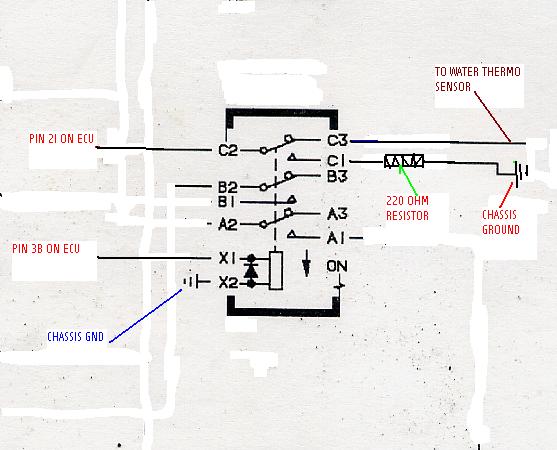
No takers eh? Everyone fixed/rebuilt their engines since summer. Great. I was going to suggest that you buy a relay and a 220 ohm resistor and wire it as is shown in the jpg attached.
That jpg along with reading the graph jpg that is attached should give you a clue of what's up. Series four only.
That jpg along with reading the graph jpg that is attached should give you a clue of what's up. Series four only.

That's pretty cool if it solves the problem. I used to get so pissed off after a night of driving around then stalling on something stupid like a dip and having to get out do the whole fuse pull act. lol My water thermo sensor was bad though. 10mpg really sucked.
If anyone with a stand alone has hot start problems that would be pretty interesting to find out also.
If anyone with a stand alone has hot start problems that would be pretty interesting to find out also.



eh, too late, my hot start issue went away with the standalone install. 
too bad i didn't have time to actually diagnose the problem though.
however i think you are in the right direction, after the EMS install i found that the coolant sensor pin had been pushed back in the connector causing a bad connection.
too bad i didn't have time to actually diagnose the problem though.
however i think you are in the right direction, after the EMS install i found that the coolant sensor pin had been pushed back in the connector causing a bad connection.
Last edited by RotaryEvolution; Jan 15, 2006 at 10:03 PM.

Trending Topics

Former Moderator. RIP Icemark.
Joined: Apr 2001
Posts: 25,896
Likes: 24
From: Rohnert Park CA
So your putting on a resistor on 2I when what is happening with the ECU???
You know this will only solve the issue if the sensor is the problem, not if the ECU is the problem.
You know this will only solve the issue if the sensor is the problem, not if the ECU is the problem.
Thread Starter
HAILERS
Joined: May 2001
Posts: 20,563
Likes: 27
From: FORT WORTH, TEXAS,USA
No. This will give a shorter opening time for the fuel injector during the START cycle. Less fuel will result in no flooding. Once the START sequence is over, the normal circuit to the water thermo sensor is re-established.
Generaly, the voltage of the water thermo sensor circuit is in the range of .45 vdc to .500 vdc with a fully warmed up engine. The 200 ohm resistor puts the voltage down in the .37vdc range.
The sensor isn't hard to figure out as far as being good/bad. Cold they run at the 2 plus volts dc. As the car warms up the voltage drops down to the approx 4.5 to 5vdc range.
A KOYO radiator with a MAZDA thermostat on a 40* 50* day will give you somewhere in the .55 to .60 range. So much for the vaunted Mazda thermostat.
Disabling the fuel pump and connecting a digital meter to one of the primary fuel injectors and cranking the engine will show the difference in the time the fuel injector is open b/t one water thermo sensor temp and another water temp sensor temp.
Generaly, the voltage of the water thermo sensor circuit is in the range of .45 vdc to .500 vdc with a fully warmed up engine. The 200 ohm resistor puts the voltage down in the .37vdc range.
The sensor isn't hard to figure out as far as being good/bad. Cold they run at the 2 plus volts dc. As the car warms up the voltage drops down to the approx 4.5 to 5vdc range.
A KOYO radiator with a MAZDA thermostat on a 40* 50* day will give you somewhere in the .55 to .60 range. So much for the vaunted Mazda thermostat.
Disabling the fuel pump and connecting a digital meter to one of the primary fuel injectors and cranking the engine will show the difference in the time the fuel injector is open b/t one water thermo sensor temp and another water temp sensor temp.
Last edited by HAILERS; Jan 16, 2006 at 11:03 AM.
Former Moderator. RIP Icemark.
Joined: Apr 2001
Posts: 25,896
Likes: 24
From: Rohnert Park CA
Ah, okay... I see what you are doing. But what about the hot start triggered by the intake manifold sensor???
*edit< just wondering what the ECU will do when it sees two different input signals during the hot start, one saying the system is cold, the other saying it is warm
*edit< just wondering what the ECU will do when it sees two different input signals during the hot start, one saying the system is cold, the other saying it is warm
Last edited by Icemark; Jan 16, 2006 at 11:12 AM.
Thread Starter
HAILERS
Joined: May 2001
Posts: 20,563
Likes: 27
From: FORT WORTH, TEXAS,USA
Originally Posted by Icemark
Ah, okay... I see what you are doing. But what about the hot start triggered by the intake manifold sensor???
*edit< just wondering what the ECU will do when it sees two different input signals during the hot start, one saying the system is cold, the other saying it is warm
*edit< just wondering what the ECU will do when it sees two different input signals during the hot start, one saying the system is cold, the other saying it is warm
I've a 220 ohm wired in all the time (no relay installed yet), for the last two days. The car requires extra cranking (three to four seconds), to start in the morning on a 40-50 degree day because the ECU is seeing a HOT resistance vs what it should be seeing. In other words it's seeing .37vdc instead of the 2 plus volts dc it should be seeing on a 50degree morning.
After the temp gauge needle starts moving off the bottom the car is driveable and once up to full temperatures I havn't noticed any anomaly with my wideband afr readings.
Never implied it was fool proof without defects. The hot start problem should disappear though.



Joined: Dec 2003
Posts: 6,598
Likes: 10
From: Temple, Texas (Central)
Couldn't you run a switch to switch between having a resistor and no resistor? That way it would still see the correct signal on cold, but you could hit the switch when its hot so it gets the lower voltage when it needs it.

Mountain Rotary Mod

Joined: Nov 2003
Posts: 2,411
Likes: 0
From: Freaking Poland!!
Originally Posted by Sideways7
Couldn't you run a switch to switch between having a resistor and no resistor? That way it would still see the correct signal on cold, but you could hit the switch when its hot so it gets the lower voltage when it needs it.
Joined: Dec 2003
Posts: 6,598
Likes: 10
From: Temple, Texas (Central)
Originally Posted by Parastie
That's what the relay is for, it'll automatically switch between the two.

Why am I here ?
Joined: May 2002
Posts: 671
Likes: 0
From: Boston, MA
you could still have leaking injectors, couldn't you? Meaning the engine starts to flood when you turn it off (thus the turn off the engine with a cut-off switch).
Good stuff but I am not sure it's gonna solve all hot-start problems.
Also, what about the FPR putting maximum fuel pressure in case of a hot-start? Does the ECU raise fuel pressure as well as lenghtening the duty cycle? Confused.
Good stuff but I am not sure it's gonna solve all hot-start problems.
Also, what about the FPR putting maximum fuel pressure in case of a hot-start? Does the ECU raise fuel pressure as well as lenghtening the duty cycle? Confused.
Last edited by hugues; Jan 16, 2006 at 01:14 PM.
Thread Starter
HAILERS
Joined: May 2001
Posts: 20,563
Likes: 27
From: FORT WORTH, TEXAS,USA
Well, during hot starts the vacuum is taken off the fpr and it goes to the 37psi range, BUT, when cranking whether hot or cold there isn't any REAL vacuum being put on the fpr anyway. Not until the engine actually starts up. So that's a wash so to speak when taliking about hot starts.
The 37-39 psi range for the fpr during hot starts is to prevent percolation in the fuel rail. I forget how long it lasts. Fifty seconds or so then vacuum returns to the fpr. But again, there's no REAL vacuum on the fpr during the actual cranking to speak of.
The duty cycle is FIXED during the cranking and the key in the START position. Going to Start puts approx 12vdc on the pin 3B of the ECU. For kicks I removed the pin from 3B and went to START the car with a fully warmed up engine. The car does NOT like to start up in that condition. Not enoiugh fuel.
I've read tooooo many threads where the fellow says he sent his injectors off to be cleaned and he still has the same old problem.
EDIT: 12V is put on 3B as long as the key is in START. Once the car starts and you let the key return to ON, then the 12vdc goes away and the relay in my jpg relaxes, putting the normal water thermo sensor circuit back into play and removing my 220 ohm resistor. Til you go to Start again.
This idea is NOT cold temperature friendly. Cold being in the thirties. Solution: move South.
I've also tried this on a real cold day. In the thirty degree range. The car is real hard to get running with a 300ohm resistor. So I swapped in a 3K ohm resistor and it started right up on a half crank or so. On a day like this 50-60 degree day the car takes a couple to four seconds to start with a 220 ohm resistor and isn't completly normal til the water temp gauge starts to move on up. After reaching full temp the car drives as normal as can be and the afr isn't screwed up.
This is just something that fellow might try sometime.
My memory sucks, but I disabled the fuel pump (fuel cut switch) and watched the time the injectors are open when the car is cold vs the time they stay open when the car is warm. Trust me, it's a dramatic change. I did this with a Fluke 88 connected to the primary injector. The Fluke shows duty cycle and duration in ms.
Leaking injectors need fixing and low compression needs fixing, but this might/will also help the fellow with low compression.
The 37-39 psi range for the fpr during hot starts is to prevent percolation in the fuel rail. I forget how long it lasts. Fifty seconds or so then vacuum returns to the fpr. But again, there's no REAL vacuum on the fpr during the actual cranking to speak of.
The duty cycle is FIXED during the cranking and the key in the START position. Going to Start puts approx 12vdc on the pin 3B of the ECU. For kicks I removed the pin from 3B and went to START the car with a fully warmed up engine. The car does NOT like to start up in that condition. Not enoiugh fuel.
I've read tooooo many threads where the fellow says he sent his injectors off to be cleaned and he still has the same old problem.
EDIT: 12V is put on 3B as long as the key is in START. Once the car starts and you let the key return to ON, then the 12vdc goes away and the relay in my jpg relaxes, putting the normal water thermo sensor circuit back into play and removing my 220 ohm resistor. Til you go to Start again.
This idea is NOT cold temperature friendly. Cold being in the thirties. Solution: move South.
I've also tried this on a real cold day. In the thirty degree range. The car is real hard to get running with a 300ohm resistor. So I swapped in a 3K ohm resistor and it started right up on a half crank or so. On a day like this 50-60 degree day the car takes a couple to four seconds to start with a 220 ohm resistor and isn't completly normal til the water temp gauge starts to move on up. After reaching full temp the car drives as normal as can be and the afr isn't screwed up.
This is just something that fellow might try sometime.
My memory sucks, but I disabled the fuel pump (fuel cut switch) and watched the time the injectors are open when the car is cold vs the time they stay open when the car is warm. Trust me, it's a dramatic change. I did this with a Fluke 88 connected to the primary injector. The Fluke shows duty cycle and duration in ms.
Leaking injectors need fixing and low compression needs fixing, but this might/will also help the fellow with low compression.
Last edited by HAILERS; Jan 16, 2006 at 01:59 PM.



Thread Starter
HAILERS
Joined: May 2001
Posts: 20,563
Likes: 27
From: FORT WORTH, TEXAS,USA
unfortunatly the great idea came up a cropper. As you can see in the chart, there is a curve that sorta bottoms out. After that no matter how low a resistance resistor you put in, you get nothing in return.
Not to despair though. The FINAL SOLUTION is to rid yourself of the programmed start mode altogether. You do that by removing the pin 3B and wrapping it in shrink tubing. From then on you'll never get the start fuel amount based on starter speed and predetermined fuel amounts based on water thermo sensor readings. That is all out the door.
You'll get a leaner or shorter duration for the fuel injectors during starting, meaning no flooding. Try it out or just forget it. It will work, does work. The DOWNSIDE is starting a stone cold engine. It takes a few seconds and the right amount of foot pedal input. But from then on, all day on, as long as there is some heat in the engine that sucker will start right up each and every time.
No relay and no resistor involved.
Not to despair though. The FINAL SOLUTION is to rid yourself of the programmed start mode altogether. You do that by removing the pin 3B and wrapping it in shrink tubing. From then on you'll never get the start fuel amount based on starter speed and predetermined fuel amounts based on water thermo sensor readings. That is all out the door.
You'll get a leaner or shorter duration for the fuel injectors during starting, meaning no flooding. Try it out or just forget it. It will work, does work. The DOWNSIDE is starting a stone cold engine. It takes a few seconds and the right amount of foot pedal input. But from then on, all day on, as long as there is some heat in the engine that sucker will start right up each and every time.
No relay and no resistor involved.

"car starts cold just fine. After driving on around and the temperature has been up for a half hour or so, and then the car is shutoff, the engine will not start if you try say five minutes after you return to the car. Only cutting the fuel will start the car then."
Heh, well I do have this problem, but it occurs so rarely that I just cut the fuel. Don't think I'd be suitible as this happens on my NA daily driver, that and my car starts in -30 celsius (-22 F)... which is not bad considering my neighbors new Jetta always freezes solid when it gets this cold.
But thanks for the effort/idea though.
Heh, well I do have this problem, but it occurs so rarely that I just cut the fuel. Don't think I'd be suitible as this happens on my NA daily driver, that and my car starts in -30 celsius (-22 F)... which is not bad considering my neighbors new Jetta always freezes solid when it gets this cold.
But thanks for the effort/idea though.

this describes my problem exactly... Hailers..im going to try this tonight and ill let you know in the next couple of days how it works out. i sent you a pm but i read that you never check them so..  that doesnt help.
thanks for the info.. ill add more later as i see how it works
that doesnt help. thanks for the info.. ill add more later as i see how it works
Thread Starter
HAILERS
Joined: May 2001
Posts: 20,563
Likes: 27
From: FORT WORTH, TEXAS,USA
Originally Posted by N3philum
this describes my problem exactly... Hailers..im going to try this tonight and ill let you know in the next couple of days how it works out. i sent you a pm but i read that you never check them so.. that doesnt help.
thanks for the info.. ill add more later as i see how it works
that doesnt help. thanks for the info.. ill add more later as i see how it works
The ONLY time it has voltage on it is when the key is HELD to START.. Try removing the wire from the connector using a small screwdriver/pick/whatever to lift up on the plastic tab inside and pulling on the wire at the same time.
I don't recommend cutting the wire, BUT if you do, do it several inches aft of the plug so you can splice the wire back together sometime in the future. It serves no other purpose other than to give the ECU a signal that your starting the car.
I would first do this with a warm/hot engine. Then drive the car hard and stop and start several times to ensure it does work for you.
The only cautionary note is that if the wire is disconnected on a cold day, say 40 degrees and the engine is that cold, the car will be difficult to start. It will be hard because THIS time the mixture is too lean.
That can be overcome by installing a relay as I described in either this post or another. Before you do the relay part, disconnect the wire from the ECU and drive it to make sure that this remedies your hot start problem. IF it does, then make the relay circuit. Actually the winters almost over and the nightly temps are staying up, so the relay might not be needed right away, at least til next Nov or so.
Nope, I never ever look at pm's.
great thanks for the info.. ill be updating as soon as i get this taken care of ... ive got some college trig homework i have to do tonight also... so ive gotta manage my time to get everything taken care of

