


greddy type rs bov. to mod or not to mod




ill post more when I get off work.
Your statement about the bov just being like a secondary wastegate is 100% false. That would be a pop-off valve.
The flutter your car is encountering is somewhat inherent to the design of the bov, and the stiffness of the spring. What is happening is the air hits the throttle, causes a wave of high pressure air to travel back towards the turbo. At the same time, the manifold is experiencing high levels of vacuum, even higher vacuum than idling. This in turn helps to compress the spring. On your car, the spring is far too stiff, so it takes a fair amount of positive pressure in the ic piping to open. Once this air is released, the bov closes. A second high pressure wave then stacks up at the throttle and reverses direction. The cycle then repeats. This opening and closing of the bov is what causes the "surging" sound. If you were to watch a tach placed on the turbo shaft while this happened, you wouldn't see much change.
Your statement about the bov just being like a secondary wastegate is 100% false. That would be a pop-off valve.
The flutter your car is encountering is somewhat inherent to the design of the bov, and the stiffness of the spring. What is happening is the air hits the throttle, causes a wave of high pressure air to travel back towards the turbo. At the same time, the manifold is experiencing high levels of vacuum, even higher vacuum than idling. This in turn helps to compress the spring. On your car, the spring is far too stiff, so it takes a fair amount of positive pressure in the ic piping to open. Once this air is released, the bov closes. A second high pressure wave then stacks up at the throttle and reverses direction. The cycle then repeats. This opening and closing of the bov is what causes the "surging" sound. If you were to watch a tach placed on the turbo shaft while this happened, you wouldn't see much change.


Thread Starter

Joined: Jun 2007
Posts: 584
Likes: 1
From: san antonio TX
ill post more when I get off work.
Your statement about the bov just being like a secondary wastegate is 100% false. That would be a pop-off valve.
The flutter your car is encountering is somewhat inherent to the design of the bov, and the stiffness of the spring. What is happening is the air hits the throttle, causes a wave of high pressure air to travel back towards the turbo. At the same time, the manifold is experiencing high levels of vacuum, even higher vacuum than idling. This in turn helps to compress the spring. On your car, the spring is far too stiff, so it takes a fair amount of positive pressure in the ic piping to open. Once this air is released, the bov closes. A second high pressure wave then stacks up at the throttle and reverses direction. The cycle then repeats. This opening and closing of the bov is what causes the "surging" sound. If you were to watch a tach placed on the turbo shaft while this happened, you wouldn't see much change.
Your statement about the bov just being like a secondary wastegate is 100% false. That would be a pop-off valve.
The flutter your car is encountering is somewhat inherent to the design of the bov, and the stiffness of the spring. What is happening is the air hits the throttle, causes a wave of high pressure air to travel back towards the turbo. At the same time, the manifold is experiencing high levels of vacuum, even higher vacuum than idling. This in turn helps to compress the spring. On your car, the spring is far too stiff, so it takes a fair amount of positive pressure in the ic piping to open. Once this air is released, the bov closes. A second high pressure wave then stacks up at the throttle and reverses direction. The cycle then repeats. This opening and closing of the bov is what causes the "surging" sound. If you were to watch a tach placed on the turbo shaft while this happened, you wouldn't see much change.
heres one of the links i got information from. i cant find the other artical, it was about surging and stalling.
http://www.alltrac.net/tuning/bovfaq.html
maybe it was wrong in calling it a waiste gate. but arnt waiste gates ment to keep from over boosting? maybe this is just another example as terms having many meanings.
what you said above is true. but did you read the post i posted on the first page with links to graphs?
the greddy bov that i have requires 22 vacuum to open. in the split secconds it takes for my car to reach 22vacuum the turbo would have already let the air escape over the blades. and that was the fluttering i heard. so by removing the softer spring. the bov only requires 12 vacuum to open. i have it set to open at 17 which is just past idle of 15.
i tested this with a hand vacuum pump. and i set the valve acordingly.
the gredy bov seems to be less responcive as other bov because of this flaw. some cars just cant meet the reqiurements for this bov and thus they have the issue of it not opening soon enough.
by removing the 2nd spring the shutter rate is less causing less of a sound. it now sounds like a puff of air followed by a long high pitch whistle. as heard in my video i posted the link to in my myspace account.
i now have it set up to where it will only flutter slightly and quietly past 5psi. the fluttering is joined with the blow off psh sound. so obiously the bov is working but the air is still reaching the turbo. on less boost i here no fluttering but instead a whistle noise.
the blow off valve is now fully functional it opens at 17vacuum . but the reduction of spring weight causes the sound to be less pronounced.
over all i am happy with the sound of this bov. though i am pissed that i cant get it to sound like it SHOULD , like gredy intended it to sound. but thats most likely because of my set up.


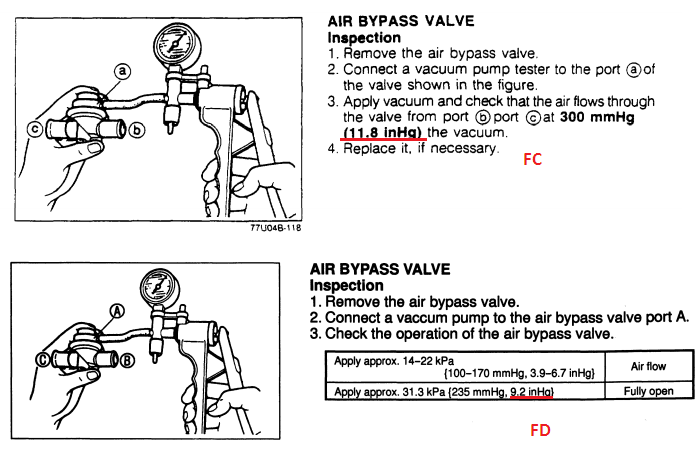
The factory FC air bypass valve opens at about 12 inches mercury, while the FD air bypass valve opens at about 9 inches:
As far as the "second waste gate" discussion: a blowoff valve can function both for venting charge air and as an overboost protection device.
As far as the "second waste gate" discussion: a blowoff valve can function both for venting charge air and as an overboost protection device.
A wastegate relieves pressure before the turbine, releasing "waste" gases into the atmosphere. A BOV that is properly designed will never leak boost, even at 100+ psi. This is because the pressure before the throttle (on the bottom of the valve) will equal the pressure on the reference line. Unless you have a large pressure drop across the IC core, or the throttle blade, this will always be true. If you do have such a substantial pressure drop, you have more issues than a BOV adjustment will properly fix.
The reason the greddy BOV requires 22" to move is because there is no pressure on the bottom side to assist the valve in opening. You are correct in lowering the spring pressure.
I actually did not see that first link from the evo site. I was posting from my phone at the time, so it doesn't surprise me if I just skipped over it. From their chart, it appears to me that the only reason greddy installed both springs simply for simplification of packaging. Hardly any boosted piston applications can provide the amount of vacuum needed to correctly operate with those spring pressures.
One thing you could do to both help response, and sound is to place the BOV on the outside of a bend in the piping. There is generally little pressure on the wall of a high flowing straight tube.
The reason the greddy BOV requires 22" to move is because there is no pressure on the bottom side to assist the valve in opening. You are correct in lowering the spring pressure.
I actually did not see that first link from the evo site. I was posting from my phone at the time, so it doesn't surprise me if I just skipped over it. From their chart, it appears to me that the only reason greddy installed both springs simply for simplification of packaging. Hardly any boosted piston applications can provide the amount of vacuum needed to correctly operate with those spring pressures.
One thing you could do to both help response, and sound is to place the BOV on the outside of a bend in the piping. There is generally little pressure on the wall of a high flowing straight tube.
The reason the greddy BOV requires 22" to move is because there is no pressure on the bottom side to assist the valve in opening. You are correct in lowering the spring pressure.
The reason why the factory valve doesn't have this problem is because it is a pull-type valve that is always open at idle. It is also designed in such a way that it never leaks. I have pressurized the FD factory air bypass valve up to 100psi with an air compressor and it holds fine. When you vent a factory air bypass valve you need to connect it to a check valve to prevent unmetered air from entering the system.

Thread
Thread Starter
Forum
Replies
Last Post
24seven_dada
3rd Generation Specific (1993-2002)
20
Nov 10, 2018 12:03 PM
Jeff20B
1st Generation Specific (1979-1985)
73
Sep 16, 2018 07:16 PM
msilvia
3rd Generation Specific (1993-2002)
15
Sep 11, 2015 12:13 PM
mulcryant
2nd Generation Specific (1986-1992)
10
Sep 9, 2015 05:24 PM
