Capacitor Interchangability Question


Thread Starter
Joined: May 2006
Posts: 4,219
Likes: 3
From: Murfreesboro, TN
Capacitor Interchangability Question
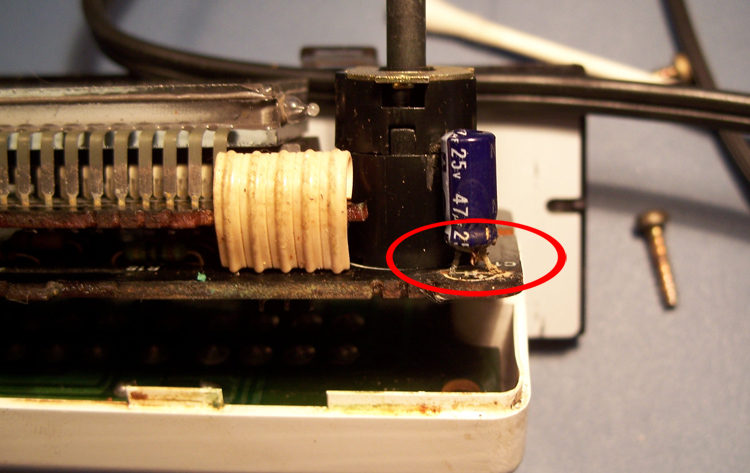
I was redoing my idiot lights and a capacitor attached to my clock area broke off (rusted somehow...). It is 25v 47uF. Apparently, Radio Shack (the only one out of 3 I could find that actually had capacitors) decided to carry every other capacitor but that one. However, I did find a 50v 47uF (and I think a 35v 47uF) that looked the exact same. Could I use that as a replacement?
Cliff notes: Can I use a 50v 47uF in place of a 25v 47uF capacitor?
P.S. Radio Shack blows.
Cliff notes: Can I use a 50v 47uF in place of a 25v 47uF capacitor?
P.S. Radio Shack blows.
Last edited by My5ABaby; Jan 23, 2007 at 03:41 PM.

Rotary Enthusiast

Joined: Feb 2006
Posts: 886
Likes: 0
From: USA
Digikey.com has proper capacitors from $0.15-$1.50 depending on some measurements you didn't give. Since you're smart enough to fix it, you're smart enough to measure it and find the one you want from them. Enjoy.

Thread Starter
Joined: May 2006
Posts: 4,219
Likes: 3
From: Murfreesboro, TN
Originally Posted by Aaron Cake
50V is fine.
But a general tip regarding electronics is to NOT SHOP AT RAT SHACK! Grab the Yellow Pages and find a real electronics store.
But a general tip regarding electronics is to NOT SHOP AT RAT SHACK! Grab the Yellow Pages and find a real electronics store.
To further it, is it basically about the Farad's being the same? Is the voltage stated on the capacitor the max it should see?
Originally Posted by Goofy
Digikey.com has proper capacitors from $0.15-$1.50 depending on some measurements you didn't give. Since you're smart enough to fix it, you're smart enough to measure it and find the one you want from them. Enjoy.

I bought my soldering iron about 2 months ago and my de-soldering iron about 1 week ago.
Here's my thread about my "progress" so far: https://www.rx7club.com/2nd-generation-specific-1986-1992-17/warning-cluster-teardown-corrosion-other-issues-w-pics-614646/

Joined: Feb 2001
Posts: 29,798
Likes: 128
From: London, Ontario, Canada
The only measurement you are concerned about matching is the capacity (ie. the uFarads). Even that is not very critical since 9x out of 10, larger value electrolytic capacitors are just used for filters and standard capacitors have a 20% tolerance value. So you could put anything around 47uF in there and likely not have issues. Hell, you could probably stuff 330uF part in there and still not experience problems but since I don't have the schematic handy I can't say for sure.
The voltage measurement is simply the maximum safe working voltage of that capacitor, so anything over 16V is fine for automotive use 99% of the time. Note that you don't want to get into higher voltage parts because the physical size of the capacitor and it's leads starts to get fairly large. Also running a HV cap at lower voltages all the time will reduce it's life...So the 50V unit is fine. I almost alway use 50V capacitors in all applications unless they call for a really low voltage (6.3V) or a much higher voltage.
The voltage measurement is simply the maximum safe working voltage of that capacitor, so anything over 16V is fine for automotive use 99% of the time. Note that you don't want to get into higher voltage parts because the physical size of the capacitor and it's leads starts to get fairly large. Also running a HV cap at lower voltages all the time will reduce it's life...So the 50V unit is fine. I almost alway use 50V capacitors in all applications unless they call for a really low voltage (6.3V) or a much higher voltage.

Lives on the Forum

Joined: Feb 2001
Posts: 26,664
Likes: 23
From: n
50V is fine.
Remember, this is a maximum rated voltage the cap can handle.
If you overvoltage the cap max rating, that thing will pop.
Keep it under the max, and the cap will stay happy.
As others have said, just as long as the farad rating is the same, everything should be cool.
-Ted
Remember, this is a maximum rated voltage the cap can handle.
If you overvoltage the cap max rating, that thing will pop.
Keep it under the max, and the cap will stay happy.
As others have said, just as long as the farad rating is the same, everything should be cool.
-Ted
Trending Topics


You could probably get it free if you when to a local college. anyway I may have one I could send you.. let me look through my stuff.
Edit: sorry I could only finda bunch of 6.3 volt ones. Keeping broken DVD players and **** helps when you need to repair other broken electronics. Though I never really have fixied anything it was a phase I went through.
Edit again: Oh yeah, Radio shack over prices their stuff by a ridiculous ammount What's a .05 cent cap they'll sell for 2 bucks.
Edit: sorry I could only finda bunch of 6.3 volt ones. Keeping broken DVD players and **** helps when you need to repair other broken electronics. Though I never really have fixied anything it was a phase I went through.
Edit again: Oh yeah, Radio shack over prices their stuff by a ridiculous ammount What's a .05 cent cap they'll sell for 2 bucks.
Last edited by yeti; Jan 24, 2007 at 02:14 AM.
Thread Starter
Joined: May 2006
Posts: 4,219
Likes: 3
From: Murfreesboro, TN
How could I get it free if I went to a local college (I go to UT...)?
I'm going to get one from Shields Electronics (they have on in Bristol too). It will probably be about .05 or something. It's good to know I could use a different (higher) voltage though.
I'm going to get one from Shields Electronics (they have on in Bristol too). It will probably be about .05 or something. It's good to know I could use a different (higher) voltage though.

Originally Posted by My5ABaby
How could I get it free if I went to a local college (I go to UT...)?
I'm going to get one from Shields Electronics (they have on in Bristol too). It will probably be about .05 or something. It's good to know I could use a different (higher) voltage though.
I'm going to get one from Shields Electronics (they have on in Bristol too). It will probably be about .05 or something. It's good to know I could use a different (higher) voltage though.
Uh, I got stacks of 47u @ 35 volt I will send you for the price of a stamp (I work in a electronics repair facility..
).
Thread Starter
Joined: May 2006
Posts: 4,219
Likes: 3
From: Murfreesboro, TN
Originally Posted by J-Rat
Uh, I got stacks of 47u @ 35 volt I will send you for the price of a stamp (I work in a electronics repair facility..).
).
Joined: Feb 2001
Posts: 29,798
Likes: 128
From: London, Ontario, Canada
Radial vs. axial just refers to mounting. Radial capacitors are the tall ones (what you are replacing). Axial capacitors are "horizontal" in that one lead exits from each side.
You can probably use either in this application since the radial will fit exactly how the old one did, and an axial capacitor can be mounted with one lead through the original hole and then the lead at the other side bent to run along the body and underneath to the other hole.
You can probably use either in this application since the radial will fit exactly how the old one did, and an axial capacitor can be mounted with one lead through the original hole and then the lead at the other side bent to run along the body and underneath to the other hole.
Thread Starter
Joined: May 2006
Posts: 4,219
Likes: 3
From: Murfreesboro, TN
Originally Posted by Aaron Cake
You can probably use either in this application since the radial will fit exactly how the old one did, and an axial capacitor can be mounted with one lead through the original hole and then the lead at the other side bent to run along the body and underneath to the other hole.

Strength and Honor

Joined: Apr 2006
Posts: 391
Likes: 0
From: CA bay area
Just to be a jerk (a bit too technical), operating electrolytic capacitors way below their rated voltage tends to lower the voltage limit of the capacitor. Also, ESR is voltage dependent on those things - the impedance changes with voltage - so if that's a cap used at some frequency, changing the voltage rating might change the output.
None of the things I just brought up should come into play here though, unless you get a cap way above the original voltage rating!
None of the things I just brought up should come into play here though, unless you get a cap way above the original voltage rating!

Joined: Dec 2003
Posts: 6,598
Likes: 10
From: Temple, Texas (Central)
Originally Posted by yeti
You could probably get it free if you when to a local college.
Also, My5ABaby, I didn't know you went to UT. Is it UT Austin? If so, we gotta meet up sometime. I live about an hour away in Killeen, but come down to Austin periodically. Once I get my car running (hopefully in the next week or two) I'm gonna try to get do to the TexasRX's meetings.
Ut is Uni of Tennessee. And I don't know if you could get it for free or not from a college but the professor at my local community college (Walters State) just gave me a few things once.
Lives on the Forum
Joined: Feb 2001
Posts: 26,664
Likes: 23
From: n
Originally Posted by stevej88na
Just to be a jerk (a bit too technical), operating electrolytic capacitors way below their rated voltage tends to lower the voltage limit of the capacitor. Also, ESR is voltage dependent on those things - the impedance changes with voltage - so if that's a cap used at some frequency, changing the voltage rating might change the output.
None of the things I just brought up should come into play here though, unless you get a cap way above the original voltage rating!
None of the things I just brought up should come into play here though, unless you get a cap way above the original voltage rating!
More technical is always appreciated.
I've never touched this stuff since freshman year in college! :P
-Ted
Thread Starter
Joined: May 2006
Posts: 4,219
Likes: 3
From: Murfreesboro, TN
Originally Posted by stevej88na
Just to be a jerk (a bit too technical), operating electrolytic capacitors way below their rated voltage tends to lower the voltage limit of the capacitor. Also, ESR is voltage dependent on those things - the impedance changes with voltage - so if that's a cap used at some frequency, changing the voltage rating might change the output.
None of the things I just brought up should come into play here though, unless you get a cap way above the original voltage rating!
None of the things I just brought up should come into play here though, unless you get a cap way above the original voltage rating!
 . From what I gather, just don't use a 309483v 47uF capacitor. Check...
Originally Posted by drago86
Make sure you put it back the same way you toke it out, electrolytic caps are polar.
Originally Posted by Sideways7
Also, My5ABaby, I didn't know you went to UT. Is it UT Austin?
Anyways, I went to the electronics store (only one I know of in town...) and they wanted ~$1.50 for one or ~$5 for a pack of 15 or so.
So, my options are, using a random example:
A) Pay $8 for a steak dinner and get 1 steak. (local)
or...
B) Pay $1 for a steak buffet and get 10 steaks. (J-Rat)
J-Rat now has a pm in his inbox.

Thread Starter
Joined: May 2006
Posts: 4,219
Likes: 3
From: Murfreesboro, TN
Originally Posted by Aaron Cake
The voltage measurement is simply the maximum safe working voltage of that capacitor, so anything over 16V is fine for automotive use 99% of the time. Note that you don't want to get into higher voltage parts because the physical size of the capacitor and it's leads starts to get fairly large. Also running a HV cap at lower voltages all the time will reduce it's life...So the 50V unit is fine. I almost alway use 50V capacitors in all applications unless they call for a really low voltage (6.3V) or a much higher voltage.
Originally Posted by gxl90rx7
and if youre bored, try running a cap with too much voltage, it will put on quite a show with lots of interesting noises lol