


battery relocation


I actually run the same battery on my BMW and because that car is on E85 it is sometimes a little recalcitrant on cold mornings. Still never had a problem.



overworking the smaller battery can be viewed the same as deep cycling it, in a sense.
electrons flow through the battery using them to power the system as it goes, the smaller the battery is the more the electrons flow versus a larger battery where the charge remains in the battery and the alternator simply keeps it topped off. it's not a drastic difference but say a normal car battery would use 25% of the battery capacity to keep the car working a battery of half the size has to do twice the work and uses 50% of it's capacity.
batteries have a cycle rating, smaller batteries will use up more cycles quicker compared to a battery twice its size.
you can also see the effects in the heat the battery generates normally. the hotter it works, the more capacity it is using. some higher quality batteries will work more efficiently than the standard lead/acid batteries but they won't tolerate the 200F engine bay as well.
electrons flow through the battery using them to power the system as it goes, the smaller the battery is the more the electrons flow versus a larger battery where the charge remains in the battery and the alternator simply keeps it topped off. it's not a drastic difference but say a normal car battery would use 25% of the battery capacity to keep the car working a battery of half the size has to do twice the work and uses 50% of it's capacity.
batteries have a cycle rating, smaller batteries will use up more cycles quicker compared to a battery twice its size.
you can also see the effects in the heat the battery generates normally. the hotter it works, the more capacity it is using. some higher quality batteries will work more efficiently than the standard lead/acid batteries but they won't tolerate the 200F engine bay as well.
Last edited by RotaryEvolution; Oct 10, 2013 at 01:56 PM.
Actually, deep cycling a battery is a specific phenomenon where the battery drops below a certain voltage level in constant use, around 7.2V for a 12V battery. That situation is not present in a car where the voltage is maintained at a constant level while the engine is operating.
The charging system in the RX-7 is more than sufficient to keep the voltage in the battery constant even with the addition of an electric fan. The smaller batteries are no more stressed with normal start/stop cycles than a big battery - what they have is less safety margin for starts in cold weather or frequent periods of long cranking. In other words, their charge will deplete more quickly if you do that. But the lifespan of the battery is not affected. It is not being "overused" or "deep cycled."
The charging system in the RX-7 is more than sufficient to keep the voltage in the battery constant even with the addition of an electric fan. The smaller batteries are no more stressed with normal start/stop cycles than a big battery - what they have is less safety margin for starts in cold weather or frequent periods of long cranking. In other words, their charge will deplete more quickly if you do that. But the lifespan of the battery is not affected. It is not being "overused" or "deep cycled."

I did put the car on a Battery Tender when it sat in the garage over the winter but otherwise it never had any special treatment and it the car was started and stopped many times over the course of a race weekend, sometimes just to move it from paddock to grid. No issues with the tiny battery. I even drove the car on the street to and from work for a couple months when I was breaking in the engine and I never had any trouble with it. But believe whatever you want; I'm not forcing anyone to run an itty bitty battery but it worked swimmingly for me.
I actually run the same battery on my BMW and because that car is on E85 it is sometimes a little recalcitrant on cold mornings. Still never had a problem.
I actually run the same battery on my BMW and because that car is on E85 it is sometimes a little recalcitrant on cold mornings. Still never had a problem.

I followed JohnV's build thread when I did mine.
I used a Braille B3121 battery. I ran new 2ga cables (both positive and negative) from the battery forward to the starter and a new 2ga positive from the the starter forward to the main fuse block. I also ran a new 4ga cable from the upgraded (100 Amp FD) alternator to the fuse block.
I have not had any issues and the new setup works well with the high output headlamps, electric cooling fan and CD ignition box.
I used a Braille B3121 battery. I ran new 2ga cables (both positive and negative) from the battery forward to the starter and a new 2ga positive from the the starter forward to the main fuse block. I also ran a new 4ga cable from the upgraded (100 Amp FD) alternator to the fuse block.
I have not had any issues and the new setup works well with the high output headlamps, electric cooling fan and CD ignition box.


I'd like to chime in on battery relocation based on my experience with Project OldTree here: https://www.rx7club.com/build-thread...tormas-888195/
The manner that I did it was very similar to Aaron Cake, though not as 'pretty'. I'm using a Deka Intimidator Group 48 battery. Weighs 50lbs, but the extra weight compared to the stock Group 35 is well worth it in my opinion. It's rated at 70AH instead of 55AH, so it's got the grunt to get things going long after a stock battery falls on its face. Box is just flat & angle iron welded together, then bolted in using existing holes in the storage bin. If I'm in a bind, I can use a group 35 again just by adding a chunk of 1.5" square tube to take up the slack.
As for the underhood stuff, what I did was run a 4awg welding cable from the main 150A breaker at the battery to a bus bar mounted inside the fender. From there, the alternator, starter & stock fuse panel are all bolted on. As for the grounds, I've got another bus bar which runs to the main chassis ground via more 4awg cable. Anything that needs a ground gets it here. These bus bars also double as convenient jumpstart points for when things go awry. Best of all, they're dirt cheap and super common too. I paid $4 each at the local Pick-N-Pull, found on any early 90s GM fullsize truck on their firewall.
Pic:
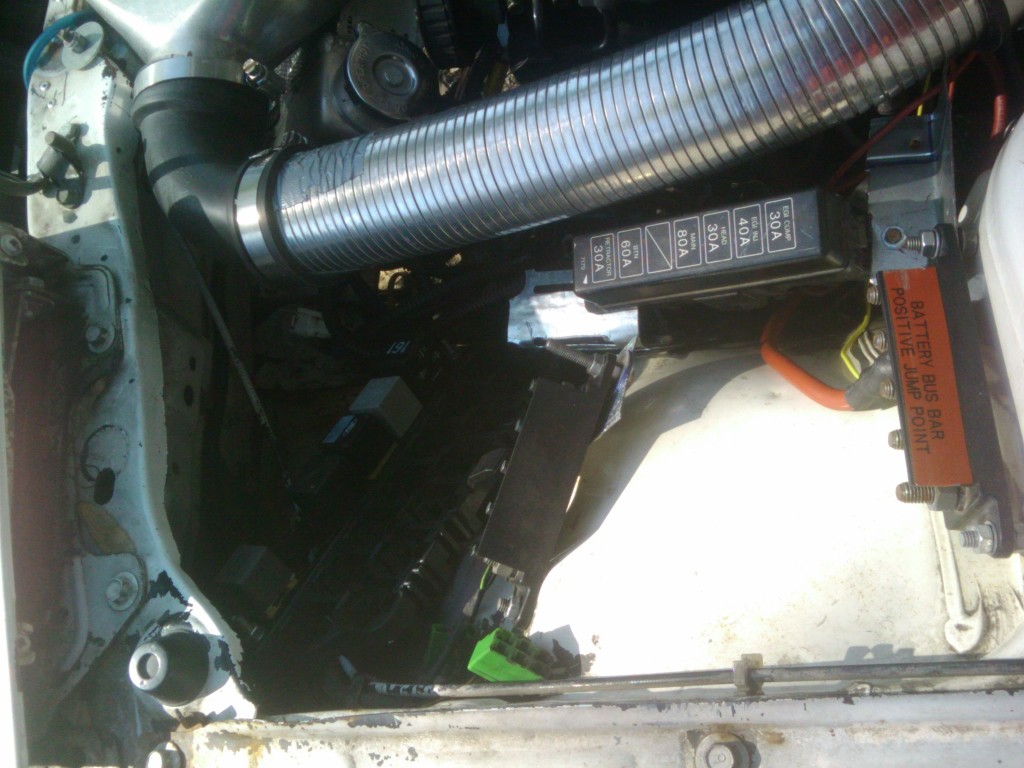
Just like Aaron Cake says to, clean them up really well with a wire wheel, use dielectric grease and you'll be happy with the results for years to come.
The manner that I did it was very similar to Aaron Cake, though not as 'pretty'. I'm using a Deka Intimidator Group 48 battery. Weighs 50lbs, but the extra weight compared to the stock Group 35 is well worth it in my opinion. It's rated at 70AH instead of 55AH, so it's got the grunt to get things going long after a stock battery falls on its face. Box is just flat & angle iron welded together, then bolted in using existing holes in the storage bin. If I'm in a bind, I can use a group 35 again just by adding a chunk of 1.5" square tube to take up the slack.
As for the underhood stuff, what I did was run a 4awg welding cable from the main 150A breaker at the battery to a bus bar mounted inside the fender. From there, the alternator, starter & stock fuse panel are all bolted on. As for the grounds, I've got another bus bar which runs to the main chassis ground via more 4awg cable. Anything that needs a ground gets it here. These bus bars also double as convenient jumpstart points for when things go awry. Best of all, they're dirt cheap and super common too. I paid $4 each at the local Pick-N-Pull, found on any early 90s GM fullsize truck on their firewall.
Pic:
Just like Aaron Cake says to, clean them up really well with a wire wheel, use dielectric grease and you'll be happy with the results for years to come.

Joined: Sep 2005
Posts: 25,581
Likes: 136
From: Smiths Falls.(near Ottawa!.Mapquest IT!)
El-cheapo way is to just extend the positive cable and run it to the Battery in the Bin.
If you look at the price of Cable,then look at the price of Booster cable..hmm?...see where I am going?
Run a Negative to the Body and Trans.If you want to get real "slick" then run another off the engine back to the body up front.
I actually did this for a bit before I re-wired the car underneath.It wasn't real pretty but it did the job.
If you look at the price of Cable,then look at the price of Booster cable..hmm?...see where I am going?
Run a Negative to the Body and Trans.If you want to get real "slick" then run another off the engine back to the body up front.
I actually did this for a bit before I re-wired the car underneath.It wasn't real pretty but it did the job.
More pictures that I found when I did mine. I do not trust the ground path though the spot welds of a 20 something year old uni-body. That is why I ran both cables forward. I upgraded to 2ga cables because of the load and distance factors. That is the same reason that I upgraded the cable from the 100 Amp FD alternator to main fuse block to 4ga. I also upgraded the main breaker from 100 Amp to 125 Amp.

Thread
Thread Starter
Forum
Replies
Last Post
Turblown
Vendor Classifieds
12
Oct 17, 2020 03:25 PM
FC3S Timmy
2nd Generation Specific (1986-1992)
16
Oct 3, 2015 01:08 AM
FC3S Timmy
2nd Generation Specific (1986-1992)
8
Oct 2, 2015 08:08 AM