


Alignment spec recommendations?


Thread Starter
Triangles and Cats

Joined: Apr 2013
Posts: 344
Likes: 0
From: corona california
Lets start with the car itself
Its an s5 vert on DECENT gripping all season tires that are 215/45 17, will be moving to hankook ventus v12 when these go out
Racing beat springs and bilstein shocks/struts with racing beat front strut tower mounts
Basically stock power-wise
I dont know anything about ideal alignment specs for FCs so here i am, asking you good folks.
What do you recommend for the best gripping setup? Asking specifically for camber, toe, and caster settings
Its an s5 vert on DECENT gripping all season tires that are 215/45 17, will be moving to hankook ventus v12 when these go out
Racing beat springs and bilstein shocks/struts with racing beat front strut tower mounts
Basically stock power-wise
I dont know anything about ideal alignment specs for FCs so here i am, asking you good folks.
What do you recommend for the best gripping setup? Asking specifically for camber, toe, and caster settings



Joined: Mar 2001
Posts: 31,851
Likes: 3,241
From: https://www2.mazda.com/en/100th/
i had a stock FC i played around with a few years ago, and here is what i liked.
zero toe in the front. handling didn't change much between toe in and toe out, but right around zero toe the steering feels better.
camber should be as much negative as you can get in the front. the upper strut mounts are eccentric, so you will want to rotate them so the strut is in and toward the rear. this will give you around -.5 which is enough, more would help. a track car would be running anything from -2 to -5
this also gives you max caster, which doesn't do much, but hey its there.
in the rear, stock camber is not adjustable, -1.5 is about where it will be. little less is better
the adjustment that made the biggest difference is rear toe in. the stock setting is a ton of toe in. and it feels really stable. zero toe felt great, although with zero toe it does want you to be on the throttle in a corner before the apex, which isn't really possible on the street. i added a little toe until i was happy, the stock adjusters have marks on them, so its really easy to move the toe an equal amount on each side.
and don't be afraid to play around with it, its pretty easy to set toe in the driveway (you tube toe plates), and the FSM has a measurement for the rear.
zero toe in the front. handling didn't change much between toe in and toe out, but right around zero toe the steering feels better.
camber should be as much negative as you can get in the front. the upper strut mounts are eccentric, so you will want to rotate them so the strut is in and toward the rear. this will give you around -.5 which is enough, more would help. a track car would be running anything from -2 to -5
this also gives you max caster, which doesn't do much, but hey its there.
in the rear, stock camber is not adjustable, -1.5 is about where it will be. little less is better
the adjustment that made the biggest difference is rear toe in. the stock setting is a ton of toe in. and it feels really stable. zero toe felt great, although with zero toe it does want you to be on the throttle in a corner before the apex, which isn't really possible on the street. i added a little toe until i was happy, the stock adjusters have marks on them, so its really easy to move the toe an equal amount on each side.
and don't be afraid to play around with it, its pretty easy to set toe in the driveway (you tube toe plates), and the FSM has a measurement for the rear.


Joined: Oct 2003
Posts: 11,576
Likes: 27
From: Morristown, TN (east of Knoxville)
You could always get one of those adjustable rear camber arms to take a little of the factory camber out. IT will help with tire wear, if you are concerned with that. IF handling is your priority, most people leave the camber about where it is in the rear.
Don't forget to consider DTSS eliminator bushings in the rear.
Don't forget to consider DTSS eliminator bushings in the rear.
Thread Starter
Triangles and Cats
Joined: Apr 2013
Posts: 344
Likes: 0
From: corona california
You could always get one of those adjustable rear camber arms to take a little of the factory camber out. IT will help with tire wear, if you are concerned with that. IF handling is your priority, most people leave the camber about where it is in the rear.
Don't forget to consider DTSS eliminator bushings in the rear.
Don't forget to consider DTSS eliminator bushings in the rear.
Joined: Mar 2001
Posts: 31,851
Likes: 3,241
From: https://www2.mazda.com/en/100th/
they do, but in a weird way.
WITH the DTSS working, the car turns in a lot harder, and in a slow turn feels like it can square off a turn, and it can feel un natural.
with the DTSS REMOVED, the car is more linear, however it tends to be snappier when you are at the limit.
in a street car i kind of like the DTSS, like i say, in a slow turn, it'll square it off
WITH the DTSS working, the car turns in a lot harder, and in a slow turn feels like it can square off a turn, and it can feel un natural.
with the DTSS REMOVED, the car is more linear, however it tends to be snappier when you are at the limit.
in a street car i kind of like the DTSS, like i say, in a slow turn, it'll square it off

DTSS eliminators make the rear of the car much easier to control and to predict when driving at the limit. The DTSS system is a type of passive rear steering, meant to improve turn-in feel under light cornering loads by deflecting the toe of the outside rear in opposite phase to the front under moderate loads (decreasing your turn radius relative to steering wheel input), then at around .5g lateral load, or under braking, shifting to same-phase steering, meaning rear-toe in, which is more stable when doing a high-speed lane change - or driving hard in a track setting. It is a system intended to combat the geometry shortcomings inherent in a semi-trailing arm independent rear suspension design.
The problem is, in a track or other sustained high-G load setting, most drivers find the rear of the car both unpredictable (specifically, prone to snap oversteer), and uncommunicative (you don't get honest feedback on what the rear end is doing or about to do as you approach the limit - making it hard to find and hold the limit, and avoid that snap oversteer). If you don't track or autocross the car, you might never notice the problem, and if your DTSS bushings aren't worn out, it adds a nice sense of extra agility in street driving (many are worn out at this point, with the age and mileage of these cars).
The gist of it is, if your DTSS bushings are worn out (they can only be replaced by buying new floating hubs at ~$700/side from Mazda, no one supplies the OEM bushing or an equivalent separately), or if you intend to track the car, getting rid of DTSS is a good idea. Signs of worn DTSS bushings can be the car (specifically the rear) pulling one way or the other, and especially if the pull changes, particularly as you transition from on the gas to off, or vice-versa. Years ago, I wrote a much lengthier response on the DTSS system, including why it makes the car hard to control at the limit, found here https://www.rx7club.com/2nd-generati...-621078/page4/, with an earlier, shorter response by me on page 3 of the same thread. If you want to get back a bit of the quick steering response in street driving that is lost when going with DTSS eliminator bushings, get some street-friendly lowering springs like those Racing Beat offers, and the moderate lowering and firmer springs will more than make up for the slight loss of quick turn-in feel that getting rid of DTSS causes.
The problem is, in a track or other sustained high-G load setting, most drivers find the rear of the car both unpredictable (specifically, prone to snap oversteer), and uncommunicative (you don't get honest feedback on what the rear end is doing or about to do as you approach the limit - making it hard to find and hold the limit, and avoid that snap oversteer). If you don't track or autocross the car, you might never notice the problem, and if your DTSS bushings aren't worn out, it adds a nice sense of extra agility in street driving (many are worn out at this point, with the age and mileage of these cars).
The gist of it is, if your DTSS bushings are worn out (they can only be replaced by buying new floating hubs at ~$700/side from Mazda, no one supplies the OEM bushing or an equivalent separately), or if you intend to track the car, getting rid of DTSS is a good idea. Signs of worn DTSS bushings can be the car (specifically the rear) pulling one way or the other, and especially if the pull changes, particularly as you transition from on the gas to off, or vice-versa. Years ago, I wrote a much lengthier response on the DTSS system, including why it makes the car hard to control at the limit, found here https://www.rx7club.com/2nd-generati...-621078/page4/, with an earlier, shorter response by me on page 3 of the same thread. If you want to get back a bit of the quick steering response in street driving that is lost when going with DTSS eliminator bushings, get some street-friendly lowering springs like those Racing Beat offers, and the moderate lowering and firmer springs will more than make up for the slight loss of quick turn-in feel that getting rid of DTSS causes.
As far as alignment - the stock front has limited adjustment. You can get some camber and caster adjustment, because the stock upper strut mount is eccentrically mounted (fancy for, the strut is off-center in the mount). That means you can rotate the upper mount in 90 degree increments (corresponding to the bolt holes), and move the upper strut axis slightly front to back (affecting caster), and in or out relative to the front-to-rear centre line of the car to affect camber. You should see a little rubber tab inside the dish around the upper strut shaft bolt, directly aligned with one of the four upper strut mount bolts on the strut tower. That tab indicates which "corner" of the upper strut mount the strut shaft is closest to. Rotate that tab such that on both sides it is at the rear, and towards the centre/engine, which will maximize the castor angle (which improves steering feel/feedback), and will get the camber close to zero, or if you're lucky, slightly negative. See the attached photo - this is the left strut, so left is front, right is rear, and the strut mount is rotated to the rearmost/inside position. Jack up the front, undo the four upper strut mount bolts, pull down a bit on the tire to get the studs clear of the holes, and rotate the top of the strut by hand to line it up with the holes you want. Then set the front toe to zero, and done. 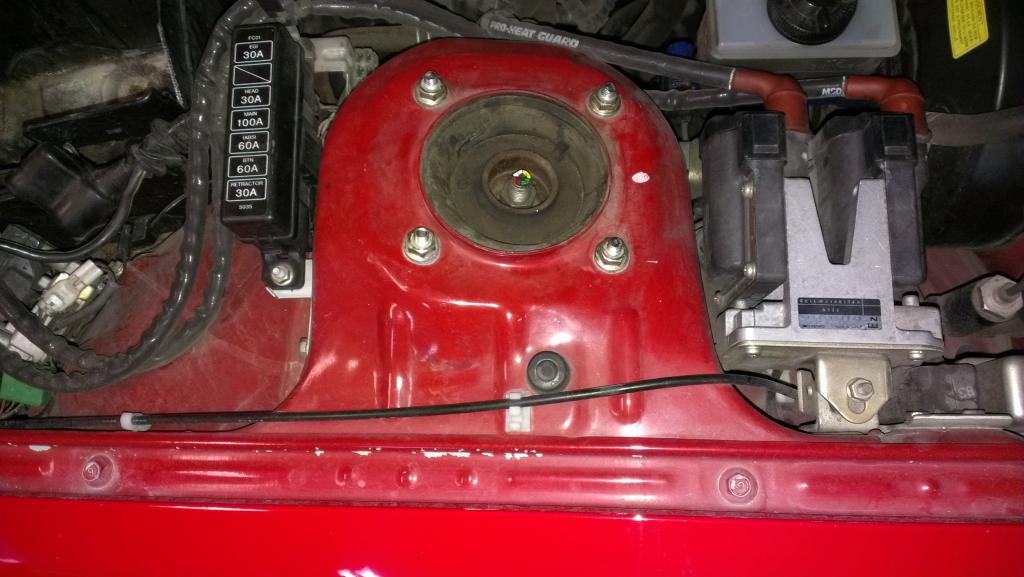
For the rear, some slight toe-in will enhance rear stability and high-speed handling regardless of whether you have the DTSS bushings or have replaced them with eliminators; the toe adjuster is at the front of each trailing arm, just inside of the factory jack point, and has handy index marks. I give mine 1/8" of total toe in, which works out to moving the marks on the bolt head one off the bottom/centre indicator notch (rotated towards the front of the vehicle, iirc). You'll need two 17mm wrenches to do the adjustment.

For the rear, some slight toe-in will enhance rear stability and high-speed handling regardless of whether you have the DTSS bushings or have replaced them with eliminators; the toe adjuster is at the front of each trailing arm, just inside of the factory jack point, and has handy index marks. I give mine 1/8" of total toe in, which works out to moving the marks on the bolt head one off the bottom/centre indicator notch (rotated towards the front of the vehicle, iirc). You'll need two 17mm wrenches to do the adjustment.
Trending Topics

i had a stock FC i played around with a few years ago, and here is what i liked.
zero toe in the front. handling didn't change much between toe in and toe out, but right around zero toe the steering feels better.
camber should be as much negative as you can get in the front. the upper strut mounts are eccentric, so you will want to rotate them so the strut is in and toward the rear. this will give you around -.5 which is enough, more would help. a track car would be running anything from -2 to -5
this also gives you max caster, which doesn't do much, but hey its there.
in the rear, stock camber is not adjustable, -1.5 is about where it will be. little less is better
the adjustment that made the biggest difference is rear toe in. the stock setting is a ton of toe in. and it feels really stable. zero toe felt great, although with zero toe it does want you to be on the throttle in a corner before the apex, which isn't really possible on the street. i added a little toe until i was happy, the stock adjusters have marks on them, so its really easy to move the toe an equal amount on each side.
and don't be afraid to play around with it, its pretty easy to set toe in the driveway (you tube toe plates), and the FSM has a measurement for the rear.
zero toe in the front. handling didn't change much between toe in and toe out, but right around zero toe the steering feels better.
camber should be as much negative as you can get in the front. the upper strut mounts are eccentric, so you will want to rotate them so the strut is in and toward the rear. this will give you around -.5 which is enough, more would help. a track car would be running anything from -2 to -5
this also gives you max caster, which doesn't do much, but hey its there.
in the rear, stock camber is not adjustable, -1.5 is about where it will be. little less is better
the adjustment that made the biggest difference is rear toe in. the stock setting is a ton of toe in. and it feels really stable. zero toe felt great, although with zero toe it does want you to be on the throttle in a corner before the apex, which isn't really possible on the street. i added a little toe until i was happy, the stock adjusters have marks on them, so its really easy to move the toe an equal amount on each side.
and don't be afraid to play around with it, its pretty easy to set toe in the driveway (you tube toe plates), and the FSM has a measurement for the rear.
Joined: Mar 2001
Posts: 31,851
Likes: 3,241
From: https://www2.mazda.com/en/100th/
the FC has a good camber curve in the rear, it just starts out with a little more than it wants. at about -1.3, the later FC's (mid 91), had a revised rear control arm for less rear camber.
And sorry, I skimmed the earlier responses and failed to see j9fd3s talked about both front and rear alignment (I caught the rear piece but not the front), so I didn't mean to basically entirely replicate what he said.
Joined: Mar 2001
Posts: 31,851
Likes: 3,241
From: https://www2.mazda.com/en/100th/


Thread
Thread Starter
Forum
Replies
Last Post
Jeff20B
1st Generation Specific (1979-1985)
73
Sep 16, 2018 07:16 PM
HalifaxFD
Canadian Forum
126
May 9, 2016 07:06 PM
erevos
2nd Generation Specific (1986-1992)
4
Sep 15, 2015 09:19 AM