


Tach reading..



im assuming this is because of the 120 degree phasing vs the 180? no wait, one rotor must fire at the same frequency as a 13b... im not sure why the signal should differ.
ok so to remedy the problem i need the previously mentioned converter?
ok so to remedy the problem i need the previously mentioned converter?

Think of it as the tach trying to work with a V6 signal from the ECU. It'll be 50% more sparks per RPM than a 4 cylinder/13B. That's why it needs that convertor box. Or you could adjust the tach (there's a FAQ on Granny's website), but I'm not sure if it'll be accurate throughout the entire range of the tach.
Another thing to worry about if hooking it to one of the coils is the fact that that one coil will only fire once per revolution. That's 50% less sparks per RPM than a 4 cylinder/13B. Again, the tach would need adjustment or a convertor box.
As for me... (I get to keep my stock 4 cylinder/13B tach without the need for adjustments or a convertor box because I fill smart).
Another thing to worry about if hooking it to one of the coils is the fact that that one coil will only fire once per revolution. That's 50% less sparks per RPM than a 4 cylinder/13B. Again, the tach would need adjustment or a convertor box.
As for me...
(I get to keep my stock 4 cylinder/13B tach without the need for adjustments or a convertor box because I fill smart).
Last edited by Jeff20B; May 10, 2004 at 09:22 PM.
Because the coil my tach is going to be hooked to will have the same amount of sparks per rev as a 4 cylinder or 13B. Therefore it's going to be matched perfectly.
This is not a joke about a 13B or whatever – it is a 20B that will run like this. I call it TLIDFIS.
This is not a joke about a 13B or whatever – it is a 20B that will run like this. I call it TLIDFIS.


All 20Bs have one leading spark per rotor face. All stock '86 and later 13Bs had two leading sparks per rotor face.
Since two rotor engines have both rotors spaced 180 degrees apart, it makes perfect sense to spark them both at the same time. It also made a substantial improvement to all my old style four port 13Bs in my REPUs etc.
I like the dual leading sparks so much I figured out a way to get 0 and 180 degree leading sparks on a 20B while spacing them 120 degrees apart so each rotor is still timed correctly. This allows me to keep my stock 4 cylinder/rotary tach without adjustment.
To be honest, I actually thought the 20B was supposed to have dual leading sparks per rotor like all the 13Bs do. Then I found out it had single sparks like '85 and older RX-7s. I also discovered that all aftermarket ECUs that people have connected to their 20Bs also lacked the ability to spark the leading plugs twice per rotor face. I had built a one-of-a-kind sort of thing without even realizing it.
If you're interested in the firing order, here it is.
L1 0
L3 60*
L2 120
L1 180*
L3 240
L2 300*
*=180º spark
If it's confusing, just think of 0, 120 and 240 without the 2nd leading spark per rotor face. Then add it and see what you come up with. It should match what I've posted, but I could have screwed up on my match.
So what do you think?
Since two rotor engines have both rotors spaced 180 degrees apart, it makes perfect sense to spark them both at the same time. It also made a substantial improvement to all my old style four port 13Bs in my REPUs etc.
I like the dual leading sparks so much I figured out a way to get 0 and 180 degree leading sparks on a 20B while spacing them 120 degrees apart so each rotor is still timed correctly. This allows me to keep my stock 4 cylinder/rotary tach without adjustment.
To be honest, I actually thought the 20B was supposed to have dual leading sparks per rotor like all the 13Bs do. Then I found out it had single sparks like '85 and older RX-7s. I also discovered that all aftermarket ECUs that people have connected to their 20Bs also lacked the ability to spark the leading plugs twice per rotor face. I had built a one-of-a-kind sort of thing without even realizing it.
If you're interested in the firing order, here it is.
L1 0
L3 60*
L2 120
L1 180*
L3 240
L2 300*
*=180º spark
If it's confusing, just think of 0, 120 and 240 without the 2nd leading spark per rotor face. Then add it and see what you come up with. It should match what I've posted, but I could have screwed up on my match.
So what do you think?
well im thinking 2 things... why would mazda do this to the 20b's seeing as its the "old way" to do things? also, do you make more power with the double spark? what about trailing? when do they fire? im trying to figure out what the firing sequence is if there are 3 (2L, 1T) sparks per rotor.... and shouldnt we see increased wear on the leading plugs with twice the firing? sorry for all the questions... im trying to understand
I think the reason why Mazda only had one leading spark per rotor on the 20B was because it would have been more complicated to do two, and it was basically a continuation of the MX03 concept car from '84 (13G engine). I guess they felt the 20BREW was complicated enough (man it's got a serious rats nest on it!).
All the engines I've upgraded to double spark (DLIDFIS) have shown great improvements in more power everywhere in the RPM range, easier starts, better fuel economy, lower emissions, and it even changed the exhaust note to something more smooth and FC-ish (less raggedy and put-put-ish).
I also found that switching trailing off while driving gave no difference that I could detect, although I thought it may have added maybe 1HP during a hill climb, but it could have been something in the road. I had a friend switch it on and off and we could have sworn there was no difference. In other words, when leading is sparking into the trailing edge of the AF mixture, it basically causes trailing ignition to become redundant (it's sparking through a bigger hole afterall). I've left trailing off and couldn't detect anything different from starting the engine to low, mid and high RPM through all sorts of driving conditions. Thanks to this testing, I won't even bother with trailing on my 20B for right now. I did build a trailing direct fire pickup plate, but I can't justify the cost for the amount of power trailing adds to the output of the engine. I also don't have room for three more coils.
If you wanted to run trailing, it would just follow each first leading spark at 15, 135 and 255 degrees. You can't spark trailing 180 degrees later and expect your engine to be happy like you can with leading.
As for the wear on the plugs, they'll be sparking as often as 13B plugs so they won't wear any faster than your typical 13B.
Here are some pics from the top.
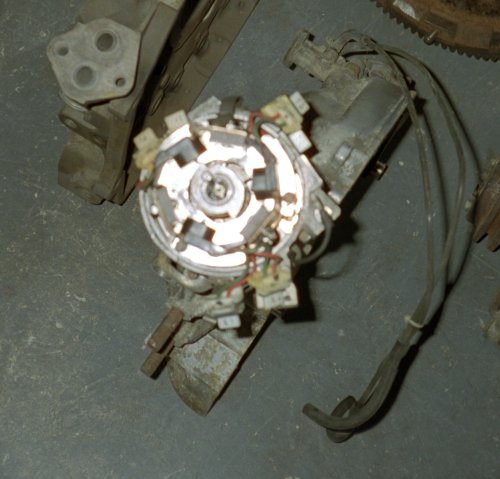
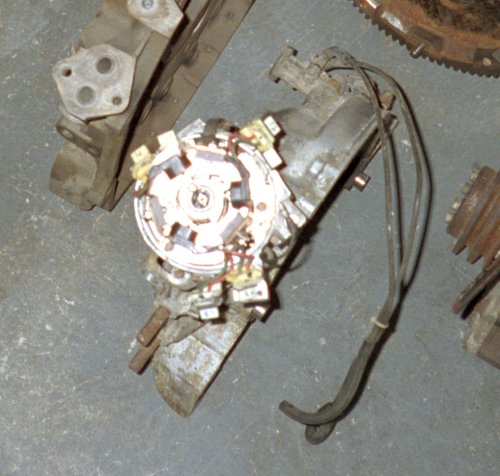
Sorry about the quality, but you can sort of make out six pickup plugs. Notice how the reluctor at the top has only two tips? The one down at the stock location has four. It's a standard '81-'85 distributor with six pickups, three per level, with trailing on top on an idependantly rotatable base to set the trailing split. Too bad Mazda didn't do something like this for that MX-03 concept? Anyway, enjoy and let me know what you think.
All the engines I've upgraded to double spark (DLIDFIS) have shown great improvements in more power everywhere in the RPM range, easier starts, better fuel economy, lower emissions, and it even changed the exhaust note to something more smooth and FC-ish (less raggedy and put-put-ish).
I also found that switching trailing off while driving gave no difference that I could detect, although I thought it may have added maybe 1HP during a hill climb, but it could have been something in the road. I had a friend switch it on and off and we could have sworn there was no difference. In other words, when leading is sparking into the trailing edge of the AF mixture, it basically causes trailing ignition to become redundant (it's sparking through a bigger hole afterall). I've left trailing off and couldn't detect anything different from starting the engine to low, mid and high RPM through all sorts of driving conditions. Thanks to this testing, I won't even bother with trailing on my 20B for right now. I did build a trailing direct fire pickup plate, but I can't justify the cost for the amount of power trailing adds to the output of the engine. I also don't have room for three more coils.
If you wanted to run trailing, it would just follow each first leading spark at 15, 135 and 255 degrees. You can't spark trailing 180 degrees later and expect your engine to be happy like you can with leading.
As for the wear on the plugs, they'll be sparking as often as 13B plugs so they won't wear any faster than your typical 13B.
Here are some pics from the top.
Sorry about the quality, but you can sort of make out six pickup plugs. Notice how the reluctor at the top has only two tips? The one down at the stock location has four. It's a standard '81-'85 distributor with six pickups, three per level, with trailing on top on an idependantly rotatable base to set the trailing split. Too bad Mazda didn't do something like this for that MX-03 concept? Anyway, enjoy and let me know what you think.
well im definatly impressed with that information... although if the trailing plugs did nothing im not sure why mazda would go through so much trouble (read spend so much money) on adding the extra stuff to have the trailing plugs. im very interested in the fact that turning on the trailing plugs did nothing for power...
the 757race motor or whatever the hell it is called uses 3 plugs for each rotor though... there must be a reason for this... if they could just spark the same plug 2 or 3 times i dont see why they wouldnt do that (except for low sparkplug life expectancy).
so i have a stock running (well sort of) FD (not the project car).... you're telling me that A) the leading plugs DO IN FACT fire twice? therefore if your testing is correct you are saying that i can unplug my trailing plugs and i will see no difference in performance?
the 757race motor or whatever the hell it is called uses 3 plugs for each rotor though... there must be a reason for this... if they could just spark the same plug 2 or 3 times i dont see why they wouldnt do that (except for low sparkplug life expectancy).
so i have a stock running (well sort of) FD (not the project car).... you're telling me that A) the leading plugs DO IN FACT fire twice? therefore if your testing is correct you are saying that i can unplug my trailing plugs and i will see no difference in performance?

Joined: Mar 2001
Posts: 31,851
Likes: 3,239
From: https://www2.mazda.com/en/100th/
the trailing plugs may not do a lot for power, but they do do a lot for emissions.
as far as the race motors are concerned they are interested in 2 things, power and fuel economy. i think for the lemans cars they are only allowed a certain amount of fuel to run the whole race so it becomes very important to use every drop of fuel as much as you can.
in a production car the extra coils, wires, and plugs add cost more than they drop gas mileage
as far as the race motors are concerned they are interested in 2 things, power and fuel economy. i think for the lemans cars they are only allowed a certain amount of fuel to run the whole race so it becomes very important to use every drop of fuel as much as you can.
in a production car the extra coils, wires, and plugs add cost more than they drop gas mileage
I would have to agree with everything j9fd3s said. Also, the engine I tested switchable trailing was in my REPU. I don't know what trailing will do for a forced induction engine, power-wise. You have to use high octane gas which burns more slowly than the good old 87 I get to use. :p Trailing may be good to use in higher octane situations because of the slower burning of the fuel (trailing sort of acts like a longer duration spark and ignites the AF mixture at the trailing edge of the 'bathtub').
The 787B had three plugs with only sparked once per rotor face. I would have had the leading plugs spark again at 180º, but might have accelerated wear on just htose plugs. Oh well, it won anyway.
If I remember right, the third or 'late trailing' plug hole caused a slight compression loss which reduced torque, but increased gas mileage.
The 787B had three plugs with only sparked once per rotor face. I would have had the leading plugs spark again at 180º, but might have accelerated wear on just htose plugs. Oh well, it won anyway.
If I remember right, the third or 'late trailing' plug hole caused a slight compression loss which reduced torque, but increased gas mileage.

I fired it up yesterday. The carb and intake setup sucked (not in a good way) but the ignition worked great. I can't wait to get a better setup and try it again. It even sounded a little smoother than RETed's, since watching his video over and over.

Thread
Thread Starter
Forum
Replies
Last Post
Thor 18
3rd Generation Specific (1993-2002)
5
Sep 28, 2015 07:35 PM
befarrer
Adaptronic Engine Mgmt - AUS
3
Sep 22, 2015 09:33 AM
