


carb problem


Thread Starter
Junior Member
Joined: Jul 2009
Posts: 10
Likes: 0
From: Delmar MD
carb problem
so what would cause a loss of power after 4k kinda like its missing bad and hard to start, i was told that after 4k the secondarys would open up so i took the top off intake and reved it to 4500 5000 rpms no secondarys so while running i pulled the secondary lever and it reved VERY quickly to 5k np at all should it spray after 4k i was told it would feel like a honda vtec after 4k the sudden lil rush of power and it doesn't do it. does that mean secondarys, so if it is how do i get it to work.

Joined: Jun 2008
Posts: 8,376
Likes: 28
From: Chino Hills, CA
What year and build is the car? Makes a big difference.
The vacuum secondaries only open under load... just revving without a load on the motor usually will not open them.
The vacuum secondaries only open under load... just revving without a load on the motor usually will not open them.

I don't think that's true. You need to have a friend put the peddle to the floor. quick. by the time you hit red line they should start to open a little bit. you cant get them to open with less than half the throttle depressed, under load or not with or without mech seconds. the part of the linkage that you wire up mech secondaries prevents them from opening unless your accelerating.
Joined: Jun 2008
Posts: 8,376
Likes: 28
From: Chino Hills, CA
I don't think that's true. You need to have a friend put the peddle to the floor. quick. by the time you hit red line they should start to open a little bit. you cant get them to open with less than half the throttle depressed, under load or not with or without mech seconds. the part of the linkage that you wire up mech secondaries prevents them from opening unless your accelerating.
The load in this case is only the engine's inertia, which isn't much, compared to the load of actually accelerating the whole car.
I thought you were meaning the car had to be in gear. I just was explaining that the motor has to be past half throttle before the secondarys can try to open. I wasn't meaning to call you out or nothing 

Full Member
Joined: Sep 2007
Posts: 52
Likes: 0
From: St Catharines, ON, Canada
i had the same issues as you, so i pulled off the carb and played with the throttle. I then noticed that the secondary linkage (opposite the throttle) was not moving. So a little WD40 unseized her.
Pull the carb off and check it out
Pull the carb off and check it out


Trending Topics
Nikki-Modder Rex-Rodder

Joined: Feb 2001
Posts: 2,890
Likes: 14
From: Trying to convince some clown not to put a Holley 600 on his 12a.
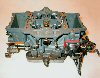
The stock Nikki secondary throttle shaft is opened via secondary signal from the left primary venturi. There's a hole in the venturi at it's apex, and the circuit ends at the "secondary vacuum box". As velocity increases through the venturi, a low pressure system is caused (due to the Bernoulli principal), and vacuum pulls on the diaphragm inside the box, which pulls on the lever, opening the secondary shaft.
On part of the linkage associated with the primary throttle shaft there is a locking mechanism that keeps the secondary throttle shaft from opening until the primary shaft is approximately half way open.
When the secondaries start to open, the velocity through the primary venturi that originally created the vacuum that opened them in the first place drops slightly, and so the result is that vacuum secondaries tend to come on very subtle, and are rarely ever fully opened. They fluctuate a lot as a result of being one of the variables that effects the velocity through the primary venturis in the carburetor.
Mechanical secondaries, on the other hand, don't fluctuate and open as far as the throttle allows, resulting in four differences; instant gratification, lower fuel mileage, a bog if the transition is done too quickly or too low in the RPMs ("secondary bog"), and your carb can truly be at WOT whenever you want.
People often say that the Nikki vacuum secondaries only open "under load". This is true, but few ever explain how or why, and the result is that some folks are left a bit confused and un-necessarily believing the Nikki to be more complicated than it really is.
The vacuum secondaries in the Nikki carburetor are simply opening when adequate velocity comes through the carb. The reason they don't open in the driveway is because the velocity isn't enough at that point. You could get them to open in the driveway, but at sustained RPMs necessary, you'd blow your engine.
Even though the engine RPMs may read 8000 on the tach, the volumetric efficiency of your engine as it spins freely while you rev it in the driveway is very low. There's no resistance to absorb all of the energy made by the engine, so it's explosively blowing past the intake cycle without ingesting as much as it is capable of. You can liken this to cavitation in a water pump at high RPM. Part of this is due to the exhaust not being able to evacuate gas which may be nearly tripled the volume of the air trying to enter the engine at the other end.
When the engine has a load on it, the RPM climbs at a considerably slower rate, giving the intake and exhaust a chance to get up to a good flow rate. While driving, by the time the primary linkage is releasing the lock on the secondary shaft, there is already a very efficient flow through the engine.
On part of the linkage associated with the primary throttle shaft there is a locking mechanism that keeps the secondary throttle shaft from opening until the primary shaft is approximately half way open.
When the secondaries start to open, the velocity through the primary venturi that originally created the vacuum that opened them in the first place drops slightly, and so the result is that vacuum secondaries tend to come on very subtle, and are rarely ever fully opened. They fluctuate a lot as a result of being one of the variables that effects the velocity through the primary venturis in the carburetor.
Mechanical secondaries, on the other hand, don't fluctuate and open as far as the throttle allows, resulting in four differences; instant gratification, lower fuel mileage, a bog if the transition is done too quickly or too low in the RPMs ("secondary bog"), and your carb can truly be at WOT whenever you want.
People often say that the Nikki vacuum secondaries only open "under load". This is true, but few ever explain how or why, and the result is that some folks are left a bit confused and un-necessarily believing the Nikki to be more complicated than it really is.
The vacuum secondaries in the Nikki carburetor are simply opening when adequate velocity comes through the carb. The reason they don't open in the driveway is because the velocity isn't enough at that point. You could get them to open in the driveway, but at sustained RPMs necessary, you'd blow your engine.
Even though the engine RPMs may read 8000 on the tach, the volumetric efficiency of your engine as it spins freely while you rev it in the driveway is very low. There's no resistance to absorb all of the energy made by the engine, so it's explosively blowing past the intake cycle without ingesting as much as it is capable of. You can liken this to cavitation in a water pump at high RPM. Part of this is due to the exhaust not being able to evacuate gas which may be nearly tripled the volume of the air trying to enter the engine at the other end.
When the engine has a load on it, the RPM climbs at a considerably slower rate, giving the intake and exhaust a chance to get up to a good flow rate. While driving, by the time the primary linkage is releasing the lock on the secondary shaft, there is already a very efficient flow through the engine.

Thread
Thread Starter
Forum
Replies
Last Post
Jeff20B
1st Generation Specific (1979-1985)
73
Sep 16, 2018 07:16 PM
The1Sun
1st Generation Specific (1979-1985)
7
Sep 18, 2015 07:13 PM
The1Sun
New Member RX-7 Technical
5
Sep 15, 2015 04:45 PM
heywier427
Naturally Aspirated Performance Forum
2
Sep 11, 2015 04:49 PM
