


brake pedal sinking.

Thread Starter
Rotary traitor
Joined: Dec 2007
Posts: 291
Likes: 0
From: Brookings SD
brake pedal sinking.
did a sbc swap a year or so ago and noticed that when i did it the brakes went from great to not impressive. the pedal doesn't feel like its going to engage till about 2/3 of the way down then it hits pressure then you can slowely feel it bleed off till it hits bottom, pumping doesn't really help. does this sound like a low vac (large cam) from where it goes to the manifold or do i just need to replace the master?


Vacuum issues make the pedal harder. Hydraulic issues make the pedal softer (unless in theory the cylinder seized or was blocked).
Sounds like a classic case of a dead master cylinder, just to be safe, here's a quick checklist of things to look at before you go buying parts.
1. check the condition of the fluid and reservoir, is the fluid low? black? leaking around the reservoir seals? Is the paint on the booster beneath the master cylinder wet, damp or extremely rusted? (brake fluid eats paint and will cause rust, sometimes a sign of a dead one or one that has died before).
2. Check the condition of all 5 flex hose, 1 at each wheel (4 wheel disc), 1 from the body to the rear axle, each of these is likely to be cracked on the outter casing but make sure there is no dampness, twist and bend the lines carefully and look for any more dampness, swelling, bubbling etc.
3. Check each caliper. Check each caliper with a flashlight and look for signs of dampness, wetness inside the wheel, on the dust pan behind the caliper, check all the bleeder screws as well for dampness, leaking etc.
3a. if you have a vehicle with drum brakes, this can be slightly annoying but if it's sinking as bad as you say, it's likely far more noticable, look at the 6 o'clock position on the brake drum and see if there is anything dripping then it's likely a wheel cylinder that's gone bad and it's dumping the brake fluid into the inside of the drum assembly. A more effective inspection would involve removing the wheel and drum and inspecting everything as well as a couple cans of brake clean while you're there to clean up any dust and buildup.
If all of these check out and there are no visible leaks, it's safe to say the master cyl is the issue, mine died the same way but took gentle massaging to get it to sink, you could pump it hard and it'd be fine, slowly massage it and it'd sink straight to the floor. Most new master cylinders don't come with reservoirs so when you get yours off, be sure to clean it out as good as possible, alot of brake clean and even some scrubbing if you need to.
Important note when/after bleeding brakes:
When topping off brake fluid, if you know your brakes are worn then do not fill the fluid to the very top, a lot of people don't realize this but your brake fluid doesn't disappear, the level goes down as the pistons in the calipers and drums have to move further and further out to brake, the difference between the Maximum and Minimum is often the actual fluid amount required to fill the calipers/cylinders behind brand new to completely worn out pads...this is so that even once the padding is nearly gone, there is still plenty of fluid left.
When you end up doing your next brake job, and the pistons are pushed back in, if the fluid is topped off, where's that fluid in the piston your pushing back gonna go? right back to the master until if overflows, I've watched it happen a few times.
Rockauto.com always has really good prices for hydraulic parts, you'll easily be able to find a cylinder in your budget but as common sense simply says, if you can afford the quality, go for it.
Sounds like a classic case of a dead master cylinder, just to be safe, here's a quick checklist of things to look at before you go buying parts.
1. check the condition of the fluid and reservoir, is the fluid low? black? leaking around the reservoir seals? Is the paint on the booster beneath the master cylinder wet, damp or extremely rusted? (brake fluid eats paint and will cause rust, sometimes a sign of a dead one or one that has died before).
2. Check the condition of all 5 flex hose, 1 at each wheel (4 wheel disc), 1 from the body to the rear axle, each of these is likely to be cracked on the outter casing but make sure there is no dampness, twist and bend the lines carefully and look for any more dampness, swelling, bubbling etc.
3. Check each caliper. Check each caliper with a flashlight and look for signs of dampness, wetness inside the wheel, on the dust pan behind the caliper, check all the bleeder screws as well for dampness, leaking etc.
3a. if you have a vehicle with drum brakes, this can be slightly annoying but if it's sinking as bad as you say, it's likely far more noticable, look at the 6 o'clock position on the brake drum and see if there is anything dripping then it's likely a wheel cylinder that's gone bad and it's dumping the brake fluid into the inside of the drum assembly. A more effective inspection would involve removing the wheel and drum and inspecting everything as well as a couple cans of brake clean while you're there to clean up any dust and buildup.
If all of these check out and there are no visible leaks, it's safe to say the master cyl is the issue, mine died the same way but took gentle massaging to get it to sink, you could pump it hard and it'd be fine, slowly massage it and it'd sink straight to the floor. Most new master cylinders don't come with reservoirs so when you get yours off, be sure to clean it out as good as possible, alot of brake clean and even some scrubbing if you need to.
Important note when/after bleeding brakes:
When topping off brake fluid, if you know your brakes are worn then do not fill the fluid to the very top, a lot of people don't realize this but your brake fluid doesn't disappear, the level goes down as the pistons in the calipers and drums have to move further and further out to brake, the difference between the Maximum and Minimum is often the actual fluid amount required to fill the calipers/cylinders behind brand new to completely worn out pads...this is so that even once the padding is nearly gone, there is still plenty of fluid left.
When you end up doing your next brake job, and the pistons are pushed back in, if the fluid is topped off, where's that fluid in the piston your pushing back gonna go? right back to the master until if overflows, I've watched it happen a few times.
Rockauto.com always has really good prices for hydraulic parts, you'll easily be able to find a cylinder in your budget but as common sense simply says, if you can afford the quality, go for it.


Thread Starter
Rotary traitor
Joined: Dec 2007
Posts: 291
Likes: 0
From: Brookings SD
yep, whole bottom of the master was damp and the paint peeling up on the booster, nothing throwing $40 at for a new cylinder cant fix, now since im switching the rear axle from a gs to a gsl-se will the gs master still work fine?
Thread Starter
Rotary traitor
Joined: Dec 2007
Posts: 291
Likes: 0
From: Brookings SD
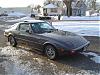
thought id post a pic of it too since i just washed it and not many are familiar with my "special" rx7.

Uploaded with ImageShack.us

Uploaded with ImageShack.us


I do believe it should BUT I do believe the proportioning valve is going to be alot different given small front disk and rear drum to 'big front disc, rear disc'. I would if you can source a used GSL-SE proportioning valve and get a GSL-SE master.
Buuuutttt I would wait for confirmation on thread pitches and such before, hopefully someone else can chime in.
Buuuutttt I would wait for confirmation on thread pitches and such before, hopefully someone else can chime in.
Trending Topics
Thread Starter
Rotary traitor
Joined: Dec 2007
Posts: 291
Likes: 0
From: Brookings SD
ok, just replaced the master and the original must have been bad even before the swap because now it actually brakes like a, well, a 80's jap sports car. i bench bled it then i bought like 16ft of vinyl tubing and hooked it to the rear right and ran it all the way back up to the master, and pumped till no bubbles then the front two. pretty effective for 2.08 of tubing. about bit the steering wheel the first couple of times braking. noticed my sway bar link on the right side was busted so now i have two new moogs in the mail to fix that. slowly making this thing handle, steer, and brake like it used to. pretty important with 430hp.
Thread Starter
Rotary traitor
Joined: Dec 2007
Posts: 291
Likes: 0
From: Brookings SD
it gained 125 lbs according to the grain scale by my house (south dakota) but i consider that a fair trade for gaining 300hp/300trq. please dont knock it till you've driven one. the balancer still sits almost straight above the front cross-member while the distribution is almost the same with the battery in the hatch. directfreak, i love your car and still show it to people who dont understand the the potential of the rotary, if my seals wouldn't have let go i'd still have one, this was just a much more price effective/economical way to keep my car on the road.


Just to clarify, although the proportioning valve is different, the drum valve will work with the disc rear. Same with the master, some people take out a check disk that is in the master, others leave it and others upgrade to the larger bore master. If you have to get a new one anyway, might as well get the larger master. I've personally tried all configurations and can't really tell much difference.
I am glad you kept another FB on the road. I was just ragging on you a little (It's is an RX-7/Rotary Forum after all).

Sorry if it came across as more than that.


Thread
Thread Starter
Forum
Replies
Last Post
The1Sun
1st Generation Specific (1979-1985)
7
Sep 18, 2015 07:13 PM
Tem120
3rd Generation Specific (1993-2002)
4
Sep 7, 2015 09:53 AM
