


216rwhp Streetport 13bre. Sure did take a while!

Thread Starter
Collections Hold
iTrader: (5)
Joined: Mar 2003
Posts: 1,987
Likes: 3
From: Pataskala, Ohio
216rwhp Streetport 13bre. Sure did take a while!
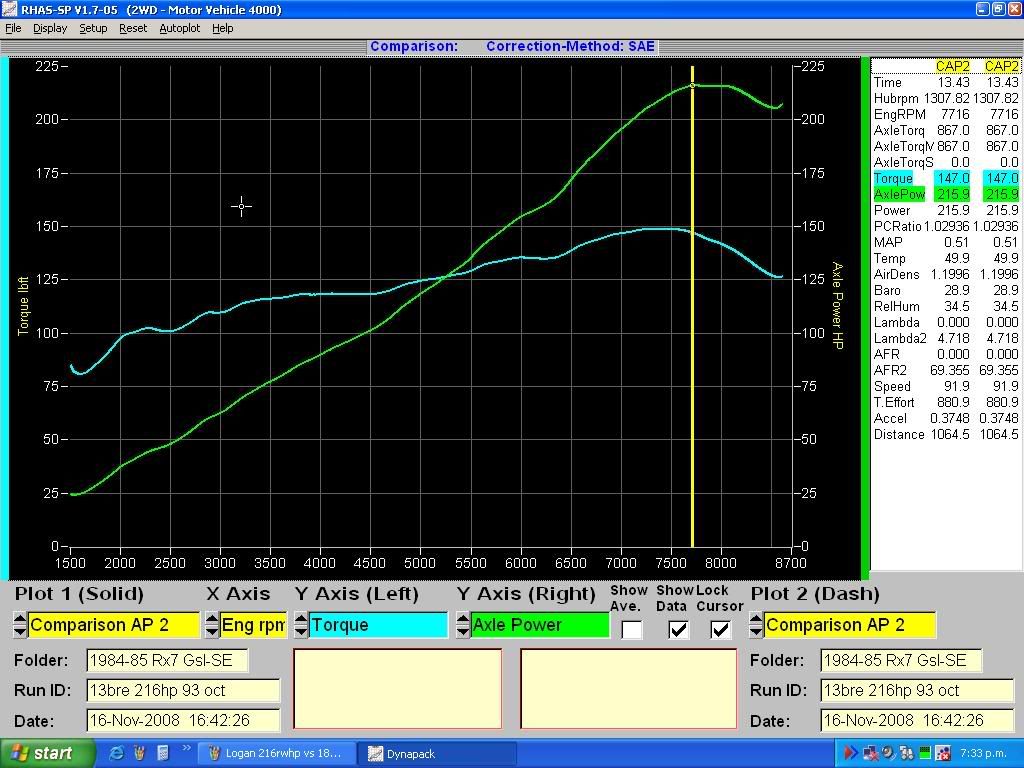
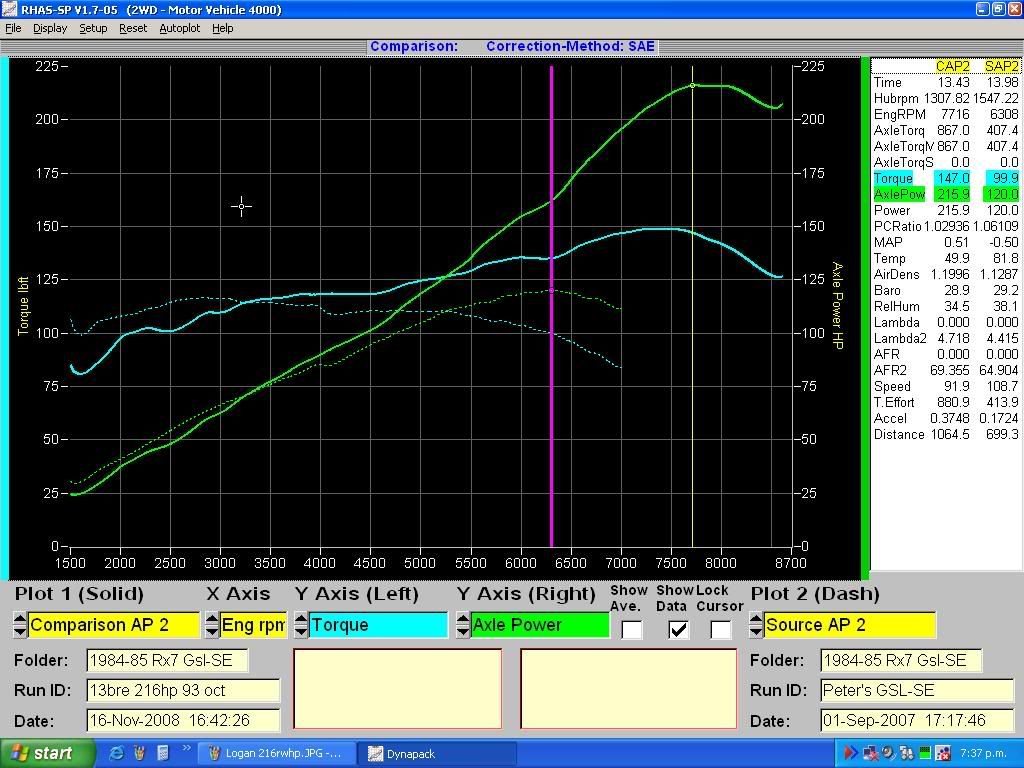
Some of you may remember my previous attempt at a higher horsepower 13b, which was in 1976 Rx-4. 206rwhp was a bit of a journey, and I was pleased when we finally did it. Later, I decided to sell the Rx-4. We pulled that good ol' engine out, and dropped it into my GSL-SE daily driver. It was installed with a turbo II transmission at the same time. Before I installed it, I wanted to tear it down, and re-port the intake ports. We were trying a experimental version. After break-in, the engine made 180rwhp and 128rwtq! NOOO!! What happened? Was it the ports, or was it the chassis with more drag from the tranny? I still dont know. But it set me on a path to re-gain and beat the old 206rwhp from the Rx-4. After doing lots of exhaust tuning, and trying out all types of things, the goal was within reach. Then I pulled out the distributer and old-school haltech, installed a electromotive setup. After more tweaking, it finally hit the mark I was shooting for 216rwhp. Yes! Finally! A total of 36hp and 20ft-lbs gained over the begining. So thats the story. Here is the chart.
Almost forgot here are the specs-
13b-re 2 rotor cosmo engine
Our circuit port intake and exhaust
9.7:1 n/a rotors, dynamically balanced
4x 550cc injectors
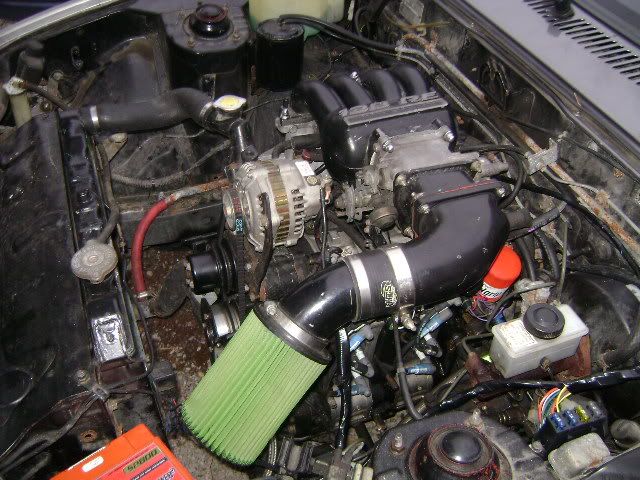
Stock 13b-re intake
Electromotive Tec3R ecu
Electromotive inductive coils
Custom ignition wires
4x NGK trailing plugs
Our own custom header, merging to a 2.5" exhaust
Racing beat main pulley
S4 waterpump
Green 3" air filter
Tuning notes-
Air fuel ratio 13.0-13.5 through out
zero split from 2000-8600
Total advance with 89 octane 21 degrees
Total advance with 93 octane 29 degrees
Almost forgot here are the specs-
13b-re 2 rotor cosmo engine
Our circuit port intake and exhaust
9.7:1 n/a rotors, dynamically balanced
4x 550cc injectors
Stock 13b-re intake
Electromotive Tec3R ecu
Electromotive inductive coils
Custom ignition wires
4x NGK trailing plugs
Our own custom header, merging to a 2.5" exhaust
Racing beat main pulley
S4 waterpump
Green 3" air filter
Tuning notes-
Air fuel ratio 13.0-13.5 through out
zero split from 2000-8600
Total advance with 89 octane 21 degrees
Total advance with 93 octane 29 degrees
Last edited by GtoRx7; Nov 18, 2008 at 05:48 PM.


Thread Starter
Collections Hold
iTrader: (5)
Joined: Mar 2003
Posts: 1,987
Likes: 3
From: Pataskala, Ohio
There you go added it to the first post, sorry about that! hah. The exhaust work was so extensive that I cant give all the details yet. But will sometime soon. I will say the primary runners are 2.0" o.d, stainless .065 wall. Merges into a series of 3 mufflers, and is 2.5". Its actually pretty quiet and a great daily driver.
Last edited by GtoRx7; Nov 18, 2008 at 06:04 PM.


Trending Topics

Thread Starter
Collections Hold
iTrader: (5)
Joined: Mar 2003
Posts: 1,987
Likes: 3
From: Pataskala, Ohio
Yes, I dont see any need to change it out to a ITB setup. I have been evaluating the current setup, and I think with a bit more tuning/changes to the exhaust, and taking a section out of the lower intake, that 223-230rwhp might be within reach.


Thread Starter
Collections Hold
iTrader: (5)
Joined: Mar 2003
Posts: 1,987
Likes: 3
From: Pataskala, Ohio
I posted it below the dyno chart, under specs. Back in the day I usually ran about 27-30 degrees advance. But I've found as the VE gets higher, and further into the rpm band, dynamic compression gets really high. So with 89 octane now, I could not go past 21 degrees without pre-ignition. With the 93 octane total advance went up to 29 degrees. This was always with zero split. Zero split always made more torque than any other split.


Lives on the Forum

Joined: Sep 2003
Posts: 5,707
Likes: 6
From: BC, Canada
Technically, yes, but a flywheel absorbs energy to be accelerated up to speed along with the engine. The heavier the flywheel, the more energy is absorbed getting it up to speed, therefore if you lighten the wheel (or make it smaller in diameter), less energy is absorbed, and more gets through and makes its way to the wheels. Presto, more wheel horsepower with a lighter flywheel (works with lighter and also smaller diameter wheels, tires and brake rotors too).

Joined: Jul 2002
Posts: 7,301
Likes: 3
From: District of Columbia
Technically, yes, but a flywheel absorbs energy to be accelerated up to speed along with the engine. The heavier the flywheel, the more energy is absorbed getting it up to speed, therefore if you lighten the wheel (or make it smaller in diameter), less energy is absorbed, and more gets through and makes its way to the wheels. Presto, more wheel horsepower with a lighter flywheel (works with lighter and also smaller diameter wheels, tires and brake rotors too).
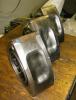
Nice header! Nice and straight off the block before it turns!
Last edited by Hyper4mance2k; Nov 20, 2008 at 07:57 PM.
Lives on the Forum
Joined: Sep 2003
Posts: 5,707
Likes: 6
From: BC, Canada
That's not exactly true, while a bad exhaust won't let the car produce the maximum possible power, it doesn't work in the way as you describe. In that case the engine is actually making less horsepower.
I hate when people say lightweight flywheels don't make more HP. Ture they don't, but they free up hp that was being used to spin it and put it to the wheels. Like that RB exhaust you just put on your car didn't make any more new HP it just freed up the horse power that was being used to push the exhaust out of the stock exhaust, and now it's going to the wheels... Nothing makes more HP it's jsut re alocated somewhere or moved in the revreange. Every engine can only make so much torque and it is based soley on it's dispalcement, and volumetric efficiancy. How much power you make depends on where the engine makes it's peak tq and when it's VE is most efficiant.
Nice header! Nice and straight off the block before it turns!
Nice header! Nice and straight off the block before it turns!
Show me two dyno sheets where the only variable changed is the flywheel from stock to a lightened one with the same engine. They will not show an increase in horsepower. If you were to do the same dyno with the only variable changed was exhaust, from stock to an open free flowing exhaust you will see a horseopower increase on the dyno. So you are wrong in your statement above.
FLYWHEELS: The actual horsepower of the engine does not change related to the weight of the flywheel. However, to increase the engine RPM, and accelerate the car, all rotating weight (as well as the entire car) must be speeded up. This requires power, and the heavier the part, the more power needed to speed it up. The less power needed to speed up the flywheel (and rotors, clutch, driveshaft, wheels, tires, car, etc.) the more power available to speed up everything else. The question we are asked frequently - "How much more horsepower will my engine have with a light flywheel" - is not the right question, because the answer is NONE. What you will have is more available horsepower to accelerate the car and yourself down the road.
This is straight from Mazdatrix=-
Last edited by ultimatejay; Nov 20, 2008 at 11:19 PM.
Lives on the Forum
Joined: Sep 2003
Posts: 5,707
Likes: 6
From: BC, Canada
No the engine won't make more hosepower, but in the real world, you'll see more hosepower getting to the wheels on acceleration. It's fairly simple physics, it takes energy to accelerate a rotating mass up to speed, how fast you do this is power. If you reduce the weight, thereby reducing the inertia, it will take less energy to accelerate the mass, so therefore it'll take less power to accelerate the mass up to speed. This means that you have to exert less power to accelerate the flywheel and more power getting through to the wheels, where it can be put to good use accelerating the car.
This only holds true for acceleration, so if the dyno measures power at set, static rpm points, then there's no acceleration and it won't show a difference, but if you were on something like a dynojet, you'd definetely see a difference, and the lower the gear, the faster the acceleration, the more you'll feel it. So it'll help you accelerate faster, but it won't help you acheive a higher top speed.
A good explanation here: http://www.uucmotorwerks.com/CTSV/LFWCTSV.htm
Dyno results: http://www.g35driver.com/forums/revi...lywheel-2.html
This only holds true for acceleration, so if the dyno measures power at set, static rpm points, then there's no acceleration and it won't show a difference, but if you were on something like a dynojet, you'd definetely see a difference, and the lower the gear, the faster the acceleration, the more you'll feel it. So it'll help you accelerate faster, but it won't help you acheive a higher top speed.
A good explanation here: http://www.uucmotorwerks.com/CTSV/LFWCTSV.htm
Dyno results: http://www.g35driver.com/forums/revi...lywheel-2.html

Old [Sch|F]ool


Joined: May 2001
Posts: 12,855
Likes: 567
From: Cleveland, Ohio, USA
Ah, but was GtoRx7 doing his dyno pulls accelerating or in steady state mode?
A flywheel may show a gain in acceleration mode, but never in steady state mode.
Anyway, I want one of your headers. Or maybe not - I'm really more concerned with getting some power up in the 3k-5k range, flatten the powerband a bit. High HP is useless if it takes you most of the straight to get to that point... by then the competition has passed you already. In the racing series I will be in next year, midrange torque will be essential, because 1st gear will be useless but 2nd gear ain't enough.
If nothing else, I'll have to go with a turbo... attached to a Ford 4-cylinder... funny how our priorities change when there's money on the line!
A flywheel may show a gain in acceleration mode, but never in steady state mode.
Anyway, I want one of your headers. Or maybe not - I'm really more concerned with getting some power up in the 3k-5k range, flatten the powerband a bit. High HP is useless if it takes you most of the straight to get to that point... by then the competition has passed you already. In the racing series I will be in next year, midrange torque will be essential, because 1st gear will be useless but 2nd gear ain't enough.
If nothing else, I'll have to go with a turbo... attached to a Ford 4-cylinder... funny how our priorities change when there's money on the line!
Lives on the Forum
Joined: Sep 2003
Posts: 5,707
Likes: 6
From: BC, Canada
Good article comparing dynos from Sport Compact Car Magazine: http://s-cars.org/postnuke/downloads...sdynoAug04.pdf
Thread Starter
Collections Hold
iTrader: (5)
Joined: Mar 2003
Posts: 1,987
Likes: 3
From: Pataskala, Ohio
Ah, but was GtoRx7 doing his dyno pulls accelerating or in steady state mode?
A flywheel may show a gain in acceleration mode, but never in steady state mode.
Anyway, I want one of your headers. Or maybe not - I'm really more concerned with getting some power up in the 3k-5k range, flatten the powerband a bit. High HP is useless if it takes you most of the straight to get to that point... by then the competition has passed you already. In the racing series I will be in next year, midrange torque will be essential, because 1st gear will be useless but 2nd gear ain't enough.
If nothing else, I'll have to go with a turbo... attached to a Ford 4-cylinder... funny how our priorities change when there's money on the line!
A flywheel may show a gain in acceleration mode, but never in steady state mode.
Anyway, I want one of your headers. Or maybe not - I'm really more concerned with getting some power up in the 3k-5k range, flatten the powerband a bit. High HP is useless if it takes you most of the straight to get to that point... by then the competition has passed you already. In the racing series I will be in next year, midrange torque will be essential, because 1st gear will be useless but 2nd gear ain't enough.
If nothing else, I'll have to go with a turbo... attached to a Ford 4-cylinder... funny how our priorities change when there's money on the line!
Lives on the Forum
Joined: Sep 2003
Posts: 5,707
Likes: 6
From: BC, Canada


FAIL!
Show me two dyno sheets where the only variable changed is the flywheel from stock to a lightened one with the same engine. They will not show an increase in horsepower. If you were to do the same dyno with the only variable changed was exhaust, from stock to an open free flowing exhaust you will see a horseopower increase on the dyno. So you are wrong in your statement above.
FLYWHEELS: The actual horsepower of the engine does not change related to the weight of the flywheel. However, to increase the engine RPM, and accelerate the car, all rotating weight (as well as the entire car) must be speeded up. This requires power, and the heavier the part, the more power needed to speed it up. The less power needed to speed up the flywheel (and rotors, clutch, driveshaft, wheels, tires, car, etc.) the more power available to speed up everything else. The question we are asked frequently - "How much more horsepower will my engine have with a light flywheel" - is not the right question, because the answer is NONE. What you will have is more available horsepower to accelerate the car and yourself down the road.
This is straight from Mazdatrix=-
Show me two dyno sheets where the only variable changed is the flywheel from stock to a lightened one with the same engine. They will not show an increase in horsepower. If you were to do the same dyno with the only variable changed was exhaust, from stock to an open free flowing exhaust you will see a horseopower increase on the dyno. So you are wrong in your statement above.
FLYWHEELS: The actual horsepower of the engine does not change related to the weight of the flywheel. However, to increase the engine RPM, and accelerate the car, all rotating weight (as well as the entire car) must be speeded up. This requires power, and the heavier the part, the more power needed to speed it up. The less power needed to speed up the flywheel (and rotors, clutch, driveshaft, wheels, tires, car, etc.) the more power available to speed up everything else. The question we are asked frequently - "How much more horsepower will my engine have with a light flywheel" - is not the right question, because the answer is NONE. What you will have is more available horsepower to accelerate the car and yourself down the road.
This is straight from Mazdatrix=-