


FD RX-7 with a V-8 Motor


Senior Member

Joined: Nov 2005
Posts: 278
Likes: 0
From: Toronto, Ontario, Canada
Originally Posted by dradon03
LS7
displacement 7011 cc / 427.8 cu in
bore 104.8 mm / 4.13 in
stroke 101.6 mm / 4.0 in
LS6
displacement 5665 cc / 345.7 cu in
bore 99 mm / 3.9 in
stroke 92 mm / 3.62 in
LS1
displacement 5670 cc / 346.0 cu in
bore 99 mm / 3.9 in
stroke 92 mm / 3.62 in
displacement 7011 cc / 427.8 cu in
bore 104.8 mm / 4.13 in
stroke 101.6 mm / 4.0 in
LS6
displacement 5665 cc / 345.7 cu in
bore 99 mm / 3.9 in
stroke 92 mm / 3.62 in
LS1
displacement 5670 cc / 346.0 cu in
bore 99 mm / 3.9 in
stroke 92 mm / 3.62 in
Senior Member
Joined: Nov 2005
Posts: 278
Likes: 0
From: Toronto, Ontario, Canada
Originally Posted by Ctrl
Good luck to you w/e you decide. If you do throw in a v8 lump, which engine were you considering? Also, don't forget to post vids/pics. 
P.S. 20b would keep the handling, same power or more (less weight).... v8... turn-in... oxymoron I'd guess in that chassis.
P.S. 20b would keep the handling, same power or more (less weight).... v8... turn-in... oxymoron I'd guess in that chassis.
I can see absolutely no downside to an LSx FC/FD, and that's exactly why it's my #1 choice.

I must say, I seen an LS1 powered First Gen in the states. It had to be the fastest Rx-7 I've ever seen. It was a street car and it ran sub-9's if I remember correctly.
On the V8 note, I'll also say I drove a new Porsche Cayenne yesterday. I had forgotten how harmonious a V8 can sound at high RPM.
The thought of an LS7 FD grows on me night and day.
On the V8 note, I'll also say I drove a new Porsche Cayenne yesterday. I had forgotten how harmonious a V8 can sound at high RPM.
The thought of an LS7 FD grows on me night and day.


I'm pretty sure the LS7 is a fair bit taller than the LS1, and LS2s. When i heard of the new LS7 and Z06, i thought about an LS/RX 7 combo, but i'm too poor. I think it would have the same mounts and everything but you'd need a taller hood, 4" cowl:P ahaha i'm a fan of the LSx idea

Super Snuggles

Joined: Feb 2001
Posts: 10,091
Likes: 34
From: Redmond, WA
Originally Posted by dradon03
LS7
displacement 7011 cc / 427.8 cu in
bore 104.8 mm / 4.13 in
stroke 101.6 mm / 4.0 in
LS6
displacement 5665 cc / 345.7 cu in
bore 99 mm / 3.9 in
stroke 92 mm / 3.62 in
LS1
displacement 5670 cc / 346.0 cu in
bore 99 mm / 3.9 in
stroke 92 mm / 3.62 in
displacement 7011 cc / 427.8 cu in
bore 104.8 mm / 4.13 in
stroke 101.6 mm / 4.0 in
LS6
displacement 5665 cc / 345.7 cu in
bore 99 mm / 3.9 in
stroke 92 mm / 3.62 in
LS1
displacement 5670 cc / 346.0 cu in
bore 99 mm / 3.9 in
stroke 92 mm / 3.62 in
To get more displacement from a rotary engine, you typically have to add more rotor housings, which increases the size (especially length) and weight of the engine. With piston engines, stroking (increasing crankshaft rod journal offset) and boring (increasing cylinder bore diameter) are commonly used to increase displacement without requiring an increase in the overall size of the engine. There's really no significant weight penalty for that additional displacement either.
Don't feel bad, you aren't the first to assume that piston engine displacement and size are directly proportionate.
Originally Posted by djphonics
I'm pretty sure the LS7 is a fair bit taller than the LS1, and LS2s.
LS7 mock-up in an FD...

LS7 intake (left) vs. L76 intake, which is comparable to an LS2 intake in dimensions...
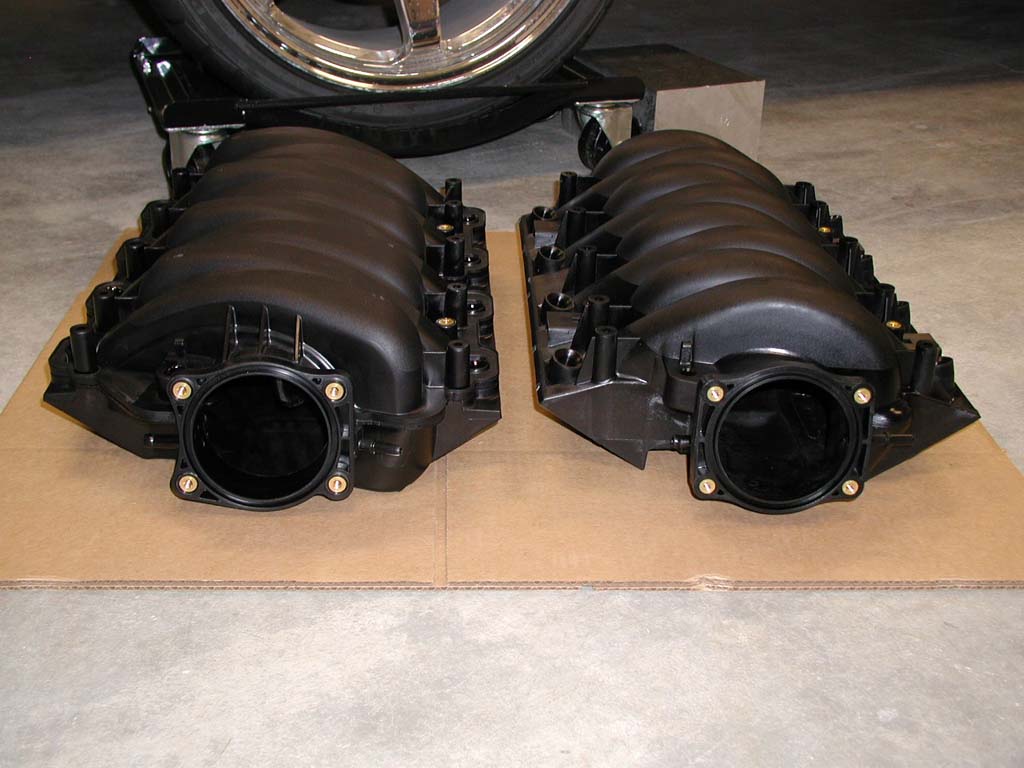

Originally Posted by jimlab
Don't feel bad, you aren't the first to assume that piston engine displacement and size are directly proportionate.
Super Snuggles
Joined: Feb 2001
Posts: 10,091
Likes: 34
From: Redmond, WA
Originally Posted by dradon03
my question is if there is no real change in the size of the engine although the displacement is much larger why would a manufacturer leave so much room for enlargement.
Keep in mind that increasing stroke results in a larger increase in displacement than increasing bore diameter, so it's the more popular method for obtaining more displacement. This is one reason why many people refer to a larger displacement version of a standard engine configuration as being a "stroker" engine (e.g. a 383 "stroker" vs. a standard 350).
Bore * Bore * Stroke * # Cylinders * 0.7854 = CID, SBC 350 = 4.0" Bore, 3.48" Stroke
Example 1 - Effect of an increase in stroke on displacement
4.00 * 4.00 * 3.48 * 8 * 0.7854 = 350 CID
4.00 * 4.00 * 3.75 * 8 * 0.7854 = 377 CID (+27 cu.in.)
Example 2 - Effect of an increase in bore diameter on displacement
4.00 * 4.00 * 3.48 * 8 * 0.7854 = 350 CID
4.03 * 4.03 * 3.48 * 8 * 0.7854 = 355 CID (+5 cu.in.)
Example 3 - Effect of both on displacement
4.00 * 4.00 * 3.48 * 8 * 0.7854 = 350 CID
4.03 * 4.03 * 3.75 * 8 * 0.7854 = 383 CID (+33 cu.in.)
I mean the thickness between cylinders is so large that it permits this?
An aftermarket or performance block, by comparison, will typically have much more material between bores to allow a very large overbore without compromising the cooling jacket or bore stability. The cast iron GM LSX block, for example, will allow a maximum bore of 4.25" with a minimum of 0.2" wall thickness remaining, and the World Products aluminum "Warhawk" can accept a 4.125" bore with 0.10" of dry sleeve and 0.3" of support. Add a 4.25" crankshaft and you've got 454 CID in a small block-sized package and weight without safety issues or breaking much more than your budget.

Rotary Enthusiast

Joined: Jan 2002
Posts: 859
Likes: 0
From: 15143
Originally Posted by jimlab
Keep in mind that increasing stroke results in a larger increase in displacement than increasing bore diameter...
Originally Posted by jimlab
...the same thing was done with the LS1 block by Katech to create the 427 CID C5R racing block.
Originally Posted by jimlab
...a maximum bore of 4.25" with a minimum of 0.2" wall thickness remaining, and the World Products aluminum "Warhawk" can accept a 4.125" bore with 0.10" of dry sleeve and 0.3" of support.
Super Snuggles
Joined: Feb 2001
Posts: 10,091
Likes: 34
From: Redmond, WA
Originally Posted by Eggie
This really depends on the engine.
With the change from LS1 to LS7, GM increased the bore by 5.9% and the stroke by 10.4%. But the bore's contribution to volume must be squared, so the bore increase was more effective, adding 12% in this particular case.
I was talking about what an average engine can accomodate without major structural changes. In the case of the LS1, that's about an 0.010" overbore for '99-up engines and only 0.005" for '97-'98 engines. An increase in stroke is far more productive and cheaper in this case, as it is in most examples.
I thought the C5R block was a unique casting. If they're just sleeving standard LS1 blocks, the results and price are surprising.
I must be up too late. Simply don't see how this can work with 4.400" bore spacing.
Maximum 4.250" bore @.200" minimum wall thickness
Even with a bore of 4.125” you’ll have .100” worth of dry sleeve and .300” support.
The ball is in your court, have fun.

Thread
Thread Starter
Forum
Replies
Last Post

