


BNR stage 3 Dyno. High boost. (might be new record)



Senior Member

Joined: Nov 2008
Posts: 357
Likes: 0
From: Czech republic
Point is that manifold absolute pressure is meaningless on its own. Only what matters is flow.
Nonetheless, external gate theoretically could give some performance and longevity gain, but not in the way you see it.

The question still remains, I wonder if the flapper door is up to the task of 20 plus pounds? Does it leak after age ?
Believe it or not the flow isn't as bad as everyone assumes. Look at some of the numbers coming from the BNR's. Remember when people were saying the turbine housing was the problem and no matter how big the turbos the manifold was impeding flow? That has been proven wrong. One of the engineers on the forum flow tested the manifold and the results were surprising. Does the manifold flow like a nice after market single set up, no but it can be ported to improve flow.
Last edited by Mr rx-7 tt; Feb 12, 2012 at 07:54 PM.
You are forgetting what the "boost" is. Its (very poor) indication of mass flow. Compressor of stock twins is maxed out, flow remains the same, but as rpms are increasing, manifold pressure is decreasing. You could weld the wastegate shut, and MAP would still drop (just pressure before intercooling would be higher due to high discharge temperature). Relieving backpressure on given compressor at max. flow rate, will cause MAP to drop even more as VE is better.
Point is that manifold absolute pressure is meaningless on its own. Only what matters is flow.
Nonetheless, external gate theoretically could give some performance and longevity gain, but not in the way you see it.
Point is that manifold absolute pressure is meaningless on its own. Only what matters is flow.
Nonetheless, external gate theoretically could give some performance and longevity gain, but not in the way you see it.
An actuator has a spring inside it with a rod that connects to the flapper door to hold it shut depending on boost controller settings right?, There probably is enough backpressure in there to open the flapper door slightly with a weak spring in the actuator? That could bleed off some boost pressure.

I'm in the process of installing an external gate on the twins to see if this is the culprit. It's already mounted in the car but I'm just waiting for a couple more pieces to come back from the machine shop before I post the write-up on how to do it. Turns out installing it is easy, the porting of the exhaust manifold and turbine housings requires a bridge mill and is the only tricky part about doing it.
When the weather warms back up I'll head back to the dyno to see the results.
I'm in the process of installing an external gate on the twins to see if this is the culprit. It's already mounted in the car but I'm just waiting for a couple more pieces to come back from the machine shop before I post the write-up on how to do it. Turns out installing it is easy, the porting of the exhaust manifold and turbine housings requires a bridge mill and is the only tricky part about doing it.
Senior Member
Joined: Nov 2008
Posts: 357
Likes: 0
From: Czech republic

You mean the porting from e-mail Joe sent me? Yes I used his R@D and spent a full day on the manifold. You sent me your maps...LOL
I'd love to see your handiwork. Please post some pics. I'm debating whether to turn up the boost but I'm not going to dyno if the wastegates can't hold the pressure. Did you check your fuel hose?
I'd love to see your handiwork. Please post some pics. I'm debating whether to turn up the boost but I'm not going to dyno if the wastegates can't hold the pressure. Did you check your fuel hose?
Don't know what you mean by checking my fuel hose. I'm still running the stock lines, FPR, and FPD and don't have any problems with fuel pressure even at 21psi.
If the porting of the manifold and turbine housings didn't have any effect on solving the problem then I bet it does have something to do with the wastegate. Here's a pic of it mounted in the car as is and a pic of it mounted to a extra turbo.
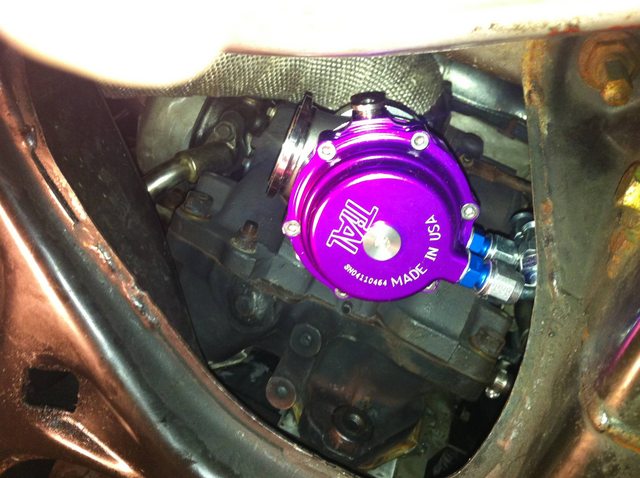
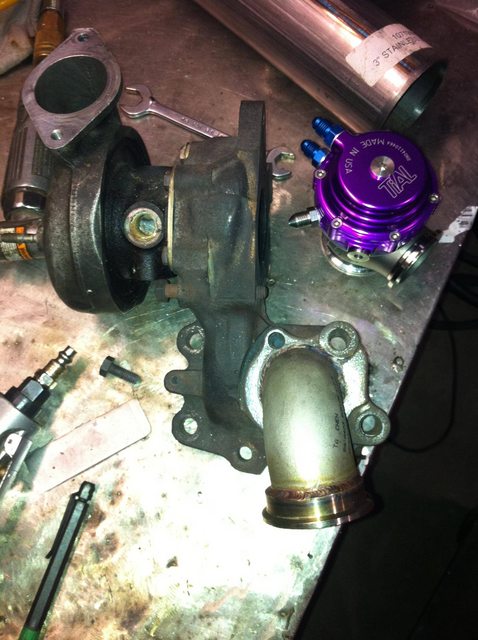
The trick that I'm amazed no one has done before is to utilize the opening behind the pre-spool door. The pre-spool door is not cast iron and is either cast steel or cast stainless. Benefit of this is that I was able to simply cut a hole in it with a plasma torch and then weld a 90 long radius 1.25" schedule 10 pipe to it. The stainless welded perfectly to the pre-spool door.
The only trick after this is done is to port out all of the material behind the pre-spool door in the rear turbine housing and exhaust manifold. The porting in the exhaust manifold requires a bridge mill, as the metal is very tough and very thick. This porting will provide direct flow to the external gate.
I still have yet to get the exhaust manifold back from the machine shop, but when I do I'll post a full write up in the main 3rd gen board.
Sorry got confused, meant to say that. Funny my name is also Joe.
Don't know what you mean by checking my fuel hose. I'm still running the stock lines, FPR, and FPD and don't have any problems with fuel pressure even at 21psi.
If the porting of the manifold and turbine housings didn't have any effect on solving the problem then I bet it does have something to do with the wastegate. Here's a pic of it mounted in the car as is and a pic of it mounted to a extra turbo.
https://i.imgur.com/cFugsl.jpg
https://i.imgur.com/5jqSll.jpg
The trick that I'm amazed no one has done before is to utilize the opening behind the pre-spool door. The pre-spool door is not cast iron and is either cast steel or cast stainless. Benefit of this is that I was able to simply cut a hole in it with a plasma torch and then weld a 90 long radius 1.25" schedule 10 pipe to it. The stainless welded perfectly to the pre-spool door.
The only trick after this is done is to port out all of the material behind the pre-spool door in the rear turbine housing and exhaust manifold. The porting in the exhaust manifold requires a bridge mill, as the metal is very tough and very thick. This porting will provide direct flow to the external gate.
I still have yet to get the exhaust manifold back from the machine shop, but when I do I'll post a full write up in the main 3rd gen board.
Don't know what you mean by checking my fuel hose. I'm still running the stock lines, FPR, and FPD and don't have any problems with fuel pressure even at 21psi.
If the porting of the manifold and turbine housings didn't have any effect on solving the problem then I bet it does have something to do with the wastegate. Here's a pic of it mounted in the car as is and a pic of it mounted to a extra turbo.
https://i.imgur.com/cFugsl.jpg
https://i.imgur.com/5jqSll.jpg
The trick that I'm amazed no one has done before is to utilize the opening behind the pre-spool door. The pre-spool door is not cast iron and is either cast steel or cast stainless. Benefit of this is that I was able to simply cut a hole in it with a plasma torch and then weld a 90 long radius 1.25" schedule 10 pipe to it. The stainless welded perfectly to the pre-spool door.
The only trick after this is done is to port out all of the material behind the pre-spool door in the rear turbine housing and exhaust manifold. The porting in the exhaust manifold requires a bridge mill, as the metal is very tough and very thick. This porting will provide direct flow to the external gate.
I still have yet to get the exhaust manifold back from the machine shop, but when I do I'll post a full write up in the main 3rd gen board.
Rich pulled a BNR pump and the in tank fuel hose supplied by Aeromotive was coming apart, it wasn't submersible fuel line. That spells a blown engine if true. I'm going to pull mine tomorrow and see. I contacted Aeromotive and they said all their hose was submersible... Rich is a straight shooter so I'm not going to take Aeromotives word.
Chris
Last edited by Mr rx-7 tt; Feb 13, 2012 at 11:32 PM.
I'll be waiting to see the finished work. How about the heat? That sucker is going to be cooking...
The external wastegate is not done yet and those pictures were taken during mock up. I'll post the results in the write up when it's all done.
I was worried about the heat but considering how close the top of the wastegate is to the underside of the car it should get enough ventilation. It's basically flush with the opening in the subframe. I was originally planning to run the water cooling feature on the wastegate but the area that the wastegate sits in is so cramped that it's impossible to hook up the two air lines as well as the two water lines. There's barely enough room to fit the two air lines as is.
I didn't use the supplied fuel line when I installed the Aeromotive. Thanks for the concern though.
The external wastegate is not done yet and those pictures were taken during mock up. I'll post the results in the write up when it's all done.
I was worried about the heat but considering how close the top of the wastegate is to the underside of the car it should get enough ventilation. It's basically flush with the opening in the subframe. I was originally planning to run the water cooling feature on the wastegate but the area that the wastegate sits in is so cramped that it's impossible to hook up the two air lines as well as the two water lines. There's barely enough room to fit the two air lines as is.
The external wastegate is not done yet and those pictures were taken during mock up. I'll post the results in the write up when it's all done.
I was worried about the heat but considering how close the top of the wastegate is to the underside of the car it should get enough ventilation. It's basically flush with the opening in the subframe. I was originally planning to run the water cooling feature on the wastegate but the area that the wastegate sits in is so cramped that it's impossible to hook up the two air lines as well as the two water lines. There's barely enough room to fit the two air lines as is.
Could you hold 20 psi on the stock set up before your current modification or did the boost drop?
Chris



I'll chime in here too since I've experienced this problem as well:
The spring in the stock actuator is on the ragged edge of being too weak. Once the boost spikes, the EMP also spikes and seems to "blow open" the WG flapper. I suspect that once it's been opened and flow is established that it does not fully reclose. The problem is exasperated by a ported WG, which will cause the valve to pop open at a slightly lower pressure (due to its increased piston surface area).
I did the math factoring in the WG piston area, lever ratio, and WG spring and found the WG will open under EMP that is achievable with our setups. If the exhaust manifold pressure (EMP) gets to approx 2:1 vs Boost at around 18-->20# MAP, the 'gate will definitely blow open.
What I did to mitigate this was shim the stock (non-adjustable) actuator further back thus increasing the effective WG spring. It helps noticeably, but did not eliminate the problem completely--it just raises the threshold that blow-open occurs, as one might expect. A better solution would be to graft on an actuator with a stronger spring, a 0.8 to 1.0 bar actuator should be adequate.
If someone wants to lock their WG flapper closed and go test it out, it might yield some interesting results. I am also interested in seeing the results of the external WG project that has been discussed here.
Based on tests and analysis that I've conducted, the small-ish area of the throat in the turbine volutes is ultimately going to limit the mass flow and thus achievable power---and probably limit boost as well. As to the compressors in these units (including the stock ones), they seem to be capable of more mass flow than we can utilize due to the foregoing limitation(s).
I'll chime in here too since I've experienced this problem as well:
The spring in the stock actuator is on the ragged edge of being too weak. Once the boost spikes, the EMP also spikes and seems to "blow open" the WG flapper. I suspect that once it's been opened and flow is established that it does not fully reclose. The problem is exasperated by a ported WG, which will cause the valve to pop open at a slightly lower pressure (due to its increased piston surface area).
I did the math factoring in the WG piston area, lever ratio, and WG spring and found the WG will open under EMP that is achievable with our setups. If the exhaust manifold pressure (EMP) gets to approx 2:1 vs Boost at around 18-->20# MAP, the 'gate will definitely blow open.
What I did to mitigate this was shim the stock (non-adjustable) actuator further back thus increasing the effective WG spring. It helps noticeably, but did not eliminate the problem completely--it just raises the threshold that blow-open occurs, as one might expect. A better solution would be to graft on an actuator with a stronger spring, a 0.8 to 1.0 bar actuator should be adequate.
If someone wants to lock their WG flapper closed and go test it out, it might yield some interesting results. I am also interested in seeing the results of the external WG project that has been discussed here.
Based on tests and analysis that I've conducted, the small-ish area of the throat in the turbine volutes is ultimately going to limit the mass flow and thus achievable power---and probably limit boost as well. As to the compressors in these units (including the stock ones), they seem to be capable of more mass flow than we can utilize due to the foregoing limitation(s).
The spring in the stock actuator is on the ragged edge of being too weak. Once the boost spikes, the EMP also spikes and seems to "blow open" the WG flapper. I suspect that once it's been opened and flow is established that it does not fully reclose. The problem is exasperated by a ported WG, which will cause the valve to pop open at a slightly lower pressure (due to its increased piston surface area).
I did the math factoring in the WG piston area, lever ratio, and WG spring and found the WG will open under EMP that is achievable with our setups. If the exhaust manifold pressure (EMP) gets to approx 2:1 vs Boost at around 18-->20# MAP, the 'gate will definitely blow open.
What I did to mitigate this was shim the stock (non-adjustable) actuator further back thus increasing the effective WG spring. It helps noticeably, but did not eliminate the problem completely--it just raises the threshold that blow-open occurs, as one might expect. A better solution would be to graft on an actuator with a stronger spring, a 0.8 to 1.0 bar actuator should be adequate.
If someone wants to lock their WG flapper closed and go test it out, it might yield some interesting results. I am also interested in seeing the results of the external WG project that has been discussed here.
Based on tests and analysis that I've conducted, the small-ish area of the throat in the turbine volutes is ultimately going to limit the mass flow and thus achievable power---and probably limit boost as well. As to the compressors in these units (including the stock ones), they seem to be capable of more mass flow than we can utilize due to the foregoing limitation(s).
No pics, but what I did was move the actuator forward, further away from the WG lever by putting a couple of washers under each mounting ear for the actuator. (The actuator is mounted to bosses at the front of the primary compressor housing.) I estimate that I spaced it out 3/16" to 1/4".
You will need to pull out on the actuator rod with vise grips to engage the WG lever once you do this.
I thought later BNRs came with an adjustable (threaded) rod end that will let you achieve the same effect.
The next step would be to adapt a high pressure actuator from a WRX or EVO to fit this setup. And it wouldn't be too hard to do.



Joined: Mar 2001
Posts: 30,814
Likes: 655
From: FL-->NJ/NYC again!


I plan on going to BNR's very soon. My question is, why non-sequential? Is it better to run non-seq vs. seq? My goal is to reach 400 hp on BNR's and I am starting my build over the winter. Love this thread and love your build!

because it's easier.
I know the stock solenoids will fall apart trying to run that high of boost. You could find AEZknights and get one of aftermarket boost solenoid kits that upgrade the solenoids that control the twins sequentially.
But lets face it, there so much less to go wrong when you're pushing that much boost through a system that's non-seq. The stock twins system is complicated and things go wrong even when running stock boost levels.
I know the stock solenoids will fall apart trying to run that high of boost. You could find AEZknights and get one of aftermarket boost solenoid kits that upgrade the solenoids that control the twins sequentially.
But lets face it, there so much less to go wrong when you're pushing that much boost through a system that's non-seq. The stock twins system is complicated and things go wrong even when running stock boost levels.

my car has 70-something kmiles on stock twins running the last 20k or so at 18psi levels. No problems at all. All I did was silicone hoses and a 10psi regulator for the solenoids (old school trick) so that they work perfect even at 18psi since they only see 10.

more info in these two threads, they talk about the pressure reg, which one to use and where to install it:
https://www.rx7club.com/3rd-generati...osting-480079/
https://www.rx7club.com/power-fc-for...ontrol-874514/
https://www.rx7club.com/3rd-generati...osting-480079/
https://www.rx7club.com/power-fc-for...ontrol-874514/
