


Howard Coleman's FD Chassis/Setup


Rotary Enthusiast

Joined: Dec 2001
Posts: 1,209
Likes: 6
From: Delaware
Definitely shouldn't be driving anywhere near cornering limits on an on-ramp on the street! Tracks usually have a fair amount of runoff 
Driving a well-balanced car requires commitment. If you find yourself going too fast for comfort around a curve and LIFT, bad things ensue...
Driving a well-balanced car requires commitment. If you find yourself going too fast for comfort around a curve and LIFT, bad things ensue...
Also, might see how you like it with the rear bar disconnected, but I think a stock-suspension '93 should handle fine with proper inputs at the helm...
.
Senior Member

Joined: Sep 2011
Posts: 682
Likes: 4
From: Pawtucket, RI
When pushing near the limit at 60mph on a 270 deg 30mph on-ramp, up-hill, the back end wants to come out and it is not a good feeling, with guard rail 6 feet away.
Rotary Enthusiast
Joined: Dec 2001
Posts: 1,209
Likes: 6
From: Delaware
Originally Posted by Howard
.... that said, it appears that the coil overs you are looking at come w 11/11 springs. the most important component to get right when choosing a coil over is the SPRING RATE.
Originally Posted by ZDan
Also have to consider the motion ratios. It is the WHEEL RATES that are important, spring rate doesn't tell the whole story. Wheel rate is spring rate multiplied by the SQUARE of motion ratio, so actually the motion ratio is the bigger driver.
Originally Posted by Howard
rear rate should be no more than 80% of front. ideally 75%. front engine rear drive cars do not balance out at 50/50.
Originally Posted by ZDan
The front and rear spring rates will be different for different cars. What works for the FD will not work on something like an FR-S/BRZ (very different motion ratios).
Originally Posted by Fritz
edit
I have a spreadsheet I made based of Fred Puhn's method, with MR^2's, for just tuning my stock suspension on my Mazda6, and it showed me exactly how much to stiffen my rear bar. But that's in the minor leagues compared to Howard's experience.
.
Senior Member
Joined: Sep 2011
Posts: 682
Likes: 4
From: Pawtucket, RI
The conversation was about the even spring rates on the Ohlins coilovers. I totally agree that the front springs *should* be stiffer than the rears. But people should know *why*. And the answer is primarily related to the motion ratios rather than:
"front engine rear drive cars do not balance out at 50/50. the rear needs to stick and be more compliant."
If he's skipping over motion ratios because he thinks everyone already knows what they are and what they mean regarding spring selection, he's definitely overestimating the knowledge of 90+% of the modding community. For sure this is not rocket science, but it is always surprising to me how few really know the ramifications of motion ratio and what a big player it is in spring rate selection.
I definitely do not think it's a good idea to suggest that you always want stiffer front springs than rears for FR cars in general, which is exactly how it reads to me.
1,000 pardons if any toes have been stepped on!
Rotary Enthusiast
Joined: Dec 2001
Posts: 1,209
Likes: 6
From: Delaware
Please pm me if you have more to say on this, rather than us messing up a great thread, based on a lot of experience.
.
Senior Member
Joined: Sep 2011
Posts: 682
Likes: 4
From: Pawtucket, RI
No, he skipped over it because it's obvious this is a level-2-race thread, not a basics thread. I searched this 35 page thread, started by a well known expert, and "motion ratio" was only brought up by you.
Please pm me if you have more to say on this, rather than us messing up a great thread, based on a lot of experience.
Please pm me if you have more to say on this, rather than us messing up a great thread, based on a lot of experience.
My impression is that this thread is more to do with street/track setups than serious track-only "race" applications. For sure most FD track-only setups use springs a lot stiffer than 8k/6k and more camber (particularly up front) than 1.2 degrees. That, to me, sounds like a street/track compromise.
I don't see what I've "messed up" bringing up motion ratios. I would bet that most people perusing the thread could stand to be exposed to what they are and what they mean regarding front and rear wheel rates.
Rotary Enthusiast
Joined: Dec 2001
Posts: 1,209
Likes: 6
From: Delaware
Originally Posted by DanZ
I don't see what I've "messed up" bringing up motion ratios.
Originally Posted by Originally Posted by howard coleman
.... that said, it appears that the coil overs you are looking at come w 11/11 springs. the most important component to get right when choosing a coil over is the SPRING RATE.
Originally Posted by DanZ
Also have to consider the motion ratios. It is the WHEEL RATES that are important, spring rate doesn't tell the whole story. Wheel rate is spring rate multiplied by the SQUARE of motion ratio, so actually the motion ratio is the bigger driver.

Thread Starter


Joined: Oct 2001
Posts: 6,279
Likes: 728
From: Florence, Alabama
the reason i didn't get into wheel rate V spring rate is that the thread is about the FD and wheel rate/spring rate is a constant...
working w the relationship between the wheel and shock-rod can be beneficial as you can know the travel at the shock-rod using a tie wrap and then calculate wheel travel.
one inch of wheel travel is .60 of spring/shock rod travel in the front and .68 in the rear.
travel is very important as travel provides both the time and the dynamic data for the driver to discern where the line of control is.
if you run too stiff a spring the time and feel compact to virtually nothing and as such the chassis will snap.
if you run too soft a spring you will end up on the bump stops where, similar to an overly stiff spring, you will not be able to comfortably control the car. (bump stops are of course like infinitely stiff springs)
travel is engineered to add camber to the all important outside wheels to compensate for body roll. the amount of camber gain on bump separates the FD from most other sports cars.
therefore the key is to end up w an amount of suspension travel in between max before the bumpstops and no travel and it is here that the wheel rate/spring rate/motion ratio is helpful.
whether you are full on track running sticky slicks or just street rubber you will want springs that deliver around an inch and a half to two inches wheel travel.
using the relationship between the wheel and spring:
1.75 inches wheel travel X .605 = 1.06 at the shock rod for the front
1.75 inches wheel travel X .68 = 1.19
just place a tie wrap on the shock rod and run 3 laps. measure how much the tie wrap has moved from static.
if you aim for the above numbers you should have a controllable fast car that is fairly easy to drive at the limit.
the spring rates that deliver approx the proper travel will vary depending on a number of factors.... however they still should end up w the rear being around 75% of the front.
please let's keep the thread calm just like you are in the driver's seat
howard
working w the relationship between the wheel and shock-rod can be beneficial as you can know the travel at the shock-rod using a tie wrap and then calculate wheel travel.
one inch of wheel travel is .60 of spring/shock rod travel in the front and .68 in the rear.
travel is very important as travel provides both the time and the dynamic data for the driver to discern where the line of control is.
if you run too stiff a spring the time and feel compact to virtually nothing and as such the chassis will snap.
if you run too soft a spring you will end up on the bump stops where, similar to an overly stiff spring, you will not be able to comfortably control the car. (bump stops are of course like infinitely stiff springs)
travel is engineered to add camber to the all important outside wheels to compensate for body roll. the amount of camber gain on bump separates the FD from most other sports cars.
therefore the key is to end up w an amount of suspension travel in between max before the bumpstops and no travel and it is here that the wheel rate/spring rate/motion ratio is helpful.
whether you are full on track running sticky slicks or just street rubber you will want springs that deliver around an inch and a half to two inches wheel travel.
using the relationship between the wheel and spring:
1.75 inches wheel travel X .605 = 1.06 at the shock rod for the front
1.75 inches wheel travel X .68 = 1.19
just place a tie wrap on the shock rod and run 3 laps. measure how much the tie wrap has moved from static.
if you aim for the above numbers you should have a controllable fast car that is fairly easy to drive at the limit.
the spring rates that deliver approx the proper travel will vary depending on a number of factors.... however they still should end up w the rear being around 75% of the front.
please let's keep the thread calm just like you are in the driver's seat
howard
Rotary Enthusiast
Joined: Dec 2001
Posts: 1,209
Likes: 6
From: Delaware
Originally Posted by Howard
one inch of wheel travel is .60 of spring/shock rod travel in the front and .68 in the rear.
I had answered a question directed at you, about lifting a front tire on tight turns on a road course. Do you think inadequate suspension travel could cause this, as well as the soft rear springs that you had mentioned:
https://www.rx7club.com/suspension-w.../#post11785597
Finally, I'd be fine if you deleted the back and forth I had with ZDan, speaking for myself.
.
Senior Member
Joined: Sep 2011
Posts: 682
Likes: 4
From: Pawtucket, RI
"front engine rear drive cars do not balance out at 50/50. the rear needs to stick and be more compliant."
But anyway, as long as we're all in agreement that most FR cars including the FD can and do balance out with F/R stiffnesses (i.e., wheel rates) in a range on either side of and including 50/50
the spring rates that deliver approx the proper travel will vary depending on a number of factors.... however they still should end up w the rear being around 75% of the front.
Did not want to change spring rate by more than 20% because I wasn't having them revalved, otherwise might have tried 750 lb/in (13.4k) or 14k. For street, would definitely have gone the other way and gotten softer 8k or 9k rear springs rather than stiffer fronts.
please let's keep the thread calm just like you are in the driver's seat
howard
howard

Thanks,
dan
Rotary Enthusiast
Joined: Dec 2001
Posts: 1,209
Likes: 6
From: Delaware
Originally Posted by Howard Coleman
The stock FD spring rate is 263 pounds per inch in front and 195 pounds in the rear. These are my numbers from my Longacre Digital Spring Checker.
I run 432 front and 378 rear. Expressed metrically 8 KG and 6 KG. I am delighted with this rate. If my springs vaporized I would repurchase this rate. It works on the track. It works on the street.
That said, Frank runs 566/422 or 10Kg/8Kg. I consider this rate the outer limit.
...the spring rates that deliver approx the proper travel will vary depending on a number of factors.... however they still should end up w the rear being around 75% of the front ....
I run 432 front and 378 rear. Expressed metrically 8 KG and 6 KG. I am delighted with this rate. If my springs vaporized I would repurchase this rate. It works on the track. It works on the street.
That said, Frank runs 566/422 or 10Kg/8Kg. I consider this rate the outer limit.
...the spring rates that deliver approx the proper travel will vary depending on a number of factors.... however they still should end up w the rear being around 75% of the front ....
Originally Posted by ZDan
In my case, I found that the Ohlins 11k/11k spring rates were too rear-stiffness biased (4.2k/5.4k wheel rates). Indeed, 13k/11k springs (5.0/5.4 wheel rates) works a lot better
.74 -- OEM
.75 -- Coleman
.80 -- Frank
.84 -- ZDan
So it looks like Frank and ZDan like more rate in the Rear.
To go from Kg/mm to lb/in, multiply by 55.86
.
Senior Member
Joined: Jun 2007
Posts: 270
Likes: 0
From: ireland
For a full blown race fd with seam welded chassis and full cage out to towers. Running a lighter 13b pp N/a up front. At about 1000kgs what sort of spring rates should I be starting out with to get a good base? Same with roll bars.
Cheers, Shane.
Cheers, Shane.
Thread Starter
Joined: Oct 2001
Posts: 6,279
Likes: 728
From: Florence, Alabama
FINALLY:
for the 80% of FD owners that LOVE to drive their magnificent cars on the street and occasionally on track a set of coil overs w the right spring rate.
and at the right price.
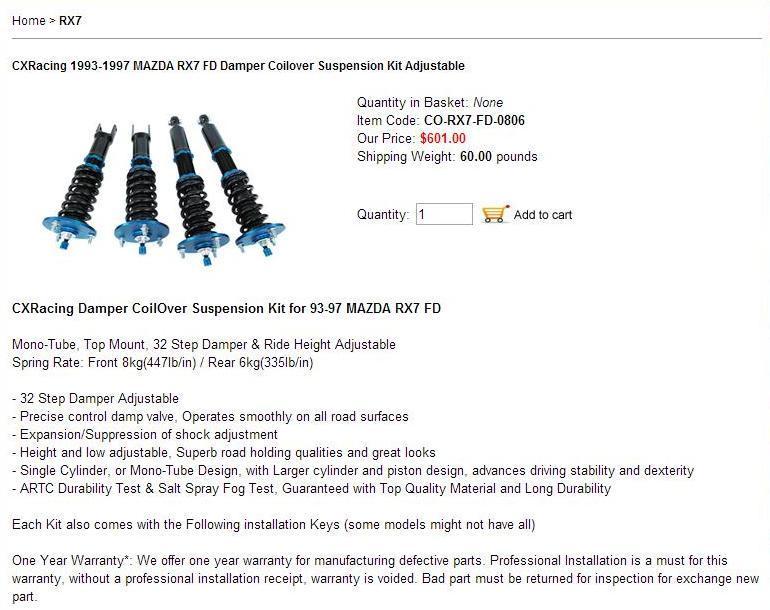
i had asked Rotary Works owner to import 8/6 coilovers in Jan 2013. he said he would. i have been busy and he never got back to me. i did check the RW site sometime last year and found only 12/10.
i was buying some titanium studs from them recently and said, OBTW, whatever happened to the 8/6 coil overs. "oh we have them in stock" ? seems they are listed not on the RW site but at the parent co site CXRacing
see link
cxracing.com: CXRacing 1993-1997 MAZDA RX7 FD Damper Coilover Suspension Kit Adjustable
8/6 is gorgeous for the FD.
stock is 4.69/3.48 or 263/195 pounds per inch (rear is 74% of front)
8/6 is 447/335 rear 75% of front.
overall up 186%....
JUST RIGHT for really nice suspension travel yet totally transforms the car, you will have to catch yourself from driving too fast on the street, but also transforms the car into something you will want to drive ALL THE TIME.
way better than the 10 and 12 KG setups for real world usage.
w 32 shock adjustments you can trim the car just the way you want.
super duper. thank you Kevin.
howard
for the 80% of FD owners that LOVE to drive their magnificent cars on the street and occasionally on track a set of coil overs w the right spring rate.
and at the right price.
i had asked Rotary Works owner to import 8/6 coilovers in Jan 2013. he said he would. i have been busy and he never got back to me. i did check the RW site sometime last year and found only 12/10.
i was buying some titanium studs from them recently and said, OBTW, whatever happened to the 8/6 coil overs. "oh we have them in stock" ? seems they are listed not on the RW site but at the parent co site CXRacing
see link
cxracing.com: CXRacing 1993-1997 MAZDA RX7 FD Damper Coilover Suspension Kit Adjustable
8/6 is gorgeous for the FD.
stock is 4.69/3.48 or 263/195 pounds per inch (rear is 74% of front)
8/6 is 447/335 rear 75% of front.
overall up 186%....
JUST RIGHT for really nice suspension travel yet totally transforms the car, you will have to catch yourself from driving too fast on the street, but also transforms the car into something you will want to drive ALL THE TIME.
way better than the 10 and 12 KG setups for real world usage.
w 32 shock adjustments you can trim the car just the way you want.
super duper. thank you Kevin.
howard
Rotary Enthusiast
Joined: Dec 2001
Posts: 1,209
Likes: 6
From: Delaware
Run some numbers based on your corner weights, vs with the FD engine, to tweek his full race suggestions for the lighter front.
Also look at "build threads" Build Threads - RX7Club.com
.


These CXracing coilovers are monotubes, I wonder if they are made in the same factory in Taiwan as the Tein Monoflex. lol I doubt it but I wouldn't be surprised.
Thread Starter
Joined: Oct 2001
Posts: 6,279
Likes: 728
From: Florence, Alabama
"I wonder if they are made in the same factory in Taiwan as the Tein Monoflex"
given that many of the coil overs today look quite similar my money would be on the above.
BTW, there's nothing wrong w monotube.... larger piston area than double tubes so a bit more responsive.
HC
given that many of the coil overs today look quite similar my money would be on the above.
BTW, there's nothing wrong w monotube.... larger piston area than double tubes so a bit more responsive.
HC
I didn't think there is anything wrong with the monotube/monoflex design. In fact I was saving my pennies to get the monoflex over the regular Tein flex, however I doubt I'd notice a difference. My last coil overs were at 12/12 and we're actually not bad. Right now I'm on the RSR down springs and Gab shocks, it's pretty nice too from what I remember (Car is not running atm).
Senior Member
Joined: Sep 2011
Posts: 682
Likes: 4
From: Pawtucket, RI
$600 coilovers, the damping is practically guaranteed to be sub-par, and that's what will really drive you nuts on the street (at the track, too). I drove around on ~$900 coilovers from a reputable name-brand with 9kg/7kg springs for a couple of years and it was pretty harsh over potholes/bumps/etc. The damping adjustment didn't seem to do much, either. No matter the setting, I got very high high-speed damping (it was like they locked up over any kind of bumps/potholes), but at the same time they didn't seem to have enough low-speed damping.
The car rides INFINITELY better now on Ohlins DFVs (initially at 11kg/11kg, now at 13kg/11kg), despite much stiffer spring rates and spherical bearing top mount (old ones had rubber isolator up top). I went from having to practically park the car for minor road imperfections on the street to smooovely gliding over them. Also, the damping adjustment makes a noticeable difference between the 6-7 clicks-out setting I run on the street and the 4-5 clicks-out I run at the track.
Damping is much more important than spring rate as far as ride quality goes, and I doubt you can get a decent ride on the street with a $600 set of coilovers. I would sooner just get aftermarket springs and Koni or Bilstein dampers if on a budget and/or street only, or spend the $2400 for Ohlins. No problem to get 8kg/6kg springs for them for another $300.
The car rides INFINITELY better now on Ohlins DFVs (initially at 11kg/11kg, now at 13kg/11kg), despite much stiffer spring rates and spherical bearing top mount (old ones had rubber isolator up top). I went from having to practically park the car for minor road imperfections on the street to smooovely gliding over them. Also, the damping adjustment makes a noticeable difference between the 6-7 clicks-out setting I run on the street and the 4-5 clicks-out I run at the track.
Damping is much more important than spring rate as far as ride quality goes, and I doubt you can get a decent ride on the street with a $600 set of coilovers. I would sooner just get aftermarket springs and Koni or Bilstein dampers if on a budget and/or street only, or spend the $2400 for Ohlins. No problem to get 8kg/6kg springs for them for another $300.
Thread Starter
Joined: Oct 2001
Posts: 6,279
Likes: 728
From: Florence, Alabama
"Damping is much more important than spring rate as far as ride quality goes"
it is possible to ruin ride quality with either spring rate or valving.
i owned a shock dyno for ten years and have dyno'd many FD app shocks and found all the adj shocks to have a very very wide adjustment scale.
i currently run the Pettit setup and the valving is just fine. my guess is the CXRacing shocks are made at the same facility. i also ran the Tein HA/RSR (8/6) and loved them both on the street and on track.
perhaps your shocks were just defective. i am not knocking your Ohlins or you setup, diff strokes for...
just saying i have found good value and performance w what i have run.
howard
it is possible to ruin ride quality with either spring rate or valving.
i owned a shock dyno for ten years and have dyno'd many FD app shocks and found all the adj shocks to have a very very wide adjustment scale.
i currently run the Pettit setup and the valving is just fine. my guess is the CXRacing shocks are made at the same facility. i also ran the Tein HA/RSR (8/6) and loved them both on the street and on track.
perhaps your shocks were just defective. i am not knocking your Ohlins or you setup, diff strokes for...
just saying i have found good value and performance w what i have run.
howard
Senior Member
Joined: Sep 2011
Posts: 682
Likes: 4
From: Pawtucket, RI
perhaps your shocks were just defective. i am not knocking your Ohlins or you setup, diff strokes for...
In my limited experience of being driven around tracks in student's cars, some coilovers seem to me to act more like orifice dampers, giving relatively little low-speed damping and very high high-speed damping. With the adjustable ones, you can choose to have way too little low-speed damping and a harsh ride over road imperfections, or sufficient low-speed damping and a totally intolerable ride where every bump feels like you crashed the car. It's always a pleasure to have a student with good coilovers...
Anyway, my point is that damping is very very very important for ride quality, more so than spring rate. Stiff springs with good dampers will ride much much better than softer springs with bad dampers.
For all I know the CX Racing ones are fine, it's just hard to believe that the internal componentry and machining and assembly tolerances are where they need to be at $600 for a complete coilover setup.
Rotary Enthusiast
Joined: Dec 2001
Posts: 1,209
Likes: 6
From: Delaware
I see DanZ's point. Most of the time "you get what you pay for" rings true, although the more you pay, the less the incremental benefit. When I designed a 3 spoke carbon fiber bicycle wheel for the pro's like at the TDF ( or the wana-bes), I used fatigue and ultrsonic testing to assure no lawyer riding on the wheels may have a failure and crash, as that fickle finger of $$blame$$ would have hit me like a lazer beam. So for H.C., the dyno testing is great to get performance curves across a velocity span, but does not say much in terms of reliability. But I know you and Fritz also have 100's of hrs track time, and valuable experience with different shocks, which is most important.
One can guess who makes what shock, at low end price points. If you are hard core racing with 10 - 12 K springs, I'd guess you are more likely to have failures or inconsistent settings with CO's in the $600 - $800 price point, vs a $2600 set of the well known Ohlins. My uderstanding is a mono-tube shock, like Bilstein's performance shocks, is better than twin tube designs, likely due to fluid heat management.
CO's from Taiwan can be made by skilled local labor, or subcontracted in part to slave labor camps in China. Child labour uncovered in Apple's supply chain | Technology | The Guardian
On the car I set up as a SCCA DP street car (incredible fun) that became the local Autox winner 2 of the 3 years I ran, I used the oem Competition Department race springs for DP, and Koni adjustable shocks.
One can guess who makes what shock, at low end price points. If you are hard core racing with 10 - 12 K springs, I'd guess you are more likely to have failures or inconsistent settings with CO's in the $600 - $800 price point, vs a $2600 set of the well known Ohlins. My uderstanding is a mono-tube shock, like Bilstein's performance shocks, is better than twin tube designs, likely due to fluid heat management.
CO's from Taiwan can be made by skilled local labor, or subcontracted in part to slave labor camps in China. Child labour uncovered in Apple's supply chain | Technology | The Guardian
On the car I set up as a SCCA DP street car (incredible fun) that became the local Autox winner 2 of the 3 years I ran, I used the oem Competition Department race springs for DP, and Koni adjustable shocks.


I'll let you know how the CXRacing coilovers hold up, I just ordered a set. I read a few reviews on other car sites and they seem pleased after having them multiple years and racing with them.

Radioactive Rotary Rocket

Joined: Aug 2005
Posts: 1,061
Likes: 1
From: Minneapolis, MN
The car rides INFINITELY better now on Ohlins DFVs (initially at 11kg/11kg, now at 13kg/11kg), despite much stiffer spring rates and spherical bearing top mount (old ones had rubber isolator up top). I went from having to practically park the car for minor road imperfections on the street to smooovely gliding over them. Also, the damping adjustment makes a noticeable difference between the 6-7 clicks-out setting I run on the street and the 4-5 clicks-out I run at the track.

Howard I have a question about Rear traction , and Swaybar VS spring / shock adjustments
I used to own a miata before I had the rx7 , and it was a very common practice to just remove the rear swaybar for rear traction .
Also spoke with some S2000 guys and they sometimes to the same thing .
I'm running 650/500 Spring rates ,
on Gab R shocks
Before I was quite over steery even with rear shocks at softest setting , and front at hardest .
So I took a page from my miata book and I took the rear swaybar off .. and It did help a bit .
But Not enough , So I ended up getting a Racing beat Front sway bar .
At FIrst the car was very understeer prone . so I started to soften the front shocks , and stiffen the rears . eventually I ended up with the 8 way adjustable Gab shocks with Both on the 5 setting
if I go higher the car will start to skate ( understeer / over steer ) depending on which end I adjust .
If i go lower then I get tomuch suspension travel Rears will hit bupstops at 25" , and the fronts will have 3 inches of travel .
Currently the car is still somewhat understeer prone . BUT! withouit hte rear swaybar . The car has great traction all over the place regardless the rear end CAN step out and will if you get to greedy with the Gas , But its much easier to control
Now my question for you Suspension pros is .. is there a down side to not running a rear sway bar . Should I reconnect it ? and then balance the car by lowering the shocks adjustments?
I used to own a miata before I had the rx7 , and it was a very common practice to just remove the rear swaybar for rear traction .
Also spoke with some S2000 guys and they sometimes to the same thing .
I'm running 650/500 Spring rates ,
on Gab R shocks
Before I was quite over steery even with rear shocks at softest setting , and front at hardest .
So I took a page from my miata book and I took the rear swaybar off .. and It did help a bit .
But Not enough , So I ended up getting a Racing beat Front sway bar .
At FIrst the car was very understeer prone . so I started to soften the front shocks , and stiffen the rears . eventually I ended up with the 8 way adjustable Gab shocks with Both on the 5 setting
if I go higher the car will start to skate ( understeer / over steer ) depending on which end I adjust .
If i go lower then I get tomuch suspension travel Rears will hit bupstops at 25" , and the fronts will have 3 inches of travel .
Currently the car is still somewhat understeer prone . BUT! withouit hte rear swaybar . The car has great traction all over the place regardless the rear end CAN step out and will if you get to greedy with the Gas , But its much easier to control
Now my question for you Suspension pros is .. is there a down side to not running a rear sway bar . Should I reconnect it ? and then balance the car by lowering the shocks adjustments?