


TiAL 60 mm Wastegate


Thread Starter
WTF is wrong with it now?

Joined: Oct 2001
Posts: 1,492
Likes: 0
From: London, ON
TiAL 60 mm Wastegate
gmonsen, you've mentioned the 60mm TiAL a couple of times in the last month. Have you got it yet? If so, how low are you able to set your boost with your setup? I have to replace my stock turbos and am looking at 2 options, one of which requires 2 46mm TiAL's to prevent boost creep. I don't want 2 wastegates, and am hoping you can give some insight towards the 60mm effectiveness compared to the 46mm.
Thread Starter
WTF is wrong with it now?
Joined: Oct 2001
Posts: 1,492
Likes: 0
From: London, ON
Thanks for the info. I was mistaken in the first post, 1 46mm gate was not enough, so they use 2 35mm gates. Keep us posted, I'd like to see how well it does and how much it costs. (hopefully less than 2 35's )
)
)

Twin Turbo LSX

Joined: Mar 2001
Posts: 787
Likes: 1
From: Jacksonville, Fl
I didn't think TiAL was offering the 60mm gate to the general public. A friend of mine was supposed to get one for his project car a while back but it was taking forever in waiting time. Isn't it made of inconel? aka high dollar

Freedoms worth a buck o'5

Joined: May 2001
Posts: 2,544
Likes: 1
From: Calgary Alberta Canada
Hey Tyson, I don't know what your engine or turbo setup is, but I am running a 40mm and have zero boost creep issues, the boost problem I have is getting my profec to maintain a given level of boost, it drops the boost off from time to time.
I am running a T04e 1.15 a/r divided housing on a divided manifold of my own design.
I am running a T04e 1.15 a/r divided housing on a divided manifold of my own design.
Thread Starter
WTF is wrong with it now?
Joined: Oct 2001
Posts: 1,492
Likes: 0
From: London, ON
Yup, it's not a T04 . I've read some of the previous discussions about manifold design assisting the wastegate. I've read on TiAL's site about a big wastegate being a crutch. However, I find it hard to believe that a manifold can be designed to provide low turbulence, high velocity gas to the turbine AND to the wastegate. I understand you design valve systems. But I think in a manifold design, shouldn't the turbine be the first priority and the wastegate the second? Do you have pictures of your manifold?
. I've read some of the previous discussions about manifold design assisting the wastegate. I've read on TiAL's site about a big wastegate being a crutch. However, I find it hard to believe that a manifold can be designed to provide low turbulence, high velocity gas to the turbine AND to the wastegate. I understand you design valve systems. But I think in a manifold design, shouldn't the turbine be the first priority and the wastegate the second? Do you have pictures of your manifold?
Freedoms worth a buck o'5
Joined: May 2001
Posts: 2,544
Likes: 1
From: Calgary Alberta Canada
It has to be a 50/50 design really, I gave the gases a straight shot at the turbine, but also put the wastegate connections in such a manner that they gases flowed easily to it as well, boost control is as equally important as boost production.
When I look at manifolds like the HKS and what not, I can easily see why they need a giant wastegate, all the gases dump into more or less a big log, and the wastegate flow has to do almost a 180 degree back turn on itself with flow out the gate, with any velocity, that could be difficult. Also I think with the fashion of having overly large exhaust, and zero back pressure, the differential pressure drop across the turbine could never be equalled by a gate smaller than the turbine itself, a little bit of back pressure on the turbine may be more of help than a hindrance when it comes to boost control. Max
When I look at manifolds like the HKS and what not, I can easily see why they need a giant wastegate, all the gases dump into more or less a big log, and the wastegate flow has to do almost a 180 degree back turn on itself with flow out the gate, with any velocity, that could be difficult. Also I think with the fashion of having overly large exhaust, and zero back pressure, the differential pressure drop across the turbine could never be equalled by a gate smaller than the turbine itself, a little bit of back pressure on the turbine may be more of help than a hindrance when it comes to boost control. Max
Thread Starter
WTF is wrong with it now?
Joined: Oct 2001
Posts: 1,492
Likes: 0
From: London, ON
Do you mean this HKS? 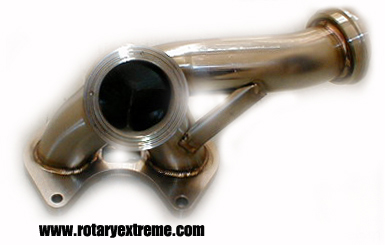
I can't really tell from the picture where the wastegate tube comes out, I'm assuming right before the turbine outlet, perpendicular to the other pipes. This manifold has a very large diameter and is for the T51. I would still like to see a picture of your manifold. Just about any design would rely on some backpressure from the turbine to flow a lot of gas through the wastegate.
I can't really tell from the picture where the wastegate tube comes out, I'm assuming right before the turbine outlet, perpendicular to the other pipes. This manifold has a very large diameter and is for the T51. I would still like to see a picture of your manifold. Just about any design would rely on some backpressure from the turbine to flow a lot of gas through the wastegate.
Trending Topics

Full Member
Joined: Mar 2001
Posts: 150
Likes: 0
From: I AM canadian
Smaller primaries will ensure Lightning quick boost response on larger turbo's.
Going to a large diameter primaries (2.25 or 2.5) is the way the japanese companies control boost. This is to keep costs down.
The proper way is to have a high velocity primaries (no larger than 2") and a wastegate large enough, or if need be 2 wastegates. This way you will have the best of both worlds. Fast response and accurate consistent boost control.
Going to a large diameter primaries (2.25 or 2.5) is the way the japanese companies control boost. This is to keep costs down.
The proper way is to have a high velocity primaries (no larger than 2") and a wastegate large enough, or if need be 2 wastegates. This way you will have the best of both worlds. Fast response and accurate consistent boost control.
Thread Starter
WTF is wrong with it now?
Joined: Oct 2001
Posts: 1,492
Likes: 0
From: London, ON
Heh, heh Why do you think I was checking on the bigger gate? I like the original design, and hope it would work with the 60mm. I thought you were out of town
BTW, Steve at JRP has a T51 kit on the shelf he's going to put on his Supra.
Why do you think I was checking on the bigger gate? I like the original design, and hope it would work with the 60mm. I thought you were out of townBTW, Steve at JRP has a T51 kit on the shelf he's going to put on his Supra.
Freedoms worth a buck o'5
Joined: May 2001
Posts: 2,544
Likes: 1
From: Calgary Alberta Canada
I was thinking of the Hks cast, but really that design, while quite aesthetically pleasing, is far from optimal when it comes to flowing gases in an equal and efficient manner to both turbo and wastegate..
I uploaded some pics previous, but I can seem to find them on the forum, just gonna check my folders here....hmm..
Found one..

Its 2" primaries, the turbo is 3.5" outlet, also the wastegate tubing is 1.5" in and out, same as the wastegate itself..
I was initially planning on 2 35mm gates however there was no stock on them at the time, so a single 40 was used, some more well known forum members felt "quite strongly" that it would not work, maybe with store bought manifolds and exhausts, which I guess may say something about the product out there thats available, one of the best manifolds I have seen is the blitz skyline GTR manifold, it actually uses y branch connections..ahh to have a mandrel bender..
If there was anything else that came out of building my own manifold, I taught myself how to Tig weld, which was something I always wanted to try..Max
I uploaded some pics previous, but I can seem to find them on the forum, just gonna check my folders here....hmm..
Found one..
Its 2" primaries, the turbo is 3.5" outlet, also the wastegate tubing is 1.5" in and out, same as the wastegate itself..
I was initially planning on 2 35mm gates however there was no stock on them at the time, so a single 40 was used, some more well known forum members felt "quite strongly"
that it would not work, maybe with store bought manifolds and exhausts, which I guess may say something about the product out there thats available, one of the best manifolds I have seen is the blitz skyline GTR manifold, it actually uses y branch connections..ahh to have a mandrel bender..If there was anything else that came out of building my own manifold, I taught myself how to Tig weld, which was something I always wanted to try..Max
Thread Starter
WTF is wrong with it now?
Joined: Oct 2001
Posts: 1,492
Likes: 0
From: London, ON
It looks like you TII guys must have a lot of room between the fenders Is it just the angle of the photo, or do your exhaust runners come straight out for the first 10"? Are your pipes to the wastegate angled into the flow from the exhaust ports?
I hate working in 2D
Is it just the angle of the photo, or do your exhaust runners come straight out for the first 10"? Are your pipes to the wastegate angled into the flow from the exhaust ports?I hate working in 2D
Freedoms worth a buck o'5
Joined: May 2001
Posts: 2,544
Likes: 1
From: Calgary Alberta Canada
Yeah its hard to tell, but pipes are maybe about 6" long, and there is a slight turn right outside the manifold flange that kicks the turbo forward, the bend is somewhat hidden by the wastegate piping and the wastegate runners are angled into the stream slightly to make sure its a vent and not a venturi....
My photography skills suck sorry.. I think this would also basically fit a 3rd gen,I ended up with about 3 inches between the turbo and the strut tower.
I was a little concerned about this material thickness with the wieght of the turbo, so far so good though..
It was fun project, next one I do I hope is for a 3 rotor though.. Or I may do a report on my 13b and buy a GT series turbo..not sure yet..max
..My photography skills suck sorry.. I think this would also basically fit a 3rd gen,I ended up with about 3 inches between the turbo and the strut tower.
I was a little concerned about this material thickness with the wieght of the turbo, so far so good though..
It was fun project, next one I do I hope is for a 3 rotor though..
Or I may do a report on my 13b and buy a GT series turbo..not sure yet..max
Thread Starter
WTF is wrong with it now?
Joined: Oct 2001
Posts: 1,492
Likes: 0
From: London, ON
That's another question I've got. Say you normally want to run 15 psi on the street, maybe turn it up to 22 psi on the track with C16, can you use a wastegate with a 3 lb spring? Of course I'm talking with a good boost controller, but it there any drawback to a really low pressure wastegate spring? Handy for valet mode, of course, and any time someone else has to drive the car.
Freedoms worth a buck o'5
Joined: May 2001
Posts: 2,544
Likes: 1
From: Calgary Alberta Canada
You always need a spring that just exceeds whatever manifold back pressure the sizing of the turbo and wheel help to dictate. Since a modulating valve such as a wastegate always opens against flow in order to avoid excessive hunting, the pressure in the manifold can act on the head of the valve as well. Max
Thread Starter
WTF is wrong with it now?
Joined: Oct 2001
Posts: 1,492
Likes: 0
From: London, ON
I think the best way to describe it for someone like myself with only a basic understanding of thermodynamics (I took 2 classes at university) is that the turbo uses change of pressure across the turbine to create rotational motion. High pressure on the inlet and low pressure on the outlet would encourage gas to travel through the tubine rapidly. Using a downpipe that expands, i.e. 3" outlet from turbine tapered to 4", would allow even more pressure drop across the turbine for more power to be produced by the turbine. Increasing the pressure ratio only works so far, then it is limited by the temperature of the exhaust which we can't really increase.
Keeping the pressure high on the manifold side can be done by keeping the exhaust runners small. Allowing the escaping exhaust to expand into overly large pipes would decrease the pressure drop and temperature drop available across the turbine.
But of course we know that using TOO small of exhaust manifold will choke your engine at higher RPM and power output. Such is the compromise of engine design.
Of course, none of what I've just typed takes into account that our gas flow is pulsed, not continuous like a jet engine. Playing with the length of the runners can cause pulses to arrive at the turbine at their highest pressure. Using a split manifold and split turbine housing will cause the pulses to arrive at the turbine at high pressure instead of expanding before the turbine.
If I've left anything out, or made any glaring mistakes, it would be great if someone could point them out. I didn't do that well in Thermodynamics, but I had a really crappy professor. One of those genius types who couldn't explain himself very well.
Keeping the pressure high on the manifold side can be done by keeping the exhaust runners small. Allowing the escaping exhaust to expand into overly large pipes would decrease the pressure drop and temperature drop available across the turbine.
But of course we know that using TOO small of exhaust manifold will choke your engine at higher RPM and power output. Such is the compromise of engine design.
Of course, none of what I've just typed takes into account that our gas flow is pulsed, not continuous like a jet engine. Playing with the length of the runners can cause pulses to arrive at the turbine at their highest pressure. Using a split manifold and split turbine housing will cause the pulses to arrive at the turbine at high pressure instead of expanding before the turbine.
If I've left anything out, or made any glaring mistakes, it would be great if someone could point them out. I didn't do that well in Thermodynamics, but I had a really crappy professor.
One of those genius types who couldn't explain himself very well.

Thread
Thread Starter
Forum
Replies
Last Post
Turblown
Vendor Classifieds
12
Oct 17, 2020 03:25 PM
eplusz
General Rotary Tech Support
15
Oct 7, 2015 04:04 PM
