


FMIC vs VMIC

Thread Starter

Joined: May 2005
Posts: 2,745
Likes: 0
From: North Bay, Ontario
FMIC vs VMIC
Being as the V-mounts seem to becoming increasingly popular (and I was going to build one myself, and chose otherwise) I figure I'd post some of the generally-thought pro's and cons of each setup that I've come across, including some good ol' math for the haters. If any of my calc's don't make sense, please feel free to correct and publicly humiliate me, I'm down.
I'll do calculations afterwards for each setup with both 2.5" intercooler piping and 3" piping, although those who don't know, it's not necessary to jump to 3" piping (airflow does not meet significant resistance) until you reach 900 CFM ~ 72 Lbs/min ~ 525+ whp; before that it is just useless void, slows air charge and is not a restriction.
VMIC
Pro-Less piping = more response (more on this later)
Pro-More concentrated airflow to Radiator
Pro-When properly ducted, more efficient cooling of both can be had at high speed
Con-Heat of radiator/engine soak intercooler and thus cooler intake charge.
Con-Needs vented hood, proper ducting, and fabrication skills.
FMIC
Pro-More direct airflow to Intercooler
Pro-No heatsoak from engine bay - cooler charge
Pro-More easily fabricated
Con-More piping = less response (more on this later)
Con-Reduced airflow to Radiator/oil cooler/engine bay
Now, it would seem that the one major benefit of running VMIC (and a reason that it seems many choose it) is for better response. I'm going to do up some math using a GT35R turbo as an example because it's a well-rounded, "common" turbo.
So, using 2.5" intercooler piping:
A FMIC will have roughly 6 feet of intake pipe. At 2.5" I.D., you get a circular area of 4.90625" (1.25 sq. x 3.14). Now, multiply that by 72 inches of piping, you get an inner volume of 353.25 square inches. I am ommitting the intercooler size in this, because we'll assume it is a constant between the two setups and the determining factor is pipe length.
A VMIC will have roughly 3 feet of intake pipe. At 2.5" I.D., you get a circular area of 4.90625", multiplied by 36" gives 176.625 square inches.
Now, let's take a 35R compressor map:

At 3,000 RPM, 1.35 PR (roughly 5 psi), using Sean @ A-Spec's formula Our engine is ingesting approx. 167 CFM (13.47 lbs/min) , or 4,809 Cubic inches per second. On the compressor map, that just puts us on the lower left region, say 60-65% efficiency. Again, if my math is *****, please correct me, I'm not trying to sound smart, but trying to figure this out for myself as well. Now, 4,809 Cubic inches per second at atmospheric pressure (keeping temperature constant - assuming intercooler thermal efficiency is the same and ignoring temp. difference from longer/shorter piping -not sure I'm allowed to do this-) translates to 3,562 Cubic inches per second at 1.35 Bar (ACFM = SCFM*(Pstd/P1))
So, air during spool to 5 psi is moving at at least 3500 Cubic inches/second. For the FMIC, it will take 1/10th of a second to fill that void. For the VMIC, it will take 5/100ths of a second (half the time)
For the 3" diameter piping:
Circular diameter is 7.065". Volume of a FMIC piping is 508.68 cubic inches
Volume of VMIC piping is 254.34 cubic inches.
For the FMIC it will take 15/100ths of a second to fill, for the VMIC it will take 7/100ths of a second to fill.
This is what got me looking less at VMIC's. I think they are a great design for those doing road race/autocross racing, where you need the most airflow to the rad, or knowingly have cooling issues, but for the average street driver/drag racer, it's completely unnecessary.
I hope Sean comes on here to correct my exam.
I'll do calculations afterwards for each setup with both 2.5" intercooler piping and 3" piping, although those who don't know, it's not necessary to jump to 3" piping (airflow does not meet significant resistance) until you reach 900 CFM ~ 72 Lbs/min ~ 525+ whp; before that it is just useless void, slows air charge and is not a restriction.
VMIC
Pro-Less piping = more response (more on this later)
Pro-More concentrated airflow to Radiator
Pro-When properly ducted, more efficient cooling of both can be had at high speed
Con-Heat of radiator/engine soak intercooler and thus cooler intake charge.
Con-Needs vented hood, proper ducting, and fabrication skills.
FMIC
Pro-More direct airflow to Intercooler
Pro-No heatsoak from engine bay - cooler charge
Pro-More easily fabricated
Con-More piping = less response (more on this later)
Con-Reduced airflow to Radiator/oil cooler/engine bay
Now, it would seem that the one major benefit of running VMIC (and a reason that it seems many choose it) is for better response. I'm going to do up some math using a GT35R turbo as an example because it's a well-rounded, "common" turbo.
So, using 2.5" intercooler piping:
A FMIC will have roughly 6 feet of intake pipe. At 2.5" I.D., you get a circular area of 4.90625" (1.25 sq. x 3.14). Now, multiply that by 72 inches of piping, you get an inner volume of 353.25 square inches. I am ommitting the intercooler size in this, because we'll assume it is a constant between the two setups and the determining factor is pipe length.
A VMIC will have roughly 3 feet of intake pipe. At 2.5" I.D., you get a circular area of 4.90625", multiplied by 36" gives 176.625 square inches.
Now, let's take a 35R compressor map:
At 3,000 RPM, 1.35 PR (roughly 5 psi), using Sean @ A-Spec's formula Our engine is ingesting approx. 167 CFM (13.47 lbs/min) , or 4,809 Cubic inches per second. On the compressor map, that just puts us on the lower left region, say 60-65% efficiency. Again, if my math is *****, please correct me, I'm not trying to sound smart, but trying to figure this out for myself as well. Now, 4,809 Cubic inches per second at atmospheric pressure (keeping temperature constant - assuming intercooler thermal efficiency is the same and ignoring temp. difference from longer/shorter piping -not sure I'm allowed to do this-) translates to 3,562 Cubic inches per second at 1.35 Bar (ACFM = SCFM*(Pstd/P1))
So, air during spool to 5 psi is moving at at least 3500 Cubic inches/second. For the FMIC, it will take 1/10th of a second to fill that void. For the VMIC, it will take 5/100ths of a second (half the time)
For the 3" diameter piping:
Circular diameter is 7.065". Volume of a FMIC piping is 508.68 cubic inches
Volume of VMIC piping is 254.34 cubic inches.
For the FMIC it will take 15/100ths of a second to fill, for the VMIC it will take 7/100ths of a second to fill.
This is what got me looking less at VMIC's. I think they are a great design for those doing road race/autocross racing, where you need the most airflow to the rad, or knowingly have cooling issues, but for the average street driver/drag racer, it's completely unnecessary.
I hope Sean comes on here to correct my exam.

Banned. I got OWNED!!!
Joined: Jun 2008
Posts: 329
Likes: 0
From: usa
You know my answer 
I will say this from the limited actual data I have from the 4.5 hours of runtime before I lost my motor.
Ambient temps all ~30*
Sitting @ idle in my driveway coolant temps where ~180* rock solid. IAT's temps crept up slightly but nothing serious by any stretch of the imagination. I wold have to go look at my logs as I just simply do not remember. I will say though that the charge pipes were all brutally cold to the touch.
Sitting at idle in my driveway oil temps got up to 200* This caused some concern. After a few seconds of driving (literally) they were back down to 140* - literally
I don't think that the rad will heatsoak the intercooler if done properly. If they are vented seperately and there is a divider between them, I just don't see it happening.
Doing a 3rd gear pull to 85mph IAT's got to 39* it was COLD that night and this was with a NON-vented hood.
I don't think that a vented hood is required for a VMIC. Here's why. I remember reading a post by Howard Coleman where he measured the exit speed of the air from his intercooler @ highway speeds and he found it to be ~3-5MPH. 3-5 MPH of air exiting the intercooler will not have a hard time finding it's way out of the engine bay. In otherwords I don't think that a non-vented hood will effect the effieciency of the core all that much.
Now, with that being said. A properly done VMIC with a properly done vented hood (my definition of properly done is a hood that is designed and built around a core and actaually ducted to it) will serve, in my mind, some advantages.
1) It will create a vacuum that will pull air through the core thus increasing flow through it.
2) Will not only expose the core to ambient temps, but will also seal a good portion of it from engine bay heat reducing the CHANCE of heatsoak.
These are the things that kept me awake at night while conjuring up my designs in my head.
Oh - VMIC piping length. I would put it more on the 2' side MAX. I can actually measure mine but it's frickin' short.
I will say this from the limited actual data I have from the 4.5 hours of runtime before I lost my motor.
Ambient temps all ~30*
Sitting @ idle in my driveway coolant temps where ~180* rock solid. IAT's temps crept up slightly but nothing serious by any stretch of the imagination. I wold have to go look at my logs as I just simply do not remember. I will say though that the charge pipes were all brutally cold to the touch.
Sitting at idle in my driveway oil temps got up to 200* This caused some concern. After a few seconds of driving (literally) they were back down to 140* - literally
I don't think that the rad will heatsoak the intercooler if done properly. If they are vented seperately and there is a divider between them, I just don't see it happening.
Doing a 3rd gear pull to 85mph IAT's got to 39* it was COLD that night and this was with a NON-vented hood.
I don't think that a vented hood is required for a VMIC. Here's why. I remember reading a post by Howard Coleman where he measured the exit speed of the air from his intercooler @ highway speeds and he found it to be ~3-5MPH. 3-5 MPH of air exiting the intercooler will not have a hard time finding it's way out of the engine bay. In otherwords I don't think that a non-vented hood will effect the effieciency of the core all that much.
Now, with that being said. A properly done VMIC with a properly done vented hood (my definition of properly done is a hood that is designed and built around a core and actaually ducted to it) will serve, in my mind, some advantages.
1) It will create a vacuum that will pull air through the core thus increasing flow through it.
2) Will not only expose the core to ambient temps, but will also seal a good portion of it from engine bay heat reducing the CHANCE of heatsoak.
These are the things that kept me awake at night while conjuring up my designs in my head.
Oh - VMIC piping length. I would put it more on the 2' side MAX. I can actually measure mine but it's frickin' short.
Thread Starter
Joined: May 2005
Posts: 2,745
Likes: 0
From: North Bay, Ontario
Weren't those 3-5 mph exit test figures from that guy selling bolt-on "Cool Louvers" or something?
And seriously, 99% of people who build VMIC's don't generally seperately duct the Rad and I/C.
And seriously, 99% of people who build VMIC's don't generally seperately duct the Rad and I/C.
Banned. I got OWNED!!!
Joined: Jun 2008
Posts: 329
Likes: 0
From: usa
Dunno
For the FC in particular I'm not sure how people are getting proper VMIC's to not neccessitate the need for seperate ducting. My rad is at a roughly 45* angle the the ground. I had to cut out the support that the factory oil cooler used. I could've pushed the radiator more forward but that wouldn't have gained me anything regarding placement of the intercooler and getting a good angle for that. I've seen a few nicely placed intercoolers. Meaning they are ~45* to the airflow but the angle of the rad would need to be much more acute.
My answer to the problem was basically an HMIC. The angle of the intercooler is the same angle as the hood. In order to get air to place pressure on the core, I needed ducting. My ducting is almost watertight against the heat exhangers, all four of them. I don't understand why people who are spending all this time, effort and money don't add that extra little piece.
I believe that ducting is really the key. ****, you could mount your rad in the hatch area of the ducting was properly done.



I've run Stock Mount, Front Mount and Vmount of my FD. My threads on performance of each are in the 3rd Gen Section. I'll share some personal experience with you here.
Personal experience has me agreeing with some of your PROs but not your CONs
- Yes less piping = much more responsive. I saw full boost 500 RPM sooner on 99 twins when compared back to back with a Greddy FMIC.
- Yes, more concentrated air flow to radiator AND intercooler.
- Who needs ducting. My unducted Vmount had much lower coolant and air temps compared to FMIC and SMIC. Real world results proven on street and road race courses. I since added some ducting and noticed VERY small improvements. It helps but is not necessary to realize the benefits of a Vmount setup.
- Heat soak? No setup heat soaks less than a Vmount. Even the FMIC heat soaked ridiculously b/c w/ an unducted FMIC to the rad, the radiator fans would just recirculate over heated engine bay air through the radiator. If you aren't getting a good source of fresh air to the radiator with whatever setup you are running, it will heat soak more and your overall temps will increase.
- Absolutely does NOT need a vented hood or "proper" ducting. You DO either need good fab skills or be willing to pay the price for a good kit. They ain't cheap but absolutely ******* worth it if you don't ever want to worry about coolant or air temps.
- Yep more direct airflow to IC.
- Disagree. My experience shows lots of heatsoak from engine bay since by adding the FMIC (especially the Greddy which sits way up front in the nose of the car), lots of air gets diverted around the car vs going through the FMIC to the stuff behind it (a/c condensor and rad). Air takes the path of least resistance. It is a bit counter intuitive, but my AIT were worse than my Vmount and only slightly better than a SMIC when MOVING with minimal traffic. As soon as speeds slowed, the engine bay would heat soak ridiculously b/c there was no airflow through the engine bay. When stuck in traffic AIT were pretty close to SMIC. It also took much longer with a FMIC for temps to normalize once you started moving again b/c of less air flow.
- Definitely easier to fab.
- Definitely less responsive b/c of longer piping.
- Much less air flow to rad and a/c and through the engine bay. Agreed there.
Don't mean to put words in Sean's mouth but here - read this thread and check out Sean's comments on IC sizing and math:
https://www.rx7club.com/single-turbo-rx-7s-23/ideal-intercooler-dimensions-13b-275273/
The math theory is cool but practically speaking you will have much cooler air and coolant and a/c temps with a Vmount.
I know the FC has a roomier engine bay and less heat and air flow management issues as compared to the FD but the above was my personal experience.
VMIC
Pro-Less piping = more response (more on this later)
Pro-More concentrated airflow to Radiator
Pro-When properly ducted, more efficient cooling of both can be had at high speed
Con-Heat of radiator/engine soak intercooler and thus cooler intake charge.
Con-Needs vented hood, proper ducting, and fabrication skills.
Pro-Less piping = more response (more on this later)
Pro-More concentrated airflow to Radiator
Pro-When properly ducted, more efficient cooling of both can be had at high speed
Con-Heat of radiator/engine soak intercooler and thus cooler intake charge.
Con-Needs vented hood, proper ducting, and fabrication skills.
- Yes less piping = much more responsive. I saw full boost 500 RPM sooner on 99 twins when compared back to back with a Greddy FMIC.
- Yes, more concentrated air flow to radiator AND intercooler.
- Who needs ducting. My unducted Vmount had much lower coolant and air temps compared to FMIC and SMIC. Real world results proven on street and road race courses. I since added some ducting and noticed VERY small improvements. It helps but is not necessary to realize the benefits of a Vmount setup.
- Heat soak? No setup heat soaks less than a Vmount. Even the FMIC heat soaked ridiculously b/c w/ an unducted FMIC to the rad, the radiator fans would just recirculate over heated engine bay air through the radiator. If you aren't getting a good source of fresh air to the radiator with whatever setup you are running, it will heat soak more and your overall temps will increase.
- Absolutely does NOT need a vented hood or "proper" ducting. You DO either need good fab skills or be willing to pay the price for a good kit. They ain't cheap but absolutely ******* worth it if you don't ever want to worry about coolant or air temps.
- Disagree. My experience shows lots of heatsoak from engine bay since by adding the FMIC (especially the Greddy which sits way up front in the nose of the car), lots of air gets diverted around the car vs going through the FMIC to the stuff behind it (a/c condensor and rad). Air takes the path of least resistance. It is a bit counter intuitive, but my AIT were worse than my Vmount and only slightly better than a SMIC when MOVING with minimal traffic. As soon as speeds slowed, the engine bay would heat soak ridiculously b/c there was no airflow through the engine bay. When stuck in traffic AIT were pretty close to SMIC. It also took much longer with a FMIC for temps to normalize once you started moving again b/c of less air flow.
- Definitely easier to fab.
- Definitely less responsive b/c of longer piping.
- Much less air flow to rad and a/c and through the engine bay. Agreed there.
Now, it would seem that the one major benefit of running VMIC (and a reason that it seems many choose it) is for better response. I'm going to do up some math using a GT35R turbo as an example because it's a well-rounded, "common" turbo.
<snip>
I hope Sean comes on here to correct my exam.
<snip>
I hope Sean comes on here to correct my exam.
Don't mean to put words in Sean's mouth but here - read this thread and check out Sean's comments on IC sizing and math:
https://www.rx7club.com/single-turbo-rx-7s-23/ideal-intercooler-dimensions-13b-275273/
The math theory is cool but practically speaking you will have much cooler air and coolant and a/c temps with a Vmount.
I know the FC has a roomier engine bay and less heat and air flow management issues as compared to the FD but the above was my personal experience.
Banned. I got OWNED!!!
Joined: Jun 2008
Posts: 329
Likes: 0
From: usa
My experience in fabrication with the FC is that from the pictures that I have seen of some of the nicer FD VMIC's, it's actually easier to get a proper angle for a VMIC with an FD than with an FC. While the FC may have a roomier engine bay, the angle of the hood is not as desireable as an FD. The FC also has that PITA to deal with ~2" support bar running between the frame rails in the front that makes it difficult to mount "stuff." I ended up cutting mine out and building an entire frame for my intercooler and rad.
Due to the constraints that I was faced with, I decided to go with an HMIC as opposed to a traditional VMIC. In my mind, seperate ducting would not be necessary with a properly angled VMIC, but I feel that it would be a decent idea. My though was that when the fan kicks on, the path of least resistance would definately be through the radiator and potentially steal some of the cooling air from the intercooler.
In my setup, the intercooler follows the same profile as the hood. gracer7, in you opinion from your experience, with an intercooler on an angle such as mine, would you think a sperate and sealed duct would be necessary?
Due to the constraints that I was faced with, I decided to go with an HMIC as opposed to a traditional VMIC. In my mind, seperate ducting would not be necessary with a properly angled VMIC, but I feel that it would be a decent idea. My though was that when the fan kicks on, the path of least resistance would definately be through the radiator and potentially steal some of the cooling air from the intercooler.
In my setup, the intercooler follows the same profile as the hood. gracer7, in you opinion from your experience, with an intercooler on an angle such as mine, would you think a sperate and sealed duct would be necessary?
My experience in fabrication with the FC is that from the pictures that I have seen of some of the nicer FD VMIC's, it's actually easier to get a proper angle for a VMIC with an FD than with an FC. While the FC may have a roomier engine bay, the angle of the hood is not as desireable as an FD. The FC also has that PITA to deal with ~2" support bar running between the frame rails in the front that makes it difficult to mount "stuff." I ended up cutting mine out and building an entire frame for my intercooler and rad.
Due to the constraints that I was faced with, I decided to go with an HMIC as opposed to a traditional VMIC. In my mind, seperate ducting would not be necessary with a properly angled VMIC, but I feel that it would be a decent idea. My though was that when the fan kicks on, the path of least resistance would definately be through the radiator and potentially steal some of the cooling air from the intercooler.
In my setup, the intercooler follows the same profile as the hood. gracer7, in you opinion from your experience, with an intercooler on an angle such as mine, would you think a sperate and sealed duct would be necessary?
Due to the constraints that I was faced with, I decided to go with an HMIC as opposed to a traditional VMIC. In my mind, seperate ducting would not be necessary with a properly angled VMIC, but I feel that it would be a decent idea. My though was that when the fan kicks on, the path of least resistance would definately be through the radiator and potentially steal some of the cooling air from the intercooler.
In my setup, the intercooler follows the same profile as the hood. gracer7, in you opinion from your experience, with an intercooler on an angle such as mine, would you think a sperate and sealed duct would be necessary?
Packaging is definitely a challenge. No doubt about it.
I don't have direct experience with an H mount setup where the IC is mounted horizontally in the car (parallel to the ground). However, if you think about it from an air flow perspective, I think the Hmount would potentially benefit more than the others from ducting to get air flow through it.
The IC, rad, oil coolers all operate on the concept of heat exchange.
- The medium being cooled (air, coolant, oil etc) passes through the heat exchanger end tank to end tank,
-air (which hopefully is cooler than the stuff flowing through the heat exchanger) flows through the fins in the heat exchanger,
-by the time the stuff reaches the other side of the heat exchanger, it has cooled b/c of the air flowing through the fins in the heat exchanger
If your IC is mounted parallel, it will be difficult to get direct air flowing through it w/o something directing air to/through the core. I would speculate that the Hmount doesn't get direct air flowing through it. It gets indirect air that bounces off the radiator below it and then passes through it. Still works I guess.
Managing air flow (aka Ducting, sealing) will always make whatever setup you run more efficient. Only testing in the environment in which you use your car will tell you just how much more efficiency you need.
Here is an example from my car. On the street here in North and South CA I found that I didn't need any ducting at all on my Vmount setup. I ran much cooler than with my Greddy FMIC and temps were manageable. After analyzing how dust and dirt accumulated in my motor in certain spots after doing the Vmount, I realized just how much air was passing through the opening at the V between the rad and IC. That translated to a loss of potential efficiency by not harnessing that air to better cool the cores. So I sealed that off. I saw better air temps as a result.
Then I added more ducting and sealing on the driver's side along the frame rail better managing air flow there so it didn't go around the cores in that area. Also added a small little L shaped piece of metal on the pass side of the IC to better manage air flow on that side also.
I still haven't done any sealing or ducting on the passenger side but will probably do so one of these days. The ducting definitely helps the cores do their job more efficiently.
Last note - the ducting helped coolant and air temps a lot on track (road courses) in extreme situations.
here is a good link to wikipedia about fluid dynamics for anyone that wants to learn more about this stuff. I'm just an amateur that learned a few things researching this and modding my own car.
http://en.wikipedia.org/wiki/Fluid_flow
Special thanks to Speed of light for all the work on my Vmount setup and for teaching me a few things about engineering and fabrication.
Trending Topics
Banned. I got OWNED!!!
Joined: Jun 2008
Posts: 329
Likes: 0
From: usa
Packaging is definitely a challenge. No doubt about it.
I don't have direct experience with an H mount setup where the IC is mounted horizontally in the car (parallel to the ground). However, if you think about it from an air flow perspective, I think the Hmount would potentially benefit more than the others from ducting to get air flow through it.
The IC, rad, oil coolers all operate on the concept of heat exchange.
- The medium being cooled (air, coolant, oil etc) passes through the heat exchanger end tank to end tank,
-air (which hopefully is cooler than the stuff flowing through the heat exchanger) flows through the fins in the heat exchanger,
-by the time the stuff reaches the other side of the heat exchanger, it has cooled b/c of the air flowing through the fins in the heat exchanger
I don't have direct experience with an H mount setup where the IC is mounted horizontally in the car (parallel to the ground). However, if you think about it from an air flow perspective, I think the Hmount would potentially benefit more than the others from ducting to get air flow through it.
The IC, rad, oil coolers all operate on the concept of heat exchange.
- The medium being cooled (air, coolant, oil etc) passes through the heat exchanger end tank to end tank,
-air (which hopefully is cooler than the stuff flowing through the heat exchanger) flows through the fins in the heat exchanger,
-by the time the stuff reaches the other side of the heat exchanger, it has cooled b/c of the air flowing through the fins in the heat exchanger
If your IC is mounted parallel, it will be difficult to get direct air flowing through it w/o something directing air to/through the core. I would speculate that the Hmount doesn't get direct air flowing through it. It gets indirect air that bounces off the radiator below it and then passes through it. Still works I guess.
Here is an example from my car. On the street here in North and South CA I found that I didn't need any ducting at all on my Vmount setup. I ran much cooler than with my Greddy FMIC and temps were manageable. After analyzing how dust and dirt accumulated in my motor in certain spots after doing the Vmount, I realized just how much air was passing through the opening at the V between the rad and IC. That translated to a loss of potential efficiency by not harnessing that air to better cool the cores. So I sealed that off. I saw better air temps as a result.
Then I added more ducting and sealing on the driver's side along the frame rail better managing air flow there so it didn't go around the cores in that area. Also added a small little L shaped piece of metal on the pass side of the IC to better manage air flow on that side also.
I still haven't done any sealing or ducting on the passenger side but will probably do so one of these days. The ducting definitely helps the cores do their job more efficiently.
Last note - the ducting helped coolant and air temps a lot on track (road courses) in extreme situations.
here is a good link to wikipedia about fluid dynamics for anyone that wants to learn more about this stuff. I'm just an amateur that learned a few things researching this and modding my own car.
http://en.wikipedia.org/wiki/Fluid_flow
Special thanks to Speed of light for all the work on my Vmount setup and for teaching me a few things about engineering and fabrication.
Then I added more ducting and sealing on the driver's side along the frame rail better managing air flow there so it didn't go around the cores in that area. Also added a small little L shaped piece of metal on the pass side of the IC to better manage air flow on that side also.
I still haven't done any sealing or ducting on the passenger side but will probably do so one of these days. The ducting definitely helps the cores do their job more efficiently.
Last note - the ducting helped coolant and air temps a lot on track (road courses) in extreme situations.
here is a good link to wikipedia about fluid dynamics for anyone that wants to learn more about this stuff. I'm just an amateur that learned a few things researching this and modding my own car.
http://en.wikipedia.org/wiki/Fluid_flow
Special thanks to Speed of light for all the work on my Vmount setup and for teaching me a few things about engineering and fabrication.


I'm flattered a few guys on here think I'm so important. Honestly there are others on here that are probably more worthy of it. 
I've run a v-mount on my car a very long time. Right after I bought the M2 unit from brian. I put it in the car and said this needs to be reversed. I can tell you this. It is better overall in many ways than a FMIC, main reason being the airflow to the radiator and engine bay.
You should run a splitter if you want any appreciable flow through the IC core. Air will just flow through the radiator more so, and not the IC core. Path of least resistance. Also it can act as a heat shield to the IC core as well.
I just made a 20B car here with a FMIC properly ducted and it worked very well with the car holding solid temps, even pull after pull on the dyno, so it is possible, and 20B's need way more cooling ability. So ducting and shielding can and do make a difference.
All this stuff is silly talk to a point, most of this pertains to street driven cars with overly enthusiastic owners, ideally a well ducted and shielded VMIC makes more sense in a lot of ways. Also FMIC's can be made to work well OEM's clearly show that.
My personal cars run VMIC, I've done enough playing around with different setups to know that is what I prefer, that said it doesn't mean it's the only way to go.
I've said it in a million different posts IC selection is very much like turbo selection it is very give and take, you compromise one piece of the puzzle for the other.
I've run a v-mount on my car a very long time. Right after I bought the M2 unit from brian. I put it in the car and said this needs to be reversed. I can tell you this. It is better overall in many ways than a FMIC, main reason being the airflow to the radiator and engine bay.
You should run a splitter if you want any appreciable flow through the IC core. Air will just flow through the radiator more so, and not the IC core. Path of least resistance. Also it can act as a heat shield to the IC core as well.
I just made a 20B car here with a FMIC properly ducted and it worked very well with the car holding solid temps, even pull after pull on the dyno, so it is possible, and 20B's need way more cooling ability. So ducting and shielding can and do make a difference.
All this stuff is silly talk to a point, most of this pertains to street driven cars with overly enthusiastic owners, ideally a well ducted and shielded VMIC makes more sense in a lot of ways. Also FMIC's can be made to work well OEM's clearly show that.
My personal cars run VMIC, I've done enough playing around with different setups to know that is what I prefer, that said it doesn't mean it's the only way to go.
I've said it in a million different posts IC selection is very much like turbo selection it is very give and take, you compromise one piece of the puzzle for the other.
Last edited by Zero R; Feb 22, 2009 at 05:51 PM.
O
In my setup, the top duct runs to the intercooler and is completely seperated from the ducting for the rad. The ducting is almost watertight. I think when it goes back together for the final time I may trim some of the ducting, take a length of vacuum tube, slit it down the middle and use this to make the ducting literally watertight. Although from reading your experience with the ducting or lack thereof, I think my overly retentive shpincter may be getting the best of me on this one. I probably won't do it just based on your experiences.
In my setup, the top duct runs to the intercooler and is completely seperated from the ducting for the rad. The ducting is almost watertight. I think when it goes back together for the final time I may trim some of the ducting, take a length of vacuum tube, slit it down the middle and use this to make the ducting literally watertight. Although from reading your experience with the ducting or lack thereof, I think my overly retentive shpincter may be getting the best of me on this one. I probably won't do it just based on your experiences.
Sounds like you've done a great job.
2 comments:
1. Great idea on the vac hose. Try to avoid any future problems that you may see from having metal rubbing on metal. If you're gonna go through the trouble of ducting do it as right as you can. I didn't think of vac hose at the time and bought some thin rubber sheet and duct tape. So many uses for duct tape
2. When you mount your heat exchangers, try to use those rubber isolators. They help isolate vibrations and increase longevity. Mazda did that on both the radiator and oil coolers and I followed their lead. I didn't do that on my IC as I didn't think it was worth it in my application.
Thread Starter
Joined: May 2005
Posts: 2,745
Likes: 0
From: North Bay, Ontario
That Shine bumper of yours is quite awesome Brian, if I wasn't so biased towards pop-up headlights I would have run that bumper, no question asked. Even with my dislike of pop-ups, I still sometimes regret not getting it (I'm running the FC2K); sooo much potential for airflow management. The only defense I have for my choice in bumpers from a functional stand-point is that if/when I do decide to track it, I can have proper ducting for individual oil coolers and still retain proper brake cooling ducts, and it is fabricated with a "splitter", I guess you could consider.

Originally Posted by Zero R
street driven cars with overly enthusiastic owners
Originally Posted by gracer7-rx7
So many uses for duct tape
Lotta great info in this thread.
Banned. I got OWNED!!!
Joined: Jun 2008
Posts: 329
Likes: 0
From: usa
Sounds like you've done a great job.
2 comments:
1. Great idea on the vac hose. Try to avoid any future problems that you may see from having metal rubbing on metal. If you're gonna go through the trouble of ducting do it as right as you can. I didn't think of vac hose at the time and bought some thin rubber sheet and duct tape. So many uses for duct tape
2 comments:
1. Great idea on the vac hose. Try to avoid any future problems that you may see from having metal rubbing on metal. If you're gonna go through the trouble of ducting do it as right as you can. I didn't think of vac hose at the time and bought some thin rubber sheet and duct tape. So many uses for duct tape
Right now the way everything is bolted together, it's all bolted off the same piece and bolted together so it shouldn't move around too much. I do see your concern though which is why I fitted everything, shaved it, and will be adding the vac hose. I spent the better part of three weeks doing the ducting when I thought it would take me a weekend. Used almost a full 4x8 sheet of AL on this car. (ducting, belly pan, rad shroud, dashes, brackets..... it fricken adds up!)2. When you mount your heat exchangers, try to use those rubber isolators. They help isolate vibrations and increase longevity. Mazda did that on both the radiator and oil coolers and I followed their lead. I didn't do that on my IC as I didn't think it was worth it in my application.
The oil coolers on the other hand, becuase of the bumper and the angle that they wanted to be at had to be exteneded out. It's not that they're mounted flimsy, but the mount inheriently absorbds vibrations. What I doo need to do though is clearance the ducting a little bit and use some fuel line or something along those lines to prevent chaffe

That Shine bumper of yours is quite awesome Brian, if I wasn't so biased towards pop-up headlights I would have run that bumper, no question asked. Even with my dislike of pop-ups, I still sometimes regret not getting it (I'm running the FC2K); sooo much potential for airflow management. The only defense I have for my choice in bumpers from a functional stand-point is that if/when I do decide to track it, I can have proper ducting for individual oil coolers and still retain proper brake cooling ducts, and it is fabricated with a "splitter", I guess you could consider.


Last edited by NotTTT; Feb 22, 2009 at 10:49 PM.
Interesting. Looks like your rad is vertical and the IC is mounted on the bottom with a 5-10 degree angle? When you said Hmount I had envisioned the rad on the bottom and the IC horizontal further up in the engine bay inline with the TB intake piping.
Both my IC and Rad are about 20 degrees.
Both my IC and Rad are about 20 degrees.

talking head

Joined: Apr 2008
Posts: 2,775
Likes: 15
From: Perth, WA, OZ


previously i had already modded my s4 FC radiator onto this frame in a rearwards position
( the radiator replicating the original angle , but further back )
and mounted this huge china FMIC vertically in the radiators original position for ultra short pipe work
[ bends and entries are 76mm , pipe past PS hoses is 65 mm ]
all i have done is rotated the FMIC to be VMIC,, and added the rx2 ASI radiator
only one bracket altered from previous set up !
the new VMIC is around 30 degrees down off horizontal
and the oil cooler angled 30 degrees up from horizontal, projecting forward from the radiator base
- on original hoses
- this ASI radiator is the shorter rx2-gen1 rx7 version
and allows the oil cooler to lay about 15 degrees from horizontal with the road to form the under tray V mount
- using stock oil cooler hoses
( and the I/C is the upper tray V mount )
was simple !!
i have separate cooling air flows and VERY short intercooler pipes
Banned. I got OWNED!!!
Joined: Jun 2008
Posts: 329
Likes: 0
From: usa
Interesting. Looks like your rad is vertical and the IC is mounted on the bottom with a 5-10 degree angle? When you said Hmount I had envisioned the rad on the bottom and the IC horizontal further up in the engine bay inline with the TB intake piping.
Both my IC and Rad are about 20 degrees.
Both my IC and Rad are about 20 degrees.
So after pondering a little more I concluded that the bumper would be the same between VMIC vs HMIC. If I duct everything properly, there should theoretically be 0 difference between the IAT/coolant temps of an HMIC vs a VMIC. For the simple fact that it'll be the same duct in the bumper feeding the same exchanger. How could the temps be any different if the same about of cooling air is tightly being directed to the exchanger? So in the interest of making things easier on the potential hood side, I went HMIC.
It also made it easier to plumb the coolent lines. I bought a few sections of 1.5" AL hardpipe and cut up stock rad FC hoses and it worked great. I was quite surprised actually.
Here is a pic of the framework that I built. The two mounting points on either side bolt to a 1/4" steel plate that I welded onto the frame rails. The top two posts bolt to the original rad support that spans between the two headlights. With this piece in place I can STAND on the outermost edges (the bar that is against the wall, putting the MOST torque on the unit as possibly) and get ~1/2" of movement. I think that'll support an interooler and radiator just plenty.

Pic of what it all looks like when together.
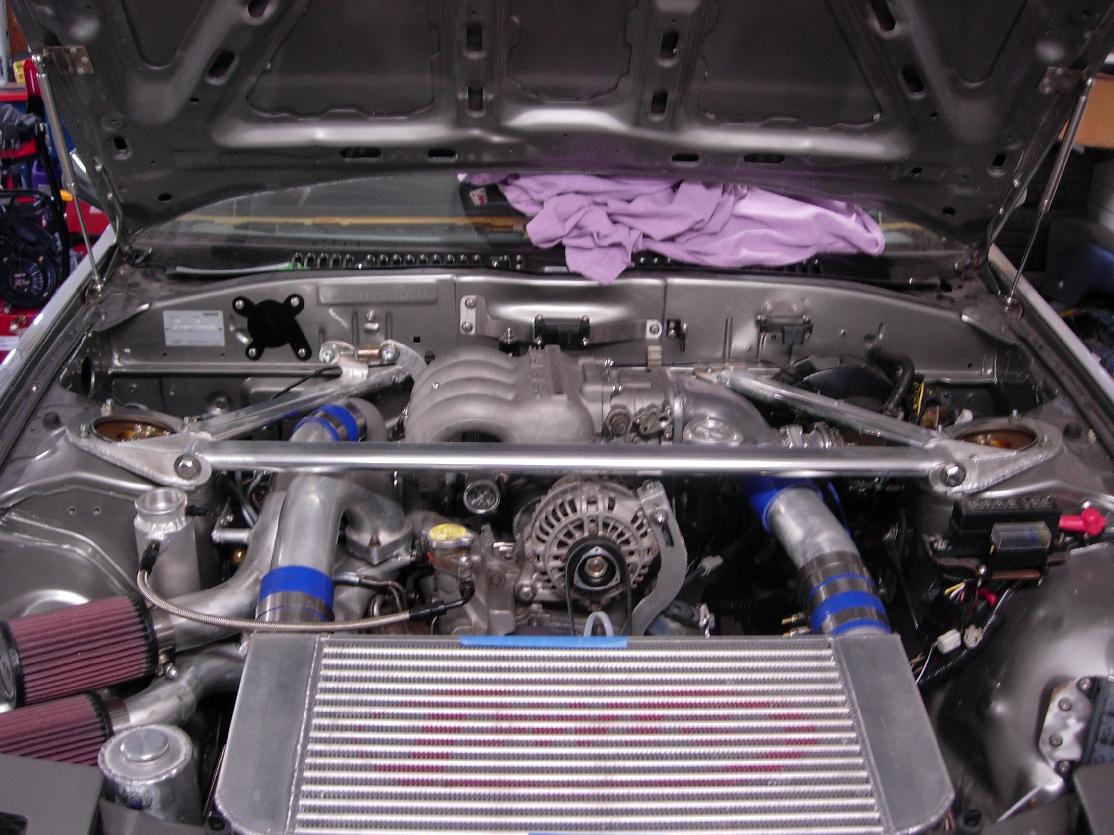
This is probably my favorite VMIC setup in an FC. True VMIC.

Last edited by NotTTT; Feb 23, 2009 at 09:24 AM.


Thread Starter
Joined: May 2005
Posts: 2,745
Likes: 0
From: North Bay, Ontario
That doesn't really look like it would flow properly to the IC or oil cooler, since flow has to abruptly turn on both, but if your temps are fine then I guess it works.
Trots buddy!
you know what the deal is with my car pics to come by the end of March/beginning of April, but they will be useless until May when I finally get some hard numbers out of my Haltech on all the temp readings.
TT, your setup is sekushi. I used to have an HMIC and ditched it for a VMIC. I noticed that my HMIC heatsoaked at idle but that couldve been for other reasons....car wasnt in the best of shape. Also, I decided not to copy your twin oil cooler setup. Only cause I have no idea what your oil temps do at idle. I'm gonna move the stock oil cooler in relation to the rad so when the 2 puller efans turn on, air also goes through the oil cooler. If its not sufficient on the track though I'll switch to copying your setup. I just got the same bumper as you
Great info! Personally, I think FMIC's are completely fail only because everyone I know who tracks and has gone off track(usually with their bumper off or their aftermarket bumper made of FRP) their i/c gets destroyed and the car is undrivable. Useless!
edit: my avatar is of my old HMIC setup.
you know what the deal is with my car
pics to come by the end of March/beginning of April, but they will be useless until May when I finally get some hard numbers out of my Haltech on all the temp readings.TT, your setup is sekushi. I used to have an HMIC and ditched it for a VMIC. I noticed that my HMIC heatsoaked at idle but that couldve been for other reasons....car wasnt in the best of shape. Also, I decided not to copy your twin oil cooler setup. Only cause I have no idea what your oil temps do at idle. I'm gonna move the stock oil cooler in relation to the rad so when the 2 puller efans turn on, air also goes through the oil cooler. If its not sufficient on the track though I'll switch to copying your setup. I just got the same bumper as you
Great info! Personally, I think FMIC's are completely fail only because everyone I know who tracks and has gone off track(usually with their bumper off or their aftermarket bumper made of FRP) their i/c gets destroyed and the car is undrivable. Useless!
edit: my avatar is of my old HMIC setup.
talking head
Joined: Apr 2008
Posts: 2,775
Likes: 15
From: Perth, WA, OZ
trots,,,
pressure builds against the restriction to airflow that is the rad
pressure exerts itself in all directions !
that means what doesn't go through the rad easily
goes up, and also goes down
that's why mazda stuck in an under tray and an upper tray !
high summer in Western Australia is like Iraq!
currently i am driving around in 40 celsius temps,, that is 104 F !
- oh, and with LPG BTW
- the oil cooler and I/C take positions of the over and under trays that mazda provided originally
the oil cooler is obviously forming the bottom dam
and the I/C is the top dam
and the lower front lip of it dams against the aprons sheet metal lip that the latch support sits on
- separating the two areas behind the bumper into high and low
the lower section lets air in, the upper lets it out through I/C to follow the underline of the bonnet
inlet air temps, despite high summer are lower by the order of 10 celsius
- coolant temps, when before had lifted the cap at 107 celsius
- is sitting pretty at 92
pressure builds against the restriction to airflow that is the rad
pressure exerts itself in all directions !
that means what doesn't go through the rad easily
goes up, and also goes down
that's why mazda stuck in an under tray and an upper tray !
high summer in Western Australia is like Iraq!
currently i am driving around in 40 celsius temps,, that is 104 F !
- oh, and with LPG BTW
- the oil cooler and I/C take positions of the over and under trays that mazda provided originally
the oil cooler is obviously forming the bottom dam
and the I/C is the top dam
and the lower front lip of it dams against the aprons sheet metal lip that the latch support sits on
- separating the two areas behind the bumper into high and low
the lower section lets air in, the upper lets it out through I/C to follow the underline of the bonnet
inlet air temps, despite high summer are lower by the order of 10 celsius
- coolant temps, when before had lifted the cap at 107 celsius
- is sitting pretty at 92
Thread Starter
Joined: May 2005
Posts: 2,745
Likes: 0
From: North Bay, Ontario
trots,,,
pressure builds against the restriction to airflow that is the rad
pressure exerts itself in all directions !
that means what doesn't go through the rad easily
goes up, and also goes down
that's why mazda stuck in an under tray and an upper tray !
high summer in Western Australia is like Iraq!
currently i am driving around in 40 celsius temps,, that is 104 F !
- oh, and with LPG BTW
- the oil cooler and I/C take positions of the over and under trays that mazda provided originally
the oil cooler is obviously forming the bottom dam
and the I/C is the top dam
and the lower front lip of it dams against the aprons sheet metal lip that the latch support sits on
- separating the two areas behind the bumper into high and low
the lower section lets air in, the upper lets it out through I/C to follow the underline of the bonnet
inlet air temps, despite high summer are lower by the order of 10 celsius
- coolant temps, when before had lifted the cap at 107 celsius
- is sitting pretty at 92
pressure builds against the restriction to airflow that is the rad
pressure exerts itself in all directions !
that means what doesn't go through the rad easily
goes up, and also goes down
that's why mazda stuck in an under tray and an upper tray !
high summer in Western Australia is like Iraq!
currently i am driving around in 40 celsius temps,, that is 104 F !
- oh, and with LPG BTW
- the oil cooler and I/C take positions of the over and under trays that mazda provided originally
the oil cooler is obviously forming the bottom dam
and the I/C is the top dam
and the lower front lip of it dams against the aprons sheet metal lip that the latch support sits on
- separating the two areas behind the bumper into high and low
the lower section lets air in, the upper lets it out through I/C to follow the underline of the bonnet
inlet air temps, despite high summer are lower by the order of 10 celsius
- coolant temps, when before had lifted the cap at 107 celsius
- is sitting pretty at 92
Again, my reasoning was just that it seems more efficient to utilize the natural flow of air through a bumper, without having to make abrupt changes in direction. The goal is not to utilize restrictions, but to minimize them and increase flow through all exchangers. Again, it works for you quite obviously, I just would not have thought to make a setup that way.
Banned. I got OWNED!!!
Joined: Jun 2008
Posts: 329
Likes: 0
From: usa
TT, your setup is sekushi. I used to have an HMIC and ditched it for a VMIC. I noticed that my HMIC heatsoaked at idle but that couldve been for other reasons....car wasnt in the best of shape. Also, I decided not to copy your twin oil cooler setup. Only cause I have no idea what your oil temps do at idle. I'm gonna move the stock oil cooler in relation to the rad so when the 2 puller efans turn on, air also goes through the oil cooler. If its not sufficient on the track though I'll switch to copying your setup. I just got the same bumper as you
Worst comes to worst, someone mentioned a Harley e-fan as it would fit nicely around those cores. If it does end up being a problem, I'll start off with one fan, then add a second. I really don't see it being a problem though unless I'm dead stopped in traffic on a hot day. But, we'll see. I've been wrong in the past.
The only shitty part about it is I won't be using the Motec to control the oil fans. I have 1 output left and I'm keeping it for Aux stuff

FWIW though, a very close friend of mine and I will really delve into his FC in the future. We're planning on doing exactely what you're suggesting. We'll be welding some brackets on his radiator, and mounting the oil cooler fairly tightly with the rad, so like you said, when the fan kicks on, it should pull some air through the oil cooler. We'll see how it goes.
I wouldn't mind seeing some pics of that
trots,,,
pressure builds against the restriction to airflow that is the rad
pressure exerts itself in all directions !
that means what doesn't go through the rad easily
goes up, and also goes down
that's why mazda stuck in an under tray and an upper tray !
high summer in Western Australia is like Iraq!
currently i am driving around in 40 celsius temps,, that is 104 F !
- oh, and with LPG BTW
- the oil cooler and I/C take positions of the over and under trays that mazda provided originally
the oil cooler is obviously forming the bottom dam
and the I/C is the top dam
and the lower front lip of it dams against the aprons sheet metal lip that the latch support sits on
- separating the two areas behind the bumper into high and low
the lower section lets air in, the upper lets it out through I/C to follow the underline of the bonnet
inlet air temps, despite high summer are lower by the order of 10 celsius
- coolant temps, when before had lifted the cap at 107 celsius
- is sitting pretty at 92
pressure builds against the restriction to airflow that is the rad
pressure exerts itself in all directions !
that means what doesn't go through the rad easily
goes up, and also goes down
that's why mazda stuck in an under tray and an upper tray !
high summer in Western Australia is like Iraq!
currently i am driving around in 40 celsius temps,, that is 104 F !
- oh, and with LPG BTW
- the oil cooler and I/C take positions of the over and under trays that mazda provided originally
the oil cooler is obviously forming the bottom dam
and the I/C is the top dam
and the lower front lip of it dams against the aprons sheet metal lip that the latch support sits on
- separating the two areas behind the bumper into high and low
the lower section lets air in, the upper lets it out through I/C to follow the underline of the bonnet
inlet air temps, despite high summer are lower by the order of 10 celsius
- coolant temps, when before had lifted the cap at 107 celsius
- is sitting pretty at 92
BOOOOOOOOOOOOOOOOOOOOOOOOOOOOOOOOOOOOOOOOOOOOOOOOO