


The effect that wastegates have on EMP



The effect that wastegates have on EMP
In another thread, the highly counter-intuitive supposition that Exhaust Manifold Pressure (EMP) increases as a result of the wastegate opening has reared its head again. This makes no sense to me, and so I thought I'd start a thread to get a discussion going to see if some light can be shed on the subject.
Let's start with an example, and the first place that I saw this posit put forward.

. . .
my base backpressure is 11 psi. that's at idle up to zero boost... so if we are going to make boost what's it going to cost us is the question.
if you look at the chart at 16 psi boost the additional backpressure is 16-17 psi. notice how it tracks from zero to 16.
THEN... the wastegate opens. the boost controller was set for 15.5 psi and it overshot so it opened up the wastegate. look what that does to EMP. it dives from 16 to 7 while boost drops about 1 psi.
THEN... the controller decides enough and closes to raise boost. just like slamming a door the EMP shoots up to 25 PSI.
. . .
The above makes perfect sense to me, and his data log confirms it clear as day.
This doesn't make sense to me. Fundamentally, it is ignoring the CHRA's inertia, as Howard goes on to point out. RICE continues to maintain that EMP increases as a result of the wastegate opening. (Feel free to read the thread by clicking on any one of these quotes if you don't want to take my word).
I understand why RICE is saying what he is, but I think that the way that he is explaining it is not strictly correct. Basically, I think that there is a miscommunication that is resulting in incorrectly reflecting the causality.
The wastegate opening isn't what is causing an increase in EMP. That's ludicrous. The exhaust drives the wastegate, not the other way around. By that reasoning, running NO header (ie - infinite wastegate) would result in the highest possible back pressure, and that is obviously not the case.
Lets simplify this. Let's consider a given engine, at a given RPM and a given load. The displacement, RPM, and load are fixed. Therefore, the exhaust mass, velocity, pressure, and temperature are fixed. Lets send this exhaust through a manifold into a turbo. Because the exhaust energy is fixed, the turbo will spool to some speed, creating some positive pressure on the cold side. Now, keeping the RPM and load constant, lets open the wastegate. What happens?
As a result of the wastegate opening, does the pressure of the exhaust gas now magically rise to keep the turbine spinning at the same speed? No. There is no way that it can because the RPM and load are fixed. It doesn't care how fast the turbo is spinning. What will happen is that the turbine will now have less energy deposited in it. It will therefore slow down producing less positive pressure on the cold side. Simple as that.
For a given engine making a given amount of power, EMP is a function of a manifold's ability to move exhaust gas and nothing else.
The question then arises, "Well why don't we run the tiniest turbines and turbine housings we can find and run gigantic wastegates?"
The answer, I believe, is because we have yet to design a wastegate that can respond precisely, dynamically, and quickly enough to control such a system. The smaller the turbine, the less inertia it has. Therefore, when the wastegate opens, it slows down much more quickly resulting in major boost fluctuation. In order to keep the turbo spinning at the desired speed, the wastegate would have to be VERY precise and VERY fast acting. That they are not perfect devices is the only reason that we don't run tiny turbines and giant gates.
I'm not an expert on fluid dynamics, but I can't see it any other way. I sure would appreciate some input from some more informed individuals in here, but any and all input is welcome.
Thank you kindly.
ryan
Let's start with an example, and the first place that I saw this posit put forward.
. . .
my base backpressure is 11 psi. that's at idle up to zero boost... so if we are going to make boost what's it going to cost us is the question.
if you look at the chart at 16 psi boost the additional backpressure is 16-17 psi. notice how it tracks from zero to 16.
THEN... the wastegate opens. the boost controller was set for 15.5 psi and it overshot so it opened up the wastegate. look what that does to EMP. it dives from 16 to 7 while boost drops about 1 psi.
THEN... the controller decides enough and closes to raise boost. just like slamming a door the EMP shoots up to 25 PSI.
. . .
No, what you are seeing is the diversion of gass through the WG . . .
What is happening is as the gas is diverted through the WG flow is drasticaly reduced through the turbine *but you still need X amount of HP to drive the compressor* so since the flow is reduced so much through the WG opening and bleeding off up to 30% or more then the only way to make up this energy imbalance is to increase pressure hence the EBP goes up AFTER the WG opens
It happens in EVERY turbo system pretty consistently, the more diverted throught he WG the more the EBP goes up another very misunderstood fact of turbocharging and wastegates.
Power required to drive comp = flow rate, pressure, EGT
(drop either the EGT or the flow rate and the pressure will go up to sustain the same boost pressure) simple energy equation.
What is happening is as the gas is diverted through the WG flow is drasticaly reduced through the turbine *but you still need X amount of HP to drive the compressor* so since the flow is reduced so much through the WG opening and bleeding off up to 30% or more then the only way to make up this energy imbalance is to increase pressure hence the EBP goes up AFTER the WG opens
It happens in EVERY turbo system pretty consistently, the more diverted throught he WG the more the EBP goes up
another very misunderstood fact of turbocharging and wastegates.Power required to drive comp = flow rate, pressure, EGT
(drop either the EGT or the flow rate and the pressure will go up to sustain the same boost pressure) simple energy equation.
I understand why RICE is saying what he is, but I think that the way that he is explaining it is not strictly correct. Basically, I think that there is a miscommunication that is resulting in incorrectly reflecting the causality.
The wastegate opening isn't what is causing an increase in EMP. That's ludicrous. The exhaust drives the wastegate, not the other way around. By that reasoning, running NO header (ie - infinite wastegate) would result in the highest possible back pressure, and that is obviously not the case.
Lets simplify this. Let's consider a given engine, at a given RPM and a given load. The displacement, RPM, and load are fixed. Therefore, the exhaust mass, velocity, pressure, and temperature are fixed. Lets send this exhaust through a manifold into a turbo. Because the exhaust energy is fixed, the turbo will spool to some speed, creating some positive pressure on the cold side. Now, keeping the RPM and load constant, lets open the wastegate. What happens?
As a result of the wastegate opening, does the pressure of the exhaust gas now magically rise to keep the turbine spinning at the same speed? No. There is no way that it can because the RPM and load are fixed. It doesn't care how fast the turbo is spinning. What will happen is that the turbine will now have less energy deposited in it. It will therefore slow down producing less positive pressure on the cold side. Simple as that.
For a given engine making a given amount of power, EMP is a function of a manifold's ability to move exhaust gas and nothing else.
The question then arises, "Well why don't we run the tiniest turbines and turbine housings we can find and run gigantic wastegates?"
The answer, I believe, is because we have yet to design a wastegate that can respond precisely, dynamically, and quickly enough to control such a system. The smaller the turbine, the less inertia it has. Therefore, when the wastegate opens, it slows down much more quickly resulting in major boost fluctuation. In order to keep the turbo spinning at the desired speed, the wastegate would have to be VERY precise and VERY fast acting. That they are not perfect devices is the only reason that we don't run tiny turbines and giant gates.
I'm not an expert on fluid dynamics, but I can't see it any other way. I sure would appreciate some input from some more informed individuals in here, but any and all input is welcome.
Thank you kindly.
ryan
Joined: May 2005
Posts: 2,745
Likes: 0
From: North Bay, Ontario
The question then arises, "Well why don't we run the tiniest turbines and turbine housings we can find and run gigantic wastegates?"
The answer, I believe, is because we have yet to design a wastegate that can respond precisely, dynamically, and quickly enough to control such a system. The smaller the turbine, the less inertia it has. Therefore, when the wastegate opens, it slows down much more quickly resulting in major boost fluctuation. In order to keep the turbo spinning at the desired speed, the wastegate would have to be VERY precise and VERY fast acting. That they are not perfect devices is the only reason that we don't run tiny turbines and giant gates.
I'm not an expert on fluid dynamics, but I can't see it any other way. I sure would appreciate some input from some more informed individuals in here, but any and all input is welcome.
Thank you kindly.
ryan
The answer, I believe, is because we have yet to design a wastegate that can respond precisely, dynamically, and quickly enough to control such a system. The smaller the turbine, the less inertia it has. Therefore, when the wastegate opens, it slows down much more quickly resulting in major boost fluctuation. In order to keep the turbo spinning at the desired speed, the wastegate would have to be VERY precise and VERY fast acting. That they are not perfect devices is the only reason that we don't run tiny turbines and giant gates.
I'm not an expert on fluid dynamics, but I can't see it any other way. I sure would appreciate some input from some more informed individuals in here, but any and all input is welcome.
Thank you kindly.
ryan
Think, if someone had a GT55R turbo with a TII hotside, no matter how much exhaust velocity you got across that wheel, it still would never have the appropriate amount of drive on each blade to spin the compressor wheel efficiently.
Larger exhaust wheels do not always reflect increases solely in top end performance.

Hopefully no one will link to that bs Australian thread about how limiting boost on the intake side as opposed to the exhaust side is better. I saw nothing but 7 pages of utter garbage and wasted several minutes of my life reading it.
Trots,
Agreed. I should be more careful to avoid speaking in generalizations. To keep the discussion in line, lets separate it into two main questions.
1) Does opening a wastegate cause EMP to increase?
I'm maintaining that NO it does not. Put most concisely, the exhaust drives the wastegate, not the other way around.
2) Why don't we run the tiniest turbines and turbine housings we can find and run gigantic wastegates?
I said that it was because of the imprecision inherent in the design of wastegates.
Trots reminded us that mechanical advantage is tied directly to turbine size. Therefore to push more and more air at a given boost, you need more and more leverage for a given amount of exhaust energy to be able to turn the requisite compressor. Your point is certainly germane and well taken. Thank you for bringing that to the discussion.
rotarygod,
Thanks for chiming in. Please keep an eye on this thread as your technical explanations of these things have always been tremendously thorough, accurate, and insightful.
Lets all call BS where we see it and don't hesitate to bring points that are being overlooked to the forefront.
Thanks again.
ryan
Agreed. I should be more careful to avoid speaking in generalizations. To keep the discussion in line, lets separate it into two main questions.
1) Does opening a wastegate cause EMP to increase?
I'm maintaining that NO it does not. Put most concisely, the exhaust drives the wastegate, not the other way around.
2) Why don't we run the tiniest turbines and turbine housings we can find and run gigantic wastegates?
I said that it was because of the imprecision inherent in the design of wastegates.
Trots reminded us that mechanical advantage is tied directly to turbine size. Therefore to push more and more air at a given boost, you need more and more leverage for a given amount of exhaust energy to be able to turn the requisite compressor. Your point is certainly germane and well taken. Thank you for bringing that to the discussion.
rotarygod,
Thanks for chiming in. Please keep an eye on this thread as your technical explanations of these things have always been tremendously thorough, accurate, and insightful.
Lets all call BS where we see it and don't hesitate to bring points that are being overlooked to the forefront.
Thanks again.
ryan
Last edited by calculon; Oct 21, 2009 at 10:56 AM.
Hopefully this isn't too far off topic but I thought some would find it of interest. My uncle Vern (actually he is my grandfather's nephew but I lack a better title for him) is a certifiable genious. He's 74 years old and has been tinkering with cars and pretty much anything mechanical for decades. He had a fuel injected Corvette before GM did and then took that car over 200 mph on a Minnesota country road! He does many things just from imagination.
He has a 1980 Corvette that is turbocharged. That car from the factory was pretty pathetic. It had a V8 and was carburated but made all of about 180 hp or so. Pretty bad due to emissions regulations. He installed the turbo himself without a kit. He used a small tractor turbo and modified the factory exhaust manifold. Incidentally he only has 1 turbo and it is only fed off of one side of the engine! The other side still goes through the factory exhaust manifold where it joins with the downpipe from the turbo. The turbo is plumbed after a Holley Carb so it is a drawthrough design. No intercooler. He modified the carb so that it gave more fuel as boost increased and changed the vacuum advance on the distributor to boost retard. He also used a rising rate fpr that he found through Paxton.
For detonation control he moved the windshield washer jets from the hood and onto the carb where they pointed straight down at the throttle plates. He just used standard windshield washer fluid since it is part Methanol. For boost control it was a bit trickier. He had NO wastegate. He controlled max boost by changing the turbo exhaust housing. He had a couple of different ones from other turbos off of various other pieces of equipment and he machined them all to fit the turbo he was using. Crazy! He then used a trial and error method and ended up installing the one that wouldn't let him develop more than about 10 lbs of boost max. The downside to this approach was that lag was pretty high. He had an old Camaro that he installed a Paxton supercharger on and boost was pretty similar to it in how it came on. He got more boost as rpms rose. After 3 psi, a switch triggered a relay that sprayed the windshield washer fluid into the carb to control detonation. There was no tuning. It was either on or off.
Here's where it gets scary. He really never wanted to run over 8 psi or so. Since the throttle plate was before the turbo, he basically had a manual boost controller called his right foot! If boost started getting higher than he wanted, he eased up a bit on the throttle. He was also a rebuilder of Cessna planes and an avid pilot so he was used to making throttle and fuel adjustments in a bit unconventional way from standard automotive practice. In the winter he'd develop boost much easier than when it was hot. He couldn't always control it as easy so he had a failsafe. On the intake plenum he had a pop off valve that opened if he topped a certain amount of boost. It was an insurance policy. It was a scary one which didn't bother him though. Remember that when boost hits a certain level, the valve opens and allows some air to just vent into the engine bay. Remember also that this is after the turbo and his carb and hence fuel are before it!!! That's a spray of fuel into the engine bay should it open!
He didn't really push that engine. It only made about 250 hp or so after the turbo at low boost and was definitely a backyard setup but it worked. I have some pictures of it somewhere but I didn't get all the finer details. I think the turbo he has on it now isn't an original tractor unit anymore but he still does control the boost by using a large exhaust housing.
He has a 1980 Corvette that is turbocharged. That car from the factory was pretty pathetic. It had a V8 and was carburated but made all of about 180 hp or so. Pretty bad due to emissions regulations. He installed the turbo himself without a kit. He used a small tractor turbo and modified the factory exhaust manifold. Incidentally he only has 1 turbo and it is only fed off of one side of the engine! The other side still goes through the factory exhaust manifold where it joins with the downpipe from the turbo. The turbo is plumbed after a Holley Carb so it is a drawthrough design. No intercooler. He modified the carb so that it gave more fuel as boost increased and changed the vacuum advance on the distributor to boost retard. He also used a rising rate fpr that he found through Paxton.
For detonation control he moved the windshield washer jets from the hood and onto the carb where they pointed straight down at the throttle plates. He just used standard windshield washer fluid since it is part Methanol. For boost control it was a bit trickier. He had NO wastegate. He controlled max boost by changing the turbo exhaust housing. He had a couple of different ones from other turbos off of various other pieces of equipment and he machined them all to fit the turbo he was using. Crazy! He then used a trial and error method and ended up installing the one that wouldn't let him develop more than about 10 lbs of boost max. The downside to this approach was that lag was pretty high. He had an old Camaro that he installed a Paxton supercharger on and boost was pretty similar to it in how it came on. He got more boost as rpms rose. After 3 psi, a switch triggered a relay that sprayed the windshield washer fluid into the carb to control detonation. There was no tuning. It was either on or off.
Here's where it gets scary. He really never wanted to run over 8 psi or so. Since the throttle plate was before the turbo, he basically had a manual boost controller called his right foot! If boost started getting higher than he wanted, he eased up a bit on the throttle. He was also a rebuilder of Cessna planes and an avid pilot so he was used to making throttle and fuel adjustments in a bit unconventional way from standard automotive practice. In the winter he'd develop boost much easier than when it was hot. He couldn't always control it as easy so he had a failsafe. On the intake plenum he had a pop off valve that opened if he topped a certain amount of boost. It was an insurance policy. It was a scary one which didn't bother him though. Remember that when boost hits a certain level, the valve opens and allows some air to just vent into the engine bay. Remember also that this is after the turbo and his carb and hence fuel are before it!!! That's a spray of fuel into the engine bay should it open!
He didn't really push that engine. It only made about 250 hp or so after the turbo at low boost and was definitely a backyard setup but it worked. I have some pictures of it somewhere but I didn't get all the finer details. I think the turbo he has on it now isn't an original tractor unit anymore but he still does control the boost by using a large exhaust housing.


Wastegate and EMP dynamics has puzzled me as well.
I do see though that almost all wastegate set ups are HORRIBLE for wastegate flow.
If the motor has to either push all the exhaust out the restrictive turbine section or out the wastegate with a horrible flow path OF COURSE EMP is going to soar.
I wonder if EMP would log any differently if you had a nice smooth header with the TURBO tacked onto the runners at 90 to the main exhaust stream as most wastegate are and the wastegate at the header collector.
Why wouldn't you do this, oh that is right because the flow into the turbo would be horrible- a good reason NOT to do this to your wastegate as well...
I do see though that almost all wastegate set ups are HORRIBLE for wastegate flow.
If the motor has to either push all the exhaust out the restrictive turbine section or out the wastegate with a horrible flow path OF COURSE EMP is going to soar.
I wonder if EMP would log any differently if you had a nice smooth header with the TURBO tacked onto the runners at 90 to the main exhaust stream as most wastegate are and the wastegate at the header collector.
Why wouldn't you do this, oh that is right because the flow into the turbo would be horrible- a good reason NOT to do this to your wastegate as well...

Haltech E6K

Joined: Feb 2001
Posts: 420
Likes: 0
From: Northern California (USA)
rotarygod, interesting story of a relative of yours, but I fail to see how any of that explains the situation that goes on in the exhaust manifold. Also note that fuel injected cars have been around since the early 40s.
There is more going on in an exhaust manifold than just pressure when it relates to turbos and wastegates. Flowrate is one of the variables that you are forgetting about. Unless you just want to get an answer that is only related to manifold pressure, which is the easiest of the two to measure.
I apologize, as it is time for me to leave my computer now to go home before it gets dark. I have some points to say on this subject as it is very similar to what I deal with on a daily basis being an engineer for hydronic and plumbing systems.
There is more going on in an exhaust manifold than just pressure when it relates to turbos and wastegates. Flowrate is one of the variables that you are forgetting about. Unless you just want to get an answer that is only related to manifold pressure, which is the easiest of the two to measure.
I apologize, as it is time for me to leave my computer now to go home before it gets dark. I have some points to say on this subject as it is very similar to what I deal with on a daily basis being an engineer for hydronic and plumbing systems.
Trending Topics
"Elusive, not deceptive!”

Joined: May 2007
Posts: 930
Likes: 13
From: Slidell, LA
Trots,
Agreed. I should be more careful to avoid speaking in generalizations. To keep the discussion in line, lets separate it into two main questions.
1) Does opening a wastegate cause EMP to increase?
I'm maintaining that NO it does not. Put most concisely, the exhaust drives the wastegate, not the other way around.
Ryan should this more correctly be, boost drives the wastegate?
I think what we are seeing on Howard's graph is the result of an electronic controller over correcting. My experience has shown plain mechanical boost controllers open smoothly and that it probably would be the best to test the theory of exhaust pressures raising after opening.
2) Why don't we run the tiniest turbines and turbine housings we can find and run gigantic wastegates?
I said that it was because of the imprecision inherent in the design of wastegates.
Trots reminded us that mechanical advantage is tied directly to turbine size. Therefore to push more and more air at a given boost, you need more and more leverage for a given amount of exhaust energy to be able to turn the requisite compressor. Your point is certainly germane and well taken. Thank you for bringing that to the discussion.
rotarygod,
Thanks for chiming in. Please keep an eye on this thread as your technical explanations of these things have always been tremendously thorough, accurate, and insightful.
Lets all call BS where we see it and don't hesitate to bring points that are being overlooked to the forefront.
Thanks again.
ryan
Agreed. I should be more careful to avoid speaking in generalizations. To keep the discussion in line, lets separate it into two main questions.
1) Does opening a wastegate cause EMP to increase?
I'm maintaining that NO it does not. Put most concisely, the exhaust drives the wastegate, not the other way around.
Ryan should this more correctly be, boost drives the wastegate?
I think what we are seeing on Howard's graph is the result of an electronic controller over correcting. My experience has shown plain mechanical boost controllers open smoothly and that it probably would be the best to test the theory of exhaust pressures raising after opening.
2) Why don't we run the tiniest turbines and turbine housings we can find and run gigantic wastegates?
I said that it was because of the imprecision inherent in the design of wastegates.
Trots reminded us that mechanical advantage is tied directly to turbine size. Therefore to push more and more air at a given boost, you need more and more leverage for a given amount of exhaust energy to be able to turn the requisite compressor. Your point is certainly germane and well taken. Thank you for bringing that to the discussion.
rotarygod,
Thanks for chiming in. Please keep an eye on this thread as your technical explanations of these things have always been tremendously thorough, accurate, and insightful.
Lets all call BS where we see it and don't hesitate to bring points that are being overlooked to the forefront.
Thanks again.
ryan
Barry

2. to me, this would make for a god-awfully inefficient, short-lived turbocharger. my feelings are increasing RPM under load only make for increased gas velocities (through increasing pulse energy and heat) and therefore tiny turbines and housings will most certainly lead to an exhaust gas buildup (not the best wording, i know) which will eventually do more harm than good.
Hopefully this isn't too far off topic but I thought some would find it of interest. My uncle Vern (actually he is my grandfather's nephew but I lack a better title for him) is a certifiable genious. He's 74 years old and has been tinkering with cars and pretty much anything mechanical for decades. He had a fuel injected Corvette before GM did and then took that car over 200 mph on a Minnesota country road! He does many things just from imagination.

i anxiously await your input. seriously.

Maybe a bit over simplified but if you were blowing into a straw that had a hole on the side of it and moved your finger over it and then off of it again you would feel the vilocity decrease at the outlet port of the straw as well as the volume of air decrease when your finger was off of the hole. Isn't this the same thing that happens here?
Last edited by hondahater; Oct 23, 2009 at 07:13 AM.
"Elusive, not deceptive!”
Joined: May 2007
Posts: 930
Likes: 13
From: Slidell, LA
Trots,
Agreed. I should be more careful to avoid speaking in generalizations. To keep the discussion in line, lets separate it into two main questions.
1) Does opening a wastegate cause EMP to increase?
I'm maintaining that NO it does not. Put most concisely, the exhaust drives the wastegate, not the other way around.
2) Why don't we run the tiniest turbines and turbine housings we can find and run gigantic wastegates?
Actually in a way we do. The first turbocharged engine produced in the US had a very large turbine housing with no wastegate or blow off valve. We evolved to smaller AR's and waste gates.
I can’t remember the exact size but I think the Corvair used a 1.3 AR exhaust housing. It was a balanced system, it would come on late in the RPM range when it was time to shift. But of course using a straight exhaust could fool it.
This became a problem for me because I used this turbocharger on my 72 Alfa and had to make a wastegate and devise/invent a BOV system. The cars at that time had no need for a BOV because everyone at the time was doing suck-through systems.
I said that it was because of the imprecision inherent in the design of wastegates.
Trots reminded us that mechanical advantage is tied directly to turbine size. Therefore to push more and more air at a given boost, you need more and more leverage for a given amount of exhaust energy to be able to turn the requisite compressor. Your point is certainly germane and well taken. Thank you for bringing that to the discussion.
rotarygod,
Thanks for chiming in. Please keep an eye on this thread as your technical explanations of these things have always been tremendously thorough, accurate, and insightful.
Lets all call BS where we see it and don't hesitate to bring points that are being overlooked to the forefront.
Thanks again.
ryan
Agreed. I should be more careful to avoid speaking in generalizations. To keep the discussion in line, lets separate it into two main questions.
1) Does opening a wastegate cause EMP to increase?
I'm maintaining that NO it does not. Put most concisely, the exhaust drives the wastegate, not the other way around.
2) Why don't we run the tiniest turbines and turbine housings we can find and run gigantic wastegates?
Actually in a way we do. The first turbocharged engine produced in the US had a very large turbine housing with no wastegate or blow off valve. We evolved to smaller AR's and waste gates.
I can’t remember the exact size but I think the Corvair used a 1.3 AR exhaust housing. It was a balanced system, it would come on late in the RPM range when it was time to shift. But of course using a straight exhaust could fool it.
This became a problem for me because I used this turbocharger on my 72 Alfa and had to make a wastegate and devise/invent a BOV system. The cars at that time had no need for a BOV because everyone at the time was doing suck-through systems.
I said that it was because of the imprecision inherent in the design of wastegates.
Trots reminded us that mechanical advantage is tied directly to turbine size. Therefore to push more and more air at a given boost, you need more and more leverage for a given amount of exhaust energy to be able to turn the requisite compressor. Your point is certainly germane and well taken. Thank you for bringing that to the discussion.
rotarygod,
Thanks for chiming in. Please keep an eye on this thread as your technical explanations of these things have always been tremendously thorough, accurate, and insightful.
Lets all call BS where we see it and don't hesitate to bring points that are being overlooked to the forefront.
Thanks again.
ryan
rotarygod, interesting story of a relative of yours, but I fail to see how any of that explains the situation that goes on in the exhaust manifold. Also note that fuel injected cars have been around since the early 40s.
There is more going on in an exhaust manifold than just pressure when it relates to turbos and wastegates. Flowrate is one of the variables that you are forgetting about. Unless you just want to get an answer that is only related to manifold pressure, which is the easiest of the two to measure.
I apologize, as it is time for me to leave my computer now to go home before it gets dark. I have some points to say on this subject as it is very similar to what I deal with on a daily basis being an engineer for hydronic and plumbing systems.
There is more going on in an exhaust manifold than just pressure when it relates to turbos and wastegates. Flowrate is one of the variables that you are forgetting about. Unless you just want to get an answer that is only related to manifold pressure, which is the easiest of the two to measure.
I apologize, as it is time for me to leave my computer now to go home before it gets dark. I have some points to say on this subject as it is very similar to what I deal with on a daily basis being an engineer for hydronic and plumbing systems.
I know good and well how pressure and flow work considering all I do all day is design large mud pumps for drilling.
I'm going to respond to this part of Rice's quote:
Power required to drive comp = flow rate, pressure, EGT
(drop either the EGT or the flow rate and the pressure will go up to sustain the same boost pressure) simple energy equation.
He is saying that if the wastegate opens and flow rate goes down, pressure must go up. If it doesn't then temperature must go up. Then he says to sustain the same boost pressure. The goal of the wastegate is to hold boost pressure constant. However as rpms rise, we are hopefully making more and more power which is more and more flow and hence more energy out the exhaust. However only a certain amount of energy is required to hold the turbo at a certain boost level The turbo still does need to change speed a little bit though as flow still has to increase even if boost doesn't. By default as a result of more rpms and hence more exhaust flow, pressure is increasing before the turbo even though the wastegate may be open or partially opened. It has to. The wastegate will just try to maintain this by opening farther and farther as rpms rise. They aren't an all or nothing device. They are progressive.
Now lets say we suddenly closed that wastegate. In a textbook you'd say that in order to hold the turbo at a steady speed either the egt, the flowrate, or the exhaust pressure has to go down. That's textbook. However we know that wouldn't happen. They'd stay constant and instead the turbo would speed up. That's why we need the wastegate. It is an appropriately named device. It wastes energy. If we wanted to decrease turbo speed with no wastegate the only thing we can do is lower heat, flow, or pressure and that is done by slowing the engine down.
When Rice said "drop either the EGT or the flow rate and the pressure will go up to sustain the same boost pressure" he was technically correct but not applying it to the real world. I think he had a textbook open and typed what he saw without thinking about it. The goal of the wastegate is to maintain the same boost pressure. The turbo only needs so much energy to hold it at a certain boost pressure. By opening the wastegate we aren't increasing pressure before the turbo. We are maintaining it. He'd claim that boost must go down but the reality is that as rpms rise flow is also rising. It should according to him though. There is just so much excess flow that some of it still has to be bled off through the wastegate.
What should happen preturbo from a pressure standpoint is that pressure is rising as rpms and boost increases. Once the wastegate starts to open to maintain boost pressure, exhaust pressure should stabilize and for the most part stay steady until redline or until the wastegate becomes too restrictive. Exhaust pressure may even go down slightly as the wastegate opens as it takes more energy to accelerate a mass than to hold it at a steady speed. Pressure would no longer be accelerating the turbine.
None of this works against the laws of physics. The key is in knowing how textbooks apply to the real world.
Power required to drive comp = flow rate, pressure, EGT
(drop either the EGT or the flow rate and the pressure will go up to sustain the same boost pressure) simple energy equation.
He is saying that if the wastegate opens and flow rate goes down, pressure must go up. If it doesn't then temperature must go up. Then he says to sustain the same boost pressure. The goal of the wastegate is to hold boost pressure constant. However as rpms rise, we are hopefully making more and more power which is more and more flow and hence more energy out the exhaust. However only a certain amount of energy is required to hold the turbo at a certain boost level The turbo still does need to change speed a little bit though as flow still has to increase even if boost doesn't. By default as a result of more rpms and hence more exhaust flow, pressure is increasing before the turbo even though the wastegate may be open or partially opened. It has to. The wastegate will just try to maintain this by opening farther and farther as rpms rise. They aren't an all or nothing device. They are progressive.
Now lets say we suddenly closed that wastegate. In a textbook you'd say that in order to hold the turbo at a steady speed either the egt, the flowrate, or the exhaust pressure has to go down. That's textbook. However we know that wouldn't happen. They'd stay constant and instead the turbo would speed up. That's why we need the wastegate. It is an appropriately named device. It wastes energy. If we wanted to decrease turbo speed with no wastegate the only thing we can do is lower heat, flow, or pressure and that is done by slowing the engine down.
When Rice said "drop either the EGT or the flow rate and the pressure will go up to sustain the same boost pressure" he was technically correct but not applying it to the real world. I think he had a textbook open and typed what he saw without thinking about it. The goal of the wastegate is to maintain the same boost pressure. The turbo only needs so much energy to hold it at a certain boost pressure. By opening the wastegate we aren't increasing pressure before the turbo. We are maintaining it. He'd claim that boost must go down but the reality is that as rpms rise flow is also rising. It should according to him though. There is just so much excess flow that some of it still has to be bled off through the wastegate.
What should happen preturbo from a pressure standpoint is that pressure is rising as rpms and boost increases. Once the wastegate starts to open to maintain boost pressure, exhaust pressure should stabilize and for the most part stay steady until redline or until the wastegate becomes too restrictive. Exhaust pressure may even go down slightly as the wastegate opens as it takes more energy to accelerate a mass than to hold it at a steady speed. Pressure would no longer be accelerating the turbine.
None of this works against the laws of physics. The key is in knowing how textbooks apply to the real world.
Here is a turbo set up on a road race FD that was specifically set up to have the lowest EMP possible so that it could do sustained lapping as EMP combined with EGT puts heat in every fluid and every component.
Note how the manifold curves down to the turbo housing, but the wastegate is a straight shot off the collector.
Ease of wastegate flow means the engine does not have to push the exhaust out of the wastegate raising EMP.
Twins Turbo FD


Note how the manifold curves down to the turbo housing, but the wastegate is a straight shot off the collector.
Ease of wastegate flow means the engine does not have to push the exhaust out of the wastegate raising EMP.
Twins Turbo FD

Here is a turbo set up on a road race FD that was specifically set up to have the lowest EMP possible so that it could do sustained lapping as EMP combined with EGT puts heat in every fluid and every component.
Note how the manifold curves down to the turbo housing, but the wastegate is a straight shot off the collector.
Ease of wastegate flow means the engine does not have to push the exhaust out of the wastegate raising EMP.
Twins Turbo FD
Note how the manifold curves down to the turbo housing, but the wastegate is a straight shot off the collector.
Ease of wastegate flow means the engine does not have to push the exhaust out of the wastegate raising EMP.
Twins Turbo FD
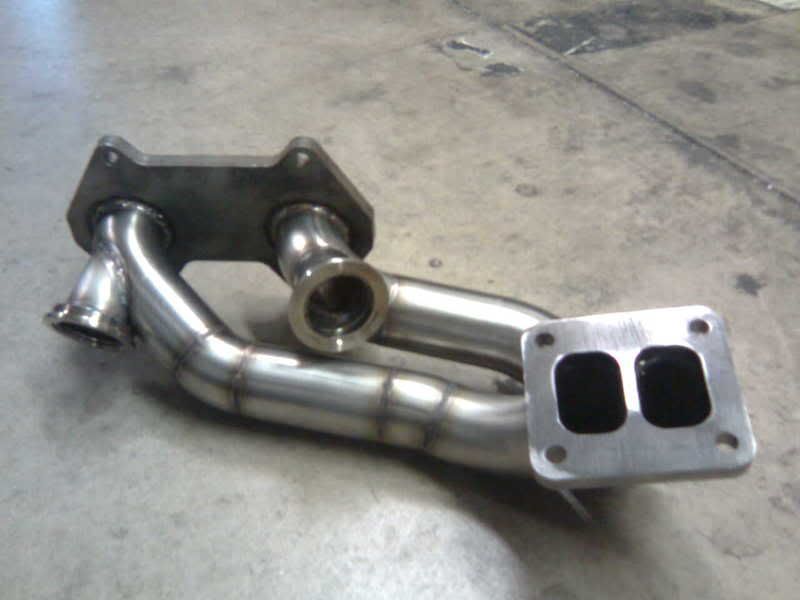
Here's a picture of a header I just got custom built....It's by no means anything close to the one above, but my fabricator said (in easier words) the quicker/sooner exhaust gases can exit the system the better, it'll improve spool time on my gt40r as well... Both runners are of exual length compared to my old megan racing header, and my synapse sits far closer as well...
Those runners still seem a little excessive though..... But if I would've known this before I would have had my guy put my wastegate before the hotside as well...I litterally just got back from the shop.....haha..Next time.
[QUOTE=mannykiller;9581559]So is this wastegate set before exhaust gasses hit the hot side? QUOTE]
What I meant to say was the waste gate is located as close to the hot side as possible to help eliminate surge?
What I meant to say was the waste gate is located as close to the hot side as possible to help eliminate surge?

Your brain is fine, once the gate opens you've just increased the internal volume of the manifold. This will cause a momentary drop in pressure until the RPM's increase enough for the flow to increase. Back pressure like boost pressure is a measurement of restriction. This is either resistance to flow of a given pipe diameter and/or a a downstream restriction such as a turbine. Time passes, now flow is increasing as RPM's go up but internal volume has stayed the same. That means resistance will go up, and pressure will go up before the restriction our turbine.
Well to compare with other setups you would have to be factoring in back pressure..if we wanted to raise the back press we could, and did see a 1000 rpm change in spool..but what we were working on, was achieving a one to one ratio. boost vs. back pressure. and that is what we have now, 19 psi of boost and 19-20 psi of back press. the entire system works much better, runs cooler, makes more HP, with less strain on the engine and gets better fuel economy. for us and how jack drives it works just fine. we routinely out run 650 hp vipers and maintain cooler egt's, oil temps and cooling temps then even them, and they are NA....
Twins Turbo....

Rotary Freak
Joined: Dec 2001
Posts: 2,402
Likes: 0
From: chandler, AZ
I've had great luck with my manifold. Stays above 1:1 map/emap ratio till ~7500, then levels off at ~1:1 till redline. Although only running about 9psi right now, will see once I can get more fuel in it and turn up the boost.
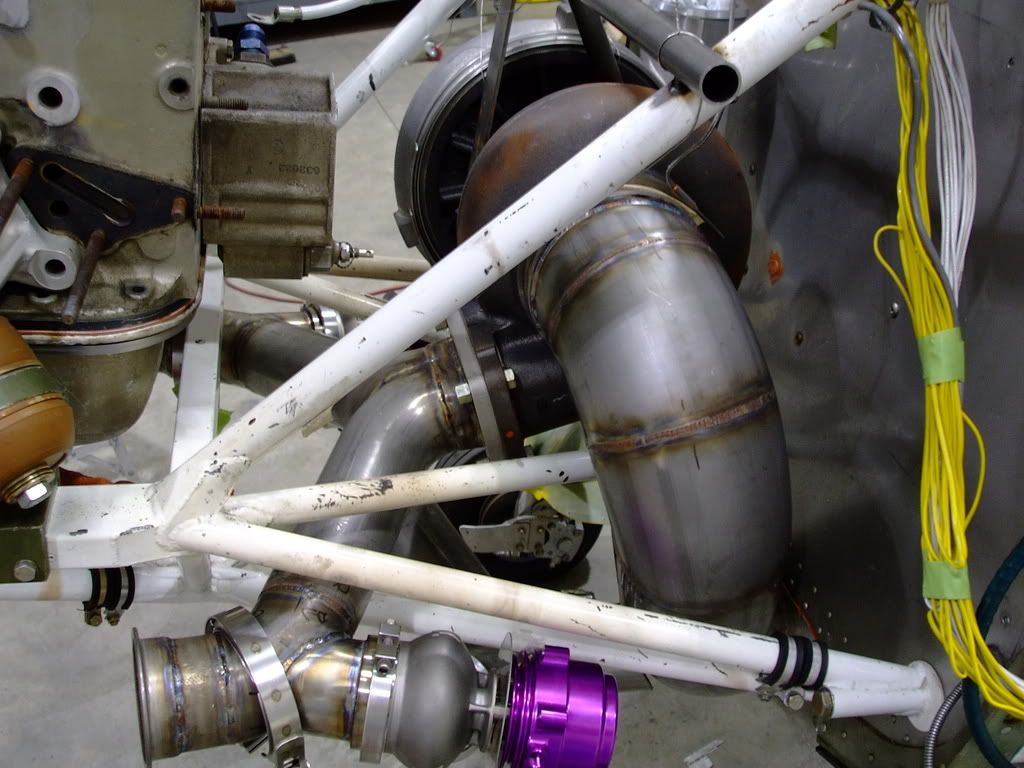
Designed it to have max flow to wastegates for best possible boost control.

Straight shot from port...

Designed it to have max flow to wastegates for best possible boost control.
Straight shot from port...


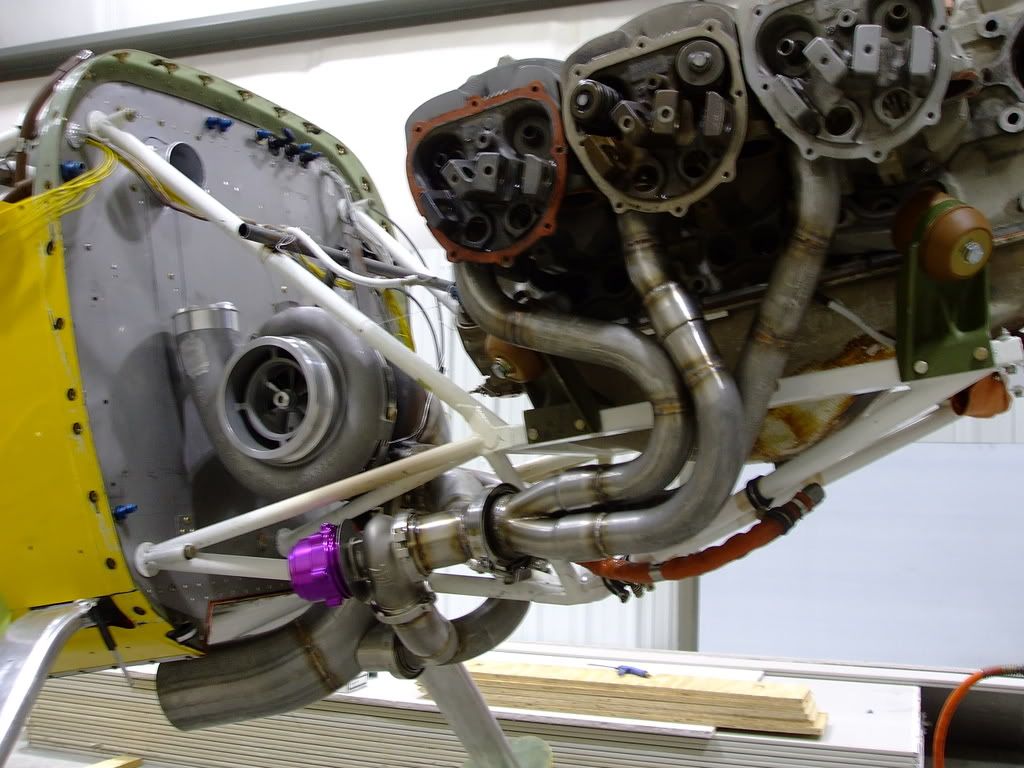


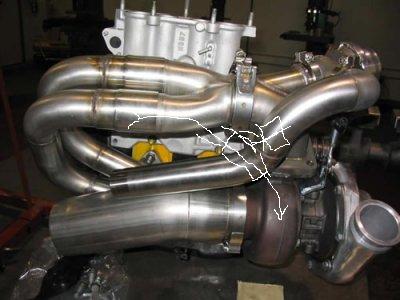
If you really want to have low EMP and good spool you could make a variable area exhaust manifold/turbo as well as having good wastegate placement.
Use a large divide T4 or T6 exhaust housing and have the flow collected into just one of the turbos runners. The higher velocity will spool the turbo considerable faster.
Have a 60mm swing valve wastegate on the front rotors runner to bypass the collector when open so that both turbo runners are being used (rear rotor runs hotter so put the restriction on front rotor).
So you stage the swing valve to open a couple PSI before your peak wastegate boost.
Kinda like the S4 TII turbo works , but on a scale and of a design that gives us HP junkies what we want.
This quick hack of the Twins Turbo manifold may get the idea across, but of course you would optimize runner lengths/diameter for even flow.
Use a large divide T4 or T6 exhaust housing and have the flow collected into just one of the turbos runners. The higher velocity will spool the turbo considerable faster.
Have a 60mm swing valve wastegate on the front rotors runner to bypass the collector when open so that both turbo runners are being used (rear rotor runs hotter so put the restriction on front rotor).
So you stage the swing valve to open a couple PSI before your peak wastegate boost.
Kinda like the S4 TII turbo works , but on a scale and of a design that gives us HP junkies what we want.
This quick hack of the Twins Turbo manifold may get the idea across, but of course you would optimize runner lengths/diameter for even flow.
Hmm, Turbonetics Neogen is just a 2" swing valve, but if you had a 2" tight radius bend into the turbo as the rear/shared rotors flow path it would still not be too bad of a flow imbalance having the front rotors flow go through the swing valve wastegate.

Joined: May 2005
Posts: 2,745
Likes: 0
From: North Bay, Ontario