


Borg Warner EFR turbos


Thread Starter


Joined: Oct 2001
Posts: 6,279
Likes: 728
From: Florence, Alabama
Borg Warner EFR turbos
Engineered For Racing
from a clean sheet of paper. the closer you look at the turbos the more you realize how
clean the sheet of paper was.
BW lists 7 EFR turbos on their excellent site.
6255
6258
6758
7064
7670
8374
9180
the first 3 are on a T25 frame and are, therefore, not a match for our high flowing rotary motors.
the 7064 is avail as an .83 T3 or as a T4 .92 or 1.05 divided. given the modest output, 54 pounds at 60% efficiency, i will focus on the three remaining EFR choices.
BW has provided us w compressor maps and they yield dividends from the details.
prior to getting started LMS that the post is based on provided numbers and i have zero experience w the turbos ATM. others may have actual experience and are of course welcome to add value to this thread.
there are probably some helpful threads on the net w other than rotary apps... i do know that Beyond Redline is just about to fire up an EFR on a Genisus coupe and will have excellent comparative data V various Garrett turbos they have previously run. i will double check which EFR it is... and provide the results ASAP.
lets take a look at the three EFRs of interest.
first let's get a size idea and relate it to turbos we know well.... Garrett and the non EFR BWs.
for details as to how i derive my measurements see the sticky thread "Turbo Comparison" most turbos are scaled.
BW EFR 7670
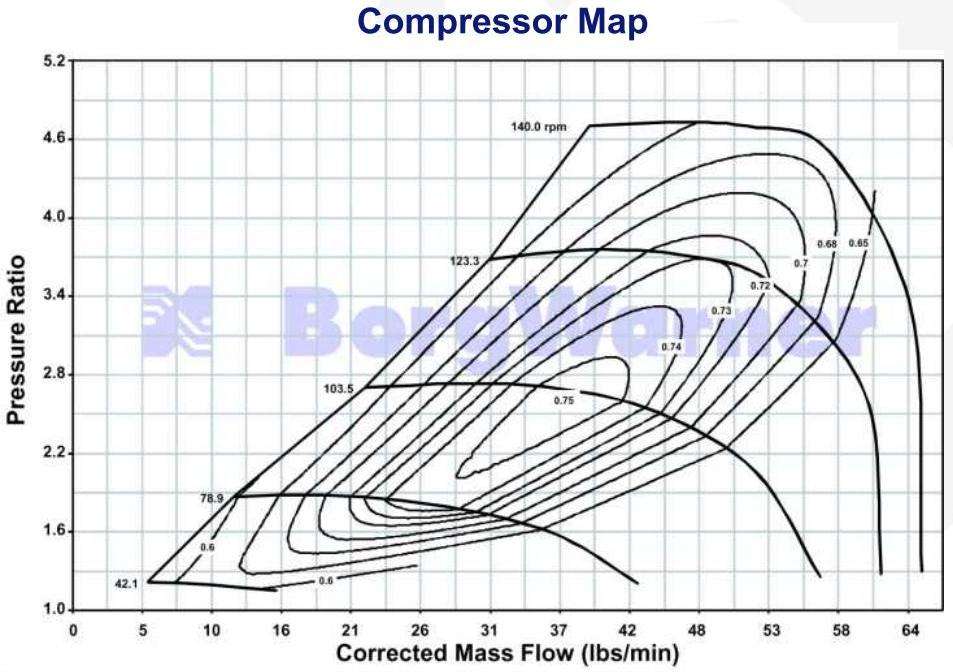
BW EFR 7670 compressor average area 5.524
GT3582r........................................... ....... 6.386
so you can see that the 7670 is a pretty small turbo
43.5 pounds of air at 14.7 psi boost good for 328 hp
52 pounds at 20 for 391
61 pounds at 44 psi for 459
note however that the compressor map stops at 65% efficiency.
unless the RPM line is vertical, indicating stall, more flow/hp is available to the right albeit at reduced efficiency.
efficiency is very important as it relates to the temp elevation of the charge which directly effects the amount of oxygen.
more O2, more hp. this is a big deal. many other compressor maps show output down to 60%.
all other things equal X pounds of air at 65% efficiency is approx 8% better than 60% efficiency.
not inconsequential.... 8% at 400 is 32 ponies.
back to the 7670.
the compressor area is 5.524
hotside area... 5.229 average area square inches
compare to the GT3582r at 5.171
as is typical of all BW turbos the hot-side is a rotary friendly huge which promotes less
back-pressure and retained (in the engine) heat.
all EFR turbine wheels are primarily Titanium and weigh "roughly half" of the typical hot-side wheel.
if you have ever held a standard turbine wheel in your hand you were surprised at how heavy it was. spool rate to 100,000+ rpm is greatly effected by turbine mass.
another interesting aspect of titanium besides being feather-light weight is that it expands when heated only 43% compared to steel. maybe closer tolerances can be achieved?
length of 7670 and 8374 w internal waste-gate is 11.5 inches....
length of the 8374 and 9180 w external waste-gate is 9.7 inches
GT3582r length 8.6 "
GT4094r 8.88
GT4294r 9.86
BW S475 11.16
BW EFR 8374
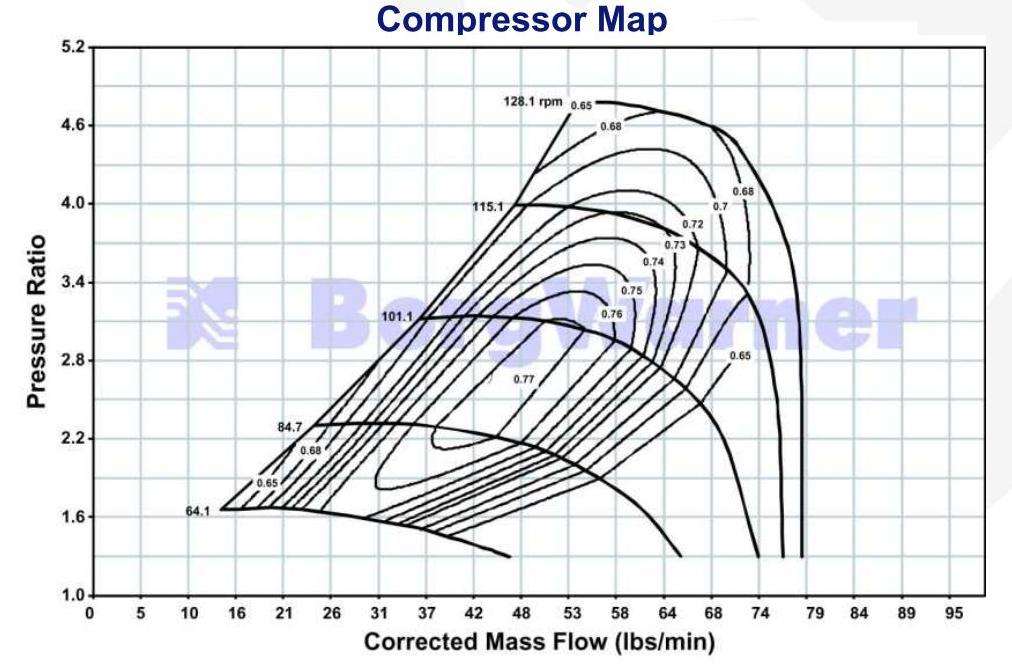
BW EFR 8374 compressor area................ 6.626
the compressor is just a bit smaller than the Garrett TO4Z, GT500, PT67 which all measure right around 7 square inches.
58 pounds of air at 14.7 psi boost good for 437 hp
66 pounds at 20 psi 497 hp
75 pounds at 35 psi 565
all of the above are plotted at 65% efficiency so there is a bit more power than i calculate as
well as more pounds output if you want to extend to 60%
the 8374 hotside is a large efficient 6.23 square inches of a Titanium composite.
TO4Z, PT67, GT500, 5.171 or 5.894 w "P" trim option
BW S300 63 6.31
like the 7670, the 8374 is available in a T4 .92 or 1.05 twin scroll configuration
clearly the 8374 is the mid-range (500-550) power generator in the line so it relates to the S300 63 (177283) and 66 in the non EFR in the BW lineup....
BW EFR 9180

BW EFR 9180 compressor area 7.974
GT4094r....................................8.175
GT4294r....................................8.384
GT4202r....................................9.726
BW S475...................................9.49
68 pounds at 14.7 psi boost or 512
74 pounds at 20 psi or 557
87 pounds at 36 psi at 65% eff 656
87 pounds at 47 psi at 68% eff 656+
all hp numbers assume the turbo can be driven to the point on the compressor map which may not be the case. they also assume best tuning configuration. the numbers are primarily for comparison.
the 9180 has 7.189 average sq inches of turbine area.
turbine wheel area
GT4094r................................. 6.423
GT4294r................................. 7.527
GT4202r................................. 7.527
BW S475.............................. 10.292
surge line is also a consideration. ideally you want it as far to the left (a lower number) as possible. surge point moves depending on boost, i picked 2.2 pressure ratios which is 17.64 psi boost
7670...................16 pounds
GT3582r........................24 pounds
8374...................22.5 pounds
TO4Z.............................24
BW S30063...................27.5
BW S366.......................23
9180.....................22 pounds
GT4094r..........................25
GT4294r..........................24
GT4202r..........................31
BW S475.........................32
executive summary:
really light reciprocating weight
really large hotside
when examining the compressor maps do make certain you are comparing apples w apples not oranges. those little numbers like 65 hold significant importance. 65% efficiency needs to be compared to 65% on another chart, not 60%.
the other item to consider is where you want to run boost-wise. i seriously doubt i will ever care about what happens above 35 psi
Howard
from a clean sheet of paper. the closer you look at the turbos the more you realize how
clean the sheet of paper was.
BW lists 7 EFR turbos on their excellent site.
6255
6258
6758
7064
7670
8374
9180
the first 3 are on a T25 frame and are, therefore, not a match for our high flowing rotary motors.
the 7064 is avail as an .83 T3 or as a T4 .92 or 1.05 divided. given the modest output, 54 pounds at 60% efficiency, i will focus on the three remaining EFR choices.
BW has provided us w compressor maps and they yield dividends from the details.
prior to getting started LMS that the post is based on provided numbers and i have zero experience w the turbos ATM. others may have actual experience and are of course welcome to add value to this thread.
there are probably some helpful threads on the net w other than rotary apps... i do know that Beyond Redline is just about to fire up an EFR on a Genisus coupe and will have excellent comparative data V various Garrett turbos they have previously run. i will double check which EFR it is... and provide the results ASAP.
lets take a look at the three EFRs of interest.
first let's get a size idea and relate it to turbos we know well.... Garrett and the non EFR BWs.
for details as to how i derive my measurements see the sticky thread "Turbo Comparison" most turbos are scaled.
BW EFR 7670

BW EFR 7670 compressor average area 5.524
GT3582r........................................... ....... 6.386
so you can see that the 7670 is a pretty small turbo
43.5 pounds of air at 14.7 psi boost good for 328 hp
52 pounds at 20 for 391
61 pounds at 44 psi for 459
note however that the compressor map stops at 65% efficiency.
unless the RPM line is vertical, indicating stall, more flow/hp is available to the right albeit at reduced efficiency.
efficiency is very important as it relates to the temp elevation of the charge which directly effects the amount of oxygen.
more O2, more hp. this is a big deal. many other compressor maps show output down to 60%.
all other things equal X pounds of air at 65% efficiency is approx 8% better than 60% efficiency.
not inconsequential.... 8% at 400 is 32 ponies.
back to the 7670.
the compressor area is 5.524
hotside area... 5.229 average area square inches
compare to the GT3582r at 5.171
as is typical of all BW turbos the hot-side is a rotary friendly huge which promotes less
back-pressure and retained (in the engine) heat.
all EFR turbine wheels are primarily Titanium and weigh "roughly half" of the typical hot-side wheel.
if you have ever held a standard turbine wheel in your hand you were surprised at how heavy it was. spool rate to 100,000+ rpm is greatly effected by turbine mass.
another interesting aspect of titanium besides being feather-light weight is that it expands when heated only 43% compared to steel. maybe closer tolerances can be achieved?
length of 7670 and 8374 w internal waste-gate is 11.5 inches....
length of the 8374 and 9180 w external waste-gate is 9.7 inches
GT3582r length 8.6 "
GT4094r 8.88
GT4294r 9.86
BW S475 11.16
BW EFR 8374

BW EFR 8374 compressor area................ 6.626
the compressor is just a bit smaller than the Garrett TO4Z, GT500, PT67 which all measure right around 7 square inches.
58 pounds of air at 14.7 psi boost good for 437 hp
66 pounds at 20 psi 497 hp
75 pounds at 35 psi 565
all of the above are plotted at 65% efficiency so there is a bit more power than i calculate as
well as more pounds output if you want to extend to 60%
the 8374 hotside is a large efficient 6.23 square inches of a Titanium composite.
TO4Z, PT67, GT500, 5.171 or 5.894 w "P" trim option
BW S300 63 6.31
like the 7670, the 8374 is available in a T4 .92 or 1.05 twin scroll configuration
clearly the 8374 is the mid-range (500-550) power generator in the line so it relates to the S300 63 (177283) and 66 in the non EFR in the BW lineup....
BW EFR 9180

BW EFR 9180 compressor area 7.974
GT4094r....................................8.175
GT4294r....................................8.384
GT4202r....................................9.726
BW S475...................................9.49
68 pounds at 14.7 psi boost or 512
74 pounds at 20 psi or 557
87 pounds at 36 psi at 65% eff 656
87 pounds at 47 psi at 68% eff 656+
all hp numbers assume the turbo can be driven to the point on the compressor map which may not be the case. they also assume best tuning configuration. the numbers are primarily for comparison.
the 9180 has 7.189 average sq inches of turbine area.
turbine wheel area
GT4094r................................. 6.423
GT4294r................................. 7.527
GT4202r................................. 7.527
BW S475.............................. 10.292
surge line is also a consideration. ideally you want it as far to the left (a lower number) as possible. surge point moves depending on boost, i picked 2.2 pressure ratios which is 17.64 psi boost
7670...................16 pounds
GT3582r........................24 pounds
8374...................22.5 pounds
TO4Z.............................24
BW S30063...................27.5
BW S366.......................23
9180.....................22 pounds
GT4094r..........................25
GT4294r..........................24
GT4202r..........................31
BW S475.........................32
executive summary:
really light reciprocating weight
really large hotside
when examining the compressor maps do make certain you are comparing apples w apples not oranges. those little numbers like 65 hold significant importance. 65% efficiency needs to be compared to 65% on another chart, not 60%.
the other item to consider is where you want to run boost-wise. i seriously doubt i will ever care about what happens above 35 psi
Howard
Last edited by Howard Coleman; Apr 6, 2014 at 10:02 AM.

executive summary:
really light reciprocating weight
really large hotside
when examining the compressor maps do make certain you are comparing apples w apples not oranges. those little numbers like 65 hold significant importance. 65% efficiency needs to be compared to 65% on another chart, not 60%.
the other item to consider is where you want to run boost-wise. i seriously doubt i will ever care about what happens above 35 psi
Howard

Just poking fun. Thank you for taking the time to compile this information and present it relative to our car.
RX-7 Old Timer

Joined: Jul 2004
Posts: 321
Likes: 10
From: Ann Arbor, MI
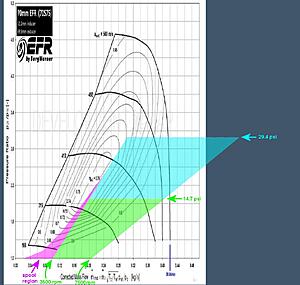
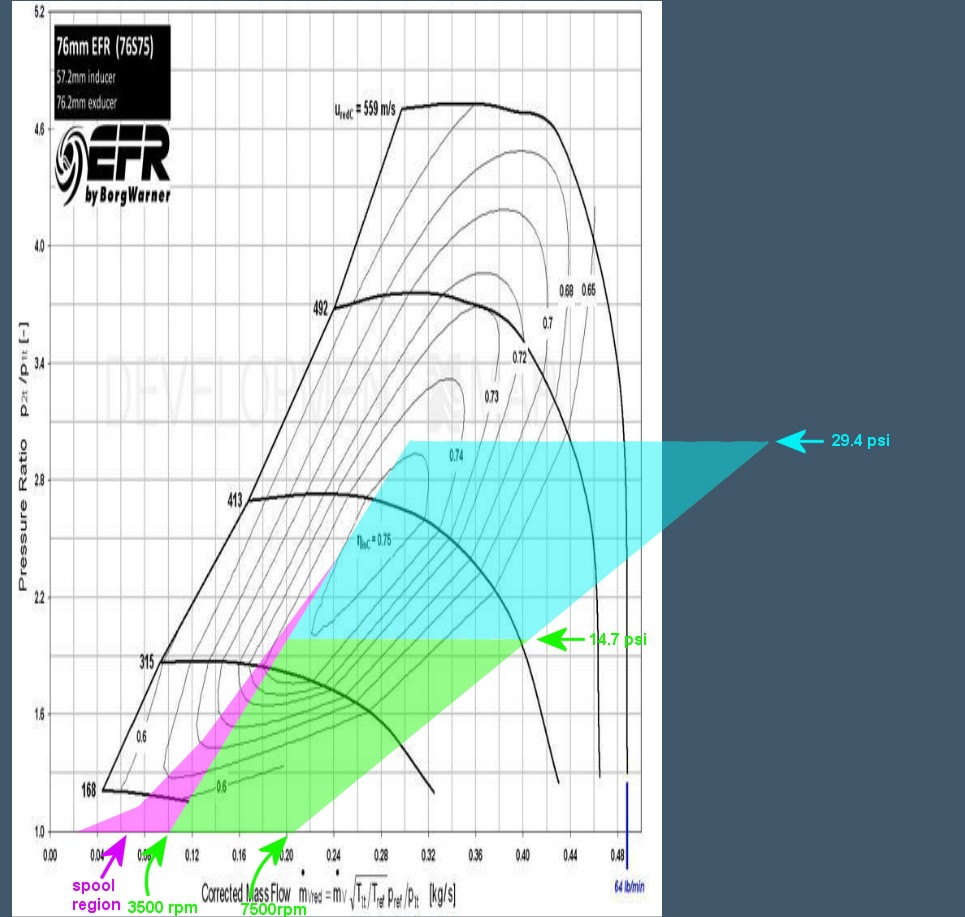
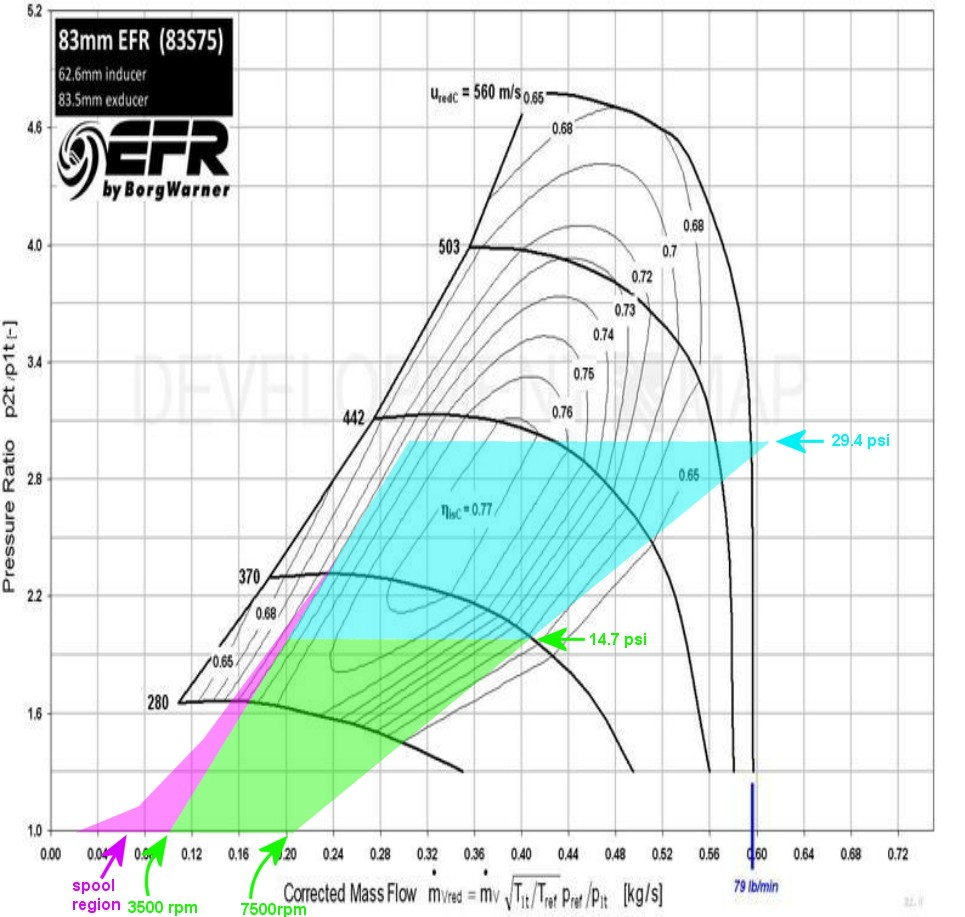
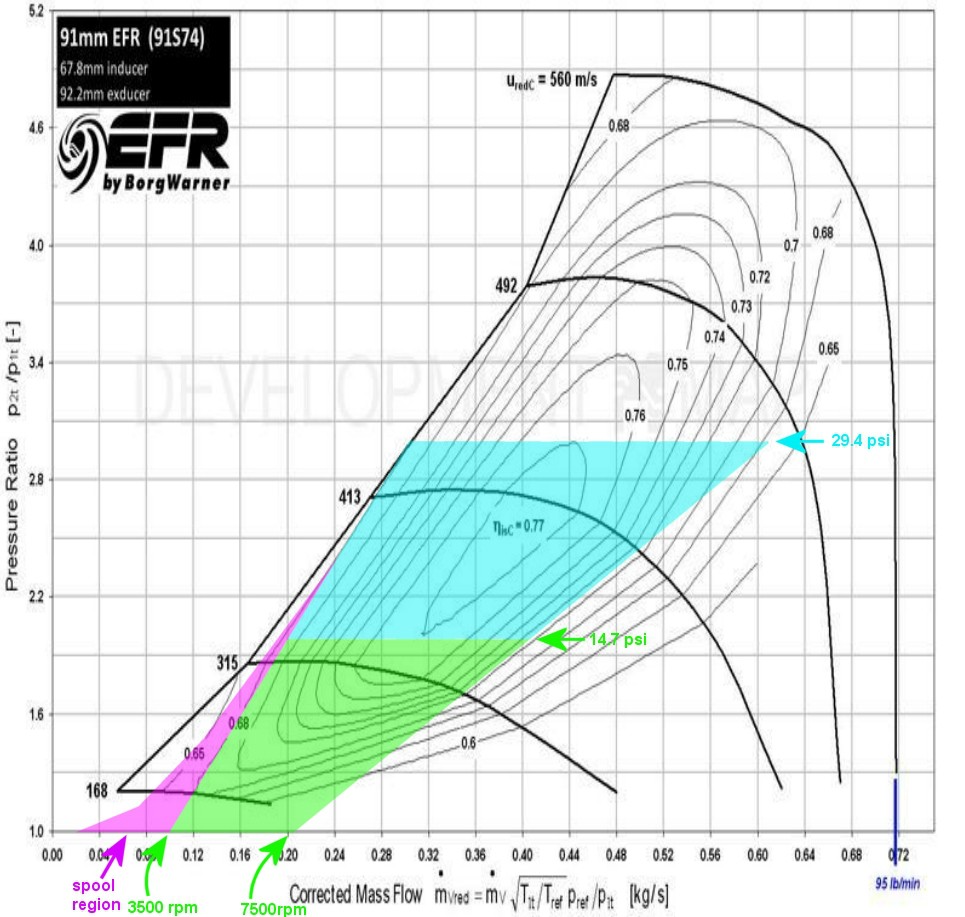
A couple weeks ago, I charted some 13B flow numbers on a bunch of compressor maps, and stretched the maps so they could be compared directly.
I think my numbers are close to yours. Should be good enough for comparison.
These should give a decent idea of where a 13B will be living on these maps.
In these charts, the "spool region" is a wild guess. It would be taller/thicker on the small turbos, and probably pushed back for the larger turbos.
EFR 7064
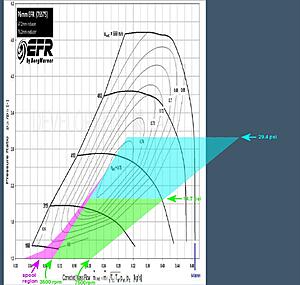
EFR 7670
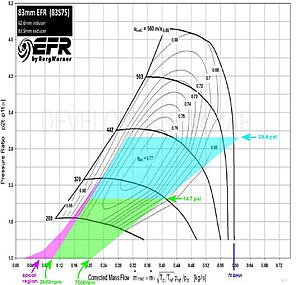
EFR 8374
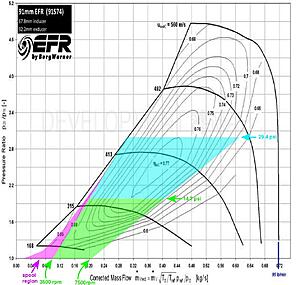
EFR 9180
I think my numbers are close to yours. Should be good enough for comparison.
These should give a decent idea of where a 13B will be living on these maps.
In these charts, the "spool region" is a wild guess. It would be taller/thicker on the small turbos, and probably pushed back for the larger turbos.
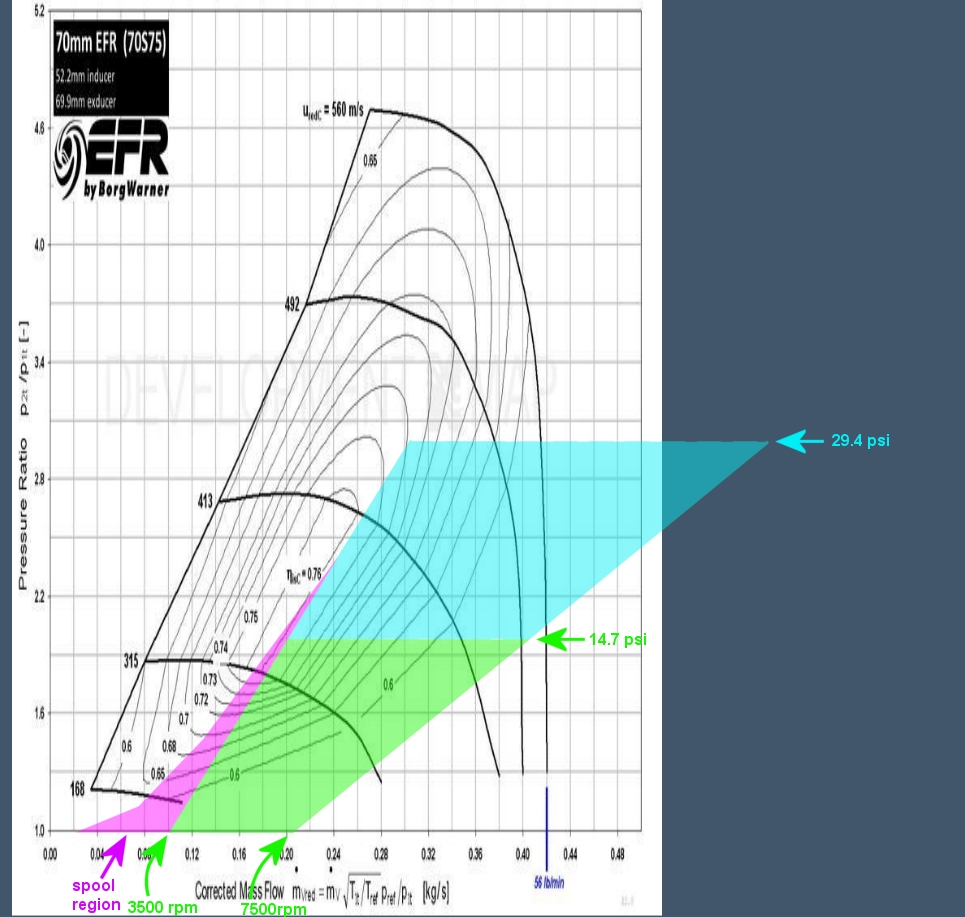
EFR 7064
EFR 7670
EFR 8374
EFR 9180

Thread Starter
Joined: Oct 2001
Posts: 6,279
Likes: 728
From: Florence, Alabama
post one in this thread was primarily an attempt to relate the EFR line to the rotary.
those wishing to learn the details as to Borg Warner's clean sheet of paper approach to turbos in the 21st century might enjoy the introductory technical paper found here:
120 pages(!) of goodness....
http://www.full-race.com/articles/efrturbotechbrief.pdf
i believe i read the document a couple of years ago so this isn't a "News Flash."
it appears to me there isn't a single aspect of the turbocharger that they didn't fundamentally improve. as to whether this works at the bottom line and more important to me how it works w the rotary...
this question will be answered in 2013.
howard
those wishing to learn the details as to Borg Warner's clean sheet of paper approach to turbos in the 21st century might enjoy the introductory technical paper found here:
120 pages(!) of goodness....
http://www.full-race.com/articles/efrturbotechbrief.pdf
i believe i read the document a couple of years ago so this isn't a "News Flash."
it appears to me there isn't a single aspect of the turbocharger that they didn't fundamentally improve. as to whether this works at the bottom line and more important to me how it works w the rotary...
this question will be answered in 2013.
howard



Trending Topics
Thread Starter
Joined: Oct 2001
Posts: 6,279
Likes: 728
From: Florence, Alabama
there may be an issue at above 1650 EGT w the turbine wheel so i suggest you enlist some informed council..
this of course isn't much of an issue w a piston motor but w the rotary have your ducks in a row.
i expect fixes at some point. E85 would probably be the fastest.
hc
this of course isn't much of an issue w a piston motor but w the rotary have your ducks in a row.
i expect fixes at some point. E85 would probably be the fastest.
hc


Its on the car, but waiting a few other parts...



Joined: Mar 2001
Posts: 30,817
Likes: 656
From: FL-->NJ/NYC again!
The biggest **** of the bunch is essentially an S-cover w/the 2.5 inch discharge? Boo


just quickly googled about it and found some phase diagrams. the gamma TiAl that the turbine is supposedly made from looks to have a melting point of around 1400 degrees celsuis, so we should be ok.
Titanium-Aluminum (Ti-Al) Phase Diagram
Titanium-Aluminum (Ti-Al) Phase Diagram

I think the problem may be the turbine housing because they have thinner walls that a normal one or the internal wastegate. This is just my assumtion! I dont really have any proof besides what ive read
Thread Starter
Joined: Oct 2001
Posts: 6,279
Likes: 728
From: Florence, Alabama
re the 1650 F number... my contact, who is a developmental partner w Borg Warner, is both highly credible and in the position to know.
i will be able to get some additional info on the subject and will certainly post it here.
i could get into some of the details but prefer not to at this time as the subject is important and info should be rock solid.
i was planning on running the 9180 as my Texas Mile turbo but until i nail down my EGTs the turbo is on hold. i will be running half E85 and half pump gasoline so my EGTs might be o k.
when i ran gasoline as a base fuel and a lot of methanol as AI my EGTs were 1550 and stable. if you run gasoline and under 1000 CC of WM you are probably looking at 1750.
if my EGTs are a problem i may be able to run the most important part of the 9180 in a more traditional package.
more on this 1650 deal later. while i do not have the details ATM IMO this is solid info. of course BW may be able to up the heat tolerance at some later point but for now if you are in the 1650 area you are on very thin ice.
howard
i will be able to get some additional info on the subject and will certainly post it here.
i could get into some of the details but prefer not to at this time as the subject is important and info should be rock solid.
i was planning on running the 9180 as my Texas Mile turbo but until i nail down my EGTs the turbo is on hold. i will be running half E85 and half pump gasoline so my EGTs might be o k.
when i ran gasoline as a base fuel and a lot of methanol as AI my EGTs were 1550 and stable. if you run gasoline and under 1000 CC of WM you are probably looking at 1750.
if my EGTs are a problem i may be able to run the most important part of the 9180 in a more traditional package.
more on this 1650 deal later. while i do not have the details ATM IMO this is solid info. of course BW may be able to up the heat tolerance at some later point but for now if you are in the 1650 area you are on very thin ice.
howard
Last edited by Howard Coleman; May 31, 2013 at 07:07 AM.


Full Member
Joined: Nov 2011
Posts: 86
Likes: 2
From: Perth, Australia
Had been waiting forever for my EFR 7670. Have now signed up for one of Elliots (Turblown) TDX61R. Would havbe been nice to try the EFR but Elliot is getting some excellent results with this turbo, so nice to have a proven good thing.
I still don't have any results to share, but it is only a matter of time til one of these end users gets one running. Here is forum member " Donz " kit...
Thread Starter
Joined: Oct 2001
Posts: 6,279
Likes: 728
From: Florence, Alabama
since i did raise the Titanium matrix turbine wheel heat issue and passed on a 1650 number i would like to pass on the "final" word on the issue.
from the 2nd in command at EFR Development:
"1742°F is the limit for the TiAl turbine wheel."
just an FYI.
howard
from the 2nd in command at EFR Development:
"1742°F is the limit for the TiAl turbine wheel."
just an FYI.
howard


Braaaap Tshhhh!

Joined: Feb 2012
Posts: 113
Likes: 5
From: Sydney, Australia
Are there any results for EFR 7670's on the 13B yet? I'm looking to go single, I daily my FD and want something responsive with a bit more of a kick than the standard twins. The 7670 seems like a good bet so I'm looking for data but it's hard to come by!


since i did raise the Titanium matrix turbine wheel heat issue and passed on a 1650 number i would like to pass on the "final" word on the issue.
from the 2nd in command at EFR Development:
"1742°F is the limit for the TiAl turbine wheel."
just an FYI.
howard
Could you press him for some context to his statement please?
Does he mean max 1742 deg F exhaust gas temperatures or turbine wheel temperatures?
Would this temp limit be the same for cruise and full load?
What is the temperature "limit" as he has stated for the companies standard Inconel exhaust wheels?
The Greddy EGT guages I read preturbo EGTs off read right around 1,000C (1832F) in lean cruise, but drop to ~700C (1292F) under tip in throttle and up to ~750C (1382F) under full load on my car.
from the 2nd in command at EFR Development:
"1742°F is the limit for the TiAl turbine wheel."
just an FYI.
howard
Could you press him for some context to his statement please?
Does he mean max 1742 deg F exhaust gas temperatures or turbine wheel temperatures?
Would this temp limit be the same for cruise and full load?
What is the temperature "limit" as he has stated for the companies standard Inconel exhaust wheels?
The Greddy EGT guages I read preturbo EGTs off read right around 1,000C (1832F) in lean cruise, but drop to ~700C (1292F) under tip in throttle and up to ~750C (1382F) under full load on my car.