


Conclusive B2B Dyno Tests: FD UIM & FC UIM.


Thread Starter
Full Member

Joined: Oct 2005
Posts: 157
Likes: 0
From: England
Conclusive B2B Dyno Tests: FD UIM & FC UIM.
I have been running my FC Turbo II with an FD UIM for 2 years, I recently built a new engine and went for a dyno mapping session on Saturday.
I fitted it by matching the ports as best i could using no spacer. While on the Dyno i seem to hit a restriction at 1 bar so i had the FC UIM with me and fitted it, I have Greddy elbows on both and used the corresponding throttle bodies.
Back to back dyno runs with everything else the same reveals that at 1 bar and 350 bhp the FC UIM is a couple of BHP behind if that!
I fitted it by matching the ports as best i could using no spacer. While on the Dyno i seem to hit a restriction at 1 bar so i had the FC UIM with me and fitted it, I have Greddy elbows on both and used the corresponding throttle bodies.
Back to back dyno runs with everything else the same reveals that at 1 bar and 350 bhp the FC UIM is a couple of BHP behind if that!






I'd like to see the graphs as well though, did it change anything at all? Are you only looking at peak gains or are you considering how it might have changed the curve overall?
Trending Topics
Thread Starter
Full Member
Joined: Oct 2005
Posts: 157
Likes: 0
From: England
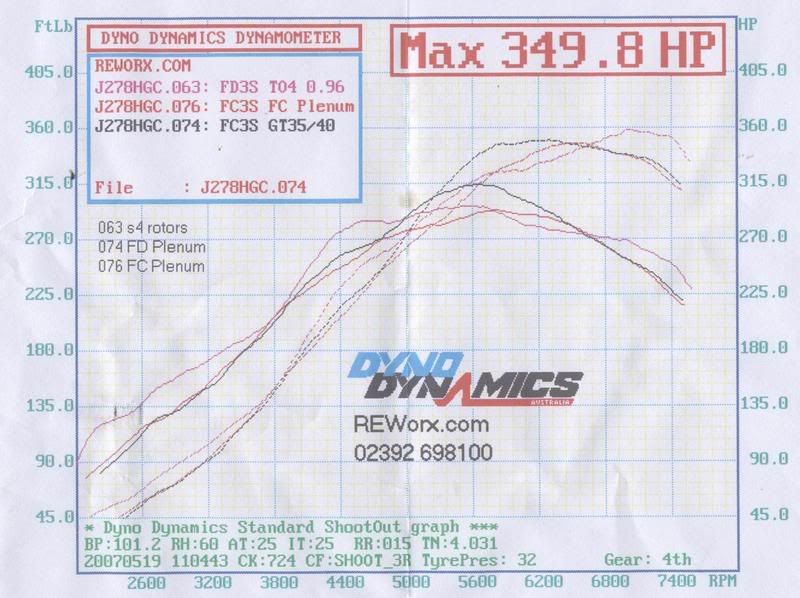
here it is,
there are 3 runs
the top run which is pink is a year old, it was my old engine with low comp rotors and a GT35/40, 0.96 turbine housing small street port,
The middle run which is red is my new engine with FD rotorsand the FC UIM with a large street port (huge) same turbo but with a 1.15 exhaust housing both T4 flange.
The black run is with the FD UIM on the new engine.
The old run may have been a slightly higher boost but the two new engine runs are a touch under 1 bar, about 13.5 - 14 psi.
I now need to try and figure out why both engines hit 350 bhp and stop, although the new engine makes it a lot earlier. The graphs are very similar considering the porting is much different and the turbine housing is different and the rotors are different. (its actually a completely different block)
I have plenty fueling, only hitting 74% duty cycle.
The only thing that is the same is the intercooler whic the tuner thinks maybe restrictive.
What do you think?
BHP and torque, both rear wheel figures.
there are 3 runs
the top run which is pink is a year old, it was my old engine with low comp rotors and a GT35/40, 0.96 turbine housing small street port,
The middle run which is red is my new engine with FD rotorsand the FC UIM with a large street port (huge) same turbo but with a 1.15 exhaust housing both T4 flange.
The black run is with the FD UIM on the new engine.
The old run may have been a slightly higher boost but the two new engine runs are a touch under 1 bar, about 13.5 - 14 psi.
I now need to try and figure out why both engines hit 350 bhp and stop, although the new engine makes it a lot earlier. The graphs are very similar considering the porting is much different and the turbine housing is different and the rotors are different. (its actually a completely different block)
I have plenty fueling, only hitting 74% duty cycle.
The only thing that is the same is the intercooler whic the tuner thinks maybe restrictive.
What do you think?
BHP and torque, both rear wheel figures.
Last edited by antnicuk; May 24, 2007 at 04:03 PM.
Thread Starter
Full Member
Joined: Oct 2005
Posts: 157
Likes: 0
From: England
looking at it again i have more torque with the FD UIM but the graph with the afr's on it showed it a tiny bit richer on the fc plenum run so that may have reduced the power a tiny bit.
Well the FD UIM certainly brings the peak HP back in the RPM band.........seems to lengthen it as well.
Interesting.....
edit: it really seems to jump on the torque though like you mention,
Interesting.....
edit: it really seems to jump on the torque though like you mention,
Are these runs on identical engine and setup with the only difference being the UIM? Your second posts seems to suggest these runs are with three entirely different engines/setups? If so, this comparison is not too scientific, if not I apologize for the misunderstanding.
No the graph is layed over an old dyno. (pink lines)
The FC vs. FD test was a back to back, switch mani's only test. (correct?)
As far as the restrictions go....what size core I/C are you running and do you have any logs or data as far as intake air temps go? That'll tell you whether or not the core is doing its job.
The FC vs. FD test was a back to back, switch mani's only test. (correct?)
As far as the restrictions go....what size core I/C are you running and do you have any logs or data as far as intake air temps go? That'll tell you whether or not the core is doing its job.
Thread Starter
Full Member
Joined: Oct 2005
Posts: 157
Likes: 0
From: England
sorry i'm not being very clear,
the FD/FC UIM runs (red and black)were done an hour apart on the same rollers. Only stopped to swap the manifold, it didnt even come off the rollers. The pink run was last years engine mapped april 2006. Its on there cos i wanted to see the differences and as you can see i'm a little dissapointed. The new engine should be much more powerful. It seems something is restricting it.......
There was no change at all not even the map was changed when the manifold was swapped.
the FD/FC UIM runs (red and black)were done an hour apart on the same rollers. Only stopped to swap the manifold, it didnt even come off the rollers. The pink run was last years engine mapped april 2006. Its on there cos i wanted to see the differences and as you can see i'm a little dissapointed. The new engine should be much more powerful. It seems something is restricting it.......
There was no change at all not even the map was changed when the manifold was swapped.
Okay, that's what I initially thought, thanks for clarifying.
It is a little difficult to read the scan, but I don't think the gains are all that bad. If you look at the torque curve between 4600rpm to around 6000rpm, you gained a nice little chunk there. I wouldn't entirely dismiss the manifold after seeing this. It may not have made a huge peak gain, but if it flattens out the curve a bit and brings power a bit sooner, that's still a good thing.
As far as comparison to the old engine, I am not sure this would be the best method for that. (different dynos, different days, different conditions, etc.) A dyno is just a tool for tuning, it is not necessarily giving you the real power figure of the car written in stone, just giving you something to gauge the differences you are making in tuning.
How does the car feel now, with either manifold, before/after the new engine? Any track time that could give you performance numbers to judge by?
It is a little difficult to read the scan, but I don't think the gains are all that bad. If you look at the torque curve between 4600rpm to around 6000rpm, you gained a nice little chunk there. I wouldn't entirely dismiss the manifold after seeing this. It may not have made a huge peak gain, but if it flattens out the curve a bit and brings power a bit sooner, that's still a good thing.
As far as comparison to the old engine, I am not sure this would be the best method for that. (different dynos, different days, different conditions, etc.) A dyno is just a tool for tuning, it is not necessarily giving you the real power figure of the car written in stone, just giving you something to gauge the differences you are making in tuning.
How does the car feel now, with either manifold, before/after the new engine? Any track time that could give you performance numbers to judge by?
Thread Starter
Full Member
Joined: Oct 2005
Posts: 157
Likes: 0
From: England
the new one feels a little more crisp low end which i think is due to the high comp rotors, other than it feels pretty similar, in fact i can hardly tell a difference. even running the same 1/4 mile times and terminals.
Its the same dyno/tuner as before and same sort of temperature.
I could understand it if i just rebuilt the old engine and maybe ported a little more, but this is a different block, different rotors, massive difference in the porting, bigger exhaust and bigger turbine!
The only thing that has remained unchanged is the intercooler, its an xs power 4 inch thick one. I seem to hit the same cieling with the power only this time its earlier. which would indicate to me that i should be capable of making more power, hopefully!
The guys at the dyno mapped a car on the same day as mine, he made 40 rwhp more just by swapping the i/c from the same one i have to a greddy one.
Its the same dyno/tuner as before and same sort of temperature.
I could understand it if i just rebuilt the old engine and maybe ported a little more, but this is a different block, different rotors, massive difference in the porting, bigger exhaust and bigger turbine!
The only thing that has remained unchanged is the intercooler, its an xs power 4 inch thick one. I seem to hit the same cieling with the power only this time its earlier. which would indicate to me that i should be capable of making more power, hopefully!
The guys at the dyno mapped a car on the same day as mine, he made 40 rwhp more just by swapping the i/c from the same one i have to a greddy one.
so it helps, just not a huge difference. Most of the FD set ups are going for what, $350. they look nicer and all, but not totally sure it's worth it.
Thanks for posting this info. Very useful
Thanks for posting this info. Very useful
That seems to sum this up pretty well.
Definitely appreciate the info, thanks antnicuk



Lives on the Forum
Joined: Feb 2001
Posts: 26,664
Likes: 22
From: n
Just about confirms all the theory, but i'm surprised it wasn't lower in the RPM band - maybe porting affected it a lot?
It looks like torque (and hp) was better in the 4,500 to 6,500 range for the FD set-up.
I would've expected this to be a bit lower.
Also, the top end power output is basically the same - kinda odd, since the FD throttle body has larger bores.
I wonder if you got a leak somewhere?
Since you mentioned hitting a wall a 350...
When portmatching the FD UIM to the FC LIM, the FD UIM gets cut pretty close to the walls on the middle two primary intake runners...
-Ted
It looks like torque (and hp) was better in the 4,500 to 6,500 range for the FD set-up.
I would've expected this to be a bit lower.
Also, the top end power output is basically the same - kinda odd, since the FD throttle body has larger bores.
I wonder if you got a leak somewhere?
Since you mentioned hitting a wall a 350...
When portmatching the FD UIM to the FC LIM, the FD UIM gets cut pretty close to the walls on the middle two primary intake runners...
-Ted

Eats, Sleeps, Dreams Rotary
iTrader: (1)
Joined: Jul 2001
Posts: 3,383
Likes: 3
From: Stinson Beach, Ca
Powerbands at RPMs shouid be the biggest change in my eyes.
Wouldve been nice to see the engine rung out a few higher RPMs to see the difference.
-Ben Martin
Wouldve been nice to see the engine rung out a few higher RPMs to see the difference.
-Ben Martin