


outside difference between s2 and s3 12a engine


Thread Starter
Full Member

Joined: Sep 2011
Posts: 191
Likes: 4
From: Germany/Stuttgart
outside difference between s2 and s3 12a engine
So I just found out the engine in my 1980 S1 RX7 isn't the original one even if the chassis only has 45000km on it. The engine has an oil pressure switch installed ( which was added from the factory first in 1981) but not connected so it must be at least a series 2 engine.
Now I' m wondering if it is a S2 or a S3 engine because I want to upgrade the oil pump to the later, bigger model. All S3 engines had the pump from the factory so it would be a waste of time to pull the front cover if it was one.
Is there any way to tell from the outside from which series the engine came from without taking half the engine apart?
Now I' m wondering if it is a S2 or a S3 engine because I want to upgrade the oil pump to the later, bigger model. All S3 engines had the pump from the factory so it would be a waste of time to pull the front cover if it was one.
Is there any way to tell from the outside from which series the engine came from without taking half the engine apart?


Joined: Mar 2001
Posts: 31,833
Likes: 3,232
From: https://www2.mazda.com/en/100th/
it might be hard to tell on an EU spec car. up to the middle of 81, the heater hose uses a screw in fitting, and then for the 83 model year (after 6/82?) it gets the beehive style oil cooler.
the 81-82 engines use the same rotors as the 78-80 engines, but the flywheel is lighter.
the EU spec keeps the thermal reactor, so it will keep the thermal reactor style rotor housings, although you guys got 10 more degrees of duration.
the 81-82 engines use the same rotors as the 78-80 engines, but the flywheel is lighter.
the EU spec keeps the thermal reactor, so it will keep the thermal reactor style rotor housings, although you guys got 10 more degrees of duration.
www.AusRotary.com


Joined: Apr 2003
Posts: 905
Likes: 272
From: Melbourne, Australia
So I just found out the engine in my 1980 S1 RX7 isn't the original one even if the chassis only has 45000km on it. The engine has an oil pressure switch installed ( which was added from the factory first in 1981) but not connected so it must be at least a series 2 engine.
Now I' m wondering if it is a S2 or a S3 engine because I want to upgrade the oil pump to the later, bigger model. All S3 engines had the pump from the factory so it would be a waste of time to pull the front cover if it was one.
Is there any way to tell from the outside from which series the engine came from without taking half the engine apart?
Now I' m wondering if it is a S2 or a S3 engine because I want to upgrade the oil pump to the later, bigger model. All S3 engines had the pump from the factory so it would be a waste of time to pull the front cover if it was one.
Is there any way to tell from the outside from which series the engine came from without taking half the engine apart?
The s3 alternator has cooling slots in the outer casing (similar appearance to series 4) whereas the s2 has a solid casing similar to series (but internal reg). A s3 alternator suggests a later engine may have been used (or it could have just had an alternator swap!)
The other way to check is to drop the gearbox and check out the clutch. S3 had a 9" clutch. S2 had 8.5".
There are differences in the carburetors. One thing to look out for perhaps is an extra throttle linkage for cruise control. This wasn't available for s2 outside of North America. It was standard on s3 in Australia and optional in parts of Europe.

Old [Sch|F]ool
Joined: May 2001
Posts: 12,856
Likes: 568
From: Cleveland, Ohio, USA
'83 had the large clutch too.
The easiest/only way to tell a S2 from a S3 is in the wiring harness. S1 and S2 the engine harness connectors are on the left side. On the S3 the harness connectors are on the right. On a LHD car this means S1/S2 has the connectors under the master cylinder and S3 cars have it near/under the washer fluid tank/cold start assist tank.
There were a lot of changes to the '83 model year which were carried over to series 3. '83 got the light rotors, large clutch, beehive oil cooler, and even the staked U-joints with the square pattern driveshaft flange. But they were series 2s not series 3s. The only difference between an '83 engine and an '84-85 is the wiring harness.
The easiest/only way to tell a S2 from a S3 is in the wiring harness. S1 and S2 the engine harness connectors are on the left side. On the S3 the harness connectors are on the right. On a LHD car this means S1/S2 has the connectors under the master cylinder and S3 cars have it near/under the washer fluid tank/cold start assist tank.
There were a lot of changes to the '83 model year which were carried over to series 3. '83 got the light rotors, large clutch, beehive oil cooler, and even the staked U-joints with the square pattern driveshaft flange. But they were series 2s not series 3s. The only difference between an '83 engine and an '84-85 is the wiring harness.
www.AusRotary.com
Joined: Apr 2003
Posts: 905
Likes: 272
From: Melbourne, Australia
'83 had the large clutch too.
The easiest/only way to tell a S2 from a S3 is in the wiring harness. S1 and S2 the engine harness connectors are on the left side. On the S3 the harness connectors are on the right. On a LHD car this means S1/S2 has the connectors under the master cylinder and S3 cars have it near/under the washer fluid tank/cold start assist tank.
There were a lot of changes to the '83 model year which were carried over to series 3. '83 got the light rotors, large clutch, beehive oil cooler, and even the staked U-joints with the square pattern driveshaft flange. But they were series 2s not series 3s. The only difference between an '83 engine and an '84-85 is the wiring harness.
The easiest/only way to tell a S2 from a S3 is in the wiring harness. S1 and S2 the engine harness connectors are on the left side. On the S3 the harness connectors are on the right. On a LHD car this means S1/S2 has the connectors under the master cylinder and S3 cars have it near/under the washer fluid tank/cold start assist tank.
There were a lot of changes to the '83 model year which were carried over to series 3. '83 got the light rotors, large clutch, beehive oil cooler, and even the staked U-joints with the square pattern driveshaft flange. But they were series 2s not series 3s. The only difference between an '83 engine and an '84-85 is the wiring harness.
Old [Sch|F]ool
Joined: May 2001
Posts: 12,856
Likes: 568
From: Cleveland, Ohio, USA
Huh. What dashboard did your S3s get? Our S3 had a completely different dash/center console from the S2s. There's no way anything from an S2 could work in an S3 dash-wise since the S2 had a bunch if discrete radio components while the S3 had a 2.5-DIN hole in the dash, which fit everything from a base radio up to a DIN receiver, DIN tape deck unit, and 1/2 DIN equalizer. Most S3s had a Logicon type HVAC system as well, although I did see an '85 S that had manual controls. Only S3 with manual controls I ever saw! (He bought it new, after the FC came out, and he hated the FC, and the dealer still had some old stock)
My opinion is the S1/S2 dash is a lot nicer, but the S3 dash basically never cracks, while I think all S1s and S2s cracked before they were even paid off by the first owner.
All S3s also have the 26 spline/large bearing rearends, all S2s have the 24 spline/small bearing rearends. My understanding is that Japan, Australia, and Europe all got the 4x4.5" bolt pattern and large brakes on everything, which means the big bearing 4x110 drum brake rearends are North America only. (The GSL rears used the same reareng housings as GSL-SE, the same axles as drum rears, and the same brake rotors/calipers as '81-83 disk rears, so nothing terribly unique there aside from the axleshafts)
My opinion is the S1/S2 dash is a lot nicer, but the S3 dash basically never cracks, while I think all S1s and S2s cracked before they were even paid off by the first owner.
All S3s also have the 26 spline/large bearing rearends, all S2s have the 24 spline/small bearing rearends. My understanding is that Japan, Australia, and Europe all got the 4x4.5" bolt pattern and large brakes on everything, which means the big bearing 4x110 drum brake rearends are North America only. (The GSL rears used the same reareng housings as GSL-SE, the same axles as drum rears, and the same brake rotors/calipers as '81-83 disk rears, so nothing terribly unique there aside from the axleshafts)
Last edited by peejay; Apr 3, 2018 at 08:42 PM.
www.AusRotary.com
Joined: Apr 2003
Posts: 905
Likes: 272
From: Melbourne, Australia
Huh. What dashboard did your S3s get? Our S3 had a completely different dash/center console from the S2s. There's no way anything from an S2 could work in an S3 dash-wise since the S2 had a bunch if discrete radio components while the S3 had a 2.5-DIN hole in the dash, which fit everything from a base radio up to a DIN receiver, DIN tape deck unit, and 1/2 DIN equalizer. Most S3s had a Logicon type HVAC system as well, although I did see an '85 S that had manual controls. Only S3 with manual controls I ever saw! (He bought it new, after the FC came out, and he hated the FC, and the dealer still had some old stock)
My opinion is the S1/S2 dash is a lot nicer, but the S3 dash basically never cracks, while I think all S1s and S2s cracked before they were even paid off by the first owner.
All S3s also have the 26 spline/large bearing rearends, all S2s have the 24 spline/small bearing rearends. My understanding is that Japan, Australia, and Europe all got the 4x4.5" bolt pattern and large brakes on everything, which means the big bearing 4x110 drum brake rearends are North America only. (The GSL rears used the same reareng housings as GSL-SE, the same axles as drum rears, and the same brake rotors/calipers as '81-83 disk rears, so nothing terribly unique there aside from the axleshafts)
My opinion is the S1/S2 dash is a lot nicer, but the S3 dash basically never cracks, while I think all S1s and S2s cracked before they were even paid off by the first owner.
All S3s also have the 26 spline/large bearing rearends, all S2s have the 24 spline/small bearing rearends. My understanding is that Japan, Australia, and Europe all got the 4x4.5" bolt pattern and large brakes on everything, which means the big bearing 4x110 drum brake rearends are North America only. (The GSL rears used the same reareng housings as GSL-SE, the same axles as drum rears, and the same brake rotors/calipers as '81-83 disk rears, so nothing terribly unique there aside from the axleshafts)
Because it retains this style, it uses the same centre fascia for the radio/cassette and the old lever style heater/aircon controls. Here's some photos of an unmolested Aussie series 3 interior:
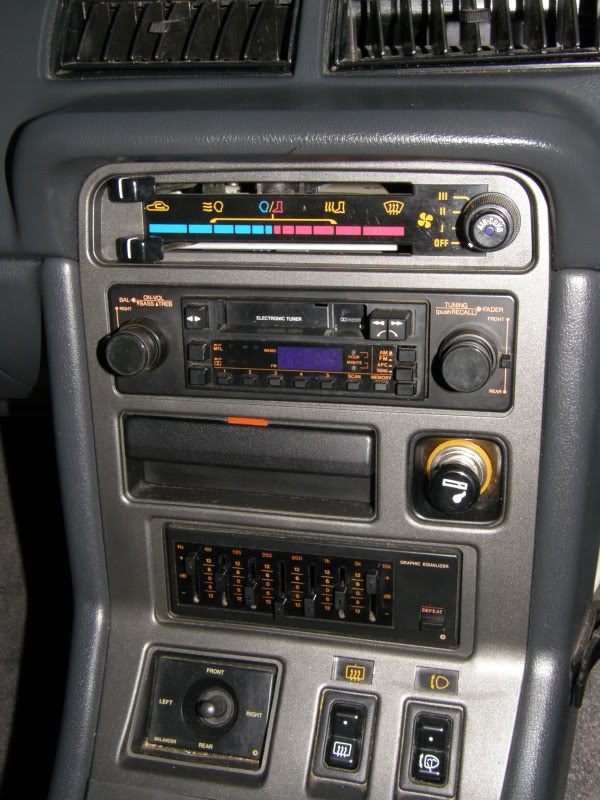
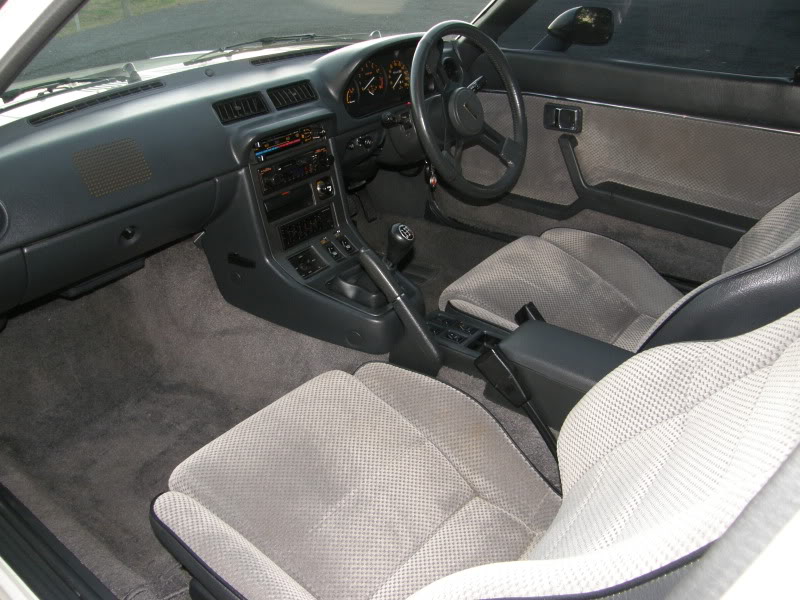
You'll see the dash shares similarities with your 83 GSL in particular, while the rest is like your 84-85 GS but with electric windows instead of manual winders. Notice also the different headlight switch - we got a headlight washer system. I believe this was to comply with local design rules - something do with need washers for popup headlights.
I think the updated 1984 dash for the FB is another example of using the USA as a guinea pig for new styles - much of the styling for the dash pad and instrument cluster got carried over to the FC.
All our cars got the big brakes and 4x114.3mm bolt pattern in series 3. The tradition of the US receiving a down-specced version continued with the FC. All of our FCs, even the NA version, got 5 stud wheels with the big brakes and 4 piston calipers at the front. North America is obviously a big bigger market, so having additional trim/luxury levels makes sense. Something like 80% of 1st gens went to the USA so there is only 1 series 3 outside of America for every 4 inside. This also explains why there are still so many brand new LHD parts available from Mazda but so few RHD versions

Last edited by KYPREO; Apr 4, 2018 at 01:30 AM. Reason: left off attachment
Trending Topics
Full Member
Joined: Jan 2017
Posts: 248
Likes: 55
From: Germany

Old [Sch|F]ool
Joined: May 2001
Posts: 12,856
Likes: 568
From: Cleveland, Ohio, USA
If you didn't get the water-oil "cooler" in your '83s, then yes, that is a dead giveaway that it is an S3 engine. Or at least, an S3 rear end housing 
That point on the engine is where the coolant is hottest. It is where the coolant is done cooling off the spark plugs/combustion area, and before it goes to the intake side and actually heats the engine area. So, that is a great place to pull coolant for cabin heat, but a horrible place to pull for a heat exchanger. I had an idea years back to put a nipple in the base of the water pump to get the coolest possible coolant for the heat exchanger. I may still do this
That point on the engine is where the coolant is hottest. It is where the coolant is done cooling off the spark plugs/combustion area, and before it goes to the intake side and actually heats the engine area. So, that is a great place to pull coolant for cabin heat, but a horrible place to pull for a heat exchanger. I had an idea years back to put a nipple in the base of the water pump to get the coolest possible coolant for the heat exchanger. I may still do this
Last edited by peejay; Apr 5, 2018 at 04:55 PM.

If you didn't get the water-oil "cooler" in your '83s, then yes, that is a dead giveaway that it is an S3 engine. Or at least, an S3 rear end housing
That point on the engine is where the coolant is hottest. It is where the coolant is done cooling off the spark plugs/combustion area, and before it goes to the intake side and actually heats the engine area. So, that is a great place to pull coolant for cabin heat, but a horrible place to pull for a heat exchanger. I had an idea years back to put a nipple in the base of the water pump to get the coolest possible coolant for the heat exchanger. I may still do this
That point on the engine is where the coolant is hottest. It is where the coolant is done cooling off the spark plugs/combustion area, and before it goes to the intake side and actually heats the engine area. So, that is a great place to pull coolant for cabin heat, but a horrible place to pull for a heat exchanger. I had an idea years back to put a nipple in the base of the water pump to get the coolest possible coolant for the heat exchanger. I may still do this
Old [Sch|F]ool
Joined: May 2001
Posts: 12,856
Likes: 568
From: Cleveland, Ohio, USA
My idea had a 1/2" NPT hole drilled in right on the left/under side of the water pump housing. Just under the distributor. That is where coolant fresh from the radiator is being pumped in under pressure to the engine. That is the coolest point in the main engine coolant system.
I note with interest that some newer vehicles are going with two separate "coolant buses", a cooling system for the engine, and another liquid cooling system for the engine oil, trans fluid, and intercooler. Siamese radiator. Eliminates a lot of nose real estate, too.
Joined: Mar 2001
Posts: 31,833
Likes: 3,232
From: https://www2.mazda.com/en/100th/
so its 2 radiators, 2 overflow tanks, and three water pumps, its a Ford...
Joined: Mar 2001
Posts: 31,833
Likes: 3,232
From: https://www2.mazda.com/en/100th/
Japan got the RHD, which is the early style dashboard. either in Red or Grey. the rest of the interior trim matches the US car.
they had two engines, the 12A turbo, and the 6 port 12A. the turbo cars all got the GSL-SE style brakes/suspension and wheels, the 6 port cars kept the 4x110 stuff. the big difference between the 12A turbo suspension and the GSL-SE is that the 12A turbo has 8 way adjustable shocks.
for models, i can't find my brochure, but they had ones that roughly correspond to the US ones, except you had a choice of engine. i'm missing the basic one, but then its GT which is roughly a GS. it may be GTR is the base and GTX is the GS equivalent? GT-Limited (GSL), and GT-Limited Special Edition (GSL with leather).
they had two engines, the 12A turbo, and the 6 port 12A. the turbo cars all got the GSL-SE style brakes/suspension and wheels, the 6 port cars kept the 4x110 stuff. the big difference between the 12A turbo suspension and the GSL-SE is that the 12A turbo has 8 way adjustable shocks.
for models, i can't find my brochure, but they had ones that roughly correspond to the US ones, except you had a choice of engine. i'm missing the basic one, but then its GT which is roughly a GS. it may be GTR is the base and GTX is the GS equivalent? GT-Limited (GSL), and GT-Limited Special Edition (GSL with leather).

Thread
Thread Starter
Forum
Replies
Last Post
Stalker
General Rotary Tech Support
6
Jan 11, 2006 07:55 AM
Monterj
1st Generation Specific (1979-1985)
6
Sep 23, 2005 01:21 AM
Emisare
1st Generation Specific (1979-1985)
7
Apr 19, 2005 01:37 PM
masonrx7
1st Generation Specific (1979-1985)
31
Dec 12, 2004 10:59 PM
Mireck 12A
1st Generation Specific (1979-1985)
25
Jan 26, 2003 10:09 AM