When you click on links to various merchants on this site and make a purchase, this can result in this site earning a commission. Affiliate programs and affiliations include, but are not limited to, the eBay Partner Network.
13BT Series 4 Engine Swap SUPER RICH and Other Fuel Issues
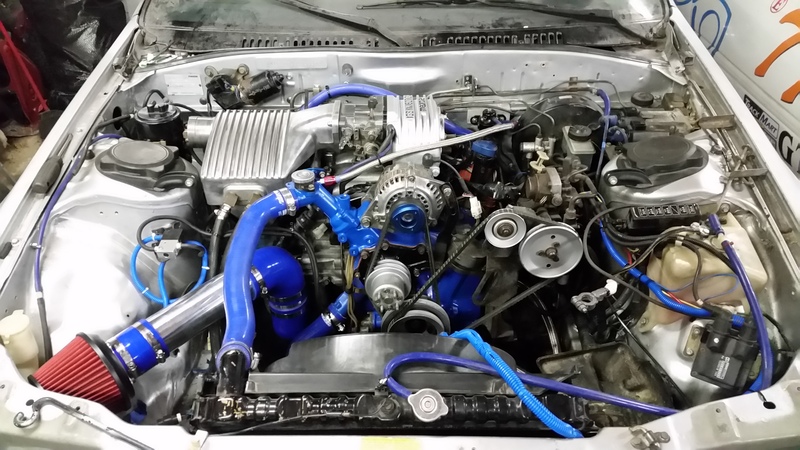
Hello, I've got another thread of here that mostly focused on getting my engine swap running (13BT into a first gen RX-7). (And thanks to everyone for their help) Now that its running, we've run into another couple issues. BTW I have a Series 4 turbo engine, removed emissions (including the air pump and the ACV on the side of the intake manifold. Our engine didn't have spots for the subzero start or EGR valves), but the BAC and twin-scroll solenoid are still connected.
1. According to my AEM AFR w/Bosch Sensor gauge, we're running a 10.0 on our air/fuel. It was 11.2 at idle, (I've been told 13.5-12.5 is normal, on average) then over the next week or so eased down to 10. Its so rich it irritates our eyes lol. Its burned 5 gallons of gas just idling maybe a few hours a week. I wondering what sensors we could've crossed that would cause it to run so rich. Also, our S4 engine has 2 TPS's, the engine came out of a Japanese automatic. We believe the 2nd TPS goes to the Automatic Transmission Computer.
2. We got the engine to 5000rpm but it never registered boost pressure on our gauge. It just read a vacuum of 20 inches. Any guess as to why that is? We don't have any leaks in the intercooler/intake piping, we tested it.
3. The engine dies when we put pressure to the fuel rails. We're using stock 550CC 87.5-88 OHM injectors, with a Walboro 255lph pump, no fuel resistor pack, stock FPR and no Pulsation damper, we replaced it when we heard they were prone to failure. We have volume tested, and pressure tested the injectors and fuel system, respectively. Everything checks within the FSM's tolerances.
Also, it engines struggles under throttle when the fuel pump is on, like its getting too much fuel.
4. We can't get the timing to set right. We've set the timing repeatedly, but the T and L coils always hit on the L mark. We thought the knock box was retarding the timing, but its the same if its wired-out of the loop.
5. On a cold start, what RPM should a JDM S4 engine crank at? I've read that the 3000rpm AWS was American only, but it seems strange that would be an American-only feature. Our engines cranks at idle, even though the BAC checks out.
Thanks to everyone for reading my long post, and another thanks to everyone who helped us get this car to crank. We're willing to try anything at this point, so feel free to take a wild guess...we'll be happy to hear it lol.
Is your pressure / boost sensor connected? And is it connected to a vacuum nipple AFTER the throttle body? Does it ever read anything but 20"?
Running the Walbro with stock regulator will over power the regulator. This will cause the car to run way rich.
When checking timing, was it idling under 1000 RPM and did you have the initial set coupler jumped?
Boost sensor is connected to the nipple on the back of the intake manifold. Im pretty sure its where I've seen other people connect theirs'. It'll vary depending on how the car is running, but it only reads vacuum. It idles at 16-18, but under heavy throttle, it'll get close to 30, its never read positive pressure, but we hear the turbo spinning and hear/feel the pressurized air come out of our temporary BOV.
I didn't know that, I'd read people used the stock FPR with a Walboro. That may be our problem. It runs about 38PSI with the Walboro connected. We have a pressurized gas can, so we disconnected the Walboro and connected the gas can to the fuel line, and it killed the engine just as fast using the can, it was about 35PSI if I remember correctly. Could you recommend a good aftermarket FPR?
It was at 750rpm and I don't think we did. Our FSM didn't say to but we thought that was strange. We'll check it again with the initial set coupler jumped.
I didn't realize that you were running a Walbro pump with stock pressure regulator,like Aaron said,it will overpower the stock regulator. I am using a aeromotive regulator with a Walbro pump and it works great
I didn't realize that you were running a Walbro pump with stock pressure regulator,like Aaron said,it will overpower the stock regulator. I am using a aeromotive regulator with a Walbro pump and it works great
Which Aeromotive FPR are you using? and what all does it take to install it on the fuel rail? Could you send me a picture? Thanks.
Boost sensor is connected to the nipple on the back of the intake manifold. Im pretty sure its where I've seen other people connect theirs'. It'll vary depending on how the car is running, but it only reads vacuum. It idles at 16-18, but under heavy throttle, it'll get close to 30, its never read positive pressure, but we hear the turbo spinning and hear/feel the pressurized air come out of our temporary BOV.
I didn't know that, I'd read people used the stock FPR with a Walboro. That may be our problem. It runs about 38PSI with the Walboro connected. We have a pressurized gas can, so we disconnected the Walboro and connected the gas can to the fuel line, and it killed the engine just as fast using the can, it was about 35PSI if I remember correctly. Could you recommend a good aftermarket FPR?
It was at 750rpm and I don't think we did. Our FSM didn't say to but we thought that was strange. We'll check it again with the initial set coupler jumped.
Thanks for your time and for your help.
Is your fuel pressure regulator vacuum line connected to a vacuum source after the throttle body? 38psi is normal with the engine off, but idling in vacuum should drop it 5-10 psi.
Is your fuel pressure regulator vacuum line connected to a vacuum source after the throttle body? 38psi is normal with the engine off, but idling in vacuum should drop it 5-10 psi.
The FPR is connected to the lower intake manifold. The car won't idle with the fuel pump on, it dies the moment we add pressure to the fuel rail. It literally dies before our fuel pressure gauge shows any pressure.
I run a walbro on the stock reg with no adverse side affects.
All this is pointing me to a restrictive or plugged exhaust.
Also, this you jumper the check connector when you checked the timing?
We haven't messed with the car the last couple days but we will jump the IS coupler this time. We thought we were supposed to jump the connector but our Haynes book didn't say to do it.
We have a 2 inch exhaust to a GReddy barrel exhaust/muffler. No cats/emissions just a pipe from the turbocharger to the muffler. I know 2in isn't great for this engine setup, but we figured it would be 'open enough' for now. I'll go with either a 2.5 or 3 once we get the car driveable. Thanks for your reply.
Don't assume a plugged or restrictive exhaust. Unless there are cats, then it is unlikely the exhaust is plugged.
A plugged exhaust would also not cause the car to run rich.
YMMV of course with the Walbro on a stock regulator, but any of those setups I've seen (I have never done it because, well, it doesn't work) have jacked up the fuel pressure at low loads.
After having the red and silver Aeromotive regulator on my car for over 10 years, it wouldn't be my first recommendation. It is designed for a LOT of flow, and is very leaky after the pump shuts off (as in, the system won't hold pressure long).
A better regulator, in my opinion, is the Aeromotive 13129.
This regulator is more street friendly with less leakage (my experience shows it holds pressure for days), it is more compact, and $100 cheaper.
You must set the initial set coupler if:
-you are checking/adjusting timing
-you are adjusting idle speed
-you are adjusting idle mixture
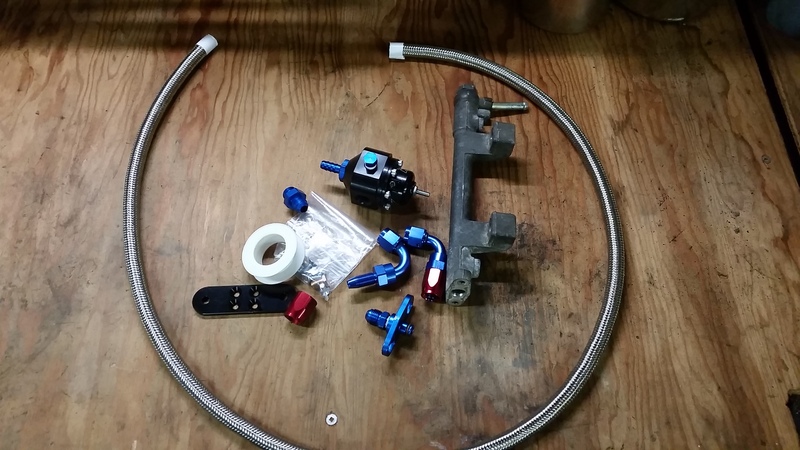
Aftermarket FPR doesn't always fit on the fuel rail - in my car it was too tight of a fit for my AEM against the back side of the Coolant neck (mine's an N/A so it's different - rails are a little backwards I think?). I had to put it on the firewall and run an adapter on the fuel rail (you can get them on ebay) to run a line across to the FPR.
You can see the blue adapter fitting on the rail in this pic, and then the FPR is over by the brake booster.
Better pic of the stuff I used to do it:
Last edited by PinkRacer; Aug 23, 2016 at 09:00 AM.
Thanks for the picture/ brand name. What adapter or whatever do you use to connect the Aeromotive FPR to the fuel rail?
I got it used off the forum,just basically a couple 3/8inch hose barbs and some 3/8inch fuel injection hose.just like Aaron said,I do notice that the fuel pressure drops off after the car is shut off
The FPR is connected to the lower intake manifold. The car won't idle with the fuel pump on, it dies the moment we add pressure to the fuel rail. It literally dies before our fuel pressure gauge shows any pressure.
Something is really wrong here.
The engine should not even be able to start, let alone idle, without pressure in the fuel rails. No pressure= no fuel. No fuel = no run.
Are you sure your fuel feed and return lines are not crossed? Can you tee a cheap fuel gauge into the fuel rail?
Something is really wrong here.
The engine should not even be able to start, let alone idle, without pressure in the fuel rails. No pressure= no fuel. No fuel = no run.
Are you sure your fuel feed and return lines are not crossed? Can you tee a cheap fuel gauge into the fuel rail?
lol welcome to our world. We prime the fuel system, turn off the pump and it starts and idles. We have a fuel pressure gauge tapped and mounted into the secondary fuel rail.
We swapped the feed and return lines a couple weeks to make sure that wasn't our issue.
Once the engine is running, whenever we turn on the pump, the engine dies before the needle moves on the gauge.
We tried a set of different injectors today. AFR gauge read 10.3 instead of the usual 10. And now it backfires flames at idle, it surges 1000-1300rpm, then pops a flame.
I've tried to find the adapter for the fuel rail, but the ones I've seen have 2 bolt holes. Mine has a banjo fitting and the FPR screws into it. Does anyone know the thread size so I can get an Earl's banjo bolt? And where do ya'll recommend I order the aftermarket FPR from? Jegs?
How does the Air Recirculate Valve (or BOV) function of the Series 4? It activates based on vacuum, right? I read online that the RX-7s use an electronic solenoid to activate the ARV/BOV like Hyundai does. But I thought they just used vacuum. I'm still new to turbocharging so I have a lot to learn.
BTW we used a professional pressure tester and at 4500rpm we're running 4lbs of boost, I don't know if that's good or not but at least its making pressure.
So your timing is definitely not correct if leading and trailing are hitting on the red mark.
Do this. Weird the manual isnt showing anything about the check connector.
As for the AFM, hopefully Satch can chime in about that. Do the timing first.
Originally Posted by Go48
Look for a single green connector right next to the leading coil pack beside the battery in the very front of the engine compartment. There should also be a larger green connector right next to it.
Originally Posted by HAILERS
FYI: Series four have a two socket, green connector that you jumper the two sockets to *set* the initial set coupler. All that does is FIX the BAC's duty cycle and nothing else. If the rpms are under 1200rpm you don't need to do this imho.
So your timing is definitely not correct if leading and trailing are hitting on the red mark.
Do this. Weird the manual isnt showing anything about the check connector.
As for the AFM, hopefully Satch can chime in about that. Do the timing first.
We connected the initial set coupler, and tried to set the timing.... repeatedly lol. It still pops fire and black smoke at idle. The timing always seems to set in the middle of Red and the Yellow. Could anyone explain how the ECU determines engine load and how the Electronic Spark Advance system works? I've done some searching but never found anything that seemed useful.
We wired in a headlight to reduce the voltage to the fuel pump, and the engine now idles with the fuel pump on but it runs rough and the fuel pressure gauge says 5-8PSI.
Thanks for the pictures! And thanks for all the help!
We connected the initial set coupler, and tried to set the timing.... repeatedly lol. It still pops fire and black smoke at idle. The timing always seems to set in the middle of Red and the Yellow. Could anyone explain how the ECU determines engine load and how the Electronic Spark Advance system works? I've done some searching but never found anything that seemed useful.
We wired in a headlight to reduce the voltage to the fuel pump, and the engine now idles with the fuel pump on but it runs rough and the fuel pressure gauge says 5-8PSI.
Thanks for the pictures! And thanks for all the help!
Some of this is found in the FSM/training manual. Load is determined by the TPS, boost sensor and AFM.