


??? Rockwell hardness of rotor housing???


Thread Starter
WingmaN

Joined: Aug 2002
Posts: 4,324
Likes: 0
From: Fort Worth Texas
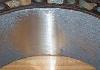
Chrome is a very generic term. The properties of chrome vary considerable. Housings are actually nitrited, but that really doesn't tell me either.
I am thinking the only way I will get my answer is to get one tested at a heat treat facility that has equipment to test with.
I am thinking the only way I will get my answer is to get one tested at a heat treat facility that has equipment to test with.

Full Member
Joined: Sep 2001
Posts: 76
Likes: 0
From: australia
I was mucking around with some apex seals at work a little while ago. I did a rockwell C on them and came up with around 57-58HRC on the working edge of the seal. The housings would have to be of a comparable or higher hardness otherwise wear would be unacceptable.
Full Member
Joined: Sep 2001
Posts: 76
Likes: 0
From: australia
Oh yeah. If you are going to get someone to do a rockwell on a housing make sure they do a superficial rockwell rather than a normal rockwell C test. You want the hardness of the surface plating right?
Thread Starter
WingmaN
Joined: Aug 2002
Posts: 4,324
Likes: 0
From: Fort Worth Texas
Right. I need to know the contact surface. I know that there is more to it than just the rockwell hardness though. I cannot remember the term for how "slippery" a surface is, but that plays a big part in the equation. Since the surface has lubrication present it helps in this area as well.
My main concern is that the plating I use is at least as hard as stock.
My main concern is that the plating I use is at least as hard as stock.
Full Member
Joined: Sep 2001
Posts: 76
Likes: 0
From: australia
If i had a junk housing available i could do it for you. I will have to ask around as rockwell is considered a destructive test. i don't want an indentation on the working face of a good housing.
Co-efficient of friction is probably what you mean by slipperiness. I think if you get a surface finish which is pretty much reflective, by that i do not mean mirror finish, i think you will be fine. You want some sort of surface roughness to promote sealing between the seal and housing. You will find that if you get a fairly good surface to start with the apex seal will do the final polishing for you, ie- bed itself in.
Co-efficient of friction is probably what you mean by slipperiness. I think if you get a surface finish which is pretty much reflective, by that i do not mean mirror finish, i think you will be fine. You want some sort of surface roughness to promote sealing between the seal and housing. You will find that if you get a fairly good surface to start with the apex seal will do the final polishing for you, ie- bed itself in.
Trending Topics
Thread Starter
WingmaN
Joined: Aug 2002
Posts: 4,324
Likes: 0
From: Fort Worth Texas
Yep, that was the word I was looking for. I stated this thread after my main thread about resurfacing housings did not get a response on it. You may want to look at the other thread to see what I am working on just in case you missed that thread.
Your input there would be helpful as well.
thanks
Your input there would be helpful as well.
thanks

Full Member
Joined: Sep 2001
Posts: 76
Likes: 0
From: australia
brinell is not really suited for this application. We are only after the hardness on the surface coating. Brinell is a tad savage for this application.
Anyway 45 HRC comes to 421 brinell using a 10mm steel ball and 3t load.
Anyway 45 HRC comes to 421 brinell using a 10mm steel ball and 3t load.

Senior Member

Joined: Jul 2001
Posts: 360
Likes: 0
From: Kalifornia
A Brinell test will not give you an accurate reading. The imprint will have to be too large and you will have to imprint past the surface coating. ( This means that you will be getting a partial reading from the softer material below the coating.) Most destructive testing shops will be able to do an accurate Rockwell test. A small imprint in the surface coating as opposed to a big dimple for the Brinell test. I have done multiple Brinell tests on materials ranging in hardness from 40 RC. To 67 RC. From my experience you have to thump it pretty hard to read it accurately. RC test is a small pin ***** compared to a brinel test.
Just my $.02
Just my $.02

Thread
Thread Starter
Forum
Replies
Last Post
cdn
2nd Generation Non-Technical and pictures
0
Aug 11, 2015 08:59 PM
