


Wilwood pedal assembly


Thread Starter
Full Member
Joined: Oct 2007
Posts: 114
Likes: 2
From: Toronto
Wilwood pedal assembly
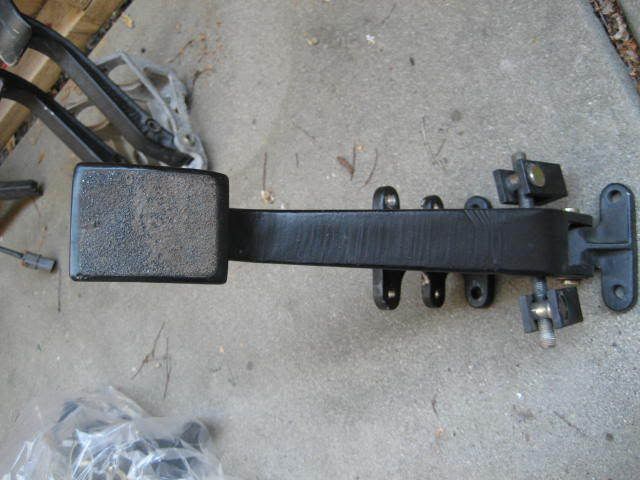
I'm ordering Wilwood's reverse swing pedal assembly for my FC race car, and was looking for some feedback on what some of you fellow racers are using.
By some rough calculations I'm leaning towards the 5.1:1 pedal ratio, 3/4" front master and 1" rear master cylinder bore sizing. This is for the stock TII brakes, and an approx. 2600lb race weight. This gives me line pressures of 350psi front and 260psi rear.
Pedal feel is driver preference, however I'd like to compare what I think will work for me, to what some of you are running.
Thanks,
Andrew.
By some rough calculations I'm leaning towards the 5.1:1 pedal ratio, 3/4" front master and 1" rear master cylinder bore sizing. This is for the stock TII brakes, and an approx. 2600lb race weight. This gives me line pressures of 350psi front and 260psi rear.
Pedal feel is driver preference, however I'd like to compare what I think will work for me, to what some of you are running.
Thanks,
Andrew.


Sounds about right for your car....
My first gen has t2 calipers with the same size front m/c, but I have t2 calipers in the rear aswell.....
If I recall my pedal ratio is 6:1.....
My first gen has t2 calipers with the same size front m/c, but I have t2 calipers in the rear aswell.....
If I recall my pedal ratio is 6:1.....

Rotary Enthusiast

Joined: Apr 2001
Posts: 1,289
Likes: 0
From: North Hollywood, Ca USA
I am using 3/4" front and 7/8" for the rears. I have also tried it reversed. smaller diameter gives longer stroke and softer(less input power) pedal. larger diameter gives shorter stroke and firmer(more input pressure required) pedal. I have seen people use the 5/8" diameter for the fronts as well.
Thread Starter
Full Member
Joined: Oct 2007
Posts: 114
Likes: 2
From: Toronto
Thanks for the input guys.
Yeah, the bigger the bore the shorter the stroke, the more muscle that's needed to obtain the same line pressure as a smaller bore.
What pedal ratio are you running tims?
Thanks,
Andrew.
I am using 3/4" front and 7/8" for the rears. I have also tried it reversed. smaller diameter gives longer stroke and softer(less input power) pedal. larger diameter gives shorter stroke and firmer(more input pressure required) pedal. I have seen people use the 5/8" diameter for the fronts as well.
What pedal ratio are you running tims?
Thanks,
Andrew.

Trending Topics
Rotary Enthusiast
Joined: Apr 2001
Posts: 1,289
Likes: 0
From: North Hollywood, Ca USA
Eggie,
It really doesn't matter. I have used that setup on the stock FC calipers and my Wilwood bilet supelite 6 calipers
Andoru,
I am using the wilwood reverse mount pedal assembly.
It really doesn't matter. I have used that setup on the stock FC calipers and my Wilwood bilet supelite 6 calipers
Andoru,
I am using the wilwood reverse mount pedal assembly.

Rotary Enthusiast
Joined: Jan 2002
Posts: 859
Likes: 0
From: 15143
The name on the caliper may not matter, but the piston sizes make one heck of a difference.
I've been a bit too cryptic in this thread.
After doing some calculations, I highly doubt that Mazda calipers will provide enough braking at ~300psi. The FD's proportioning valve doesn't even kick in until 570psi (per FSM P-19).
Is my math way off?
I've been a bit too cryptic in this thread.
After doing some calculations, I highly doubt that Mazda calipers will provide enough braking at ~300psi. The FD's proportioning valve doesn't even kick in until 570psi (per FSM P-19).
Is my math way off?
Thread Starter
Full Member
Joined: Oct 2007
Posts: 114
Likes: 2
From: Toronto
The name on the caliper may not matter, but the piston sizes make one heck of a difference.
I've been a bit too cryptic in this thread.
After doing some calculations, I highly doubt that Mazda calipers will provide enough braking at ~300psi. The FD's proportioning valve doesn't even kick in until 570psi (per FSM P-19).
Is my math way off?
I've been a bit too cryptic in this thread.
After doing some calculations, I highly doubt that Mazda calipers will provide enough braking at ~300psi. The FD's proportioning valve doesn't even kick in until 570psi (per FSM P-19).
Is my math way off?
If you want the exact math layed out, stop techs website has a very well written article laying out the calculation of master cylinder sizing.
My biggest dilemma is should I get the 5.1:1 or 6.25:1 pedal ratio offered by Wilwood. Because when it comes down to it, I can calculate all I like. Real world application out weights my calculations. I may find it too hard for me to press the pedal with the 5.1:1 ratio. 461psi may also not be enough, requiring me to press harder to achieve a higher pressure.
Anyway, good eye on catching me in my bluff

Thanks,
Andrew.
Last edited by Andoru; Dec 19, 2007 at 11:40 PM.
Rotary Enthusiast
Joined: Jan 2002
Posts: 859
Likes: 0
From: 15143
PM me your email address, and I'll send a copy of the sheet.


Thread Starter
Full Member
Joined: Oct 2007
Posts: 114
Likes: 2
From: Toronto
I appreciate the input you've given.
Andrew.
Rotary Enthusiast
Joined: Apr 2001
Posts: 1,289
Likes: 0
From: North Hollywood, Ca USA
everybody's math seems correct, but in the real world it doesn't matter. the larger the piston size of the caliper does require more volume of brake fluid. This will then give you a longer stroke on the M/C, and if you used a larger diameter M/C it would give you a shorter stroke. In the real world I have used all types of combinations with the same results. If you want a softer(less pressure needed) pedal use the smaller diameter M/C. Most people will find that there is very little pressure needed for the rear brakes so the larger M/C will give you more adjustment on the balance bar. I started by calculating what I "should" use and found the best combo for my particular style by trial and error. I do have a collection of used M/C's though. I personally would start with (2) 3/4" M/C's.

Thread
Thread Starter
Forum
Replies
Last Post
LongDuck
1st Generation Specific (1979-1985)
12
Oct 7, 2015 08:12 PM
