


Power FC What does the typical turbo rotary timing curve look like?

Thread Starter
R1derful

Joined: Feb 2004
Posts: 702
Likes: 0
From: N Cali
What does the typical turbo rotary timing curve look like?
Hi All:
I've been researching engine management for rotaries, but I had a more basic question about ignition timing vs RPM.
On the piston engines that I've tuned, a conservative guideline is you pull about ~1 deg of ignition timing for every 1 psi of boost.
Here is the high speed timing map from my older supercharged Civic:

Manifold pressure is across the top with boost beginning at column 11. RPMs are along the left side.
Having looked through the shop manual already, i can see that the ignition timing for a rotary seems like it is much different than it is for a piston engine?
Thanks,
Sonny
I've been researching engine management for rotaries, but I had a more basic question about ignition timing vs RPM.
On the piston engines that I've tuned, a conservative guideline is you pull about ~1 deg of ignition timing for every 1 psi of boost.
Here is the high speed timing map from my older supercharged Civic:
Manifold pressure is across the top with boost beginning at column 11. RPMs are along the left side.
Having looked through the shop manual already, i can see that the ignition timing for a rotary seems like it is much different than it is for a piston engine?
Thanks,
Sonny


The assumption about retarding 1 degree for each psi boost is still a correct safe starting point even for rotaries.
The real differences between a normal 4 cycle engine and rotary engine are: (1) we have two plugs in the combustion chamber area because it is long and wide. They are about 3" apart. Some 4 cycle racing engines have two plugs.(2) our rotor (piston equivalent) rotates at 1/3 e-shaft(crank shaft) speed. Thus if we change timing 3 crank degrees, the rotor only sees 1 degree change.
Our two plugs usually fire at different intervals and thus the difference is called split. For NA racing engines split is usually 0 or very low. For boosted, split may very from 15degrees to less. 15 is usually for emisions or very high boost. You can run different split for the same boost at different rpms to fine tune. I run 15 at idle, 3 off idle to light boost, 8 for boost, and 15 for overboost.
Similar to a twin plug 4 cycle engine, the closer the split, the less over advance is needed as combustion pressure builds faster due to two flame fronts burning simultaneously towards each other.
Some people still tune with very flat timing curves like your example. This may be very conservative and old fashion like mechanical distributor days depending on what your torque curve is doing. Your B11 column runs from 6025-8975 rpms with the same timing. From this I assume that torque is coming on very stong at about 6025 and continues to rise stongly up to about 8975 which is you red line. I doubt that is how your torque is!
After max torque, timing should still rise due to the faster crank speeds and less time for combustion to happen. Otherwise, you will lose some top end torque.
Just my opinion.
Here is my leading timing (first plug to fire) for 14-15psi boost in 400rpm increments from 400 to 8000. I run stock intake ports and mild exhaust ports, torque tops out at 6000rpm which is the last 12:
1-2-2-3-5-6-8-9-10-11-12-13-12-12-12-14-16-19-21-23
The real differences between a normal 4 cycle engine and rotary engine are: (1) we have two plugs in the combustion chamber area because it is long and wide. They are about 3" apart. Some 4 cycle racing engines have two plugs.(2) our rotor (piston equivalent) rotates at 1/3 e-shaft(crank shaft) speed. Thus if we change timing 3 crank degrees, the rotor only sees 1 degree change.
Our two plugs usually fire at different intervals and thus the difference is called split. For NA racing engines split is usually 0 or very low. For boosted, split may very from 15degrees to less. 15 is usually for emisions or very high boost. You can run different split for the same boost at different rpms to fine tune. I run 15 at idle, 3 off idle to light boost, 8 for boost, and 15 for overboost.
Similar to a twin plug 4 cycle engine, the closer the split, the less over advance is needed as combustion pressure builds faster due to two flame fronts burning simultaneously towards each other.
Some people still tune with very flat timing curves like your example. This may be very conservative and old fashion like mechanical distributor days depending on what your torque curve is doing. Your B11 column runs from 6025-8975 rpms with the same timing. From this I assume that torque is coming on very stong at about 6025 and continues to rise stongly up to about 8975 which is you red line. I doubt that is how your torque is!
After max torque, timing should still rise due to the faster crank speeds and less time for combustion to happen. Otherwise, you will lose some top end torque.
Just my opinion.
Here is my leading timing (first plug to fire) for 14-15psi boost in 400rpm increments from 400 to 8000. I run stock intake ports and mild exhaust ports, torque tops out at 6000rpm which is the last 12:
1-2-2-3-5-6-8-9-10-11-12-13-12-12-12-14-16-19-21-23
Last edited by cewrx7r1; Mar 12, 2004 at 04:07 PM.
Thread Starter
R1derful
Joined: Feb 2004
Posts: 702
Likes: 0
From: N Cali
cewrx7r1: Man, you rule!  That was exactly what I was looking for! I guess the terms "BTDC" and "ATDC" don't quite mean the same thing in a rotary, but are your timing numbers equivalent to the "BTDC" timing values in my map?
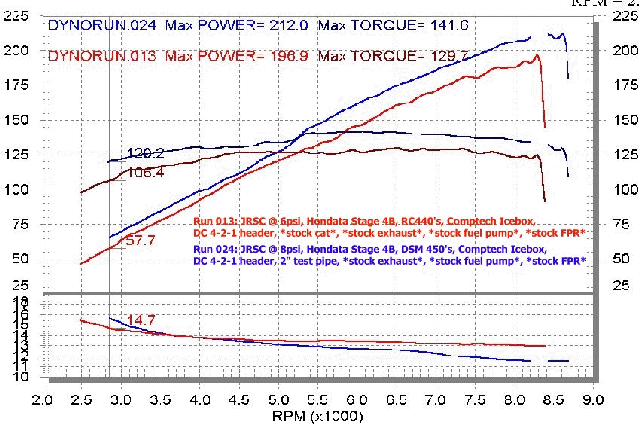
Here is the dyno chart associated with the map above. Since a VTEC engine has 2 cam profiles, this map doesn't actually get used until RPM > 5200. I tuned this thing for several hours on the dyno and in the end, the "flat" timing curve made the most power. This is pretty typical with a roots type supercharger that makes your torque curve look like a table-top. The centrifugal superchargers build more boost as RPMs rise and as you stated, require additional advance as RPMs increase.
I'm looking forward to playing with the PFC!
Sonny
That was exactly what I was looking for! I guess the terms "BTDC" and "ATDC" don't quite mean the same thing in a rotary, but are your timing numbers equivalent to the "BTDC" timing values in my map?Here is the dyno chart associated with the map above. Since a VTEC engine has 2 cam profiles, this map doesn't actually get used until RPM > 5200. I tuned this thing for several hours on the dyno and in the end, the "flat" timing curve made the most power. This is pretty typical with a roots type supercharger that makes your torque curve look like a table-top. The centrifugal superchargers build more boost as RPMs rise and as you stated, require additional advance as RPMs increase.
I'm looking forward to playing with the PFC!
Sonny

Thread
Thread Starter
Forum
Replies
Last Post
sherff
Adaptronic Engine Mgmt - AUS
9
Feb 24, 2019 12:09 PM
stickmantijuana
Engine Management Forum
11
Nov 9, 2015 01:15 PM


