


Switching to S5 NA rotors and housings


Thread Starter
Vintage sportcars

Joined: Jun 2010
Posts: 348
Likes: 1
From: Germany
Switching to S5 NA rotors and housings
Hello,
Assuming a S4 NA (of course) bone stock needs a rebuild. Is it a good idea to replace the S4 Rotors with S5 rotors and housings to gain compression ?
What about the S5 housings, are they stronger than the S4 ones ?
Facts I found:
Assuming a S4 NA (of course) bone stock needs a rebuild. Is it a good idea to replace the S4 Rotors with S5 rotors and housings to gain compression ?
What about the S5 housings, are they stronger than the S4 ones ?
Facts I found:
- S4 comp: 9.4 @ 4553 gramms
- S5 comp: 9.7 @ 4328 gramms


You don't really need the s5 housings unless your s4 housings were already too worn. If you go to the s5 rotors you will need to make sure the rotating assembly is matched so the balance is correct.
Thread Starter
Vintage sportcars
Joined: Jun 2010
Posts: 348
Likes: 1
From: Germany
Thanks,
yes getting the matching assembly was obvious to me, I just forgot to write it down.
Balancing the whole assembly will be considered as a must.
I was more interested if it would bring the desired effect of more compression when using S5 rotors.
Are the S5 housings stronger than their S4 counterparts ? I believe I read it somewhere but I would like to have it confirmed. What exactly is stonger about them if so ?
I am still not sure If it will be a 100% fit. I mean will they bolt together without trouble ? Same specs ?
Many thanks
Steven
yes getting the matching assembly was obvious to me, I just forgot to write it down.
Balancing the whole assembly will be considered as a must.
I was more interested if it would bring the desired effect of more compression when using S5 rotors.
Are the S5 housings stronger than their S4 counterparts ? I believe I read it somewhere but I would like to have it confirmed. What exactly is stonger about them if so ?
I am still not sure If it will be a 100% fit. I mean will they bolt together without trouble ? Same specs ?
Many thanks
Steven

S5 housings use a different spark plug hole location than S4, the S4 is "preferred" because it is the same as orientation/location/dimension as the race rotary engines that mazda builds. They are equally as strong just find a set that has least wear ideally.
they will bolt together just dont mix s4 with s5 rotor housings, make sure that your rotor housings are paired together in condition (close as possible) and engine series.
they will bolt together just dont mix s4 with s5 rotor housings, make sure that your rotor housings are paired together in condition (close as possible) and engine series.


Joined: Mar 2001
Posts: 31,859
Likes: 3,243
From: https://www2.mazda.com/en/100th/
S5 housings use a different spark plug hole location than S4, the S4 is "preferred" because it is the same as orientation/location/dimension as the race rotary engines that mazda builds. They are equally as strong just find a set that has least wear ideally.
they will bolt together just dont mix s4 with s5 rotor housings, make sure that your rotor housings are paired together in condition (close as possible) and engine series.
they will bolt together just dont mix s4 with s5 rotor housings, make sure that your rotor housings are paired together in condition (close as possible) and engine series.


Trending Topics
Thread Starter
Vintage sportcars
Joined: Jun 2010
Posts: 348
Likes: 1
From: Germany
I think the S4 eshaft can be used with S5 rotors without problem.
S5 rotors has more compression different spark location the rest should be the same. (E-shaft wise)
But I would check endplay regardless to be on the safe side.
The only thing is when using an RX-8 shaft the stationary gears needs to be changed or modified.
Mazdatrix has a good description of it.
Steven
S5 rotors has more compression different spark location the rest should be the same. (E-shaft wise)
But I would check endplay regardless to be on the safe side.
The only thing is when using an RX-8 shaft the stationary gears needs to be changed or modified.
Mazdatrix has a good description of it.
Steven
Last edited by StevenL5975; Aug 5, 2011 at 02:39 PM.

Not worth the bother, a large part of the performance difference has to do with the vdi intake on the s5.
Make it easier & simpler and just get a lighter flywheel, atkins aux sleeves and invest in a really good exhaust.
Make it easier & simpler and just get a lighter flywheel, atkins aux sleeves and invest in a really good exhaust.


(Now I'm even questioning if a lighter flywheel is going to change my driving style too much and force me to shift like a race car driver while I'm going through the city.)
Regardless, you can't go wrong with a good exhaust header.

Senior Member

Joined: Nov 2004
Posts: 627
Likes: 0
From: Fallston, MD
A lighter flywheel doesn't change how you shift, it changes how you press the gas pedal. Jerky throttle movements are going to translate into jerky driving because you've got less mass keeping the engine from revving freely.
My mistake.
I thought with less rotating mass, that stepping on the clutch would cause the rev's to drop quicker. Matching rev's when you shift would demand quicker shifting, or blipping the throttle to keep the RPMs up.
Normally after the shift, I either release the clutch and mat the gas pedal or get up to speed and set the cruise. I can't see how driving would be jerky due to a lighter flywheel.
I've heard the difficually is to get rolling from a dead stop without reving too much and spinning or reving too low and stalling.
I don't know. I don't want to drive like a jerk.
I thought with less rotating mass, that stepping on the clutch would cause the rev's to drop quicker. Matching rev's when you shift would demand quicker shifting, or blipping the throttle to keep the RPMs up.
Normally after the shift, I either release the clutch and mat the gas pedal or get up to speed and set the cruise. I can't see how driving would be jerky due to a lighter flywheel.
I've heard the difficually is to get rolling from a dead stop without reving too much and spinning or reving too low and stalling.
I don't know. I don't want to drive like a jerk.
Thread Starter
Vintage sportcars
Joined: Jun 2010
Posts: 348
Likes: 1
From: Germany
My mistake.
I thought with less rotating mass, that stepping on the clutch would cause the rev's to drop quicker. Matching rev's when you shift would demand quicker shifting, or blipping the throttle to keep the RPMs up.
Normally after the shift, I either release the clutch and mat the gas pedal or get up to speed and set the cruise. I can't see how driving would be jerky due to a lighter flywheel.
I've heard the difficually is to get rolling from a dead stop without reving too much and spinning or reving too low and stalling.
I don't know. I don't want to drive like a jerk.
I thought with less rotating mass, that stepping on the clutch would cause the rev's to drop quicker. Matching rev's when you shift would demand quicker shifting, or blipping the throttle to keep the RPMs up.
Normally after the shift, I either release the clutch and mat the gas pedal or get up to speed and set the cruise. I can't see how driving would be jerky due to a lighter flywheel.
I've heard the difficually is to get rolling from a dead stop without reving too much and spinning or reving too low and stalling.
I don't know. I don't want to drive like a jerk.
Remember to get a scattershield for the trans once messing around with flywheels, nothing funny about a flywheel/clutch assembly going off like a grenade at redline.
Personally I use heeltoe all the time, I can imagin with a lighter flywheel it might be a small bit trickier to keep it from stalling while clutching in in 1st.
Can be fixed with better sense in the right foot...
A good heeltoe is nothing to laugh at, people still look confused, but it sounds just right.
Sounds like a sequential tiptronic race gearbox

The s5 manifolds have better area under the torque curve than the s4. It's not just for top end. When developing the s5 VDI system, Mazda experimented with different runner lengths:
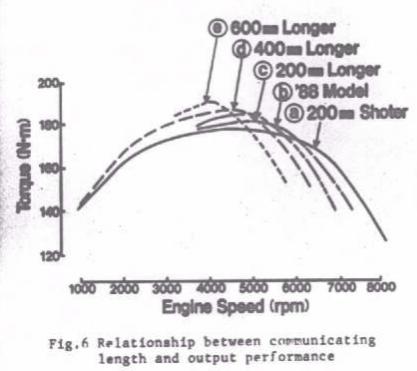
During lower rpm operation, the s5 intake manifold runners are 400mm longer than the s4, resulting in torque curve "d." After the changeover point, the runners become 200mm shorter than the s4 manifold runners, resulting in torque curve "a." The s4 manifolds were a compromise design because the lengths were fixed. The s5 manifolds have two fixed lengths, while the R26B engine found in the 787B 4 rotor race car had continuously variable runner lengths:
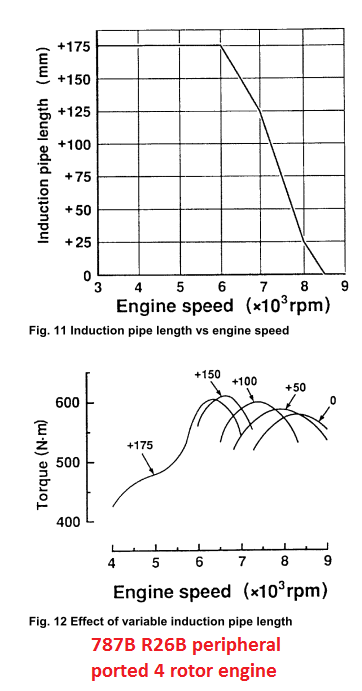
During lower rpm operation, the s5 intake manifold runners are 400mm longer than the s4, resulting in torque curve "d." After the changeover point, the runners become 200mm shorter than the s4 manifold runners, resulting in torque curve "a." The s4 manifolds were a compromise design because the lengths were fixed. The s5 manifolds have two fixed lengths, while the R26B engine found in the 787B 4 rotor race car had continuously variable runner lengths:
The revs can also increase faster. When you free rev the engine (vehicle is stopped) it will generally increase faster. If you pop the clutch in to rev match, the revs will go up faster. This doesn't apply here as much but on high horsepower turbo engines, when you shift at the top of a gear the revs will actually increase before they drop down.
Normally after the shift, I either release the clutch and mat the gas pedal or get up to speed and set the cruise. I can't see how driving would be jerky due to a lighter flywheel.
I've heard the difficually is to get rolling from a dead stop without reving too much and spinning or reving too low and stalling.
Senior Member
Joined: Nov 2004
Posts: 627
Likes: 0
From: Fallston, MD
I like light flywheels because it lets the engine rev more freely and increases the effect of engine braking. In my opinion, having the throttle react so much more quickly (in both increasing and decreasing rpms) is a huge benefit. The downside is without that mass, the engine will be more likely to surge or stall (flywheel mass helps keep the idle steady). On my previous car, I went from a stock flywheel of around 17 lbs to a 7.5-lb Fidanza, and I absolutely loved it. It makes the car feel so much faster when it's that quick to respond to throttle movements.
I had a bit of a problem adjusting to a 6-puck clutch with such a light flywheel. I stalled the car a couple times (the clutch wouldn't slip). Honestly though, that's something that never actually bothered me. I liked the fact that nobody wanted to drive my car because it was "so hard to drive".
I had a bit of a problem adjusting to a 6-puck clutch with such a light flywheel. I stalled the car a couple times (the clutch wouldn't slip). Honestly though, that's something that never actually bothered me. I liked the fact that nobody wanted to drive my car because it was "so hard to drive".
keep the flysheel stock, get a better clutch, streetport the endplates and get atkins sleeves, job done and budget friendly.
or, source all the s5 stuff, figure out the conversion (could get complicated) and you will squeeze a little more out of the motor. For that money though, i would do a TII swap.
or, source all the s5 stuff, figure out the conversion (could get complicated) and you will squeeze a little more out of the motor. For that money though, i would do a TII swap.

FWIW I switched from 84-85 13b rotors 11.5lbs 9.2 compression to the S5 n/a rotors and the difference was very noticeable. Revved so much easier and the extra compression can be felt. Just lifting the rotor was easier during assembly. If you're looking for that extra punch use the S5 rotors. Is it worth the cost and effort? That's up to you.
Joined: Mar 2001
Posts: 31,859
Likes: 3,243
From: https://www2.mazda.com/en/100th/
i personally i think the stock flywheels are too heavy! i think the RB 17lbs flywheel is what the car should have some with stock.
with the stock flywheel, the revs DON'T drop, and you either have to wait, or get the rubber band thing where the car is upset during a shift.
i also don't like puck clutches, they just aren't for street use
with the stock flywheel, the revs DON'T drop, and you either have to wait, or get the rubber band thing where the car is upset during a shift.
i also don't like puck clutches, they just aren't for street use
Senior Member
Joined: Nov 2004
Posts: 627
Likes: 0
From: Fallston, MD

What is the length of the runner for the "0" value, where no "extra length" is added? I have a pport and would like to compare the length versus my manifold. Is it measured from the opening in the motor itself (the inside of the rotor housing), or from the face of the housing?
And curiously, what length is the header primaries (and size) of the 787? Or any mazda pport engine? Mine has 21 inch primaries.

^I've searched high and low for 787B header length and came up with nothing. I've skimmed every SAE paper I could find and still nothing. There are several publications on 13B/12A header lengths, but only long primary systems for the most part.
What is the length of the runner for the "0" value, where no "extra length" is added? I have a pport and would like to compare the length versus my manifold. Is it measured from the opening in the motor itself (the inside of the rotor housing), or from the face of the housing?
And curiously, what length is the header primaries (and size) of the 787? Or any mazda pport engine? Mine has 21 inch primaries.
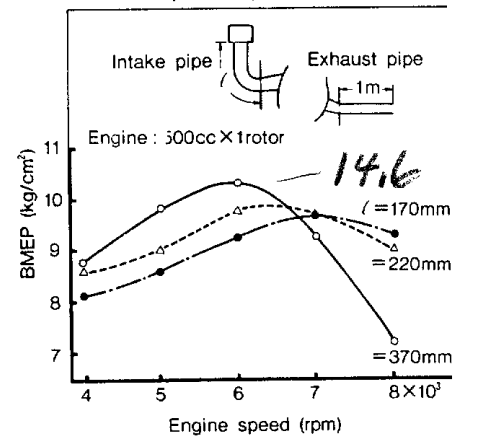
The exhaust length had crazy resonance effects and seems pretty unpredictable without lab-grade equipment and expensive/proprietary modeling. They did seem to like 300mm though, as it was the fixed exhaust length used in some of their intake piping tests.
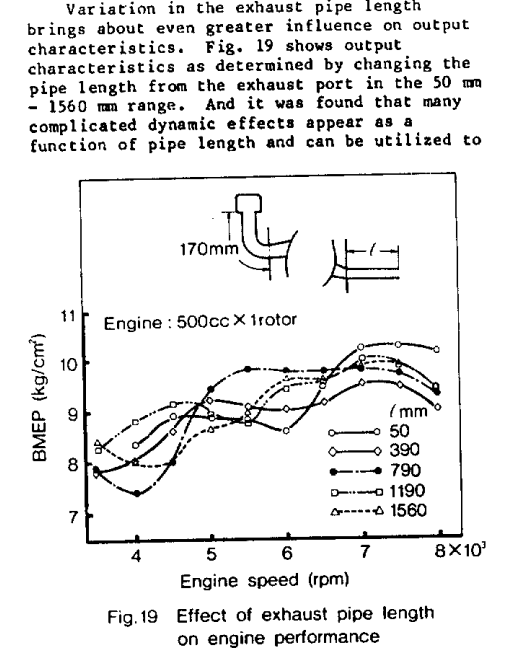
There's a lot of stuff here about port timing as well, and a comparison of bridge port + peripheral + semi pp. PM me and I can send you the whole thing.
Joined: Mar 2001
Posts: 31,859
Likes: 3,243
From: https://www2.mazda.com/en/100th/
having seen the 787B a TON of times, its a 4 into 1. there are 4 "S" shaped pipes, which make a 4 into 1 header. its all slip fit, with spring clips. it collects into 3", goes into a 12-14" muffler, and then theres a crappy pie cut section to turn out in front of the rear wheel.
its really short and simple.
the 787 (non B!) has the exact same thing, except its got a mandrel bent piece to exit the car

Thread
Thread Starter
Forum
Replies
Last Post
Boriquaguerrero
2nd Generation Specific (1986-1992)
20
Apr 22, 2019 01:15 PM
cdn
2nd Generation Non-Technical and pictures
0
Aug 11, 2015 08:59 PM
