


Haltech Injector dead time/battery map


Thread Starter
Joined: Jun 2008
Posts: 870
Likes: 4
From: Paradise
Injector dead time/battery map
Hello guys, how important is the battery map? I was wondering if should I consider implementing this map. I am presently road tuning my E8 from scratch with the help of one of Claudios base maps and slowly working my way up in boost. I am presently just below 10psi and plan to top off at just over 20psi with water injection. Should I consider using the dead time map? I have the lag time info for the injectors I am using (precision 1000cc and bosch 1600), but dont know how to use the info on the map. I dont want to adjust my present tune, could it be done with out changing my fuel delivery map?
Thanks
Thanks


At higher rpm you are more likely to be at full battery voltage so the compensation may matter less.
It is my understanding that the older Haltechs, E8/E11, use a compensation table
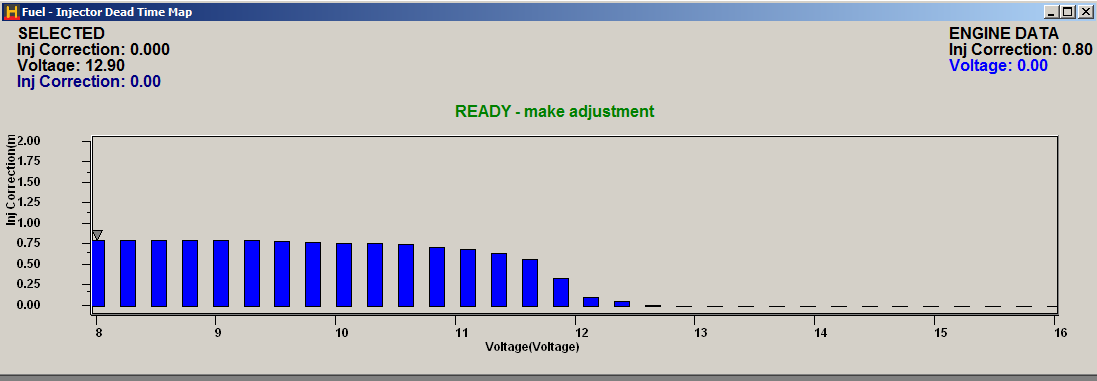
while the Platinum ECU's use an actual lag time table.
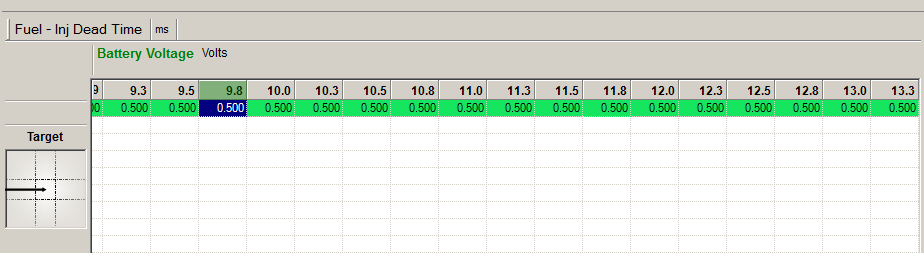
The Platinum ECU is straightforward enough, but I'll admit I'm not 100% sure what the best approach is for setting up deadtime compensation on an earlier ECU. Is that table a percentage change of the final calculated injector pulsewidth? Or is it a table in milliseconds of pulsewidth, adding or subtracting milliseconds?
It is my understanding that the older Haltechs, E8/E11, use a compensation table
while the Platinum ECU's use an actual lag time table.
The Platinum ECU is straightforward enough, but I'll admit I'm not 100% sure what the best approach is for setting up deadtime compensation on an earlier ECU. Is that table a percentage change of the final calculated injector pulsewidth? Or is it a table in milliseconds of pulsewidth, adding or subtracting milliseconds?

Yes....
If it is really a unit less correction, and you follow the same labeling convention as the other unit less correction maps, than Haltech has only given you a 2.0% influence. No other unit less maps are labeled as 100%=1.00 and all of the duration addition corrections are labeled with units of ms.
Also, I am using the dead time map as such on my car, which I run an E8 on.
If it is really a unit less correction, and you follow the same labeling convention as the other unit less correction maps, than Haltech has only given you a 2.0% influence. No other unit less maps are labeled as 100%=1.00 and all of the duration addition corrections are labeled with units of ms.
Also, I am using the dead time map as such on my car, which I run an E8 on.
Yes but you need the information regarding the dead times of the injectors that you are using in order to construct the table effectively..... which can be harder that you may think to come up with.
Injector Dynamics is one of the only retailers publishing dynamic dead time data for their injectors.
Injector Dynamics is one of the only retailers publishing dynamic dead time data for their injectors.
Trending Topics


1) The E8/11, E6K/X, and Platinum injector dead time compensation maps work the same. Whether you call it a compensation map or a dead time table, they're the same thing. They're simply represented differently (2D bar graph versus 2D numerical values). Just like the fuel and ignition maps are the same, but different, among the systems. They're both modifiers of the base fuel map versus battery voltage. You program the amount of on-time that will be added to the base fuel map relative to battery voltage. The idea is that, as the battery voltage falls, the injector response is slower (opens more slowly) and a longer on-time is needed to maintain a common mixture.
2) The compensation map is absolutely needed. Some platforms are better than others at maintaining a consistent voltage, but you will always have variables. Unless you want to chase fluctuating AFRs, use the compensation map.
3) A millisecond (mS) is a thousandth of a second. A microsecond (μS) is a millionth of second. You can do the conversion easily enough.
4) They're not "unit less" tables. The units are in mS and the values are added to the base fuel map along with the other percentage based modifiers.
5) You do not need injector dead time values. You can come up with an effective compensation table without any injector information at all. As part of a scratch tune you'll get the car running and idling well and able to hold a given AFR while holding a consistent idle speed. We'll say 14:1 at 1000 rpm. At this point note the battery voltage. We'll say 13.5V. Now you can start manipulating battery voltage by turning on accessories. As the battery voltage falls, you will need to manipulate the values in the compensation table to maintain our 14:1 target AFR. It's possible to do all manner of things to alter the system voltage to hit the relevant spots on the table (usually 12-14 volts). And that's it. No exotic test equipment or calculations needed and it only takes a few minutes. You just need to make sure the base fuel map is accurately calibrated and the engine speed is consistent in the area you're doing the voltage test so that you're not fighting yourself as you go.
2) The compensation map is absolutely needed. Some platforms are better than others at maintaining a consistent voltage, but you will always have variables. Unless you want to chase fluctuating AFRs, use the compensation map.
3) A millisecond (mS) is a thousandth of a second. A microsecond (μS) is a millionth of second. You can do the conversion easily enough.
4) They're not "unit less" tables. The units are in mS and the values are added to the base fuel map along with the other percentage based modifiers.
5) You do not need injector dead time values. You can come up with an effective compensation table without any injector information at all. As part of a scratch tune you'll get the car running and idling well and able to hold a given AFR while holding a consistent idle speed. We'll say 14:1 at 1000 rpm. At this point note the battery voltage. We'll say 13.5V. Now you can start manipulating battery voltage by turning on accessories. As the battery voltage falls, you will need to manipulate the values in the compensation table to maintain our 14:1 target AFR. It's possible to do all manner of things to alter the system voltage to hit the relevant spots on the table (usually 12-14 volts). And that's it. No exotic test equipment or calculations needed and it only takes a few minutes. You just need to make sure the base fuel map is accurately calibrated and the engine speed is consistent in the area you're doing the voltage test so that you're not fighting yourself as you go.
Rotary Freak

Joined: Dec 2001
Posts: 2,402
Likes: 0
From: chandler, AZ
1-4 are absolutely correct.
However, #5 I disagree with. Although many tuners have done it that way in the past, it does not make it the right way to do it. Because dead time is being added in after all other compensations have been made, it can skew those compensations in a dynamic environment. As rpm changes, the cycle time also changes, making the dead time take up a varying amount of the injector duty cycle. The only real way to account for dead time is to measure it from flowing the injectors.
However, #5 I disagree with. Although many tuners have done it that way in the past, it does not make it the right way to do it. Because dead time is being added in after all other compensations have been made, it can skew those compensations in a dynamic environment. As rpm changes, the cycle time also changes, making the dead time take up a varying amount of the injector duty cycle. The only real way to account for dead time is to measure it from flowing the injectors.
1-4 are absolutely correct.
However, #5 I disagree with. Although many tuners have done it that way in the past, it does not make it the right way to do it. Because dead time is being added in after all other compensations have been made, it can skew those compensations in a dynamic environment. As rpm changes, the cycle time also changes, making the dead time take up a varying amount of the injector duty cycle. The only real way to account for dead time is to measure it from flowing the injectors.
However, #5 I disagree with. Although many tuners have done it that way in the past, it does not make it the right way to do it. Because dead time is being added in after all other compensations have been made, it can skew those compensations in a dynamic environment. As rpm changes, the cycle time also changes, making the dead time take up a varying amount of the injector duty cycle. The only real way to account for dead time is to measure it from flowing the injectors.
Good point. However, if other correction factors are stable (and I feel that is reasonably achievable), then you're not fighting those factors as you're manipulating the dead time compensation. Further, when working with an injector that you have no idea what the latency is, you have no other option. I believe ID quit accepting random injectors sent in for test, is that true?
As for dead time accounting for a varying amount of the injector cycle, I agree, but without a 3D compensation table is it a moot point?

Junior Member

Joined: Nov 2009
Posts: 40
Likes: 0
From: Poland
yes I know it`s old thread but I can`t find answer
anybody have dead time for mazda fd3s primary 550cc injectors ?
I have only info about secondary 850cc
10 Volts = 2.55 milliseconds
11 Volts = 2.28 milliseconds
12 Volts = 2.00 milliseconds
13 Volts = 1.79 milliseconds
14 Volts = 1.62 milliseconds
15 Volts = 1.46 milliseconds
anybody have dead time for mazda fd3s primary 550cc injectors ?
I have only info about secondary 850cc
10 Volts = 2.55 milliseconds
11 Volts = 2.28 milliseconds
12 Volts = 2.00 milliseconds
13 Volts = 1.79 milliseconds
14 Volts = 1.62 milliseconds
15 Volts = 1.46 milliseconds

Thread
Thread Starter
Forum
Replies
Last Post
mulcryant
2nd Generation Specific (1986-1992)
10
Sep 9, 2015 05:24 PM
