


Haltech Advance..

Originally Posted by eViLRotor
...My Steve Kan timing is map is not a ramped map like that. No timing increase after peak torque.

Lives on the Forum

Joined: Feb 2001
Posts: 26,664
Likes: 23
From: n
Originally Posted by Claudio RX-7
So does that mean you have a fixed timing value after peak torque? where exactly does your peak torque occur and how much power is that?
Peak torque is where you'd have the most chance of detonation - makes sense.
Some tuners will flatten the ignition timing after peak torque, cause the chance of detonation goes down after peak torque.
Some will also raise the ignition timing slightly (like 2 to 3 degrees) after peak torque with no ill ffects.
You need to really trust your fuel quality!

-Ted
Senior Member

Joined: Oct 2002
Posts: 685
Likes: 1
From: Portland, OR
timing 2cents
VE (mass of air in chamber per combustion event/static mass possible) drops after (and before) peak torque. also the amount of time that the mixture has to burn also decreases with rpm.
the idea of bumping timing is to offset the reduced cylinder pressure following peak VE (torque) and to begin the flame earlier to compensate for the reduced burn time available. the only factor working against this might be the fact that combustion surface temperatures will surely be higher due to heat transfer being a time dependant process. the lower cylinder pressure and/or burn rates after peak torque might be needed to ward off possible detonation due to the higher surface temps.
justin
the idea of bumping timing is to offset the reduced cylinder pressure following peak VE (torque) and to begin the flame earlier to compensate for the reduced burn time available. the only factor working against this might be the fact that combustion surface temperatures will surely be higher due to heat transfer being a time dependant process. the lower cylinder pressure and/or burn rates after peak torque might be needed to ward off possible detonation due to the higher surface temps.
justin

Haven't we ALL heard this

Joined: Mar 2001
Posts: 3,948
Likes: 1
From: Indiana
Originally Posted by RETed
Yeah, that's one of the theories that is popular right now.
Peak torque is where you'd have the most chance of detonation - makes sense.
Some tuners will flatten the ignition timing after peak torque, cause the chance of detonation goes down after peak torque.
Some will also raise the ignition timing slightly (like 2 to 3 degrees) after peak torque with no ill ffects.
You need to really trust your fuel quality!
-Ted
Peak torque is where you'd have the most chance of detonation - makes sense.
Some tuners will flatten the ignition timing after peak torque, cause the chance of detonation goes down after peak torque.
Some will also raise the ignition timing slightly (like 2 to 3 degrees) after peak torque with no ill ffects.
You need to really trust your fuel quality!
-Ted
With you saying that....it would be intresting to see where people blow their engines at...boost/rpm. ESP with those who popped on the dyno...
James

Originally Posted by Claudio RX-7
So does that mean you have a fixed timing value after peak torque? where exactly does your peak torque occur and how much power is that?
My PT is 290 ft/lb at 4700 rpm at 12 psi. (Mind you that is the last time my car was dynoed, and it is tuned much better now).
My timing map above 2500 rpm is basically a linearized downward slope from 30* at 0 to 14* at 15psi. What Steve then did is add 1* of timing from 6000 to 7000 rpm at 15 psi, then another 1* at 7500 rpm to 8000 rpm at 15 psi.
So, basically, at my max boost, my timing does rise slightly from 14* at 6000 rpm to 17* by 8000 rpm.
This is what Steve considers his safe tune. There is certainly no ramping up and down throughout the boost range the way Sonic has his...
...the 6x is kicking my old Wolf3D's *** btw
Last edited by eViLRotor; Oct 26, 2005 at 10:45 AM.
Rotary Freak
Joined: Feb 2001
Posts: 1,926
Likes: 0
From: fort worth, tx, usa
I do tune differently from one EMS to the next. You'll see more ramp up timing more on PFC and AEM than with Haltech and even microtech.
Originally Posted by eViLRotor
My PT is 290 ft/lb at 4700 rpm at 12 psi. (Mind you that is the last time my car was dynoed, and it is tuned much better now).
My timing map above 2500 rpm is basically a linearized downward slope from 30* at 0 to 14* at 15psi. What Steve then did is add 1* of timing from 6000 to 7000 rpm at 15 psi, then another 1* at 7500 rpm to 8000 rpm at 15 psi.
So, basically, at my max boost, my timing does rise slightly from 14* at 6000 rpm to 17* by 8000 rpm.
This is what Steve considers his safe tune. There is certainly no ramping up and down throughout the boost range the way Sonic has his...
...the 6x is kicking my old Wolf3D's *** btw
My timing map above 2500 rpm is basically a linearized downward slope from 30* at 0 to 14* at 15psi. What Steve then did is add 1* of timing from 6000 to 7000 rpm at 15 psi, then another 1* at 7500 rpm to 8000 rpm at 15 psi.
So, basically, at my max boost, my timing does rise slightly from 14* at 6000 rpm to 17* by 8000 rpm.
This is what Steve considers his safe tune. There is certainly no ramping up and down throughout the boost range the way Sonic has his...
...the 6x is kicking my old Wolf3D's *** btw



Senior Member
Joined: Mar 2001
Posts: 524
Likes: 0
From: Calgary, Alberta, Canada
I'm having a really hard time grasping this...
First, you're *advancing* the timing by 1 degree at max boost? What's the merit? Seems like you're asking for trouble.
Second, why would you tune the timing differently from one EFI system to another?
If someone could post a screen shot of what the timing map might look like, I'd appreciate it.
(Excellent thread, by the way)
First, you're *advancing* the timing by 1 degree at max boost? What's the merit? Seems like you're asking for trouble.
Second, why would you tune the timing differently from one EFI system to another?
If someone could post a screen shot of what the timing map might look like, I'd appreciate it.
(Excellent thread, by the way)
Lives on the Forum
Joined: Feb 2001
Posts: 26,664
Likes: 23
From: n
Originally Posted by ShaunO
First, you're *advancing* the timing by 1 degree at max boost? What's the merit? Seems like you're asking for trouble.
Second, why would you tune the timing differently from one EFI system to another?
Good tuners know this.
This is the reason why you can't just start slapping generic maps on identical set-p's.
Every engine is different, and each needs to be tuned individually to get the most out of it's set-up.
Even with identical mods, engine VE's can still be different.
There are just too many variables to be taken into consideration, and we could take volumes just trying to discuss every one of them.
This is why good tuners make a lot of money...
-Ted
Rebreaking things
Joined: Jun 2001
Posts: 2,586
Likes: 0
From: 1 foot in Boston 1 in NJ
Originally Posted by ShaunO
Okay, I'll give the thread another look.
Let ask my second question again. Why would you tune the timing differently from one EMS to another. (i.e. Haltech vs. PFC vs. AEM, etc)
Let ask my second question again. Why would you tune the timing differently from one EMS to another. (i.e. Haltech vs. PFC vs. AEM, etc)
Originally Posted by ShaunO
I'm having a really hard time grasping this...
First, you're *advancing* the timing by 1 degree at max boost? What's the merit? Seems like you're asking for trouble.
Second, why would you tune the timing differently from one EFI system to another?
If someone could post a screen shot of what the timing map might look like, I'd appreciate it.
(Excellent thread, by the way)
First, you're *advancing* the timing by 1 degree at max boost? What's the merit? Seems like you're asking for trouble.
Second, why would you tune the timing differently from one EFI system to another?
If someone could post a screen shot of what the timing map might look like, I'd appreciate it.
(Excellent thread, by the way)
The theory is that this adds some peak HP.
I'm trying to discern the difference between a (basically) linear timing map like mine, or more of a wave shaped one like Sonic's, in terms of performance?
Last edited by eViLRotor; Oct 27, 2005 at 11:01 PM.
Rotary Freak
Joined: Feb 2001
Posts: 1,926
Likes: 0
From: fort worth, tx, usa
Chris Carlisi got this one!!! dang dang dang. 
Honestly, based on my experience with different ECUs. PFC and AEM has the most accuracy in its timing. You can get away and get more with them because of it.
Haltech was known to have at least 2-3 degrees off so ramp up to me is more danger compared to PFC and/or AEM. I can ramp up 1-2 degrees but not 5 like other ECUs. Besides, I deal with split timing differently between each system so depending upon what you use, I do it based on what I know works on that system.
Microtech from what i was told should be very accurate with timing, but due to the lack of resolution and map sensor sensitivity, I don't want to take a chance in ramping the timing too much either.
hope that makes sense.
Steve
Honestly, based on my experience with different ECUs. PFC and AEM has the most accuracy in its timing. You can get away and get more with them because of it.
Haltech was known to have at least 2-3 degrees off so ramp up to me is more danger compared to PFC and/or AEM. I can ramp up 1-2 degrees but not 5 like other ECUs. Besides, I deal with split timing differently between each system so depending upon what you use, I do it based on what I know works on that system.
Microtech from what i was told should be very accurate with timing, but due to the lack of resolution and map sensor sensitivity, I don't want to take a chance in ramping the timing too much either.
hope that makes sense.
Steve
Originally Posted by CCarlisi
Good question. Given the reputation of the ecus listed above, my guess is that it relates to timing accuracy.

Could someone post something on what to do with timing at vacuum? I think I'm starting to understand at boost but not sure what to do across the rpm range from -450mmHg to 0psi. Anybody got a picture like what evilrotor posted?
Running 9.7:1 rotors on 92 octane but with boosted 20B...
Running 9.7:1 rotors on 92 octane but with boosted 20B...
Senior Member
Joined: Mar 2001
Posts: 524
Likes: 0
From: Calgary, Alberta, Canada
Originally Posted by eViLRotor
^Shouldn't take any guts. Supposed to be a very safe map for 94 Octane.
Originally Posted by eViLRotor
From 2500-8000, this is what my map looks like, with the exception of the ramping I described.
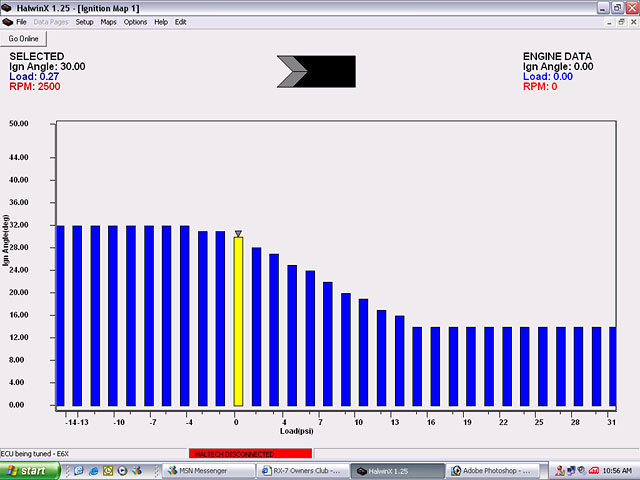
also keep in mind that map is with a 15psi max

Rotary Freak
Joined: Feb 2001
Posts: 2,524
Likes: 0
From: MN
Originally Posted by Turbo 3
Could someone post something on what to do with timing at vacuum? I think I'm starting to understand at boost but not sure what to do across the rpm range from -450mmHg to 0psi. Anybody got a picture like what evilrotor posted?
Running 9.7:1 rotors on 92 octane but with boosted 20B...
Running 9.7:1 rotors on 92 octane but with boosted 20B...
My 2500+ rpm vacuum maps look a little like evilrotors but 36deg @30 in hg ramping down to 30 by 0psi.
Mine currently look like 0 advance at 1300rpm, then 14 to 20's around 3k at -0500mm Hg. Plus as they are advanced to 0 psi, they go in huge increments on the vacuum side. I believe they should be much more advanced but don't know how to set them up on that side of the map...
help...
help...



Joined: Mar 2001
Posts: 31,851
Likes: 3,239
From: https://www2.mazda.com/en/100th/
Originally Posted by Turbo 3
Mine currently look like 0 advance at 1300rpm, then 14 to 20's around 3k at -0500mm Hg. Plus as they are advanced to 0 psi, they go in huge increments on the vacuum side. I believe they should be much more advanced but don't know how to set them up on that side of the map...
help...
help...