


Primary and Secondary mixing efi question

Thread Starter
Junior Member
Joined: Jan 2025
Posts: 5
Likes: 0
From: Cornell WI
Primary and Secondary mixing efi question
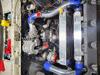
I am using a fc turbo 2 intake setup on my gslse "ish" motor, and I am confused on how fueling works with the primary secondary setup. I understand that at low throttle just the primary injectors fire and when more throttle is applied the secondary opens up and those injectors fire. I don't get is the threshold, my TB seems like the primary butterfly only opens like about 5 degrees, then the secondary butterflys start to open. Is that normal? And if so isn't that still under the threshold where the secondary injectors would fire? Wouldn't that mean that the primary runners would be saturated with fuel and the secondarys would be completely lean? Am I over thinking this and it all mixes in the housing just fine or is this something to consider for the tune?

Old [Sch|F]ool


Joined: May 2001
Posts: 12,880
Likes: 577
From: Cleveland, Ohio, USA
They're going to the same rotor so it doesn't matter.
Mazda made many many engines with no secondary injectors at all.
The primary and secondary throttles open the way they do because you really don't want a closed throttle on an engine running under power. It makes enough vacuum to disturb things, that I could probably write a few paragraphs about. Suffice to say that the secondaries start to open at about 10-15% throttle very intentionally.
What are you using the intake for? IMO if you have the opportunity to use a GSL-SE or Series 4 N/A intake manifold, use that instead. Even the tiny GSL-SE manifold flows better and makes more power than the T2 manifold.
Mazda made many many engines with no secondary injectors at all.
The primary and secondary throttles open the way they do because you really don't want a closed throttle on an engine running under power. It makes enough vacuum to disturb things, that I could probably write a few paragraphs about. Suffice to say that the secondaries start to open at about 10-15% throttle very intentionally.
What are you using the intake for? IMO if you have the opportunity to use a GSL-SE or Series 4 N/A intake manifold, use that instead. Even the tiny GSL-SE manifold flows better and makes more power than the T2 manifold.

Thread Starter
Junior Member
Joined: Jan 2025
Posts: 5
Likes: 0
From: Cornell WI
Thanks for the reply, that make sense. I was over complicating thigs, it make sense that you don't want vacuum on a closed butterfly, just like you don't want boost on a closed butterfly.
I am using the intake to add a turbo, I port matched it as best I could, I have a strange setup. The motor that is in the car has 12a irons and gslse everything else. So I have no injector holes in the center iron. I found this weird fc T2 intake that has 4 injectors added to the upper intake and I figured I could try and use upper primary and lower secondary. I realize it's kinda backwards from traditional staged injection, but I figured if nothing else I could use the 4 upper injectors in two banks and kinda be like tbi.
I am using the intake to add a turbo, I port matched it as best I could, I have a strange setup. The motor that is in the car has 12a irons and gslse everything else. So I have no injector holes in the center iron. I found this weird fc T2 intake that has 4 injectors added to the upper intake and I figured I could try and use upper primary and lower secondary. I realize it's kinda backwards from traditional staged injection, but I figured if nothing else I could use the 4 upper injectors in two banks and kinda be like tbi.

Arrogant Wankeler

Joined: Nov 2006
Posts: 1,012
Likes: 233
From: Hunter Valley NSW Australia
There are real power gains to be had by getting optimised charge distribution between runners, I think Andy got 5-10% more torque on rx8 motors optimising the injector staging/flow balancing when beta testing rx8 ecus, I know some of that work was done on Ric Shaw's dyno. It's very ecu dependent.
There is a reason all the best circuit race rotaries used Motec gold box ecus back in the day. You mapped the injection split in 3d when everyone else has a dumb primary only then equal injection earth time.
There is a reason all the best circuit race rotaries used Motec gold box ecus back in the day. You mapped the injection split in 3d when everyone else has a dumb primary only then equal injection earth time.
Last edited by Slides; Jan 10, 2025 at 04:03 AM.
Arrogant Wankeler
Joined: Nov 2006
Posts: 1,012
Likes: 233
From: Hunter Valley NSW Australia
They're going to the same rotor so it doesn't matter.
Mazda made many many engines with no secondary injectors at all.
The primary and secondary throttles open the way they do because you really don't want a closed throttle on an engine running under power. It makes enough vacuum to disturb things, that I could probably write a few paragraphs about. Suffice to say that the secondaries start to open at about 10-15% throttle very intentionally.
What are you using the intake for? IMO if you have the opportunity to use a GSL-SE or Series 4 N/A intake manifold, use that instead. Even the tiny GSL-SE manifold flows better and makes more power than the T2 manifold.
Mazda made many many engines with no secondary injectors at all.
The primary and secondary throttles open the way they do because you really don't want a closed throttle on an engine running under power. It makes enough vacuum to disturb things, that I could probably write a few paragraphs about. Suffice to say that the secondaries start to open at about 10-15% throttle very intentionally.
What are you using the intake for? IMO if you have the opportunity to use a GSL-SE or Series 4 N/A intake manifold, use that instead. Even the tiny GSL-SE manifold flows better and makes more power than the T2 manifold.
Last edited by Slides; Jan 10, 2025 at 03:18 AM.


Joined: Mar 2001
Posts: 31,857
Likes: 3,243
From: https://www2.mazda.com/en/100th/
Do you just make stuff up? The low end torque that FDs make with the vacuum operated secondaries completely closed in "warm up" in the bottom half of the rev range is significantly more than with them open. There is a reason mazda completely closed staged runners on the rx8 too.
Arrogant Wankeler
Joined: Nov 2006
Posts: 1,012
Likes: 233
From: Hunter Valley NSW Australia
Trending Topics
Joined: Mar 2001
Posts: 31,857
Likes: 3,243
From: https://www2.mazda.com/en/100th/
Old [Sch|F]ool
Joined: May 2001
Posts: 12,880
Likes: 577
From: Cleveland, Ohio, USA
I experiment and try new things.
Having closed secondaries at 3000-4000rpm makes a high vacuum in the secondary side which pulls a lot of exhaust gases up during the overlap period. Cracking the secondaries open with an FC manifold to the point where the engine is idling on the secondaries and the primary injector bleeds allowed me to run a lot cleaner and leaner under cruise, and fuel economy skyrocketed, because there wasn't a significant vacuum in the secondary side pulling exhaust gases up to dilute the mix and make it harder to ignite.
You're talking about low RPM torque under boost with the FD, I'm talking about part throttle drivability on the highway. Two different things.
RX-8s don't have overlap periods, so what they do is irrelevant.
Having closed secondaries at 3000-4000rpm makes a high vacuum in the secondary side which pulls a lot of exhaust gases up during the overlap period. Cracking the secondaries open with an FC manifold to the point where the engine is idling on the secondaries and the primary injector bleeds allowed me to run a lot cleaner and leaner under cruise, and fuel economy skyrocketed, because there wasn't a significant vacuum in the secondary side pulling exhaust gases up to dilute the mix and make it harder to ignite.
You're talking about low RPM torque under boost with the FD, I'm talking about part throttle drivability on the highway. Two different things.
RX-8s don't have overlap periods, so what they do is irrelevant.
Last edited by peejay; Jan 11, 2025 at 01:03 PM.
Arrogant Wankeler
Joined: Nov 2006
Posts: 1,012
Likes: 233
From: Hunter Valley NSW Australia
I'll need to datalog the ecu outputs to confirm functionality but I'm hoping hopinsingle turbo I may be able to use the secondary turbo charge control valve output, possibly in combination with another (using external relay logic if necessary) to get the functionality.
Arrogant Wankeler
Joined: Nov 2006
Posts: 1,012
Likes: 233
From: Hunter Valley NSW Australia
I experiment and try new things.
Having closed secondaries at 3000-4000rpm makes a high vacuum in the secondary side which pulls a lot of exhaust gases up during the overlap period. Cracking the secondaries open with an FC manifold to the point where the engine is idling on the secondaries and the primary injector bleeds allowed me to run a lot cleaner and leaner under cruise, and fuel economy skyrocketed, because there wasn't a significant vacuum in the secondary side pulling exhaust gases up to dilute the mix and make it harder to ignite.
You're talking about low RPM torque under boost with the FD, I'm talking about part throttle drivability on the highway. Two different things.
RX-8s don't have overlap periods, so what they do is irrelevant.
Having closed secondaries at 3000-4000rpm makes a high vacuum in the secondary side which pulls a lot of exhaust gases up during the overlap period. Cracking the secondaries open with an FC manifold to the point where the engine is idling on the secondaries and the primary injector bleeds allowed me to run a lot cleaner and leaner under cruise, and fuel economy skyrocketed, because there wasn't a significant vacuum in the secondary side pulling exhaust gases up to dilute the mix and make it harder to ignite.
You're talking about low RPM torque under boost with the FD, I'm talking about part throttle drivability on the highway. Two different things.
RX-8s don't have overlap periods, so what they do is irrelevant.
Have you confirmed that behaviour with high speed logging of port pressure sensors?
Do your primary and secondary ports have significantly different timing?
Did you try shifting injection timing if available on your ecu?
how much did your AFRs shift before retuning?
A lot of manufacturers use EGR specifically to increase "inert"(not entirely) pumping gas and reduce pumping losses at cruise for efficiency, however "lazy" intake flow can achieve similar reduced vacuum at lower demand. I really need to get my car back on the road so I can do more testing.
Last edited by Slides; Jan 13, 2025 at 03:08 PM.




Old [Sch|F]ool
Joined: May 2001
Posts: 12,880
Likes: 577
From: Cleveland, Ohio, USA
No apologies needed, it's a case of tuning for expectations. As someone who was driving 30k miles a year, fuel economy was important to me 
I first started doing it on a large streetport Turbo II. When I half bridged it was when the difference was really noticeable. Computer was a MS (now called an MS1) which was strictly batch fire and .1ms injection resolution. No datalogging because at the time I only had a narrowband and I merely gave the engine what it wanted. I could estimate air/fuel ratios by tuning from "happy" to stoich to see how far away "happy" was. I could run as lean as 16:1 at cruise with the street port. With the street and the half bridge I could see 29mpg at 70mph, which was nice.
Mazda was pretty much stuck at having to run stoich to keep the cats happy, or 10:1 pig rich to keep the cats from melting..
What's interesting, and what made me play with that, is that the carbureted manifolds feed all four ports all the time. There are channels between the primaries and secondaries.
I first started doing it on a large streetport Turbo II. When I half bridged it was when the difference was really noticeable. Computer was a MS (now called an MS1) which was strictly batch fire and .1ms injection resolution. No datalogging because at the time I only had a narrowband and I merely gave the engine what it wanted. I could estimate air/fuel ratios by tuning from "happy" to stoich to see how far away "happy" was. I could run as lean as 16:1 at cruise with the street port. With the street and the half bridge I could see 29mpg at 70mph, which was nice.
Mazda was pretty much stuck at having to run stoich to keep the cats happy, or 10:1 pig rich to keep the cats from melting..
What's interesting, and what made me play with that, is that the carbureted manifolds feed all four ports all the time. There are channels between the primaries and secondaries.
Last edited by peejay; Jan 16, 2025 at 05:57 PM.
Joined: Mar 2001
Posts: 31,857
Likes: 3,243
From: https://www2.mazda.com/en/100th/
i just did a long trip with my FC-REW, its ~800miles. mileage varied more than i'm used to, but it was 20-23mpg
my 5th gear is the short one (and i think my 225/45/17's are shorter than stock), so rpm is pretty high. car is tuned to stoich, although the Power FC isn't using the o2 sensor (i thought about it, but i left it so i could take some logs)
higher rpm and stoich = really high EGT's, i added a little fuel to keep the 900c warning light off, although perhaps it could have used a little more timing advance too
anyways, i'm quite a ways from 30mpg, and prospects aren't great either, in 2019 i used a stock low mile 12A car and that one did 25-27mpg, which is the best ive ever done in a Rotary car.
my 5th gear is the short one (and i think my 225/45/17's are shorter than stock), so rpm is pretty high. car is tuned to stoich, although the Power FC isn't using the o2 sensor (i thought about it, but i left it so i could take some logs)
higher rpm and stoich = really high EGT's, i added a little fuel to keep the 900c warning light off, although perhaps it could have used a little more timing advance too
anyways, i'm quite a ways from 30mpg, and prospects aren't great either, in 2019 i used a stock low mile 12A car and that one did 25-27mpg, which is the best ive ever done in a Rotary car.

Thread
Thread Starter
Forum
Replies
Last Post
serbRX7
3rd Generation Specific (1993-2002)
7
Jun 8, 2009 02:31 PM
AnthonyT78/88
Single Turbo RX-7's
6
Sep 14, 2001 07:56 PM